
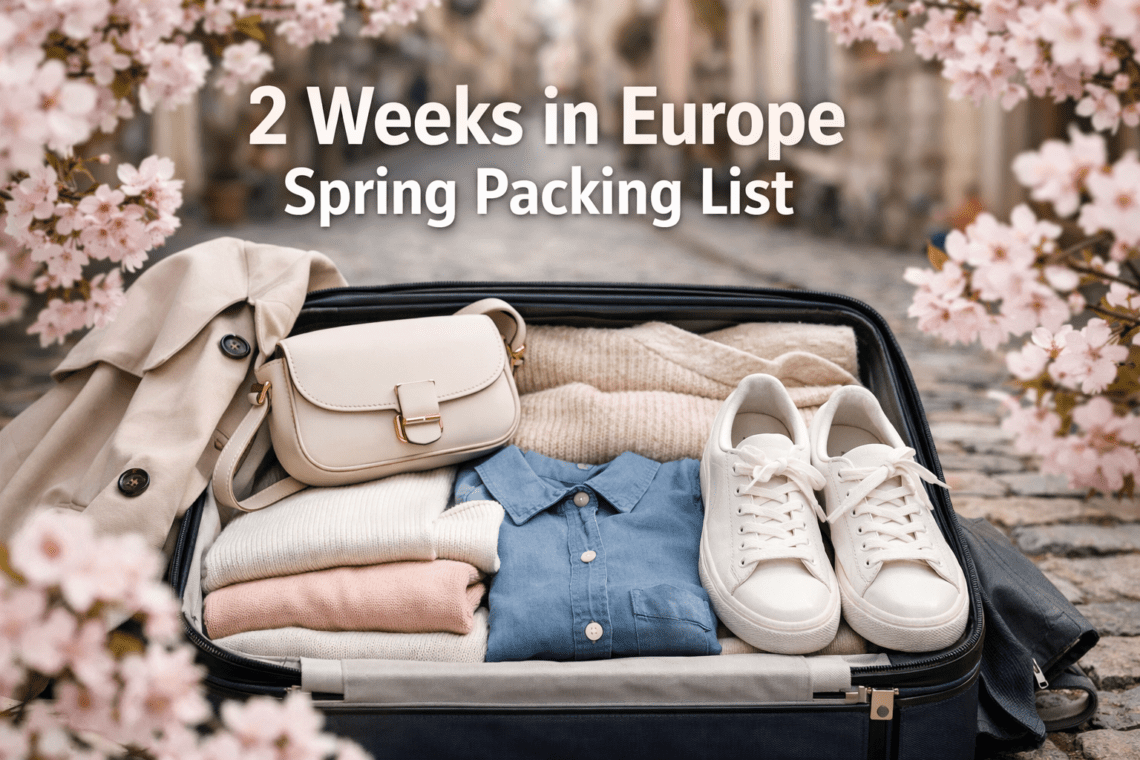
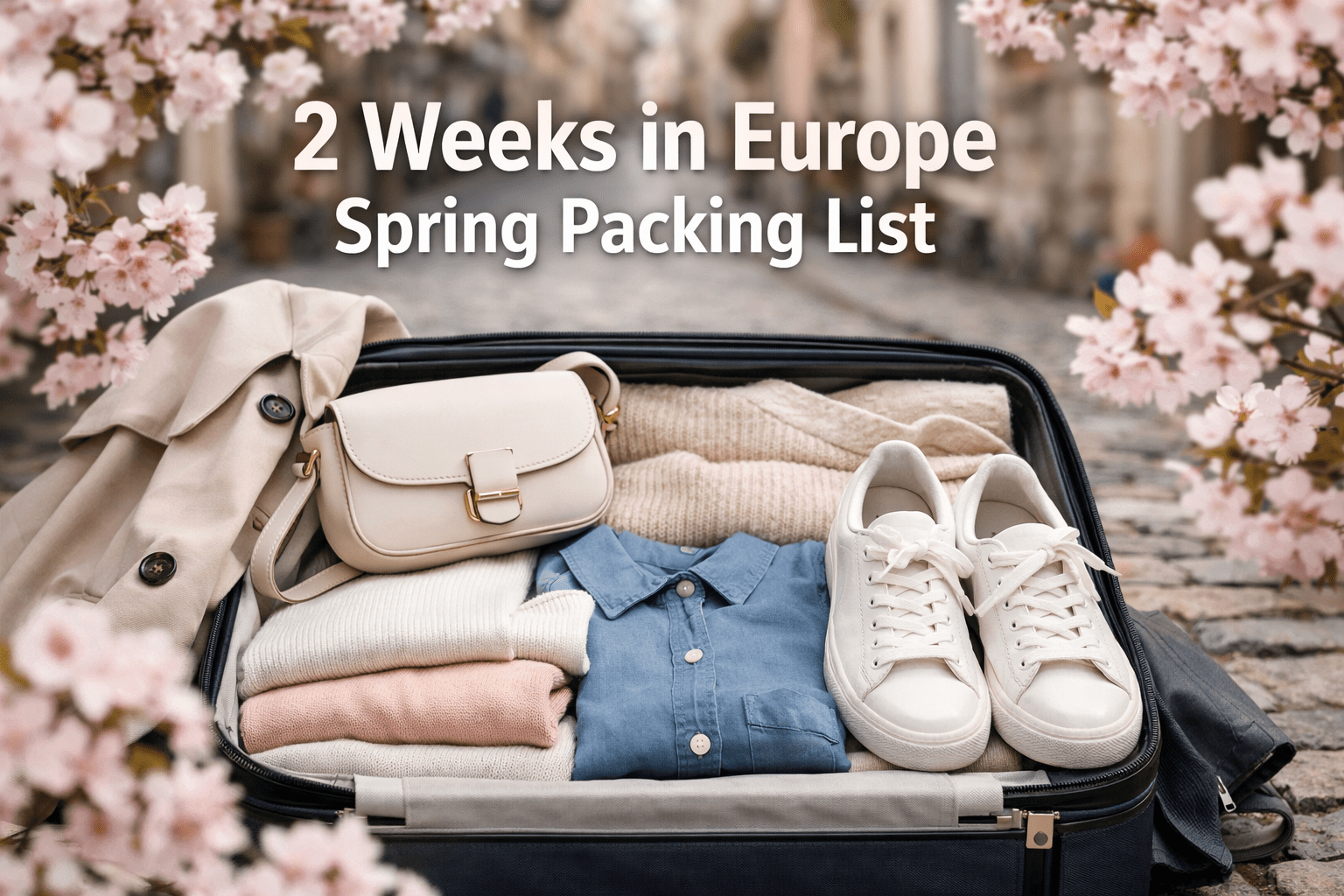
Quick Answer: A solid 2 weeks in Europe spring packing list fits in one carry-on and includes about 21 versatile pieces built around layering. Spring temperatures across Europe range roughly from 45°F to 65°F (7°C–18°C), with frequent rain, so you need breathable layers, a waterproof jacket, and comfortable walking shoes. Pack neutral colors that mix and match easily, and leave room for a few souvenirs.
Key Takeaways
- Layering is everything — spring weather in Europe shifts fast, so bring pieces that work together, not separately.
- Aim for 21 items or fewer: 5 tops, 4 bottoms, 3 shoe pairs, 2 dresses, plus accessories covers 2+ weeks without laundry [3].
- A waterproof jacket and small travel umbrella are non-negotiable — spring drizzle hits the UK and Central Europe almost daily [2][4].
- Comfortable walking shoes matter more than style — white leather sneakers and waterproof ankle boots handle most European terrain [2][3].
- Stick to neutrals — dark wash jeans, beige trousers, and black basics mix with almost anything [4][5].
- A leather crossbody bag with secure pockets keeps your belongings safe and your hands free [3].
- Pack a scarf — it adds warmth, works as a cover-up at religious sites like the Vatican, and takes up almost no space [1].
- Bring a portable charger and AirTags — long sightseeing days drain batteries fast, and luggage tracking is worth it [2].
- A reusable water bottle saves money — refill at public fountains throughout Italy, France, and Spain [2].
- Use packing cubes — they compress clothing and make unpacking at each hotel much faster.
What Makes Spring Europe Packing Different from Other Seasons?
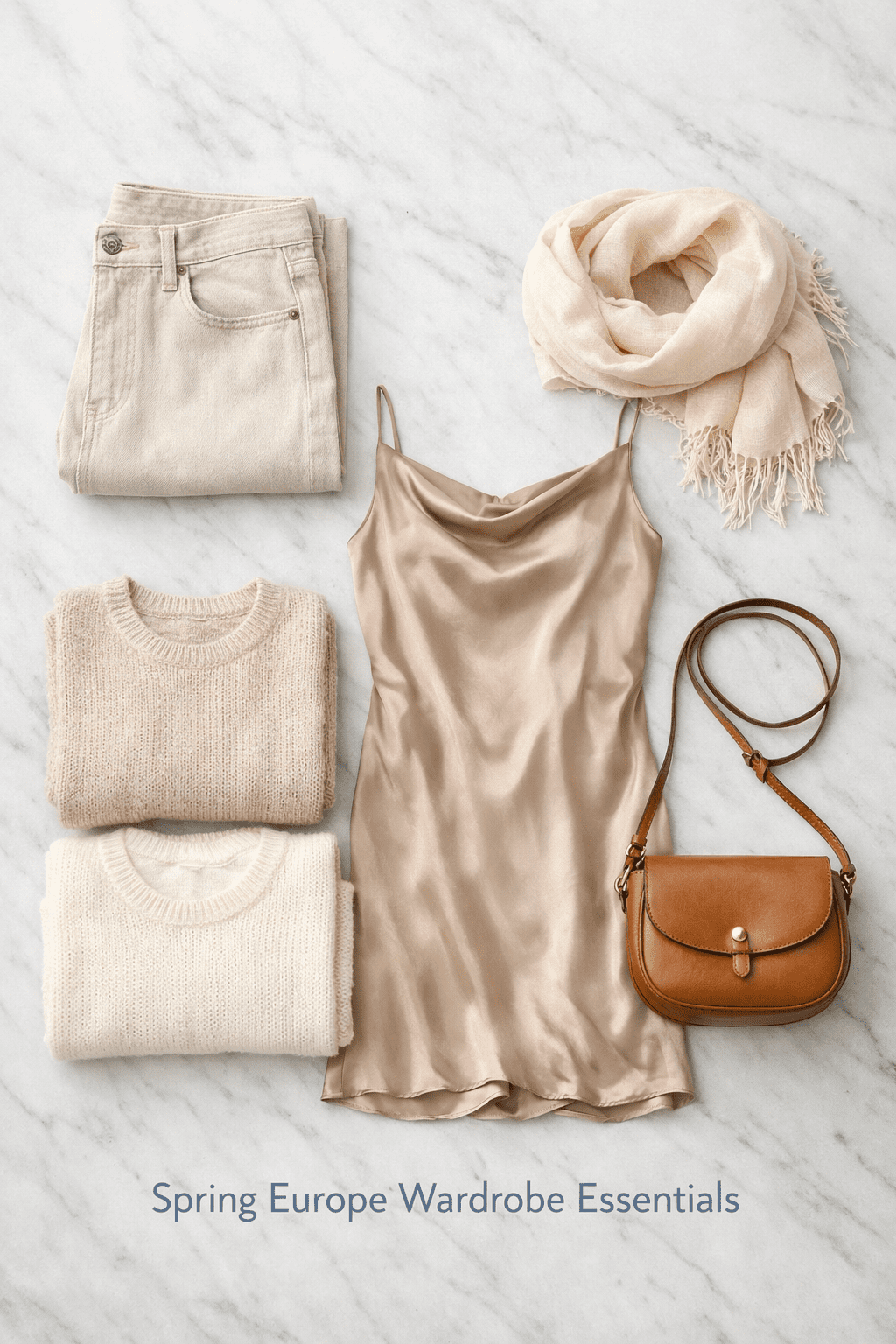
Spring in Europe is genuinely unpredictable — you can have warm sunshine in Rome in the morning and need a jacket by evening. That variability is what makes a thoughtful 2 weeks in Europe spring packing list so different from a summer or winter one.
Unlike summer, when you can get away with lighter fabrics and fewer layers, spring requires a system. Temperatures across regions vary widely: Southern Europe (Spain, Portugal, Italy) tends to run warmer, while Central and Northern Europe (UK, Germany, Czech Republic) stays cooler and wetter well into May [1][4].
What this means practically:
- You need both short-sleeved and long-sleeved options in the same bag.
- Rain gear isn’t optional — it’s a core part of the kit.
- Fabrics matter: linen and cotton breathe well on warm days but layer under a sweater when it cools down.
Common mistake: Packing for the warmest days you expect and ignoring the cold mornings. Even in Barcelona, April mornings can feel chilly until 10 a.m.
If you’re planning to explore multiple countries, check out our Europe travel guide hub for destination-specific tips that pair well with this packing strategy.
How Many Clothes Do You Actually Need for 2 Weeks in Europe in Spring?
For a 2-week trip, you need far less than you think. The 21-piece strategy — 5 tops, 4 bottoms, 3 shoes, 2 dresses, and 1 accessory set — creates enough outfit combinations for 2.5+ weeks without doing laundry [3].
The key is choosing pieces that genuinely work together. Every item should pair with at least three others in your bag.
The core clothing breakdown:
| Category | Quantity | Notes |
|---|---|---|
| Tops (tees + long-sleeve) | 5 | Mix short and long sleeve [6] |
| Bottoms | 4 | 2 dark jeans, 1 lightweight pants, 1 shorts [4][5] |
| Dresses | 2 | 1 silk midi, 1 casual day dress |
| Sweaters/Cardigans | 2 | Lightweight, packable |
| Outerwear | 1 | Waterproof jacket or light trench coat [4] |
| Shoes | 3 | Sneakers, ankle boots, sandals [2][3] |
| Accessories | 1 set | Scarf, sunglasses, minimal jewelry [1][3] |
Choose carry-on only if: You’re moving cities frequently (trains, budget airlines) and want to skip checked bag fees.
Choose a checked bag if: You’re visiting colder regions like Scotland or Scandinavia, or you plan to shop and bring things home.
For a broader look at what to bring on any international trip, our travel essential list covers the full picture.
What Shoes Should You Pack for a Spring Europe Trip?
Pack three pairs: one for walking all day, one for rain and cobblestones, and one for dinners or warmer days. That’s it.
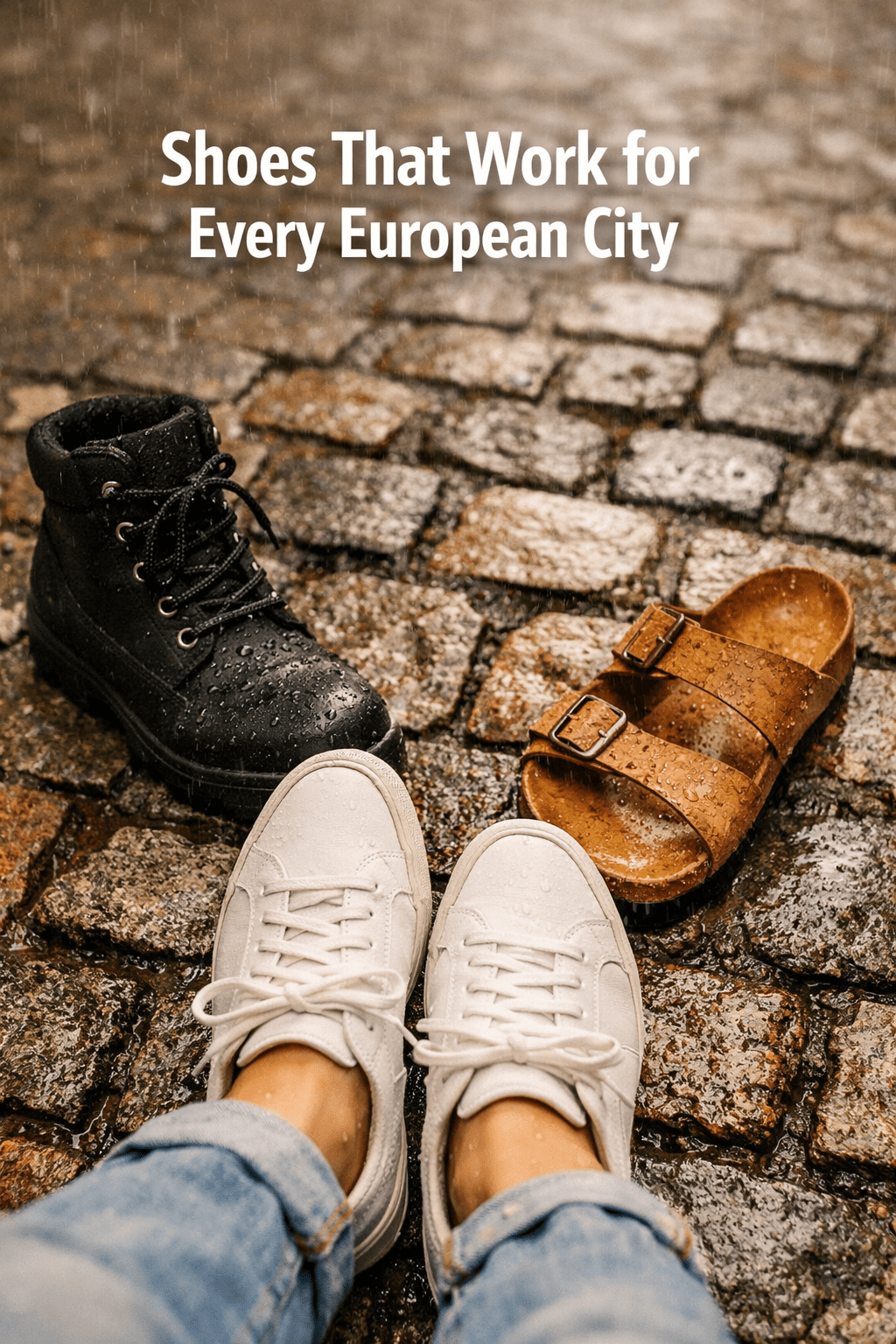
European cities are hard on feet. Cobblestones, hills, and long walking days (easily 8–12 miles) mean your shoes need to be genuinely comfortable, not just cute [2][3].
The three-shoe formula:
- White leather sneakers — versatile enough for sightseeing and casual dinners. They look polished and hold up well [2][3].
- Waterproof ankle boots — essential for rainy mornings and uneven streets. Choose a low heel or flat sole [2][4].
- Flat sandals or platform sandals — for warmer afternoons in Southern Europe. Italian leather sandals are a popular (and practical) souvenir [3].
What to skip: High heels are genuinely miserable on cobblestones. Even if you plan one fancy dinner, a block-heeled boot or dressy flat works better.
Edge case: If you’re visiting Greece or Croatia in late April or May, sandals become your primary shoe. Swap the ankle boots for a second sandal pair if your trip is beach-heavy.
What’s the Best Clothing Strategy for Variable Spring Weather?
Layering is the answer. Build every outfit around a base layer, a mid layer, and one outer layer that handles wind and light rain [4][6].
This approach works because spring in Europe doesn’t give you one consistent temperature — it gives you three in a single day. A silk midi dress with a lightweight sweater and a trench coat covers you from a cool morning to a warm afternoon without carrying extra bags [3].
The layering formula that works:
- Base: A fitted tee or long-sleeve top in a neutral color.
- Mid: A lightweight sweater or cardigan (merino wool packs small and doesn’t wrinkle).
- Outer: A waterproof jacket or classic trench coat [4].
For Central Europe specifically (Prague, Vienna, Budapest): Pack maxi dresses, flowy linen or cotton pants, and lightweight sweaters for cooler evenings [1]. If you’re planning to visit Vienna, our Vienna travel guide has helpful notes on what to expect in spring.
Fabric picks that work:
- Merino wool: warm, odor-resistant, packs small.
- Cotton: breathable for warmer days.
- Linen: great for Southern Europe but wrinkles easily.
- Avoid: Heavy denim, bulky knits, anything that takes a full day to dry.
What Toiletries and Gear Should Be on Your 2 Weeks in Europe Spring Packing List?
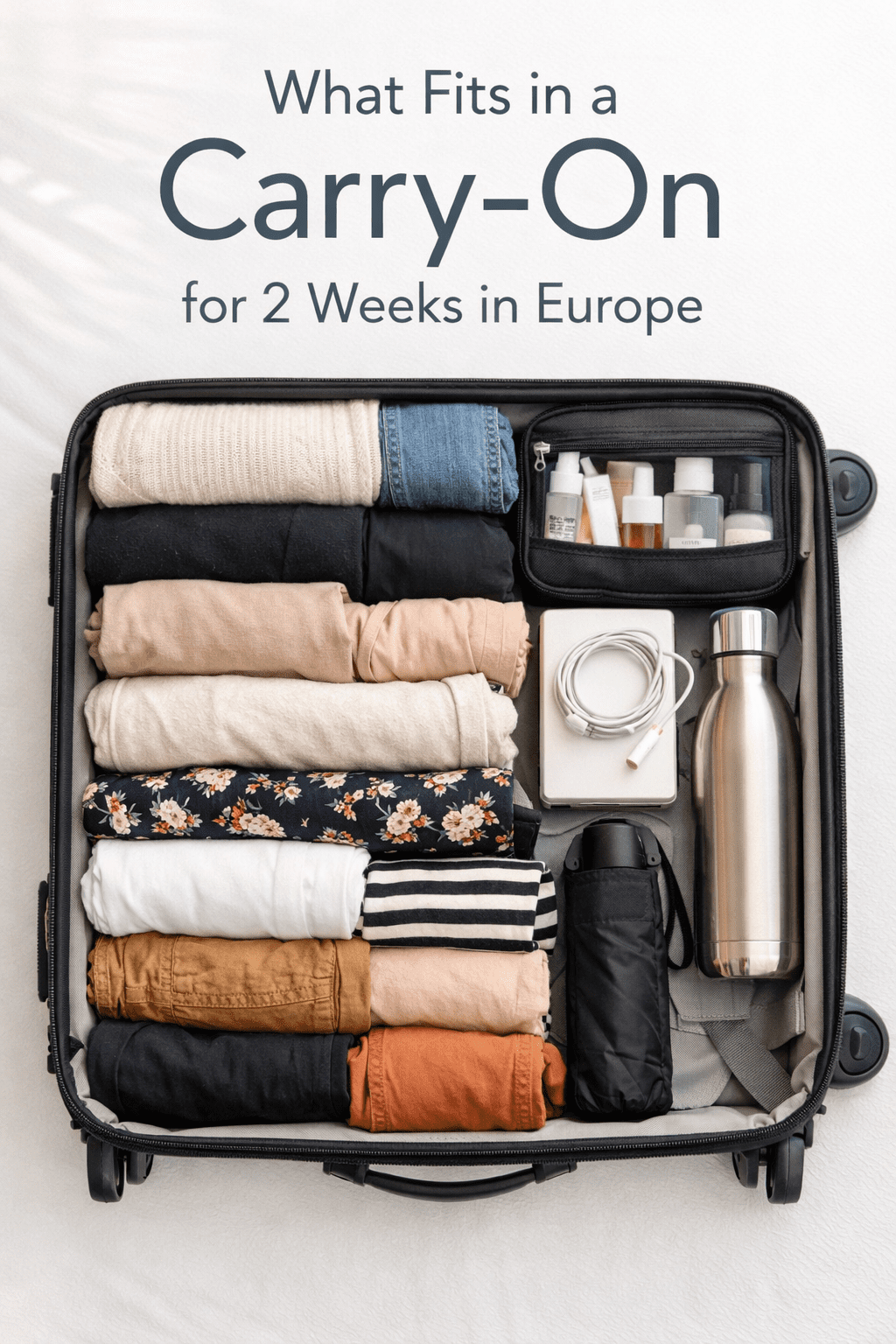
Keep toiletries minimal and buy what you forget in Europe. Most cities have pharmacies (called farmacia in Italy, pharmacie in France) with everything you’d find at home, often cheaper.
Toiletries to bring:
- Travel-size shampoo, conditioner, body wash (or solid bars to save space)
- SPF moisturizer — spring sun is stronger than it looks
- Lip balm with SPF
- Any prescription medications (bring extra supply)
- Motion sickness remedies if you’re doing boat trips in Greece, Croatia, or Sicily — Sea Bands and non-drowsy Dramamine are worth packing [2]
Tech and gear essentials:
- Portable charger — all-day sightseeing drains your phone fast [2]
- Universal power adapter (Europe uses Type C/E/F plugs)
- AirTags or similar tracker for checked bags [2]
- Reusable water bottle — saves money at public fountains throughout Italy, France, and Spain [2]
- Small travel umbrella — compact ones fit in a crossbody bag [2][4]
- Packing cubes — compress clothing and keep your bag organized
What to leave home:
- Full-size toiletries (buy travel sizes or decant)
- A hair dryer (hotels almost always provide one)
- More than one “just in case” outfit
What Bag Setup Works Best for 2 Weeks in Europe?
Use one carry-on suitcase plus one personal item. That combination gets you through budget airlines, train stations, and cobblestone streets without checking bags.
The two-bag system:
- Carry-on suitcase (max 22″ x 14″ x 9″ for most European budget airlines): holds your clothing and main gear.
- Leather crossbody bag: your daily bag for sightseeing. Look for one with a zipper closure and an interior pocket for your passport [3]. A crossbody keeps your hands free and is harder to pickpocket than a backpack.
Optional: A lightweight tote bag folds flat and works as a grocery bag, beach bag, or overflow bag on shopping days [2].
Tip for first-timers: Check your specific airline’s carry-on dimensions before you fly. Ryanair and easyJet have stricter limits than major carriers.
If you’re flying for the first time or want a refresher on airport logistics, our first time in airplane guide walks you through check-in to landing.
How Do You Pack Light But Still Look Put-Together in Europe?
The secret is a neutral color palette and a few statement accessories. When every piece of clothing works with every other piece, you create more outfits from fewer items [3][4].

Color palette that works:
- Neutrals as your base: Black, white, cream, navy, camel, and dark denim.
- One or two accent colors: Olive green, dusty rose, or terracotta work well in spring.
- Avoid: Packing multiple bold prints that only work as standalone outfits.
Accessories that add polish without weight:
- A pashmina or lightweight scarf (doubles as a blanket on overnight trains and a cover-up at churches) [1]
- Simple gold jewelry — a few pieces go a long way [3]
- One pair of sunglasses
- A belt to change the look of basics
The practical polish rule: If an item only works with one other thing in your bag, leave it home.
For destination-specific outfit inspiration, our guides on what to see in Rome and what to see in Barcelona give you a feel for the local vibe and dress culture.
FAQ: 2 Weeks in Europe Spring Packing List
Q: Can I really do 2 weeks in Europe with just a carry-on?
Yes. With 21 well-chosen pieces and packing cubes, a standard carry-on holds everything you need. Plan to do laundry once (most hotels and Airbnbs offer it) or use a laundromat.
Q: What temperature should I pack for in spring Europe?
Plan for 45°F–65°F (7°C–18°C) as your range, with cooler mornings and evenings. Southern Europe runs warmer; Northern and Central Europe stays cooler and wetter [1][4].
Q: Do I need a rain jacket or will an umbrella do?
Bring both if you can. A compact umbrella fits in your crossbody bag for daily use, but a waterproof jacket is better for active days and keeps your hands free [2][4].
Q: What shoes are best for cobblestone streets?
Flat or low-heeled shoes with cushioned soles. White leather sneakers and flat ankle boots are the most practical combination [2][3].
Q: Should I pack a scarf even if it’s spring?
Yes. A lightweight scarf or pashmina adds warmth on cool evenings, works as a cover-up at religious sites, and takes up almost no space [1].
Q: Is it worth bringing an AirTag for my luggage?
If you’re checking a bag, yes. It gives you real-time location tracking and peace of mind, especially on connecting flights [2].
Q: What’s the biggest packing mistake first-time Europe travelers make?
Overpacking “just in case” outfits. Every extra item adds weight and stress. Stick to your list and trust that you can buy anything you forget.
Q: Should I pack shorts for a spring Europe trip?
One pair is fine, especially if you’re visiting Southern Europe in late April or May. They’re not essential for Central or Northern Europe [4][5].
Q: How do I handle laundry on a 2-week trip?
Most accommodations offer laundry service or have a washing machine. Alternatively, use a laundromat — they’re easy to find in most European cities and cost around €5–€10 per load (estimate based on typical urban pricing).
Q: Can I wear the same jeans multiple times without washing?
Yes. Dark wash jeans are the most forgiving — they look clean longer and pair with almost everything [4][5].
Conclusion
A well-built 2 weeks in Europe spring packing list comes down to three things: a layering system that handles variable weather, neutral pieces that mix and match freely, and the right shoes for serious walking. You don’t need a massive suitcase — you need smart choices.
Your next steps:
- Start with your shoe selection — it’s the heaviest decision and shapes everything else.
- Build your color palette before picking individual items.
- Lay everything out on your bed before packing and remove anything that doesn’t pair with at least three other pieces.
- Use packing cubes to compress and organize.
- Weigh your bag before you leave — carry-on limits on European budget airlines are strict.
Spring in Europe is genuinely one of the best times to travel — fewer crowds than summer, beautiful light, and flowers everywhere. Pack smart, pack light, and enjoy every cobblestone street.
For more Europe travel planning, browse our full collection of Europe travel guides and travel planning tips.
References
[1] Packing List For Europe Seasons Regions – https://under30experiences.com/blog/packing-list-for-europe-seasons-regions
[2] Packing List For Europe Spring – https://www.ourescapeclause.com/packing-list-for-europe-spring/
[3] Travel Outfit Planner Spring Europe – https://waysofstyle.com/travel-outfit-planner-spring-europe/
[4] Europe Travel Wardrobe By Season – https://www.pintspoundsandpate.com/traveltips/europe-travel-wardrobe-by-season
[5] What To Pack For Europe Spring Or Fall – https://www.greatvaluevacations.com/travel-inspiration/what-to-pack-for-europe-spring-or-fall
[6] Ricks Packing List – https://www.ricksteves.com/travel-tips/packing-light/ricks-packing-list