


I’ve watched too many friends pay double what they should for flights, and it breaks my heart every time. Just last month, my colleague booked a spring break trip for $687 per ticket when the exact same flight was available for $312 just three weeks earlier. That’s $375 thrown away because of one simple timing mistake. If you’re wondering where to find cheap flights without spending hours hunting for deals, you’re making costly errors without even realizing it.
The truth is, finding affordable airfare isn’t about luck or having insider connections. It’s about understanding a few key principles and avoiding the common traps that airlines and booking platforms set for unsuspecting travelers. Most people approach flight booking completely backward, which is why they end up paying hundreds more than necessary.
Key Takeaways
- Book domestic flights 1-2 months in advance and international flights 3-5 months ahead for the best prices[3]
- Flying Monday through Wednesday saves an average of $56 per ticket compared to weekend travel, with savings exceeding $100 during holidays[3]
- Price alerts and flexible date searches are your most powerful tools for finding deals without constant manual checking[3]
- January and February offer the best off-peak deals across multiple destinations, with some Caribbean routes under $400 round-trip[1]
- Last-minute booking and single-site searching are the two biggest mistakes costing travelers hundreds of dollars per trip
Quick Answer: Where to Find Cheap Flights in 2026

The best places to find cheap flights are Google Flights for comprehensive price tracking and date flexibility tools, combined with setting price alerts 1-2 months before domestic trips and 3-5 months before international travel[3]. Flying midweek (Monday-Wednesday) saves approximately 13% or $56 per ticket on average[3]. Avoid booking too early or too late, and never search only on weekends when you’re planning weekday travel.
What Are the Biggest Mistakes People Make When Booking Flights?
The most expensive mistake is booking at the wrong time. Travelers who book domestic flights less than two weeks before departure or more than four months in advance consistently pay significantly more than those who book in the sweet spot of one to two months ahead[3].
The top flight booking mistakes that cost you money:
- Waiting until the last minute: Prices spike dramatically in the final two weeks before departure
- Booking too far in advance: Airlines haven’t released their competitive pricing yet, so early-bird prices are often inflated
- Only searching on one website: Different platforms show different prices due to commission structures and cached data
- Ignoring nearby airports: Flying into or out of a secondary airport can save $100+ per ticket
- Searching only on weekends: If you’re planning weekday travel, search and book on the days you intend to fly for more accurate pricing
- Not using incognito mode: Some sites track your searches and may increase prices on repeat visits
- Booking round-trips separately: Sometimes two one-way tickets cost more, but not always—check both options
Choose flexible dates if you have any wiggle room in your schedule. The difference between flying on a Tuesday versus a Saturday can easily exceed $100 per person[3]. For a family of four, that’s $400 saved just by shifting your departure by a few days.
One common mistake I see constantly: people book spring break trips in mid-February or early March when they should have booked in late January or early February. The ideal booking window for March/April spring break travel is 43 days before departure, within a 28-61 day range[3].
When Is the Best Time to Book Flights to Save Money?
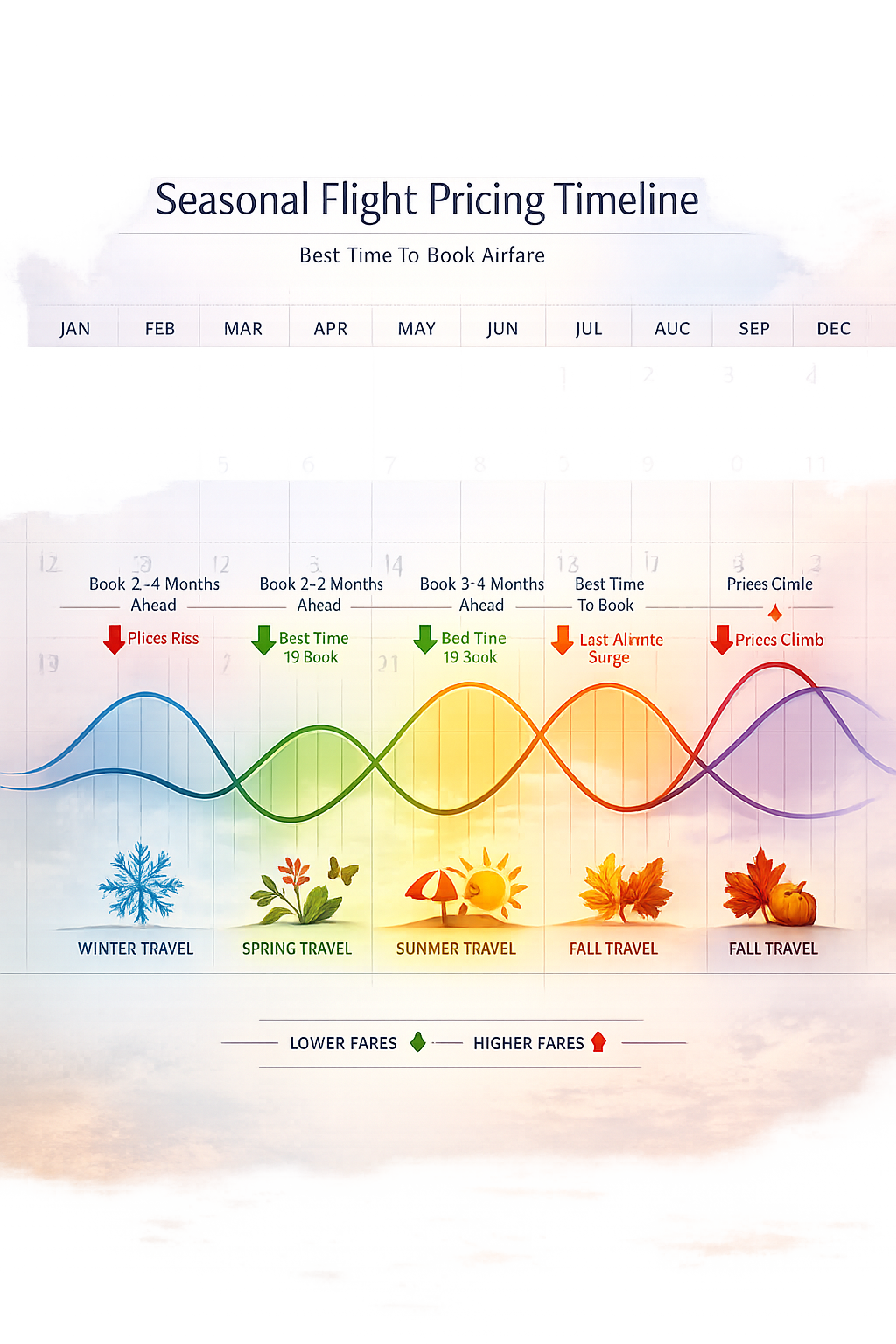
For domestic flights within the United States, book one to two months before your departure date for optimal pricing[3]. For international trips, start your search three to five months ahead and set price alerts to monitor fluctuations[3].
Booking timeline by trip type:
- Domestic flights: 1-2 months in advance (30-60 days)
- International flights: 3-5 months in advance (90-150 days)
- Spring break travel: Late January to early February for March/April trips (43 days out is ideal)[3]
- Summer vacation: Start monitoring in March-April for June-August travel
- Holiday travel: 2-3 months ahead minimum, earlier for Thanksgiving and Christmas
The monitoring strategy that works: Start checking prices three months before your international travel dates[3]. Set up price alerts immediately. When you see a price drop into the lower range you’ve been tracking, book it. Waiting for the “perfect” price often means missing good deals entirely.
I learned this the hard way when planning a trip to explore what to do in Mykonos Greece. I watched prices for weeks, saw a great deal at $687 round-trip, hesitated because I thought it might drop further, and ended up paying $842 when I finally booked two weeks later.
Edge case to know: During major sales events like Black Friday or Cyber Monday, airlines sometimes release deals that break these rules. Sign up for airline newsletters and follow deal sites to catch these limited-time offers.
Which Days of the Week Offer the Cheapest Flights?

Monday through Wednesday flights are approximately 13% cheaper than weekend departures, saving travelers an average of $56 per domestic ticket[3]. During peak travel seasons like spring break and summer, midweek savings can exceed $60 per ticket[3].
Day-of-week pricing breakdown:
- Cheapest days to fly: Tuesday and Wednesday (lowest demand)
- Moderate pricing: Monday and Thursday
- Most expensive: Friday, Saturday, and Sunday (highest demand)
- Holiday periods: Midweek savings can exceed $100 per ticket[3]
Here’s the math: If you’re booking a round-trip flight and both your departure and return fall on expensive days (Friday outbound, Sunday return), you could be paying $100-200 more than if you flew out Monday and returned Wednesday. For a couple, that’s $200-400 wasted.
The reason is simple supply and demand. Business travelers fly Monday mornings and Friday afternoons. Leisure travelers want to maximize their weekends. Airlines know this and price accordingly.
Choose midweek travel if your work schedule allows flexibility or if you’re planning a longer trip where shifting by a day or two won’t impact your plans. The savings are too substantial to ignore.
Common mistake: Searching for flights on Saturday for a Saturday departure. You’re seeing the most expensive day’s pricing for the most expensive day to fly. Instead, search on a Tuesday for Tuesday travel to see more realistic baseline pricing.
Where to Find Cheap Flights: The Best Search Tools and Platforms
Google Flights is the most comprehensive tool for finding cheap flights because it offers price alerts, a date grid showing the cheapest days to travel, and the ability to search multiple destinations simultaneously[3]. The “Date grid” feature alone can save you hundreds by showing exactly which dates offer the lowest fares[3].
Essential flight search tools:
| Tool | Best Feature | Best For |
|---|---|---|
| Google Flights | Price tracking alerts, date grid, explore map | Overall best search, flexibility tools |
| Skyscanner | “Everywhere” search, whole month view | Finding inspiration, flexible destinations |
| Kayak | Price forecast, hacker fares | Predicting price movements |
| Momondo | Comprehensive meta-search | Comparing across all platforms |
| Airline websites | Direct booking, loyalty points | Final booking, frequent flyers |
| Hopper | Mobile app predictions | Mobile-first users |
How to use Google Flights effectively:
- Enter your departure city and destination
- Click the “Date grid” button to see a calendar view with prices for each day
- Look for the green (cheapest) dates and adjust your travel plans accordingly
- Set up price alerts by toggling “Track prices” to receive notifications when fares drop[3]
- Use the “Explore” map if you’re flexible on destination to find the cheapest places to fly
Pro tip: Search one-way flights separately from round-trips. Sometimes mixing airlines (flying out on one carrier, returning on another) yields better prices than a round-trip on a single airline.
When I was planning my 7-day South of France itinerary, I used Google Flights’ date grid and discovered that flying out on a Tuesday instead of Friday saved $143 per person. For my family of three, that was $429 back in our travel budget for actual experiences.
Avoid this trap: Don’t book directly through third-party sites like Expedia or Priceline without checking the airline’s website first. Sometimes the airline offers the same price with better change/cancellation policies.
How Much Should You Expect to Pay for Flights in 2026?
U.S. airfares in January 2026 are up 2.2% compared to January 2025, but they’re down 2.6% compared to prices from 10 years ago[2]. Compared to pre-pandemic January 2020, prices are up 17%, which is significantly lower than the 26.1% increase across all consumer items[2].
2026 pricing context:
- Month-to-month volatility: January 2026 saw a 6.9% increase compared to December 2025, showing seasonal pricing shifts[2]
- Domestic average: Varies widely by route, but expect $250-450 for cross-country flights booked in advance
- International average: $600-1,200 for transatlantic flights, $400-800 for Caribbean/Mexico, $800-1,500+ for Asia/Pacific
- Budget carrier options: Can be 30-50% cheaper but with significant restrictions and fees
What this means for you: Prices are relatively stable compared to the wild fluctuations we saw in 2022-2023. This makes planning and price tracking more predictable. When you see a fare that’s 15-20% below the average you’ve been tracking, it’s likely a good deal worth booking.
Choose budget carriers if you’re comfortable with no-frills service, can travel with only a personal item, and don’t need flexibility for changes. The base fare might be $89, but after adding a carry-on ($35), seat selection ($15), and booking fee ($20), you’re at $159—still cheaper than mainline carriers for many routes, but not always the massive savings advertised.
What Are the Best Months to Find Flight Deals?

January and February are the best months for finding flight deals because they’re considered low-travel seasons with reduced demand across most destinations[1]. Airlines release abundant affordable deals during these months to fill seats during the post-holiday travel slump.
Seasonal deal calendar:
- Best deal months: January, February, September, early November
- Moderate pricing: March, April, May, October
- Most expensive: June, July, August, December, Thanksgiving week, spring break weeks
- Shoulder season sweet spots: Late April-early May, September-early October
Specific 2026 opportunities:
Round-trip flights to Saint Lucia are available for less than $500 from major U.S. cities, with New York City offering the cheapest options under $400 when booking January 22-29[1]. This is exactly the type of deal that appears during off-peak booking windows.
The strategy: Plan your major trips during shoulder seasons when possible. Not only are flights cheaper, but hotels, attractions, and restaurants are less crowded and often offer better rates too. I’ve saved literally thousands over the years by traveling to popular destinations just before or after peak season.
For example, visiting Lisbon in late September instead of July meant $340 cheaper flights, 40% lower hotel rates, and actually being able to enjoy the city without fighting crowds at every attraction.
Edge case: Some destinations have inverted seasons. Caribbean islands are cheaper in summer (hurricane season), while ski destinations are cheapest in summer when there’s no snow. Research your specific destination’s peak season and travel during the opposite period.
How Can You Set Up Effective Price Alerts?
Set up price alerts through Google Flights by searching for your desired route, clicking “Track prices,” and enabling notifications to receive emails when fares drop[3]. This automated approach means you don’t have to manually check prices daily, and you’ll be notified immediately when deals appear.
Step-by-step alert setup:
- Go to Google Flights and search your route with approximate dates
- Toggle “Track prices” at the top of the results
- Enable email notifications in your Google account settings
- Set alerts for multiple date ranges if you have flexibility (e.g., first week of June AND second week)
- Check your email regularly and act quickly when you see significant drops
- Set alerts 3-5 months out for international trips, 1-2 months for domestic[3]
What makes an alert worth acting on:
- 15-20% drop from the average you’ve been tracking
- Price hits the “low” range shown in Google Flights’ historical data
- Deal appears during optimal booking window (not too early, not too late)
- Multiple alerts trigger for the same route around the same time (indicates a fare sale)
I set up alerts for a summer trip to Martha’s Vineyard three months in advance. When the alert showed a $127 drop two months before my trip, I booked immediately. The price went back up within 48 hours.
Common mistake: Setting alerts and then ignoring them or hesitating too long when a good deal appears. Airline sales often last only 24-72 hours. If you see a legitimate deal, book it.
Pro tip: Use multiple alert services. Set up alerts on both Google Flights and Hopper or Kayak. Different platforms sometimes catch deals at different times.
Should You Book Directly with Airlines or Use Third-Party Sites?
Book directly with airlines after using third-party search engines to find the best price. Third-party sites like Google Flights, Skyscanner, and Kayak are excellent for comparing options, but booking directly with the airline gives you better customer service, easier changes/cancellations, and the ability to earn loyalty points.
When to use third-party search engines:
- Comparing prices across multiple airlines
- Using date flexibility tools and price grids
- Finding routes you hadn’t considered
- Setting up comprehensive price alerts
- Discovering alternative airports or connections
When to book directly with airlines:
- Final booking after finding the best price
- When you need flexibility for changes
- If you’re a loyalty program member
- When you want better customer service options
- If the price is identical to third-party sites
The booking process I recommend:
- Search on Google Flights or Skyscanner to find the best option
- Note the airline, flight numbers, and price
- Go directly to that airline’s website
- Search for the same flight
- If the price is the same (or within $10), book directly
- If the third-party site is significantly cheaper ($30+), verify the booking conditions before deciding
Red flag: If a third-party site shows a price dramatically lower than everywhere else ($100+ difference), it might be an error, involve multiple separate tickets (risky for connections), or include hidden restrictions. Read the fine print carefully.
When I booked flights for my Belize vacation, I found the route on Kayak but booked directly with the airline. When my return flight was delayed and I needed to rebook, dealing directly with the airline was infinitely easier than it would have been through a third party.
What About Budget Airlines and Hidden Fees?
Budget airlines can offer genuine savings of 30-50% on base fares, but only if you understand and avoid their fee structure. The advertised $49 fare can easily become $149 after adding baggage, seat selection, and booking fees.
Common budget airline fees:
- Carry-on bag: $35-60 each way
- Checked bag: $40-80 for first bag, more for additional
- Seat selection: $10-50 depending on seat type
- Booking fee: $15-25 per person
- Printing boarding pass at airport: $10-25
- Onboard snacks/drinks: $3-10 per item
- Flight changes: $75-150 plus fare difference
Budget airlines worth considering:
- Southwest: Free checked bags, no change fees, decent service
- Spirit/Frontier: Ultra-low base fares, but fees add up quickly
- JetBlue: Good middle ground with some amenities included
- Allegiant: Great for specific leisure routes, very limited network
Calculate the true cost: Take the base fare and add realistic fees. If you’re traveling with just a personal item (fits under the seat) and don’t care about seat selection, budget carriers can save substantial money. If you need a carry-on and checked bag, the savings often disappear.
Choose budget airlines if:
- You can travel with only a personal item
- You’re comfortable with no-frills service
- Your route is significantly cheaper than mainline carriers
- You don’t need flight flexibility or changes
Avoid budget airlines if:
- You need to check bags
- You value comfort and amenities
- You have tight connections (they often don’t rebook you if delayed)
- The total cost after fees is within $50 of a mainline carrier
FAQ
How far in advance should I book flights for the best price?
Book domestic flights 1-2 months in advance and international flights 3-5 months ahead for optimal pricing[3]. Booking too early (more than 4-5 months for domestic) or too late (less than 2 weeks) typically results in higher fares.
Are flights really cheaper on certain days of the week?
Yes, flying Monday through Wednesday saves an average of $56 per domestic ticket compared to weekend travel, approximately 13% cheaper[3]. During holidays and peak seasons, midweek savings can exceed $100 per ticket[3].
Should I use incognito mode when searching for flights?
While there’s debate about whether airlines actually track searches and raise prices, using incognito mode ensures you’re seeing fresh pricing without cached data from previous searches. It can’t hurt and takes only seconds.
What’s the best way to find cheap last-minute flights?
Check airline websites directly for unsold inventory deals, use apps like Hopper that specialize in last-minute pricing, and be extremely flexible with dates, times, and destinations. Last-minute deals exist but are unpredictable and rare.
Is it cheaper to book one-way or round-trip flights?
It depends on the route and airlines. International flights are usually cheaper as round-trips, while domestic flights sometimes offer better pricing when booking two one-way tickets, especially when mixing carriers. Always compare both options.
How accurate are flight price prediction tools?
Tools like Hopper and Kayak’s price forecast are reasonably accurate (70-80% according to their own data) but not perfect. They’re useful for guidance but shouldn’t be your only decision factor. If you see a good deal within your budget, book it.
Can I get a refund if the price drops after I book?
Most airlines don’t offer automatic refunds for price drops, but some allow free cancellation within 24 hours of booking. Southwest lets you rebook at the lower fare and receive the difference as travel credit. Always check the specific airline’s policies.
Are connecting flights always cheaper than direct flights?
Usually, but not always. The time saved and hassle avoided with direct flights often justifies a modest price difference ($50-100). However, if a connection saves $200+ and the layover is reasonable (1.5-3 hours), it’s often worth considering.
What are mistake fares and how do I find them?
Mistake fares are pricing errors where airlines accidentally publish dramatically low prices (like $300 for business class to Europe). They’re found on deal sites like Secret Flying and Scott’s Cheap Flights. Airlines sometimes honor them but can also cancel bookings.
Is travel insurance worth it for flights?
If you’re booking non-refundable flights months in advance and there’s any chance you’ll need to cancel, travel insurance can be worthwhile. For cheap, short-notice trips with flexible tickets, it’s usually unnecessary. Evaluate based on your specific situation and risk tolerance.
Should I clear my cookies before searching for flights?
Clearing cookies serves the same purpose as incognito mode—ensuring you see fresh pricing. Either approach works. The more important factors are when you book, which days you fly, and how flexible you can be with dates.
What’s the best time of day to book flights?
There’s no definitive “best time” to book during the day. Airlines release deals at various times, and prices change constantly. More important is booking during the right window (1-5 months ahead depending on trip type) and setting price alerts so you’re notified whenever deals appear[3].
Key Takeaways
- Timing is everything: Book domestic flights 1-2 months ahead and international flights 3-5 months in advance for the best prices[3]
- Midweek travel saves serious money: Flying Monday-Wednesday averages $56 less per ticket than weekends, with savings exceeding $100 during holidays[3]
- Use the right tools: Google Flights’ price alerts and date grid features eliminate the need for constant manual searching[3]
- Avoid the booking extremes: Both last-minute panic booking and ultra-early booking (4+ months for domestic) result in inflated prices
- January and February are deal goldmines: Off-peak season travel offers the best pricing across most destinations, with Caribbean routes available under $400 round-trip[1]
- Calculate true costs: Budget airline base fares can double after adding bags and fees—always compare total costs, not just advertised prices
- Flexibility is your superpower: Being able to shift travel dates by even 1-2 days can save $100+ per person
- Search smart, book direct: Use third-party search engines to find deals, but book directly with airlines for better service and flexibility
- Price tracking beats price hunting: Set alerts and let technology notify you of deals rather than manually checking prices daily[3]
- Act decisively on real deals: When you see a fare 15-20% below average during the optimal booking window, book it—waiting for perfection often means missing good opportunities
Conclusion: Your Action Plan for Finding Cheap Flights
Finding cheap flights isn’t about getting lucky or spending hours hunting for deals. It’s about understanding the patterns, using the right tools, and avoiding the costly mistakes that most travelers make without realizing it.
Start by setting up price alerts today for any trips you’re considering in the next 3-6 months. Use Google Flights’ date grid to identify the cheapest days to travel, and be willing to shift your plans by even a day or two to capture significant savings. Remember that midweek flights save an average of $56 per ticket[3], which adds up quickly for couples and families.
Stop booking too early or too late. The sweet spot is 1-2 months for domestic trips and 3-5 months for international travel[3]. If you’re planning spring break, book in late January or early February for March/April trips[3].
Most importantly, act when you see a good deal. The difference between a traveler who consistently finds cheap flights and one who overpays hundreds isn’t luck—it’s preparation, flexibility, and decisiveness. Set up your alerts now, mark your calendar for the optimal booking windows, and be ready to book when the right price appears.
Your next trip doesn’t have to cost hundreds more than necessary. With these strategies, you’ll never again watch a friend get the same flight for half what you paid. Whether you’re planning summer adventures with friends or a romantic cabin getaway, these flight-finding techniques will save you money that’s better spent on actual experiences rather than airline profits.
Start searching smarter today, and watch those savings add up trip after trip.

References
[1] January 2026 Travel Flight Deals – https://travelnoire.com/january-2026-travel-flight-deals
[2] Travel Price Tracker – https://www.nerdwallet.com/travel/learn/travel-price-tracker
[3] Best Time To Book A Flight – https://thepointsguy.com/airline/best-time-to-book-a-flight/