Last updated: September 12, 2026
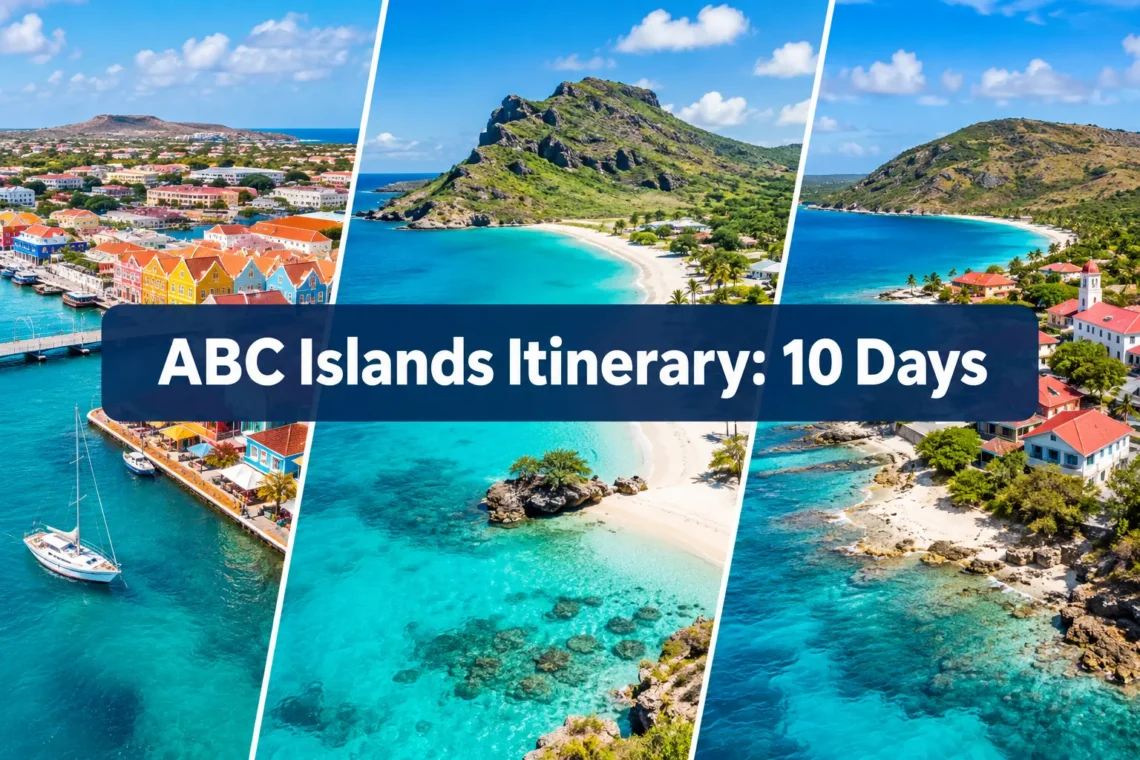
Quick Answer: A 10-day ABC Islands itinerary covers Aruba, Curaçao, and Bonaire comfortably if you split your time roughly as 3-4 days in Aruba, 3-4 days in Curaçao, and 2-3 days in Bonaire. Fly into Aruba first (it has the most international connections), island-hop east by inter-island flight, and end in Bonaire for diving and nature. Ten days is enough to hit the highlights of all three islands without feeling rushed.
Key Takeaways
- Aruba is the best entry point – most international flights land here, and it’s the easiest island to settle into.
- Curaçao is the cultural and culinary heart of the three islands, with UNESCO-listed Willemstad and varied beaches.
- Bonaire is the world-class diving and snorkeling capital – don’t skip it, even for just 2 nights.
- The recommended route is west to east: Aruba → Curaçao → Bonaire.
- Divi Divi Air is the main inter-island carrier connecting all three islands.
- Budget travelers can keep costs reasonable in Bonaire and Curaçao – Aruba tends to run pricier.
- Rent a car on each island. Public transport is limited and taxis add up fast.
- Families, divers, beach lovers, and culture seekers all have a strong reason to visit – the islands genuinely suit different travel styles.
- The best time to visit is mid-January through mid-April, when rainfall is lowest and crowds are manageable.
- Ten days is enough for all three islands, but 12-14 days gives you more breathing room.
What Are the ABC Islands?
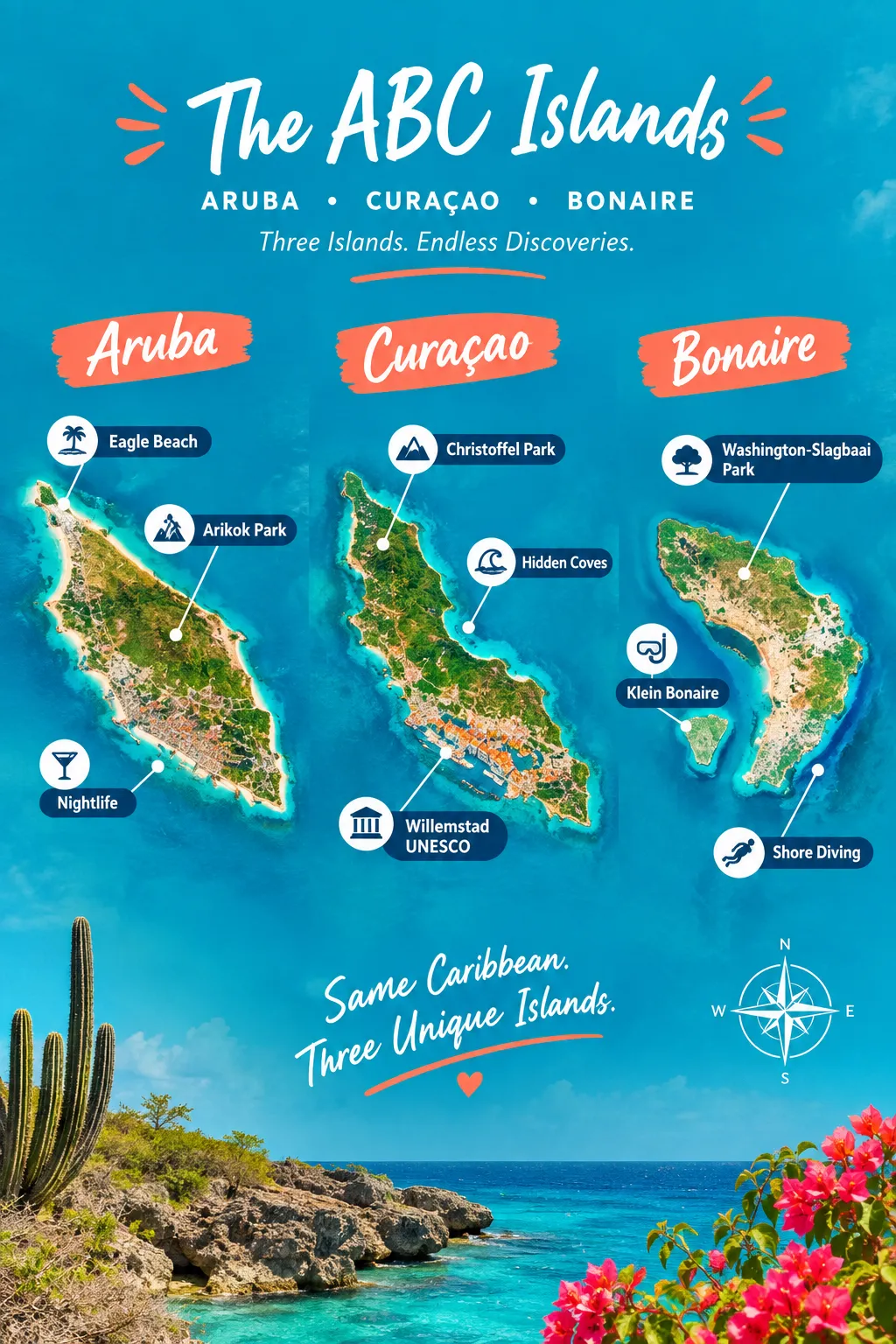
The ABC Islands are Aruba, Bonaire, and Curaçao – three Dutch Caribbean islands located just off the northwest coast of Venezuela. They sit outside the hurricane belt, which makes them reliably sunny year-round.
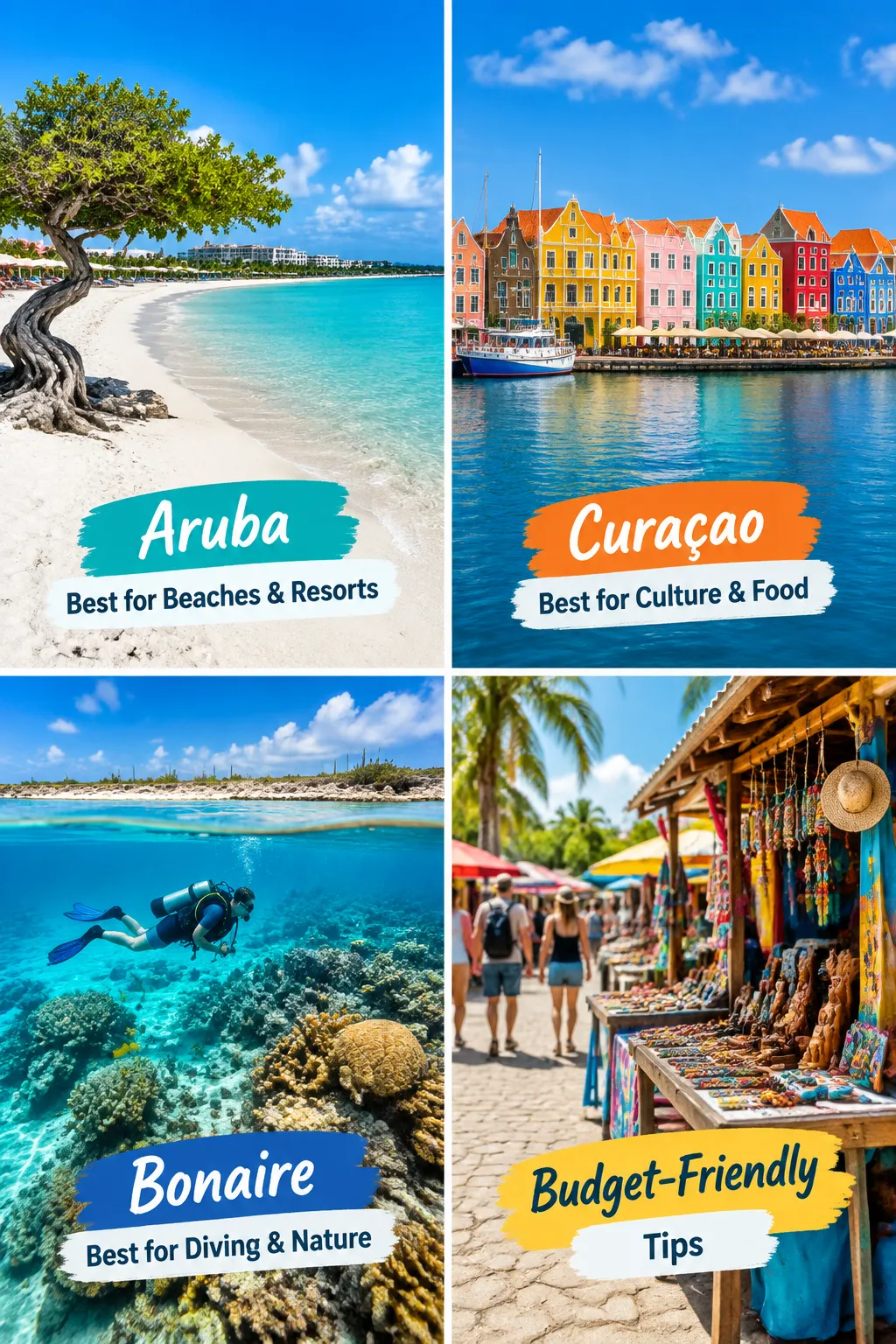
Each island has its own personality. Aruba is known for white-sand beaches, resort strips, and lively nightlife. Curaçao blends Dutch colonial architecture with a vibrant local food scene and hidden coves. Bonaire is quieter and nature-focused, famous for some of the best shore diving in the world.
All three are autonomous territories or special municipalities of the Netherlands, so Dutch influence is visible everywhere – from the pastel-painted buildings to the language.
Best Time to Visit Aruba, Bonaire, and Curaçao
The best time to visit the ABC Islands is mid-January through mid-April. This window offers the least rainfall, low humidity, and consistent trade winds that keep temperatures comfortable around 82-84°F (28-29°C).
The islands sit outside the Atlantic hurricane belt, so unlike most Caribbean destinations, they’re a reasonable choice year-round. That said, a few things to keep in mind:
- December to April – Peak season. Expect higher prices and more crowds, especially in Aruba.
- May to August – Shoulder season. Fewer tourists, slightly lower prices, still very dry.
- September to November – Quietest period. Best deals, but occasional rain squalls are possible.
If you’re planning a dive-focused trip to Bonaire, visibility is excellent almost year-round, with calmer conditions from April to October.
How Many Days Do You Need in the ABC Islands?
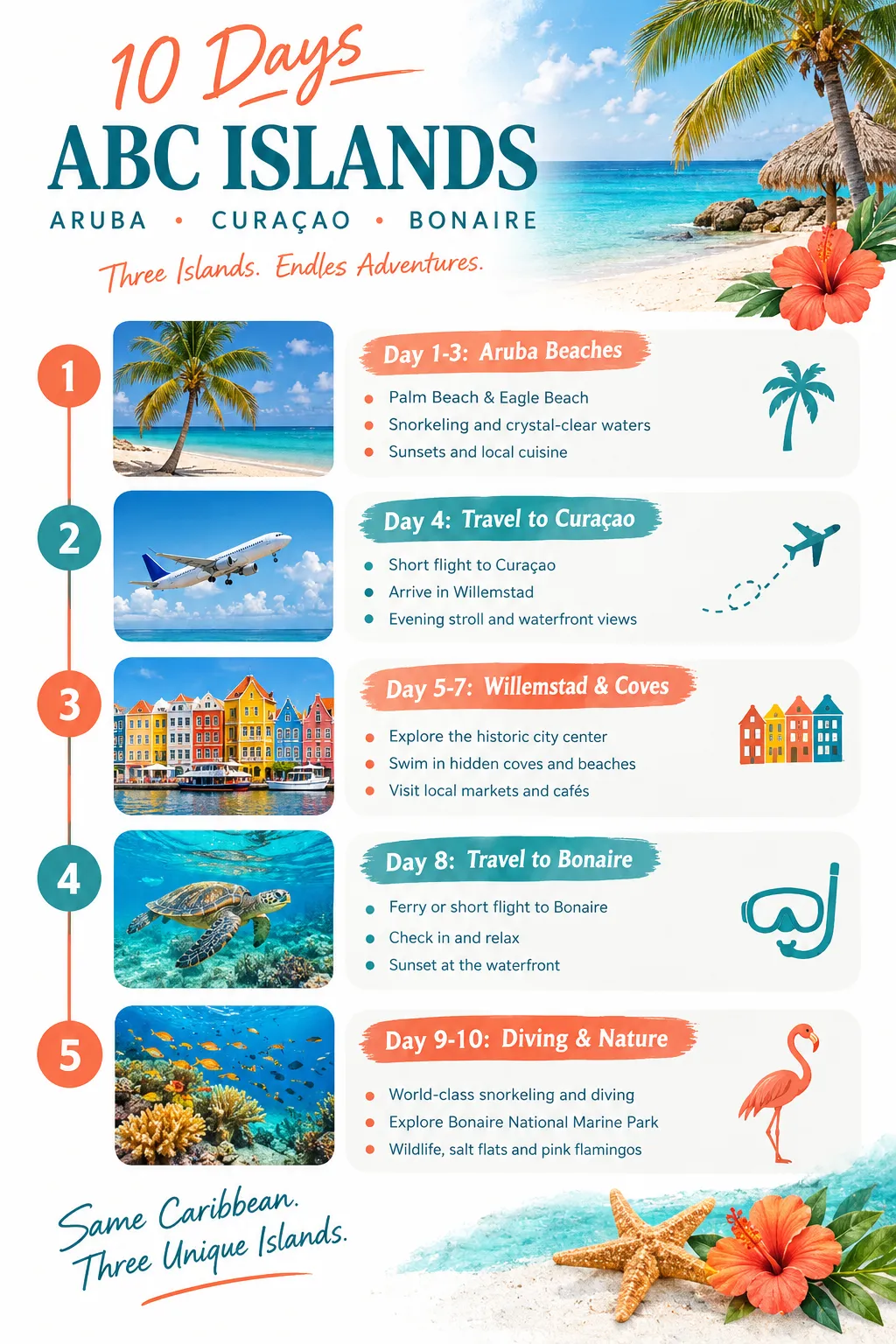
Ten days works well for all three islands if you stay focused and don’t try to do everything. A comfortable split is 3-4 days in Aruba, 3-4 days in Curaçao, and 2-3 days in Bonaire.
According to a detailed multi-island itinerary guide, a 10-14 day land-based trip is “realistic and efficient, but not rushed” when you follow a Days 1-4 Aruba, Days 5-8 Curaçao, Days 9-12 Bonaire structure.
If you only have 7 days, you can still do two islands well. Choose Aruba + Curaçao for beaches and culture, or Curaçao + Bonaire for a diver-focused trip.
Is 10 days enough for the ABC Islands? Yes – as long as you accept that you’re hitting the highlights rather than going deep on every beach and trail. Most travelers leave satisfied with 10 days.
Your ABC Islands Itinerary: 10-Day Sample Plan
This is the most practical 10-day structure, based on a route outlined in a complete island-hopping guide from Aruba:
Days 1-3: Aruba
- Day 1 – Arrive, check in, explore Oranjestad’s colorful streets and waterfront.
- Day 2 – Eagle Beach in the morning, Palm Beach strip in the afternoon. Sunset at the California Lighthouse.
- Day 3 – Arikok National Park for the Natural Pool, Casibari rock formations, and Boca Prins beach.
Day 4: Travel Day – Aruba to Curaçao
- Morning Divi Divi Air flight (roughly 30-40 minutes). Check in and explore Willemstad’s Punda district in the evening.
Days 5-7: Curaçao
- Day 5 – Walking tour of Willemstad’s UNESCO-listed waterfront, Floating Market, and Handelskade.
- Day 6 – Christoffel National Park hike in the morning, Playa Knip (Grote Knip) beach in the afternoon.
- Day 7 – Beach-hopping: Cas Abou, Porto Marie, and a sunset drink in Pietermaai.
Day 8: Travel Day – Curaçao to Bonaire
- Short Divi Divi Air flight. Rent a car or truck on arrival. Afternoon shore dive or snorkel at Lac Bay.
Days 9-10: Bonaire
- Day 9 – Shore diving at 1,000 Steps and Hilma Hooker wreck. Flamingo spotting at Goto Lake.
- Day 10 – Morning boat trip to Klein Bonaire for snorkeling. Washington-Slagbaai National Park in the afternoon. Depart or overnight for an early flight.
Pro tip: Build your travel days around morning flights so you arrive with half a day to explore – don’t waste them sitting in a hotel lobby.
Aruba vs Bonaire vs Curaçao: Which Island Should You Visit?
Each island serves a different type of traveler. Here’s a quick breakdown:
| Island | Best For | Skip If… |
|---|---|---|
| Aruba | Beach resorts, nightlife, first-time Caribbean visitors | You want quiet or authentic local culture |
| Curaçao | Culture, food, varied beaches, history | You want pure beach relaxation only |
| Bonaire | Diving, snorkeling, nature, slow travel | You don’t dive and prefer nightlife |
A comparative analysis of the three islands frames it this way: Aruba is the best air gateway, Curaçao is the culture and coves hub, and Bonaire is the shore-diving capital of the Caribbean.
Choose Aruba if you want a classic Caribbean resort holiday with great beaches and easy logistics.
Choose Curaçao if you want a mix of culture, history, food, and diverse beaches in one place.
Choose Bonaire if you dive or snorkel and want a quieter, nature-first experience.
For a different kind of island adventure, check out this Seychelles travel guide and dream island itinerary – a great comparison point for island-hopping trips.
Cheapest ABC Island to Visit
Bonaire is generally the most budget-friendly of the three islands, largely because it has fewer luxury resorts and a smaller tourist infrastructure. Curaçao is mid-range. Aruba is the most expensive, especially along the hotel strip.
A rough daily budget estimate per person (accommodation + food + activities, mid-range):
- Aruba – $200-$300/day
- Curaçao – $150-$220/day
- Bonaire – $120-$180/day (not counting dive gear rental)
Note: Diving in Bonaire adds cost – a full dive package with gear can run $80-$120/day. But shore diving is free once you pay the annual marine park tag (around $45 in 2026).
If budget travel is a priority, you might also enjoy this list of 11 cheap islands to visit for a dream vacation.
How to Get Between Aruba, Bonaire, and Curaçao
Divi Divi Air is the primary inter-island carrier connecting all three ABC Islands with short flights of 30-50 minutes. EZAir and InselAir also operate some routes seasonally.
Key logistics:
- Book inter-island flights early – small planes fill up fast, especially in peak season.
- Flights typically cost $80-$150 one-way per person.
- There is no regular ferry service between the islands for tourists.
- Cruise ships do visit all three in sequence – Holland America Line’s 10-day Southern Caribbean itinerary is one popular option that includes Bonaire, Curaçao, and Aruba in a single sailing.
Rent a car on each island. Public buses are limited, and taxis are expensive for daily use. A car gives you freedom to reach the best beaches and parks on your own schedule.
ABC Islands All-Inclusive Packages and Pricing
All-inclusive resorts are mainly concentrated in Aruba, particularly along Palm Beach. Curaçao has a smaller selection. Bonaire has almost none – it’s more of a dive-lodge and guesthouse destination.
Popular all-inclusive options in Aruba include Barceló Aruba, Divi Aruba All Inclusive, and Manchebo Beach Resort. Expect to pay $300-$600/night for two people at a mid-to-upper range all-inclusive in peak season.
For a multi-island trip, most travelers book all-inclusive for Aruba only and use boutique hotels or guesthouses in Curaçao and Bonaire. This hybrid approach saves money without sacrificing comfort.
If you’re comparing Caribbean all-inclusive options, a Punta Cana 7-day stress-free trip plan offers a useful benchmark for pricing and resort styles.
ABC Islands Itinerary for Families with Kids
The ABC Islands are genuinely family-friendly, especially Aruba and Curaçao. Here’s what works well for families:
Aruba with kids:
- Baby Beach – shallow, calm, and perfect for young swimmers.
- Butterfly Farm near Palm Beach.
- Arikok National Park for easy hikes and natural pools.
Curaçao with kids:
- Curaçao Sea Aquarium – hands-on marine life experiences.
- Dolphin Academy at Bapor Beach.
- Shete Boka National Park for dramatic wave blow holes.
Bonaire with kids:
- Flamingo sanctuary at Goto Lake.
- Snorkeling at Lac Bay – shallow, calm, and full of marine life.
- Salt flats and pink flamingo sightings along the southern road.
Common mistake: Booking Bonaire for families who don’t snorkel or dive. The island is quiet and has limited entertainment for non-water activities. If your kids aren’t into the ocean, extend your time in Aruba or Curaçao instead.
For another family-friendly adventure idea, the Belize vacation itinerary that balances adventure is worth a look.
Common Mistakes Visitors Make on the ABC Islands
The biggest mistake is treating all three islands the same. Each one needs a different mindset and packing list.
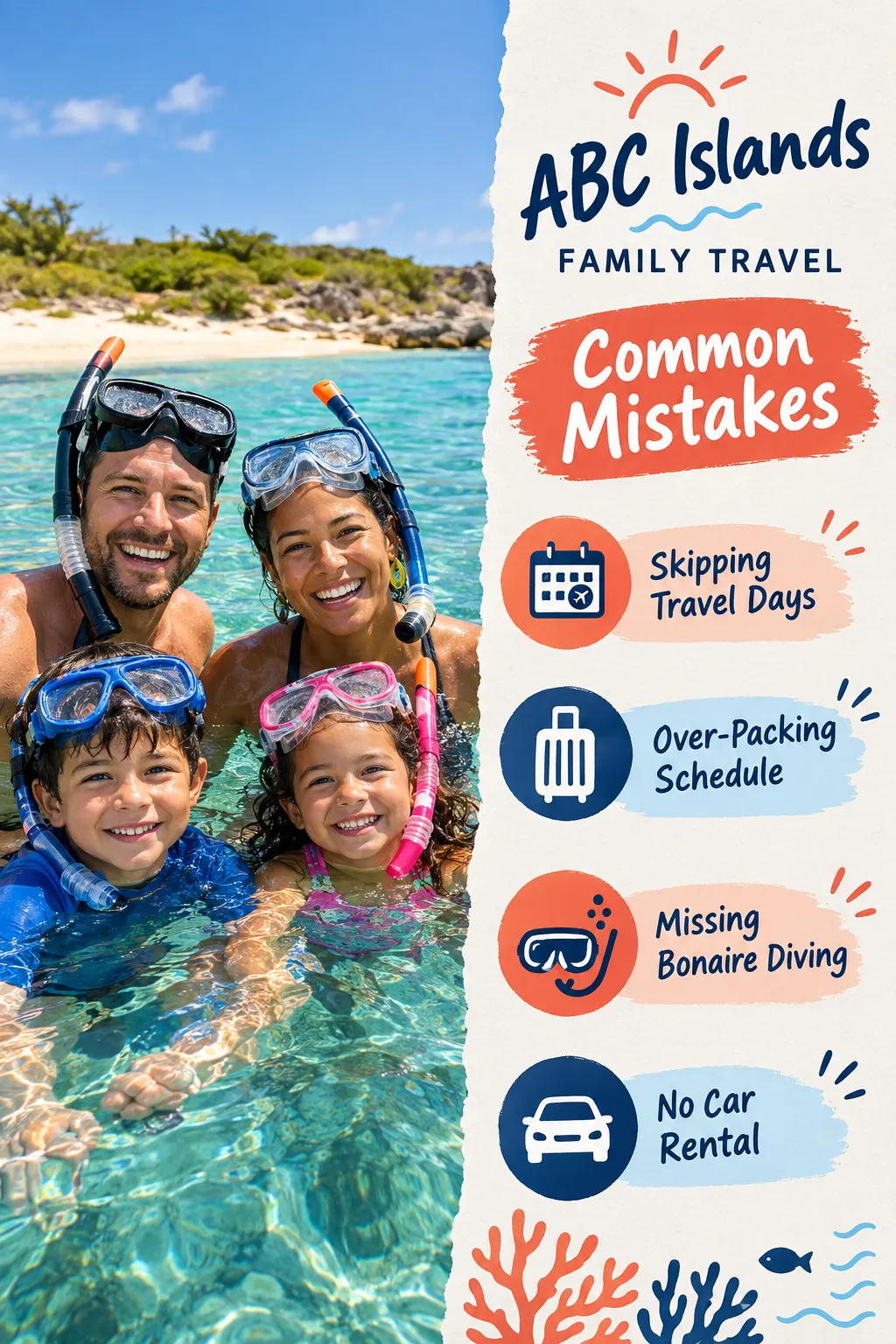
Here are the most common errors to avoid:
- Not renting a car – Especially in Curaçao and Bonaire, you’ll miss the best beaches without one.
- Under-estimating travel days – Flights, transfers, and check-ins eat up time. Don’t plan a full activities day on the same day you island-hop.
- Skipping Bonaire because it “seems boring” – If you snorkel or dive even casually, Bonaire is the highlight of the trip.
- Over-packing the schedule – Three islands in 10 days sounds like a lot. It is. Leave buffer time.
- Not booking inter-island flights early – Divi Divi Air planes are small. They sell out weeks in advance in peak season.
- Forgetting Bonaire’s marine park tag – You need it to dive or snorkel. Buy it on arrival at the airport or dive shop.
Can You Island-Hop the ABC Islands in One Week?
Yes, but it’s tight. A 7-day ABC Islands trip means roughly 2 days per island, with 2 travel days eating into that. You’ll see the highlights but won’t have time to slow down.
A mini-guide to ABC island hopping recommends a minimum of 4-5 days in Aruba, 3-4 in Curaçao, and 2-3 in Bonaire for a “comfortable” experience. A 7-day trip forces you to cut at least one island short.
Best 7-day option: Skip one island entirely and do two well. Aruba + Curaçao is the most popular pairing for first-timers. Curaçao + Bonaire works best for divers.
ABC Islands or Caribbean Alternatives: How Do They Compare?
The ABC Islands stand out in the Caribbean for a few specific reasons – but they’re not for everyone.
Choose the ABC Islands if:
- You want reliable sunshine year-round (outside the hurricane belt).
- Diving or snorkeling is a priority, especially Bonaire.
- You want a mix of beach, culture, and nature across one trip.
- You enjoy Dutch-Caribbean architecture and European influences.
Consider alternatives if:
- You want lush rainforest or dramatic volcanic scenery – look at St. Lucia or Dominica.
- You want a single-island, deep-dive experience – Barbados or St. Barths may suit better.
- You’re on a tight budget for the whole trip – some Eastern Caribbean islands run cheaper overall.
For comparison, a 10-day Azores Islands travel itinerary shows how a different Atlantic island chain handles a similar multi-island structure – useful if you’re weighing options.
ABC Islands Trip Cost: Budget Breakdown
A 10-day ABC Islands trip for two people (mid-range, land-based) typically runs:
- Flights (international round-trip from the US East Coast) – $600-$1,000 per person
- Inter-island flights (2 hops, Divi Divi Air) – $160-$300 per person
- Accommodation (mix of hotel and guesthouse, 10 nights) – $1,200-$2,500 total for two
- Car rental (3 separate rentals, one per island) – $400-$600 total
- Food and drink – $80-$150/day for two
- Activities and entrance fees – $300-$500 total (includes Bonaire marine park tag, national park fees, one snorkel trip)
Rough total for two people: $4,500-$7,500 for 10 days, depending on accommodation choices and how much you dine out.
Budget travelers can cut costs significantly by staying in guesthouses in Bonaire, cooking some meals, and focusing on free shore diving and beach days.
FAQ
Do I need a visa to visit the ABC Islands?
US, Canadian, and EU citizens do not need a visa for short stays (under 90 days) on any of the three ABC Islands. Always check current entry requirements before traveling.
What currency is used on the ABC Islands?
Aruba uses the Aruban florin, Bonaire uses the US dollar, and Curaçao uses the Netherlands Antillean guilder. US dollars are widely accepted on all three islands, and credit cards work almost everywhere.
Is it safe to travel to the ABC Islands?
Yes. All three islands are considered among the safest destinations in the Caribbean. Standard travel precautions apply – don’t leave valuables in rental cars and be aware of your surroundings at night.
Do I need dive certification to enjoy Bonaire?
No, but it helps. Bonaire’s shallow reefs are excellent for snorkelers. You can also do a beginner “discover scuba” course on the island if you want to try diving without a full certification.
What language is spoken on the ABC Islands?
Papiamentu (a local creole language) is spoken on all three islands. Dutch is also official. English is widely spoken in tourist areas, so communication is rarely a problem.
Can I use my US cell phone on the ABC Islands?
Yes, most major US carriers offer international roaming plans that cover the ABC Islands. Check with your provider before you go. Local SIM cards are also available cheaply on each island.
What’s the best way to get around each island?
Rent a car. It’s the most practical option on all three islands. Taxis exist but are expensive for daily use, and public buses are limited in routes and frequency.
Is Bonaire worth visiting if I don’t dive?
It’s worth a short visit for the flamingos, salt flats, and Washington-Slagbaai National Park. But if you don’t snorkel or dive at all, 2 days is plenty. Extend your time in Curaçao or Aruba instead.
What’s the difference between Aruba and Curaçao beaches?
Aruba’s beaches (Eagle Beach, Palm Beach) are long, calm, and resort-lined. Curaçao’s beaches are smaller, more varied, and often hidden – you’ll need a car to find the best ones like Cas Abou and Playa Knip.
Can I do the ABC Islands as a cruise?
Yes. Several cruise lines include all three islands on 10-day Southern Caribbean itineraries. You get one day per island, which is enough for a taste but not a deep experience. A cruise-based ABC Islands breakdown shows exactly what a typical cruise day looks like on each island.
Conclusion
A well-planned ABC Islands itinerary turns three very different islands into one cohesive, memorable trip. The key is respecting each island’s character – Aruba for beaches and ease, Curaçao for culture and variety, Bonaire for diving and quiet nature.
Your next steps:
- Book your international flight into Aruba first – it has the most connections and lowest fares.
- Reserve your Divi Divi Air inter-island flights as soon as your dates are set – they sell out.
- Pre-book car rentals on each island, especially in peak season.
- Decide your priorities – if diving matters, protect those Bonaire days. If culture matters, give Curaçao an extra day.
- Leave one afternoon unplanned per island – the best moments in the ABCs happen when you stumble onto an empty beach or a local fish fry.
Ten days, three islands, and the right mindset. That’s all it takes.