


Last updated: September 20, 2026
Quick Answer: Paris scams are real, concentrated in specific tourist zones, and follow predictable patterns that are easy to avoid once you know what to look for. The most common traps include the gold ring drop, shell game setups, fake police checks, unlicensed taxis, and Metro pickpocketing near closing doors. Knowing the red flags before you arrive is the single best protection you have.
Key Takeaways
- Paris scams cluster around a handful of high-traffic tourist spots – Eiffel Tower, Sacre-Coeur, Champs-Elysees, and the Metro
- The gold ring scam, shell games, and “petition” scams are still active in 2026
- Real French police will never ask to inspect your wallet on the street
- Always book taxis through official apps or licensed ranks at CDG and Orly airports
- Metro door-chime phone snatching is a time-specific trick – watch your device as doors close
- Fake ticket websites and tour-booking portals are a growing digital threat
- If you get scammed, stay calm, document everything, and report to the nearest police station
- Use contactless or chip-and-PIN cards; avoid ATMs with “helpers” nearby
- Restaurants near major landmarks often use tourist menus with inflated prices – always check before sitting
- Currency exchange kiosks near tourist sites frequently offer terrible rates
What Are the Most Common Paris Scams Tourists Fall For?
The most common Paris scams target distraction, goodwill, and urgency. Tourists get caught off guard because the setups feel casual and friendly, not threatening.
Here are the top scams to know:
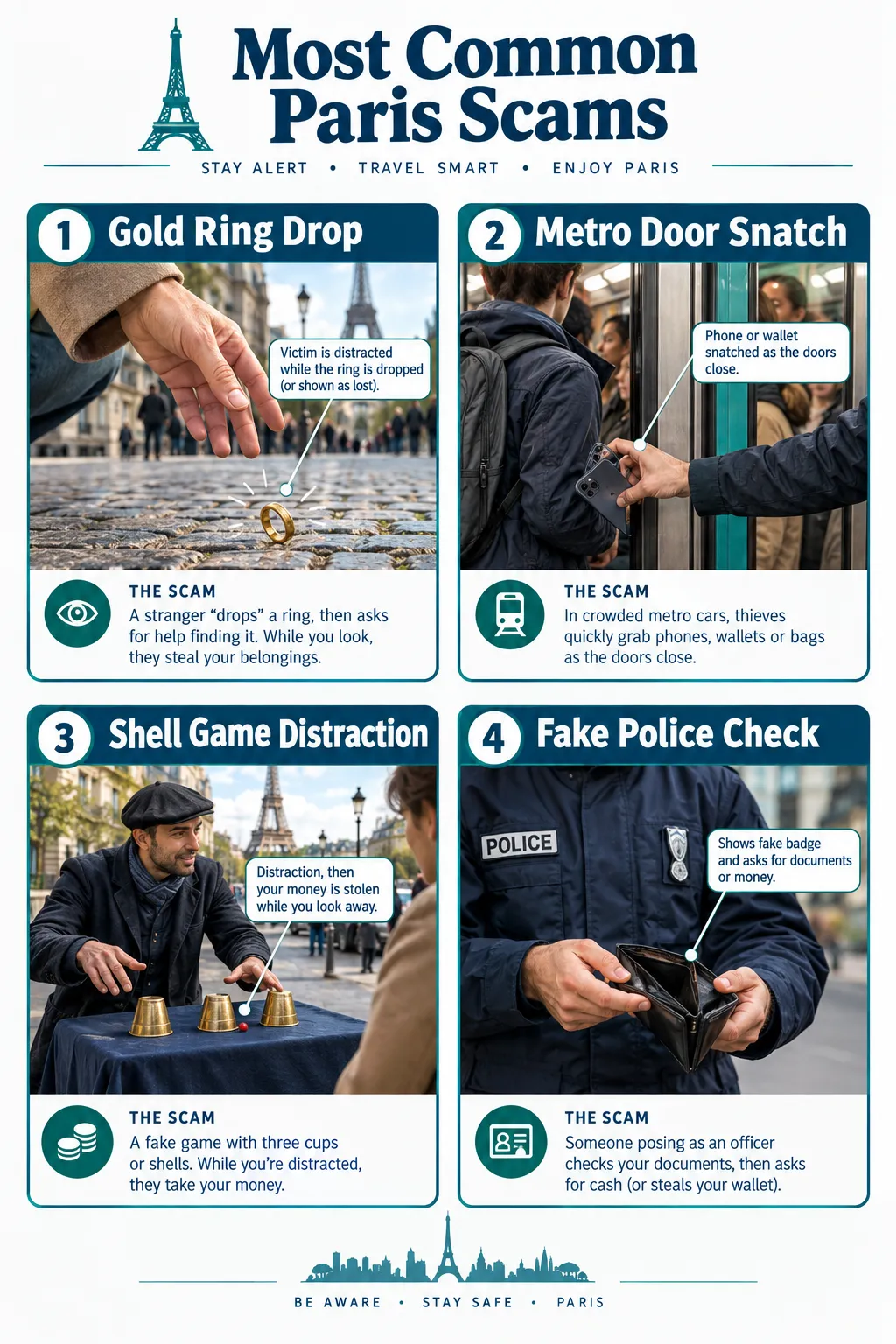
- Gold ring drop – Someone “finds” a gold ring near you and offers it as a gift, then demands money
- Petition scam – People approach with clipboards asking for signatures, then demand payment or pickpocket you while you’re distracted
- Shell game (bonneteau) – A street card or cup game that looks winnable but is rigged, with a crowd of accomplices
- Fake police check – Scammers dressed in plain clothes claim to be officers and ask to inspect your wallet
- Unlicensed taxis – Unofficial drivers at airports and train stations charge wildly inflated fares
- Fake ticket sellers – People outside the Eiffel Tower and Louvre sell counterfeit or invalid tickets
- Friendship bracelet trap – Someone ties a bracelet on your wrist without asking, then demands payment
- Restaurant tourist traps – Menus without prices, or dishes added to your bill that you didn’t order
According to travel safety guides covering Paris tourist risks, these scams are non-violent but highly concentrated in specific micro-zones, making them very predictable once you know where to look.
How Do Pickpockets Operate in the Paris Metro?
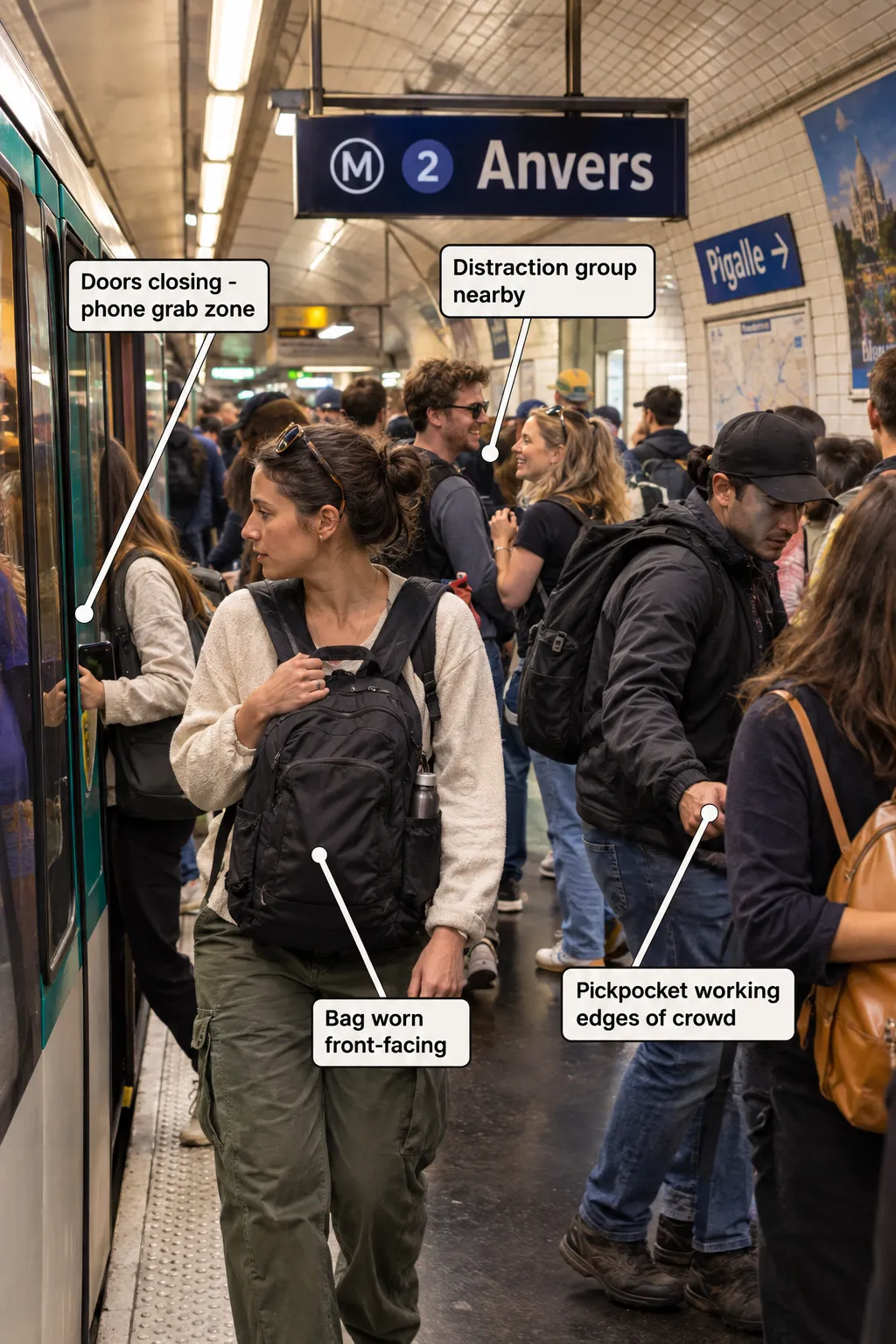
Pickpockets in the Paris Metro rely on distraction, crowding, and timing. The most effective technique is the door-chime phone snatch – a thief grabs your phone or bag just as the Metro doors are closing, stepping off the train before you can react.
Watch for these specific red flags on the Metro:
- Someone standing unusually close to you even when the car isn’t crowded
- A group creating a commotion near the doors right before they close
- Anyone who “accidentally” bumps into you while you’re looking at your phone
- People watching your hands rather than the direction of travel
Documented Paris scam patterns show that stations like Anvers (near Sacre-Coeur), Barbès-Rochechouart, and Châtelet-Les Halles have historically higher rates of tourist theft.
Practical tips:
- Keep your phone in a front pocket or zipped bag
- Wear your backpack on your front in crowded carriages
- Step away from the doors once you’re on board
- Never use your phone right next to the closing doors
The Paris in November itinerary guide also notes that off-peak travel times reduce your exposure significantly.
Is the Gold Ring Scam Still Happening and How Does It Work?
Yes, the gold ring scam is still very active in Paris in 2026. It’s one of the oldest tricks on the books, and it works because it exploits politeness.
Here’s how it plays out:
- A stranger bends down near you and “discovers” a gold ring on the ground
- They offer it to you as a gift, saying they can’t keep it for religious or personal reasons
- Once you accept, they ask for money – for food, a bus ticket, anything
- If you refuse, they become persistent or aggressive
The ring is always fake. Paris scam advisories confirm this scam is most common near the Eiffel Tower, Pont d’Iena, and along the Seine.
The fix is simple: Don’t touch the ring. Say “non merci” and walk away without breaking stride. Eye contact and engagement are what keep the scam going.
What’s the Difference Between a Legitimate Taxi and an Unlicensed Cab in Paris?
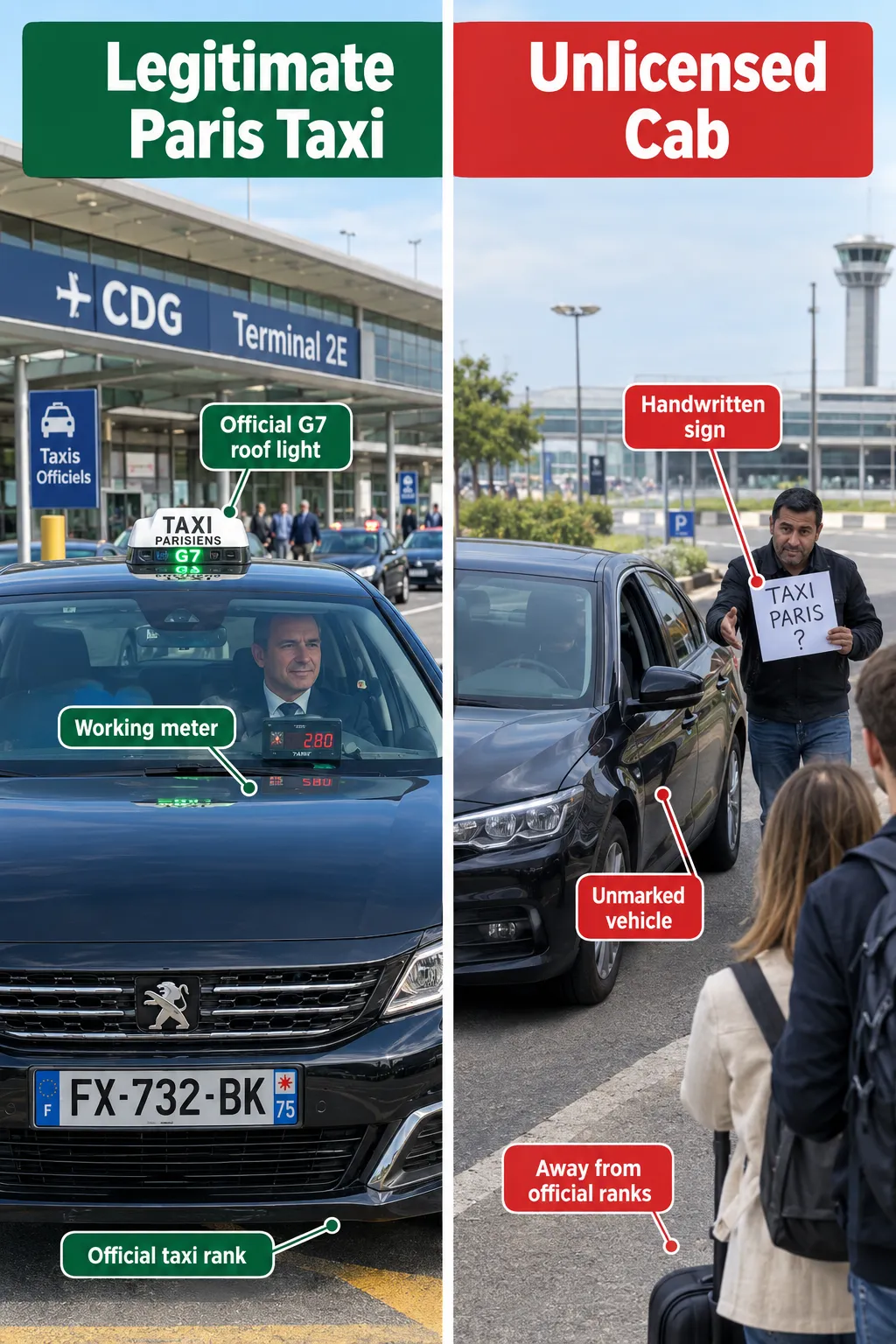
A legitimate Paris taxi has a rooftop light displaying “TAXI PARISIEN,” a working meter, and a license displayed on the dashboard. Unlicensed cabs have none of these – they’re just regular cars whose drivers approach tourists outside airports and train stations.
How to spot the difference:
| Feature | Licensed Taxi | Unlicensed Cab |
|---|---|---|
| Roof light | Yes – official “TAXI PARISIEN” | None or generic |
| Meter | Always running from pickup | Often absent or ignored |
| License plate | Registered, visible | May be covered or absent |
| Where they wait | Official taxi ranks | Random spots near exits |
| Booking | App, phone, or rank | Approaches you directly |
At Charles de Gaulle (CDG) and Orly airports, unlicensed taxi operators are a documented problem. Fixed fares from CDG to central Paris are set by law – roughly 50-55 euros to the Right Bank and 55-60 euros to the Left Bank (as of 2026 estimates). If someone quotes you significantly more or refuses to use a meter, walk away.
Use the official G7 or Taxis Bleus apps, or book through your hotel.
How Can I Tell If a Restaurant in Paris Is Overcharging Tourists?
Tourist-trap restaurants are easy to spot once you know the signs. They tend to cluster within 200 meters of major landmarks and use specific tactics to inflate your bill.
Red flags to watch for:
- A menu with no prices, or a “tourist menu” posted outside with a different (lower) price than what you’re charged
- Staff standing outside aggressively inviting you in
- No French customers at all – only tourists
- Dishes appearing on your bill that you didn’t order
- Bread, water, or “cover charges” added without warning
Scam-aware Paris travel guides recommend always checking the posted menu price before sitting down and confirming that water and bread are included (or asking the price upfront).
A good rule: walk one or two streets back from any major monument and you’ll find better food at fairer prices. For more ideas on keeping costs down, see Paris on a Budget: 17 Ways to Travel Cheap in 2026.
Are Paris Street Games and Shell Games Real Scams?
Shell games and street card games in Paris are 100% scams. They are not games of skill or chance – they are rigged performances with a team of accomplices.
The setup always looks the same: a folding table, three cups or cards, and a crowd of people “winning” easily. Those winners are plants. Their job is to make you think the game is beatable.
Paris scam documentation notes that the crowd itself is part of the operation. While you’re watching the game, other members of the team are picking pockets.
Never:
- Stop to watch, even briefly
- Place any bet, even a small one
- Try to “beat” the game
These setups are most common near Sacre-Coeur, the Eiffel Tower, and along Rue de Rivoli. If you see one, keep moving.
How Do Fake Ticket Sellers Operate at Paris Attractions?
Fake ticket sellers position themselves near the entrance queues of major attractions – especially the Eiffel Tower, Louvre, and Musée d’Orsay. They sell tickets that are counterfeit, expired, or simply non-existent (a printed piece of paper).
Beyond physical sellers, a growing wave of fake ticket websites mimics official booking portals. These sites look professional, charge real money, and send confirmation emails – but the tickets don’t work at the gate.
How to protect yourself:
- Always book through the official attraction website (e.g., ticket.paris.fr for the Eiffel Tower)
- Check the URL carefully – scam sites often use slight misspellings
- Never buy tickets from someone approaching you in the queue
- Screenshot your booking confirmation and check it against the official site’s format
For a full list of Paris landmarks worth booking in advance, see Paris Monuments: 17 Iconic Landmarks You Can’t Leave Without Seeing.
What Should I Do If I Get Scammed While Visiting Paris?
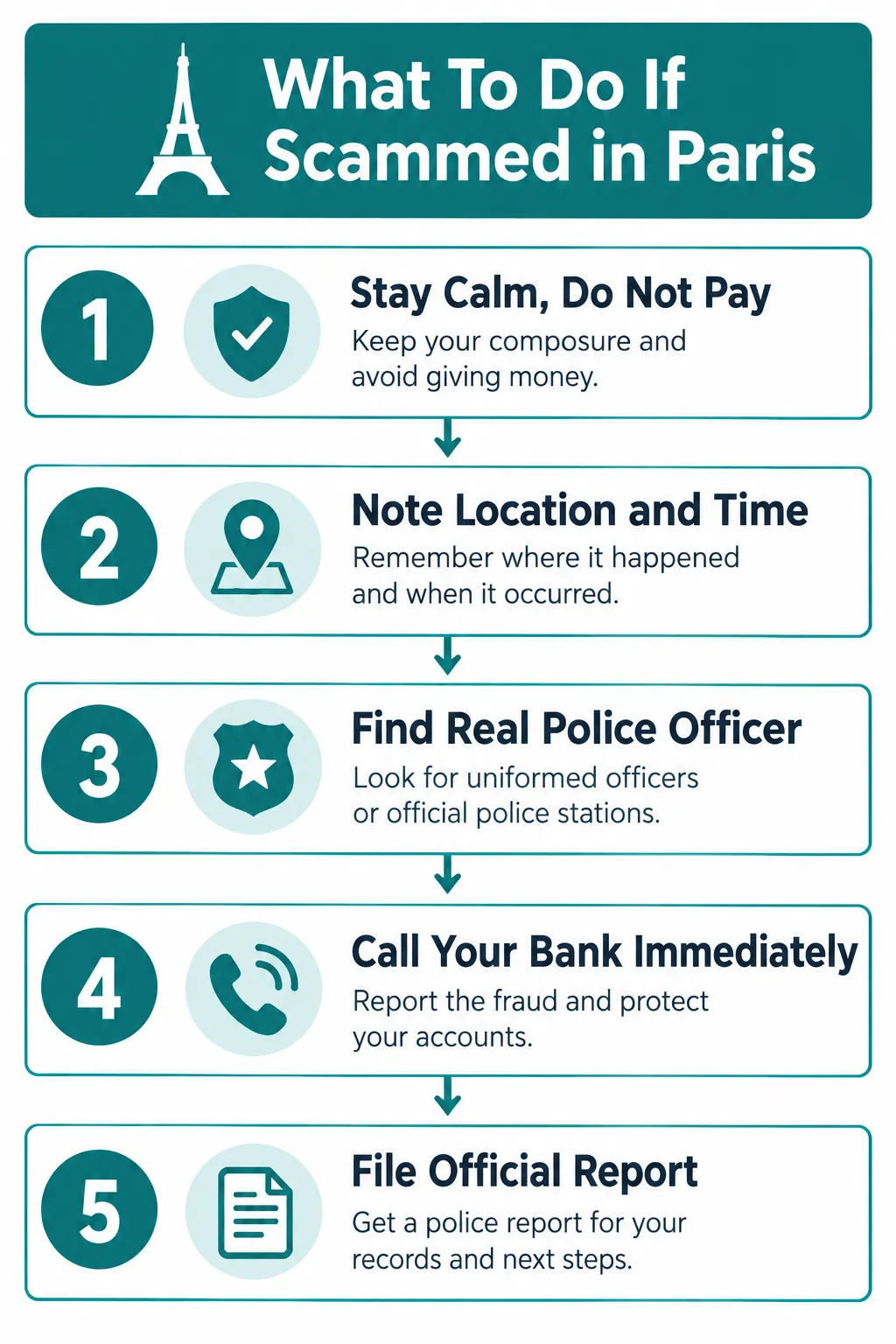
If you get scammed in Paris, the most important thing is to stay calm and not hand over more money under pressure. Most Paris scams are non-violent, and scammers rely on your confusion and embarrassment to extract payment.
Follow these steps:
- Stop and disengage – Say no firmly and walk toward a busy, public area
- Note the details – Time, location, description of the person(s) involved
- Find real police – Look for uniformed officers or a police station (commissariat)
- Call your bank – If card details were compromised, freeze your card immediately
- File a report – You’ll need this for travel insurance claims
French tourist safety resources confirm that filing a police report (even if recovery is unlikely) is essential for insurance purposes. The main tourist police office in Paris is located near the Opera district.
How Do I Know If a Paris Tour Guide Is Legitimate?
A legitimate Paris tour guide will have verifiable credentials, a fixed meeting point, and a booking confirmation you received through a reputable platform. Scam “guides” approach you on the street, offer unofficial tours for cash, and may lead you into shops where they earn commissions.
Signs of a legitimate guide:
- Booked through platforms like Viator, GetYourGuide, or the Paris tourist office
- Carries official accreditation (France has a national guide certification system)
- Has a fixed, published meeting point and start time
- Accepts card payment or pre-payment through a verified platform
Red flags:
- Approaches you uninvited near a landmark
- Insists on cash only
- Has no reviews or booking confirmation to show
What Are the Safest Payment Methods in Paris?
Using a chip-and-PIN credit or debit card is the safest way to pay in Paris. Contactless payments are widely accepted and reduce the risk of card skimming.
Payment safety tips:
- Use ATMs inside banks rather than standalone machines on the street
- Never accept “help” from a stranger at an ATM or ticket machine – this is a common distraction technique
- Avoid currency exchange kiosks near tourist sites; Paris currency exchange scams often involve poor rates and sleight-of-hand cash counting
- Use a travel card with no foreign transaction fees (Wise, Revolut, or similar)
- Keep a small amount of cash for markets and small cafes, but don’t carry more than you need for the day
Before you pack, check The Only Travel Essential List You’ll Ever Need for anti-theft gear recommendations like RFID-blocking wallets and slash-proof bags.
What’s the Best Way to Avoid Getting Robbed in Paris Neighborhoods?
Paris is generally safe, but certain neighborhoods and micro-zones have higher concentrations of tourist-targeted crime. Knowing where scams cluster helps you stay alert at the right moments.
Higher-risk zones for tourists:
- Montmartre / Sacre-Coeur area (especially the steps and surrounding streets)
- Eiffel Tower and Trocadero plaza
- Champs-Elysees and surrounding metro stations
- Gare du Nord and Gare de l’Est (especially arrivals areas)
- Châtelet-Les Halles metro interchange
Lower-risk, less touristy areas:
- Marais district (Le Marais)
- Canal Saint-Martin
- Belleville and Oberkampf
The risk isn’t about violence – it’s about distraction theft. Paris safety assessments consistently note that awareness and body language are your best defenses. Walk with purpose, keep valuables secured, and avoid looking confused in crowded areas.
For planning your visit around Paris’s best sights safely, see 15 Best Things To Do In Paris.
FAQ
Are Paris scams violent?
No. The vast majority of Paris scams are non-violent. They rely on distraction, social pressure, and confusion rather than physical force. Pickpocketing is the most common form of theft.
Is the petition scam still common in Paris in 2026?
Yes. Groups of people – often young women – approach tourists near landmarks with clipboards and ask for signatures for a “charity.” While you’re distracted, accomplices pickpocket you. Never stop for clipboard approaches near tourist sites.
What should I do if someone puts a bracelet on my wrist?
Pull your hand back immediately and say “non” firmly. Once it’s on, they’ll demand payment and become aggressive. The safest move is to not let it happen – keep your hands in your pockets near the Sacre-Coeur steps where this is most common.
Are Airbnb listings in Paris trustworthy?
Most are legitimate, but fake short-term rental listings have increased. Always book through the official Airbnb platform, verify host reviews carefully, and never transfer money outside the platform.
Can I get my money back if I’m scammed in Paris?
Rarely, if cash was taken. If a card was used fraudulently, contact your bank immediately – most banks will reverse unauthorized charges. Travel insurance may cover losses if you have a police report.
Is it safe to use ATMs in Paris?
Yes, if you use ATMs inside bank branches during business hours. Avoid standalone street ATMs at night, and never accept help from a stranger while using one.
What’s the fastest way to spot a scam in progress?
Look for a small crowd gathering around a street game, someone approaching you with an object you didn’t ask for, or anyone creating a distraction near your bag or pockets. Trust your instincts – if something feels staged, it probably is.
Do real French police ever stop tourists on the street?
Uniformed police can ask for ID in France, but they will never ask to inspect your wallet or count your cash. If someone in plain clothes claims to be police and asks to see your money, they are scammers. Ask to see a badge and walk toward a public space.
Is the perfume shop scam still active in Paris?
Yes. A well-dressed person approaches you near a luxury area claiming to be a perfume sales rep with “excess stock” to sell cheaply. The perfume is fake or heavily diluted. Never buy perfume from street sellers.
Which Paris Metro stations should I be most careful at?
Anvers, Barbès-Rochechouart, Châtelet-Les Halles, and Gare du Nord are the stations most frequently mentioned in tourist theft reports. Stay alert at these stops, especially during peak tourist hours.
Conclusion
Paris is one of the world’s great cities, and the vast majority of visitors have a wonderful, trouble-free trip. But paris scams are real, predictable, and easy to avoid with the right preparation.
Your action plan before you go:
- Screenshot this guide and save it offline
- Book all attraction tickets directly through official websites
- Set up your bank’s travel notifications and have the fraud hotline number saved
- Pack an RFID-blocking wallet and a front-zip bag or money belt
- Share your itinerary with someone at home
The scammers in Paris count on tourists being unprepared, distracted, and too polite to say no. Now you know the playbook. Walk confidently, trust your instincts, and enjoy everything this incredible city has to offer.
For more on planning your Paris trip, check out Paris in Spring: 15 Magical Things To Do and Best Hotels in Paris That Are Affordable.