


Last updated: September 24, 2026
Quick Answer: Washington DC in the fall peaks for foliage between mid-October and early November, with the sweetest window typically landing around October 20-30. Three days is the ideal amount of time to hit the best color spots, explore the free museums, and soak in the city without rushing. No car needed – DC’s Metro and walkable layout make it one of the easiest fall trips in the country.
Key Takeaways
- 🍂 Peak foliage in DC typically runs from mid to late October, with some neighborhoods holding color into early November
- 🏛️ Most major monuments and museums are free, making DC one of the most budget-friendly fall city trips in the US
- 🚇 You don’t need a car – the Metro, Capital Bikeshare, and walkable neighborhoods cover everything
- 🌤️ Fall crowds are lighter than spring, especially compared to cherry blossom season
- 💰 Budget travelers can do DC for under $150/day including accommodation if they plan smart
- 📍 Best foliage spots: Tidal Basin, Rock Creek Park, the National Arboretum, and Georgetown
- 🗓️ Day 1 – National Mall and monuments; Day 2 – Tidal Basin and Georgetown; Day 3 – Rock Creek Park or a day trip
- 🎭 Fall 2026 brings strong cultural programming at the Smithsonian and Kennedy Center
- 🌧️ Pack layers and a rain jacket – DC fall temps range from 45°F to 65°F with occasional showers
When Does Fall Foliage Peak in Washington DC?
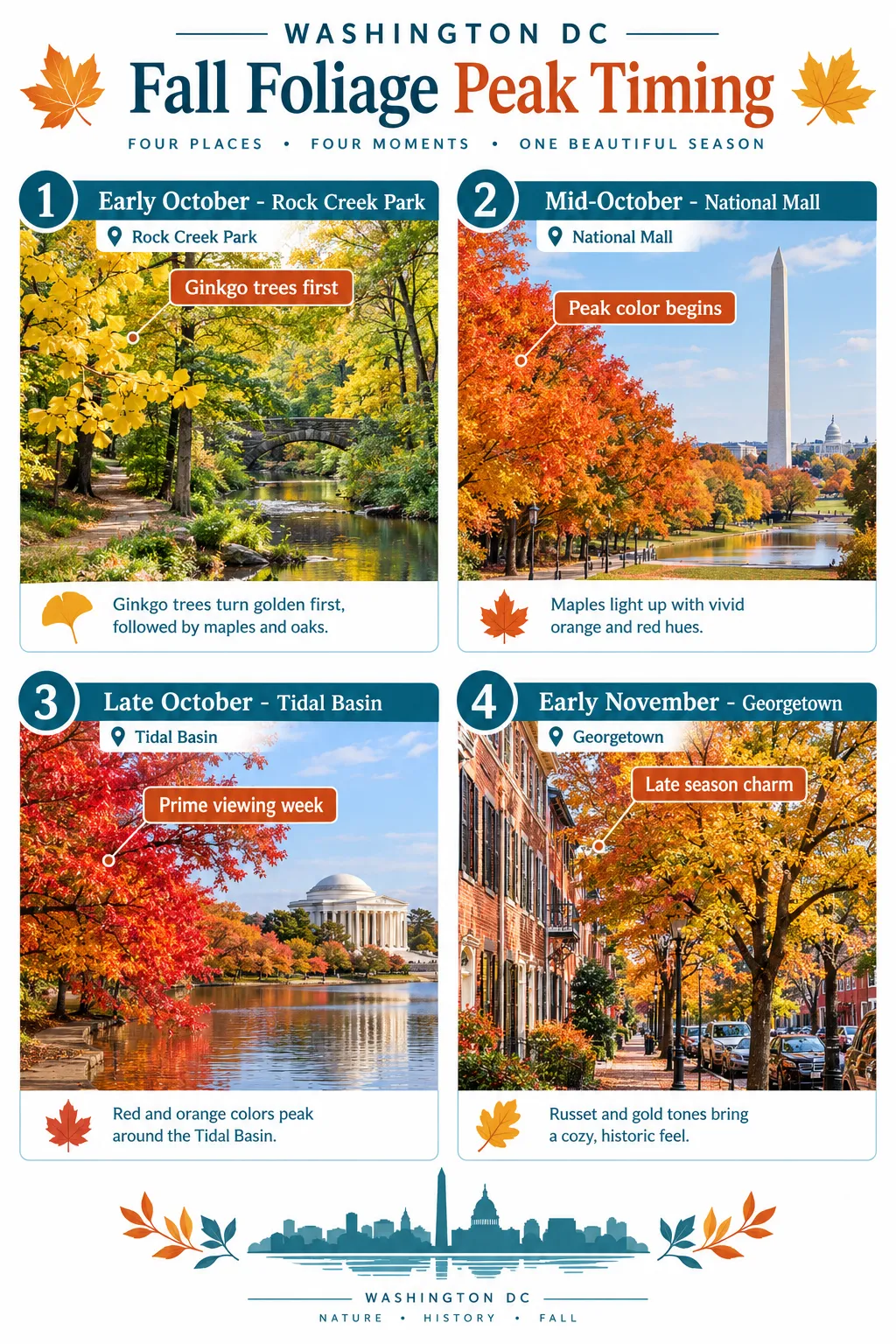
Peak fall foliage in Washington DC typically arrives between October 15 and November 5, with the most vibrant color usually concentrated in the last 10 days of October. The exact timing shifts slightly each year depending on temperature and rainfall patterns.
According to DC’s fall foliage forecast for 2026, the city’s urban heat island effect means color change runs about one to two weeks behind rural Virginia and Maryland. That’s actually good news for travelers – it gives you a longer window to catch peak color.
Key trees to watch:
- Ginkgo trees – Turn brilliant yellow, usually mid to late October
- Red maples – Peak orange-red color, late October
- Oak trees – Deep russet and brown, often holding color into early November
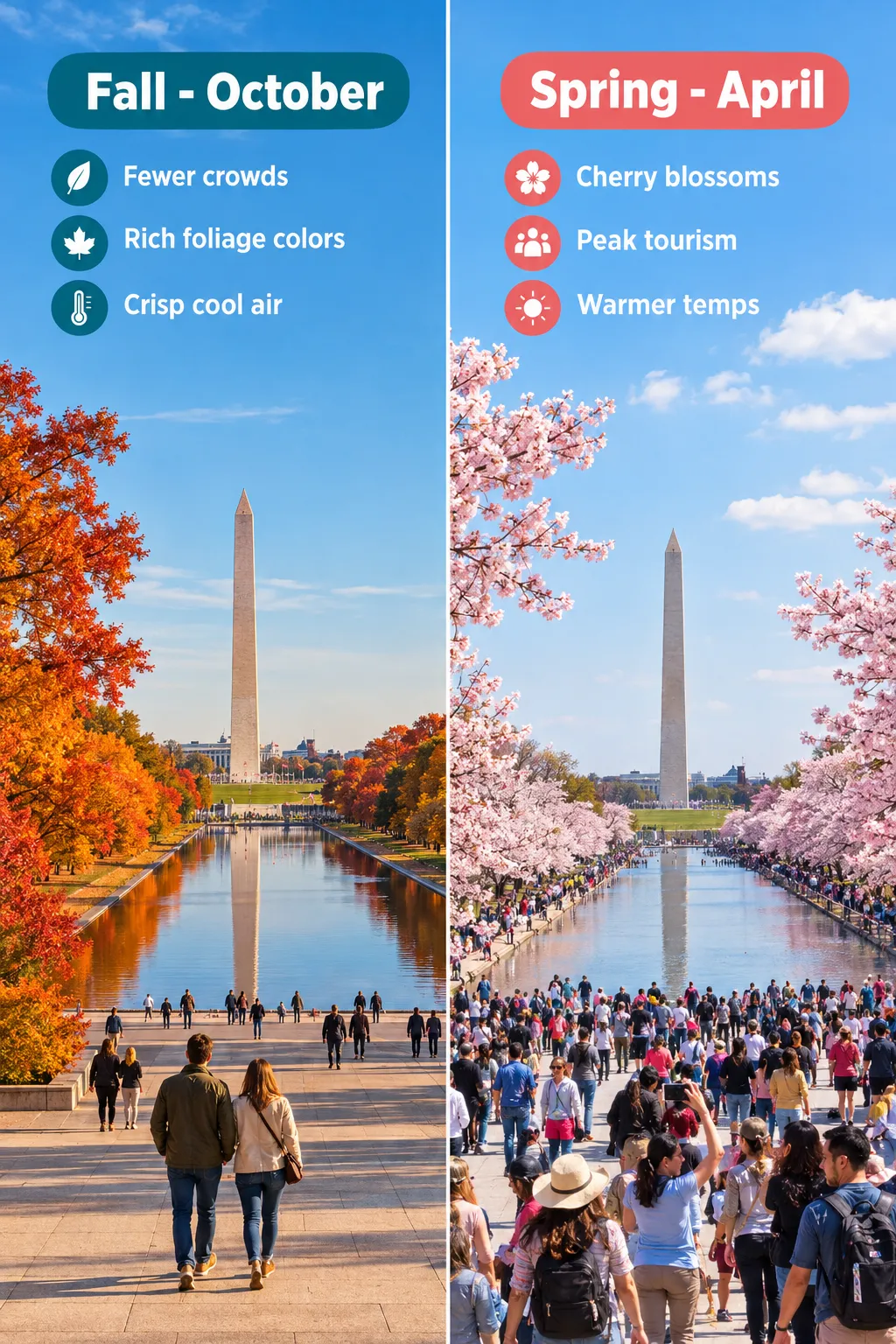
- Japanese maples – Vivid crimson, best around Tidal Basin
As Capital Weather Gang notes, a warm, dry September followed by cool October nights tends to produce the most saturated colors. Check foliage trackers in early October to fine-tune your travel dates.
What Is the Best Time to Visit Washington DC for Fall Foliage?
The best time to visit Washington DC in the fall for foliage is the third and fourth week of October. Book your trip for October 18-28 if you want the highest probability of hitting peak color.
That said, early November still offers beautiful late-season color in Rock Creek Park and along Georgetown’s side streets. If you can’t make late October work, early November is a solid backup.
Quick timing guide:
| Week | What’s Happening |
|---|---|
| Early October | Early color on ginkgos; mostly green |
| Mid-October | Color spreading across the Mall and Rock Creek |
| Late October | Peak color at Tidal Basin, Georgetown, Arboretum |
| Early November | Late color in Rock Creek; most trees past peak |
Where to See the Best Fall Colors in Washington DC
The best fall color spots in DC are the Tidal Basin, Rock Creek Park, the US National Arboretum, and the tree-lined streets of Georgetown. Each offers a different kind of foliage experience within the city.
Here’s where to go on each day of your 3-day itinerary:
Day 1 – The National Mall and Monuments
Start at the Lincoln Memorial at sunrise. The elm trees lining the Mall turn golden yellow in late October, and the morning light on the Reflecting Pool is genuinely stunning. Walk east toward the Capitol, stopping at the Washington Monument. The Smithsonian museums along the Mall are all free and worth an hour each. End the day at the Capitol Reflecting Pool as the sun sets through the trees.
Day 2 – Tidal Basin and Georgetown
The Tidal Basin is famous for cherry blossoms in spring, but the Japanese maples and other ornamental trees around the Jefferson Memorial turn deep red and orange in late October. Morning is the best time – the water is still and the reflections are sharp. After lunch, head to Georgetown. The C&O Canal towpath is lined with mature trees that put on a serious color show. According to washington.org, many of DC’s best fall experiences are completely free.
Day 3 – Rock Creek Park or Day Trip
Rock Creek Park is DC’s largest green space and the best place in the city for a proper fall hike. The 1,754-acre park has miles of trails through dense hardwood forest. Alternatively, take a short drive or train to the US National Arboretum, which has one of the most concentrated collections of fall-color trees on the East Coast.
If you want to extend the foliage experience beyond DC, check out our guide to Vermont fall foliage road trips for comparison – Vermont peaks 2-3 weeks earlier than DC.
Is DC Crowded in the Fall, and How Does Fall Compare to Spring?
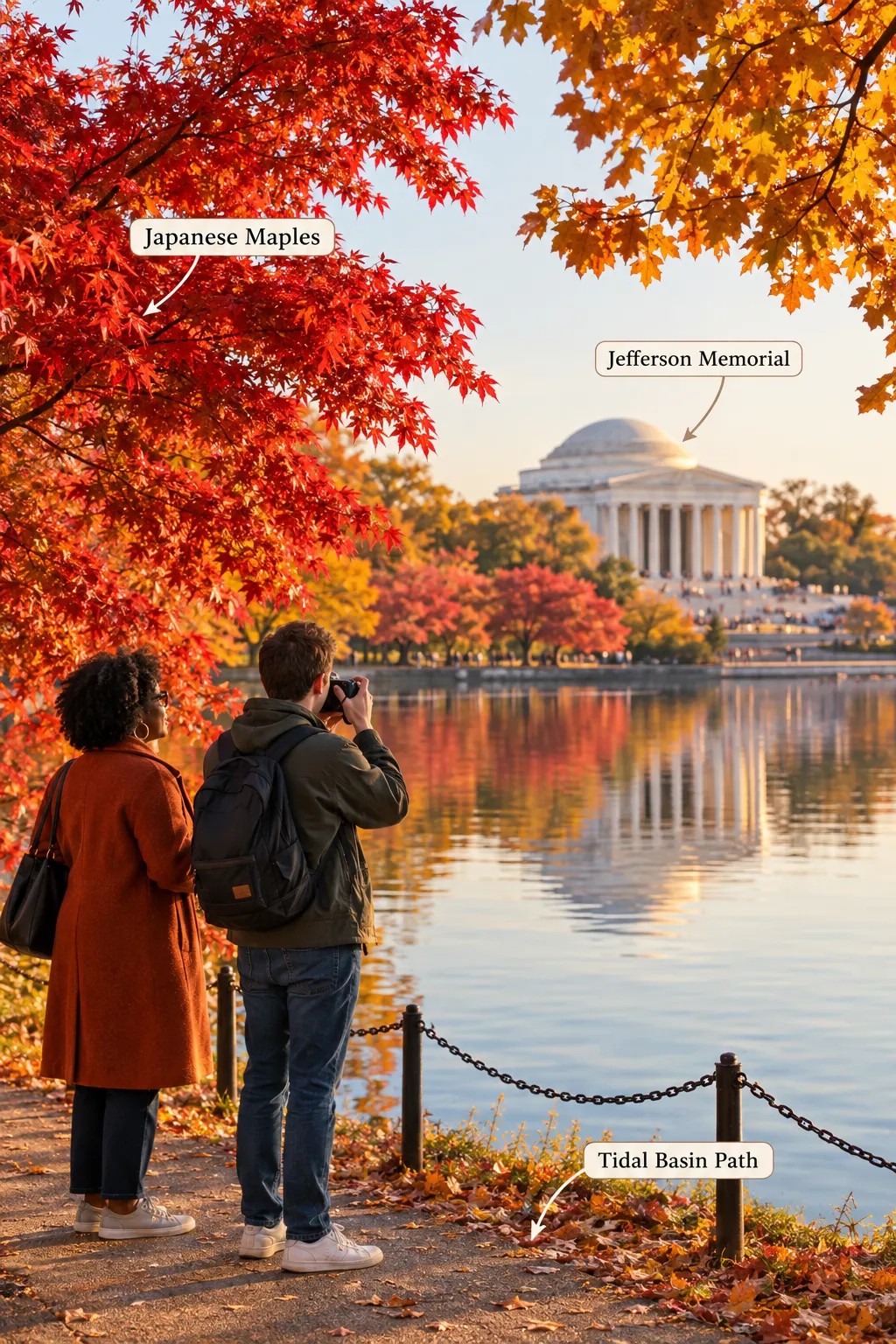
Washington DC in the fall is noticeably less crowded than spring, particularly compared to cherry blossom season in late March and early April. Fall is considered a “shoulder season” for DC tourism, which means shorter lines, easier restaurant reservations, and more breathing room at popular spots.
Travel analysts at The Traveler frame fall 2026 as a particularly smart time to visit DC, partly because spring 2026 saw record crowds and hotel prices that pushed many visitors away.
Fall vs Spring in DC – quick comparison:
- Crowds: Fall is lighter; spring cherry blossom season is the busiest week of the year
- Weather: Fall is cooler and drier on average; spring can be rainy and unpredictable
- Color: Spring has cherry blossoms (2 weeks); fall foliage lasts 3-4 weeks
- Hotel prices: Fall rates are generally 15-25% lower than peak spring (estimate based on typical seasonal patterns)
- Events: Both seasons have strong cultural programming; fall adds harvest festivals and football
Choose fall if you want fewer crowds, a longer color window, and better value. Choose spring if cherry blossoms are a bucket-list item and you don’t mind booking months in advance.
For another great fall city trip comparison, see our NYC weekend fall itinerary – New York peaks slightly earlier than DC.
How Many Days Do You Need in DC, and Can You Do It in 2 Days?
Three days is the ideal length for a Washington DC fall foliage trip. It gives you enough time to cover the National Mall, the Tidal Basin, Georgetown, and Rock Creek Park without rushing.
If you only have 2 days in Washington DC:
Prioritize the Tidal Basin and Georgetown on Day 1 (best foliage concentration), then the National Mall and at least two Smithsonian museums on Day 2. You’ll miss Rock Creek Park and the National Arboretum, but you’ll still see the best of the city.
Can you see fall colors in one day in DC?
Yes – a single focused day can cover the Tidal Basin, a walk down the Mall, and a stroll through Georgetown. It’s tight but doable if you start early (7am) and stay until dusk.
How Much Does a 3-Day Trip to DC Cost?
A 3-day Washington DC fall trip can cost anywhere from $300 to $1,200+ per person depending on accommodation and dining choices. The good news: most of DC’s best attractions are free.
Rough budget breakdown (per person, 3 nights):
- Budget option: Hostel or budget hotel + free museums + casual dining – roughly $300-$500 total
- Mid-range: 3-star hotel + mix of free and paid experiences + sit-down meals – roughly $600-$900 total
- Splurge: Boutique hotel in Georgetown or Dupont Circle + fine dining – $1,000+ total
The Smithsonian museums, National Gallery of Art, and all National Mall monuments are completely free. That’s easily $100+ in savings compared to other major cities.
Transport costs are low too – a 3-day Metro pass covers unlimited rides, and Capital Bikeshare day passes are inexpensive.
Best Neighborhoods to Stay in DC for Foliage Viewing
The best neighborhoods to stay in Washington DC in the fall for foliage access are Georgetown, Dupont Circle, and Capitol Hill. Each puts you within walking distance of major color spots.
- Georgetown: Best for Tidal Basin and C&O Canal access; walkable, charming, lots of dining options
- Dupont Circle: Central location, easy Metro access, close to Rock Creek Park’s southern entrance
- Capitol Hill: Walking distance to the National Mall and the US Botanic Garden; more affordable than Georgetown
- Logan Circle: Trendy, good value, 15-minute walk to the Mall
Avoid staying in suburban Maryland or Virginia if foliage is your priority – the extra commute time eats into your day.
Do You Need a Car to Get Around DC in the Fall?
No, you do not need a car to get around Washington DC in the fall. The Metro covers all major tourist areas, and most of the best foliage spots are within walking distance of each other or a short Metro ride.
In fact, driving in DC can slow you down. Parking is expensive and limited near the Mall and Georgetown. The Metro’s Red, Blue, Orange, Silver, and Green lines connect all the key neighborhoods.
Getting around without a car:
- Metro: Most reliable for longer distances; buy a SmarTrip card on arrival
- Capital Bikeshare: Perfect for the Mall, Tidal Basin, and Georgetown – all relatively flat
- Walking: The Mall is 2 miles end to end; Georgetown to the Tidal Basin is about 1.5 miles
- Rideshare: Useful for Rock Creek Park or the National Arboretum
For the National Arboretum specifically, a rideshare or taxi is the easiest option since it’s not directly on the Metro.
What Should I Pack for Fall in Washington DC?
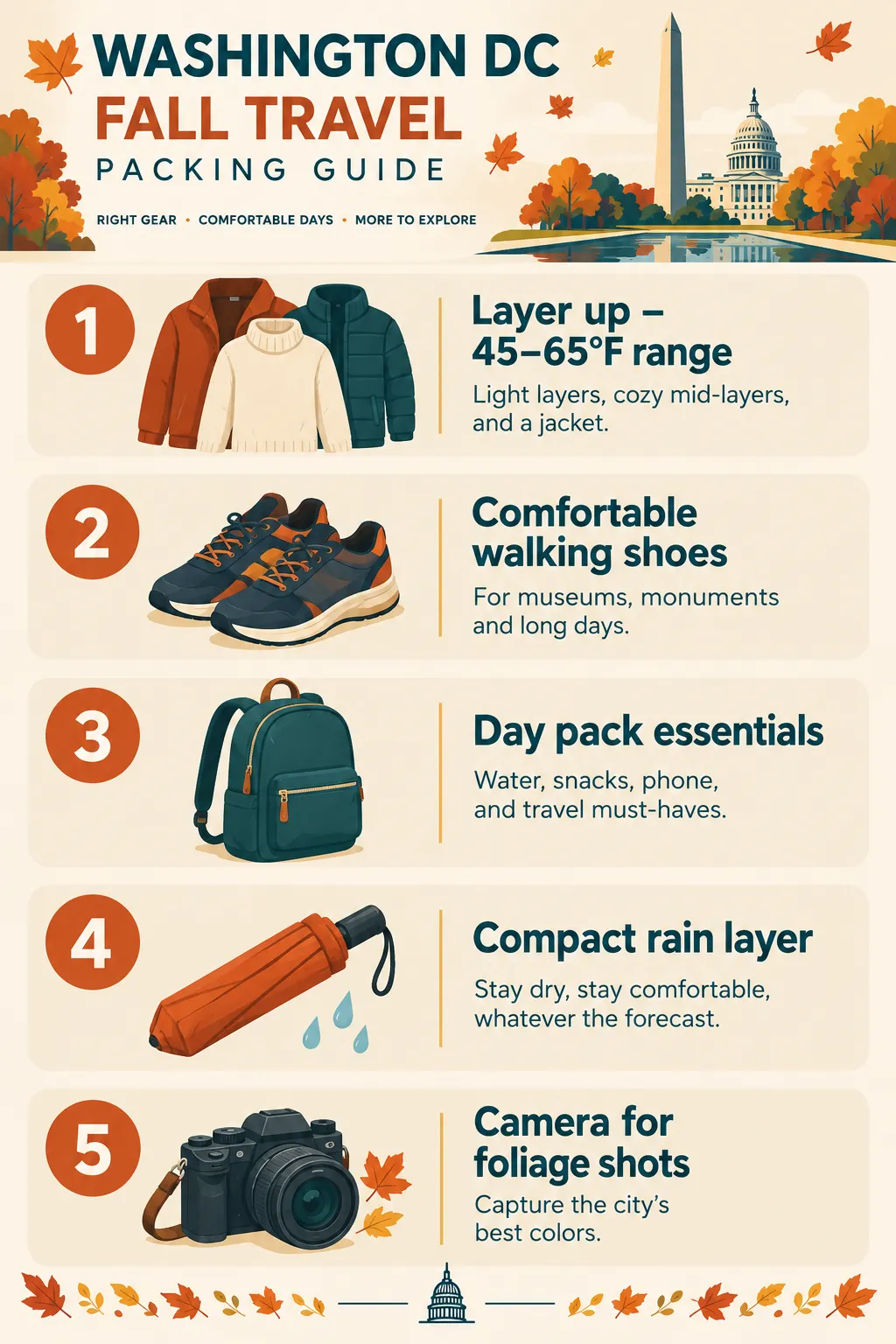
Pack layers for Washington DC in the fall. October temperatures typically range from 45°F at night to 65°F during the day, with occasional rain showers and some warm afternoons.
Packing checklist for DC in fall:
- ✅ Light to mid-weight jacket (not a heavy winter coat)
- ✅ Layering pieces – a fleece or sweater works well
- ✅ Compact rain jacket or packable umbrella
- ✅ Comfortable walking shoes (you’ll easily log 8-12 miles/day)
- ✅ One slightly dressier outfit if you plan on nicer restaurants
- ✅ Camera or phone with a good camera – the foliage is worth it
- ✅ Reusable water bottle – there are water fountains throughout the Mall
Skip the heavy winter coat unless you’re visiting in late November. A good mid-layer plus a rain shell handles most DC fall weather.
What’s the Cheapest Way to Visit DC in the Fall?
The cheapest way to visit Washington DC in the fall is to lean into the city’s extraordinary free offerings. Nearly every major museum and monument is free, which makes DC one of the most affordable major cities in the US for travelers.
Money-saving tips:
- Stay in a hostel, budget hotel, or use points/miles – fall rates are lower than spring
- Eat lunch at Eastern Market or a food truck near the Mall instead of sit-down restaurants
- Use the Metro instead of taxis
- Visit free events – DC’s fall festival calendar includes many no-cost options
- Book accommodation 6-8 weeks out for the best fall rates
If you enjoy scenic train travel as part of your fall trip, our guide to fall foliage train rides in the USA covers some great options for getting to or from DC by rail.
Fall 2026 Events and Cultural Programming Worth Planning Around
Fall 2026 in DC brings strong cultural programming that pairs well with foliage viewing. The Smithsonian Institution runs special autumn exhibitions, and the Kennedy Center’s fall season typically opens in late September.
Washington.org’s fall events calendar lists dozens of festivals, outdoor markets, and cultural events running through October and November.
A few highlights worth noting for 2026:
- Smithsonian Craft Show and seasonal exhibitions at multiple museums
- Eastern Market fall harvest events in Capitol Hill
- Kennedy Center fall programming – check their schedule for specific dates
- Outdoor film screenings and food festivals on the Mall through October
Travel and tourism coverage notes that fall 2026 is being positioned as a strong season for DC tourism, with the city actively promoting its foliage and cultural calendar to draw visitors away from the spring rush.
FAQ
When is the best week to visit Washington DC for fall foliage in 2026?
The third week of October – roughly October 18-26 – gives you the highest probability of hitting peak color at the Tidal Basin, Georgetown, and the National Mall.
Is the National Mall free to visit in the fall?
Yes. All National Mall monuments, memorials, and Smithsonian museums are free to enter year-round, including in the fall.
How far in advance should I book a hotel for fall in DC?
Book 6-8 weeks in advance for the best rates and availability during peak foliage weeks (mid to late October). Last-minute booking in this window gets expensive.
Is Rock Creek Park safe for solo hikers in the fall?
Yes, Rock Creek Park is generally safe during daylight hours. Stick to marked trails, go in the morning or early afternoon, and let someone know your plans.
What’s the weather like in Washington DC in November?
Early November is cool and can still have some foliage. Expect temperatures from 38°F to 58°F, with more rain than October. Pack a warmer jacket for November visits.
Can I take a day trip from DC to see fall foliage?
Absolutely. Shenandoah National Park is about 75 miles from DC and peaks slightly earlier than the city. Skyline Drive is one of the best fall drives on the East Coast.
Are the Smithsonian museums crowded in October?
Less crowded than spring, but popular museums like the National Air and Space Museum and the Natural History Museum still get busy on weekends. Visit on a weekday morning if possible.
Do I need to reserve Smithsonian museum tickets in advance?
Some Smithsonian museums require free timed-entry passes, especially on weekends. Check each museum’s website before your trip and reserve passes a week or two ahead.
What’s the best free thing to do in DC in the fall?
Walking the National Mall at sunrise or sunset during peak foliage is hard to beat – it’s free, beautiful, and far less crowded than midday.
Is Washington DC in the fall good for families with kids?
Yes. The free museums, wide open spaces on the Mall, and mild fall weather make it an excellent family destination. Kids especially love the National Zoo (free admission) and the Air and Space Museum.
Conclusion
Washington DC in the fall is genuinely one of the best city trips you can take in the US. The combination of free world-class museums, stunning foliage across the Mall and Tidal Basin, lighter crowds than spring, and a walkable layout makes it hard to beat for value and experience.
Your action plan:
- Target October 18-28 for peak foliage – mark your calendar now
- Book accommodation 6-8 weeks out in Georgetown, Dupont Circle, or Capitol Hill
- Reserve free Smithsonian timed-entry passes a week or two before arrival
- Download the Metro app and plan your routes in advance
- Check the foliage tracker at Secret DC or Capital Weather Gang in early October to fine-tune your dates
If you want to extend your fall foliage adventure beyond DC, our guides to Vermont fall foliage road trips and fall foliage train rides across the USA are great next reads.
Three days, peak color, zero admission fees. Washington DC in the fall doesn’t ask much of you – just show up at the right time.