
Last updated: August 13, 2026
Quick Answer: New Zealand is one of the world’s most expensive travel destinations, with average daily costs running NZD 150-250 per person for mid-range travelers in 2026. But with the right hacks, you can realistically cut that figure nearly in half – down to NZD 80-100 per day – without sacrificing comfort or sleeping in a van. The key is stacking smart accommodation choices, free nature activities, budget supermarket meals, and strategic flight timing.
Key Takeaways
- 🎒 A realistic New Zealand budget for 2026 is NZD 80-150 per day depending on your travel style
- ✈️ Flights from the USA to New Zealand start around NZD 1,073+ per person – booking 3-6 months out saves the most
- 🛏️ Budget accommodation costs roughly NZD 35-55 per night in a hostel dorm, or NZD 90-130 for a private room
- 🚗 Car rental averages NZD 62 per day but shared rentals and buses cut that cost significantly
- 🥗 Eating from Pak n Save or New World supermarkets instead of restaurants saves NZD 30-50 per day
- 🏔️ Many of New Zealand’s best experiences – Great Walks, beaches, national parks – are completely free or very low cost
- 📅 Shoulder season (April-May and September-October) offers lower prices and fewer crowds
- 🗓️ A working holiday visa lets budget travelers offset costs by earning NZD while exploring the country
- 🧳 A 2-week New Zealand trip on a budget costs roughly NZD 2,000-3,500 per person all-in (excluding flights)
- 💡 The biggest money mistake travelers make is renting a car full-time from day one – use targeted transport instead
How Much Does New Zealand Really Cost in 2026?
New Zealand is genuinely expensive – but not unmanageable. According to budget travel benchmarks for New Zealand, a backpacker spending carefully can get by on NZD 80-100 per day, while a mid-range traveler typically spends NZD 150-200 per day in 2026.
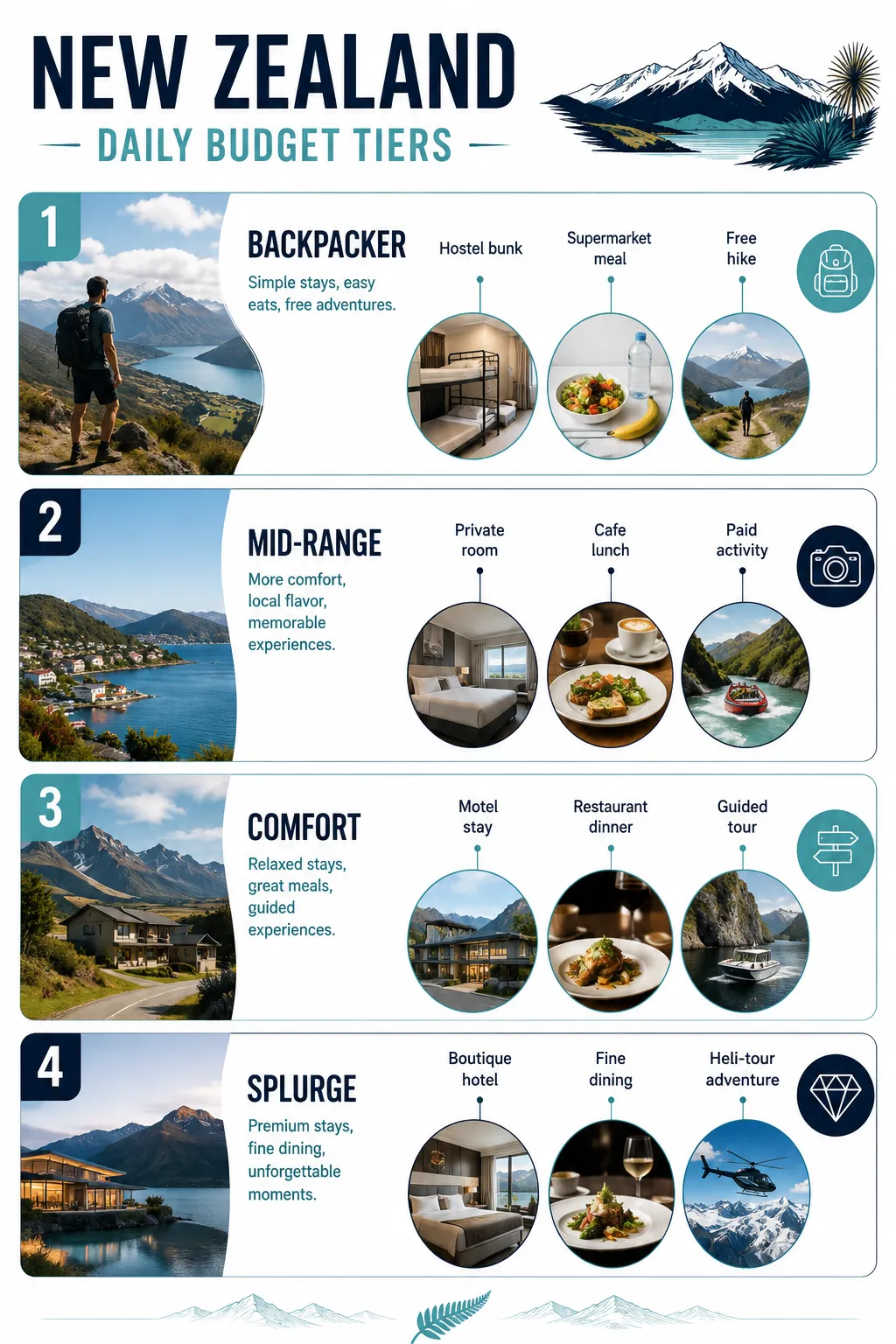
Here is what the numbers look like across different travel styles:
| Travel Style | NZD per day | What you get |
|---|---|---|
| Budget backpacker | NZD 80-100 | Hostel dorm, supermarket meals, free hikes |
| Mid-range | NZD 150-200 | Private room, some cafes, paid activities |
| Comfort traveler | NZD 250-350 | Motel/Airbnb, restaurants, guided tours |
| Splurge | NZD 400+ | Boutique hotels, fine dining, heli-tours |
Post-2020 inflation has pushed prices noticeably higher across the country. New Zealand trip costs have risen about 15-20% since 2019, driven by accommodation, food, and activity price increases. The NZD nzd 2026 exchange rate also matters a lot – as of mid-2026, NZD cad usd conversions mean Americans and Canadians get reasonable value, but it still adds up fast.
The good news: New Zealand’s biggest assets – its national parks, beaches, hiking trails, and scenic drives – cost nothing. That is the foundation of every smart New Zealand budget.
Is New Zealand expensive compared to Australia?
Yes, New Zealand is generally slightly more expensive than Australia for travelers, particularly for accommodation and activities. Queenstown in particular rivals Sydney prices. However, New Zealand’s free outdoor activities give it a much better value proposition for adventure-focused travelers who plan ahead.
Hack #1 – Nail the Backpacker Budget Band (NZD 80-100 per Day)
The backpacker budget band is the sweet spot for New Zealand on a budget in 2026. At NZD 80-100 per day, you can stay in comfortable modern hostels, eat well from supermarkets, and still do a paid activity every few days.
Here is what a realistic NZD 90 day looks like:
- Accommodation: NZD 35-45 in a hostel dorm
- Food: NZD 20-25 from supermarkets plus one cheap cafe meal
- Transport: NZD 10-15 (bus pass or shared costs)
- Activities: NZD 10-15 (free hike or one paid entry split over the day)
- Miscellaneous: NZD 5-10 (SIM card data, laundry, etc.)
This is not roughing it. Modern hostels in New Zealand are genuinely good – many have private en-suite rooms, fast wifi, full kitchens, and social common areas. Think less “grungy bunk room” and more “budget boutique.”
The key mindset shift: Stop treating every day as a restaurant day. Cook four meals out of seven, and your food budget drops dramatically. New Zealand supermarkets – especially Pak n Save – have excellent fresh produce, and most hostels have full kitchens.
“The travelers who blow their budget in New Zealand are almost always the ones eating out three times a day and renting a car they don’t need for the first week.” – common advice from long-term New Zealand travelers
For more inspiration on traveling comfortably without overspending, check out these solo travel budget ideas for stretching your money further.
How to Save Money on Flights to New Zealand from the USA
Flights are the single biggest upfront cost for any New Zealand trip. From the USA, expect to pay NZD 1,073+ per person for a return flight – and often much more if you book late or fly during peak season.
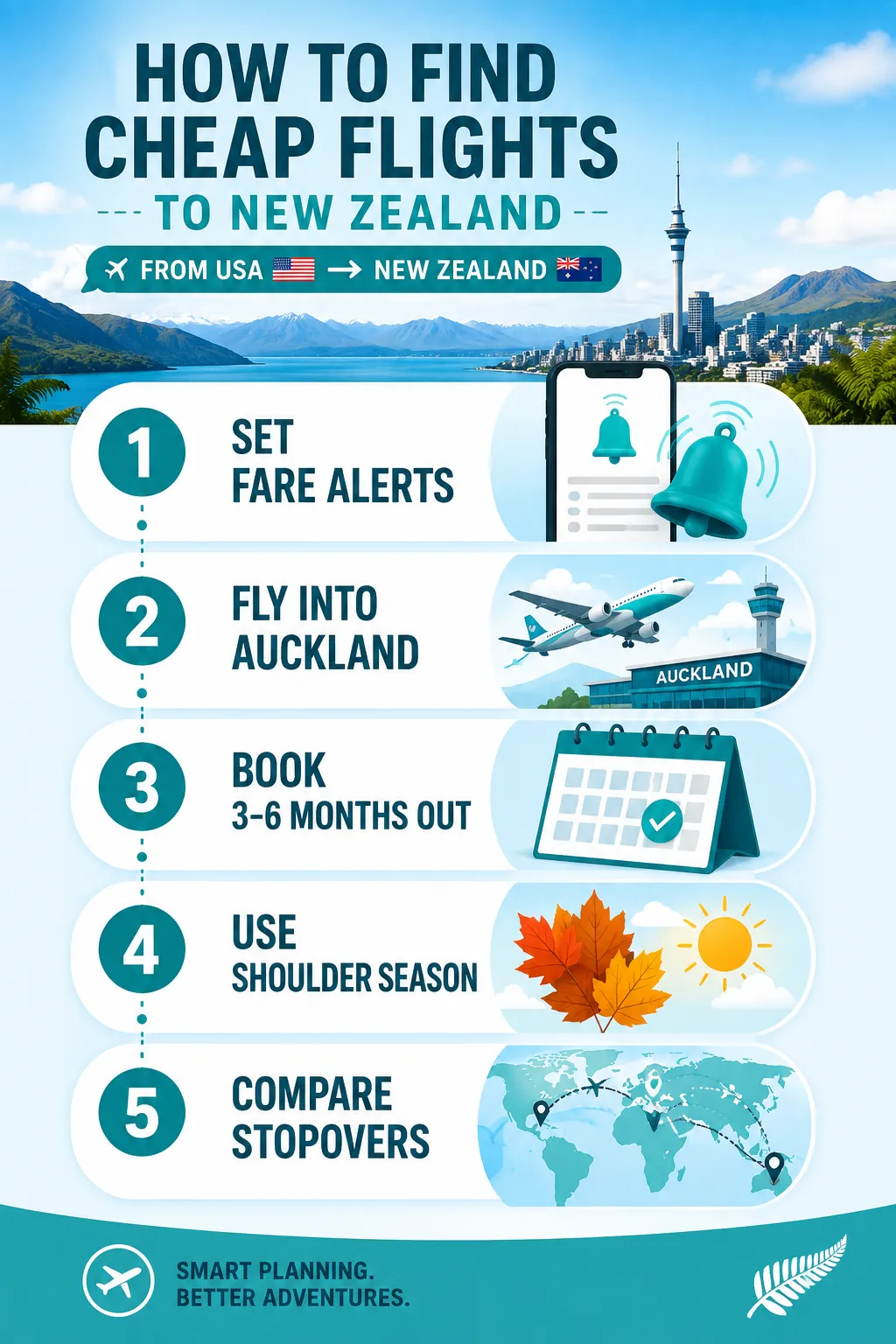
Here are the strategies that actually work in 2026:
Book 3-6 Months in Advance
Airlines like Air New Zealand, United, and Qantas release their best fares 3-6 months out. Booking inside 6 weeks almost always costs significantly more. Set fare alerts on Google Flights and Skyscanner the moment you decide on a trip.
Fly Into Auckland, Not Queenstown
Auckland is New Zealand’s main international hub and consistently has the cheapest international fares. Flying directly into Queenstown or Christchurch costs more. Land in Auckland, then use domestic flights or buses to reach the South Island.
Use Shoulder Season Timing
The cheapest time to visit New Zealand is during shoulder season – April through May and September through October. Flights and accommodation during these months can be 20-35% cheaper than peak summer (December-February). The weather is still excellent, and there are far fewer crowds at popular spots.
Consider a Stopover in Asia or the Pacific
Routing through Tokyo, Singapore, Bali, or Fiji often produces cheaper total fares than a direct route. It also lets you add a mini-trip for almost no extra cost.
Common mistake: Booking a return flight from the same city you flew into. If you plan to travel from Auckland to Queenstown, book a one-way in and a one-way out from different cities – it often costs the same or less and saves you backtracking.
How to Find Budget Accommodation in New Zealand (Beyond Hostels)
Budget accommodation in New Zealand goes well beyond hostel dorms. In 2026, the average hostel dorm costs NZD 35-55 per night, while a private room in a guesthouse or budget motel runs NZD 90-130 per night. Airbnb private rooms often sit between these two price points at NZD 70-100.
My Favourite Hostels in New Zealand
New Zealand has some genuinely excellent hostels. The YHA (Youth Hostels Association) network is the gold standard – clean, well-run, and located in every major destination. YHA New Zealand membership costs about NZD 35 per year and saves you NZD 3-5 per night at each property, paying for itself quickly.
Top picks for budget travelers:
- YHA Auckland City – central location, great kitchen, strong wifi
- Base Queenstown – social atmosphere, close to the lake
- YHA Christchurch – best base for South Island exploration
- Nomads Queenstown – good value, lively common areas
Budget Accommodation Options Beyond Hostels
- Holiday parks: NZD 20-35 per night for a powered campsite with shared facilities. Many have basic cabins for NZD 60-80. Holiday Parks New Zealand lists over 250 options.
- Airbnb private rooms: Often cheaper than motels and more social than hotels. Great for couples traveling together.
- Couchsurfing: Still active in New Zealand’s main cities – completely free and a great way to get local tips.
- Wwoofing (Willing Workers on Organic Farms): Work a few hours per day in exchange for free accommodation and meals. WWOOF New Zealand membership costs NZD 40.
- DOC huts: Department of Conservation huts on Great Walks cost NZD 15-65 per night and are an incredible budget option for hikers.
Decision rule: If you’re traveling solo, a hostel dorm is almost always the best value. If you’re traveling as a couple, a private Airbnb room or holiday park cabin often works out cheaper per person than two hostel beds.
How Much It Costs to Buy Food in New Zealand (and How to Save)
Food is one of the easiest places to save money in New Zealand, and one of the most common areas where travelers overspend. Eating out at a cafe or restaurant costs NZD 20-35 per meal per person. Cooking your own food from a supermarket costs NZD 8-15 per meal.

The Supermarket Hierarchy
New Zealand has a clear supermarket hierarchy for budget travelers:
- Pak n Save – the cheapest chain by a significant margin. No-frills, warehouse-style, but excellent value. Pak n Save is the go-to for budget travelers across the country.
- New World – mid-range pricing, wider selection, good own-brand products
- Countdown (now Woolworths NZ) – similar to New World, slightly more expensive
- Four Square – small convenience stores, significantly more expensive, avoid for bulk shopping
A week of groceries for one person – covering breakfast, lunch, and most dinners – costs about NZD 80-120 at Pak n Save. That is NZD 11-17 per day for all your food.
Budget Food Tips That Actually Work
- Cook breakfast and lunch every day. Oats, eggs, bread, peanut butter, and fresh fruit are cheap and filling.
- Treat restaurants as a splurge, not a default. One nice meal every 3-4 days keeps costs down while still letting you enjoy New Zealand’s food scene.
- Use the hostel kitchen. Most New Zealand hostels have full kitchens with basic condiments. Some even have free food shelves where departing travelers leave leftovers.
- Check out local markets. Farmers markets in cities like Wellington and Christchurch sell fresh produce cheaply and are a great cultural experience.
- Grab the daily special at bakeries. New Zealand bakeries are excellent and cheap – a pie or filled roll costs NZD 4-6 and is genuinely filling.
Quick stat: Travelers who cook at least half their meals in New Zealand save an average of NZD 30-50 per day compared to eating out for every meal.
How to Find Budget Activities in New Zealand (Free and Low-Cost)
New Zealand’s best activities are free. The country’s national parks, beaches, coastal walks, and scenic drives cost nothing to access – and they are genuinely world-class. Travel New Zealand estimates that over 60% of the country’s most popular visitor experiences involve free outdoor access.
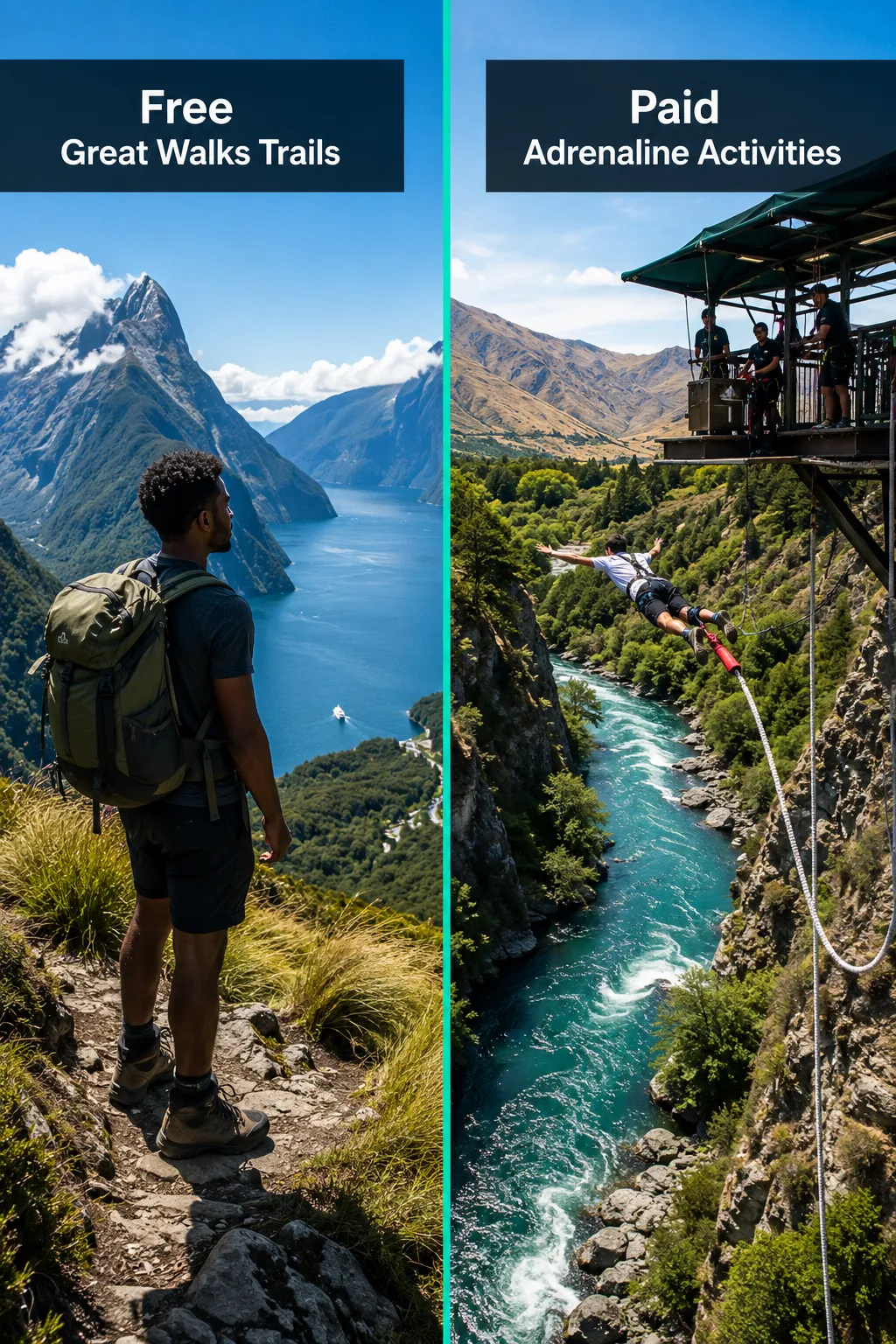
Free Activities in New Zealand
Here is a list of genuinely great free things to do across the country:
North Island:
- Tongariro Alpine Crossing (one of the world’s best day hikes, free)
- Hobbiton exterior views from the road (the paid tour is optional)
- Rotorua geothermal areas – many free roadside viewing spots
- Auckland’s Mission Bay beach and coastal walks
- Wellington’s Te Papa Museum (free entry)
- Cape Reinga lighthouse walk
South Island:
- Abel Tasman coastal walks (day sections are free)
- Milford Sound scenic drive (the road itself is free)
- Roys Peak Track above Wanaka
- Queenstown lakefront and Frankton Trail
- Christchurch Botanic Gardens
- Pancake Rocks at Punakaiki (free)
The Great Walks – Worth Every NZD
New Zealand’s Great Walks are some of the best multi-day hikes in the world. Booking hut passes costs NZD 15-65 per night depending on the walk and season – far cheaper than paying for accommodation in town. The Routeburn Track, Milford Track, and Abel Tasman Coast Track are the most popular.
Book Great Walks huts early. They sell out months in advance, especially for the Milford Track. Bookings open through the DOC booking system about 6 months before the season starts.
How to Stack Activity Discounts
- Get Your Guide and Viator often have 10-20% discounts on paid activities like bungee jumping, skydiving, and boat tours
- Combo deals in Queenstown bundle 2-3 activities for less than buying separately
- Backpacker cards (BBH Card, YHA membership) give 5-15% off at many activity operators
- Go on weekdays. Many operators charge less Monday-Thursday than on weekends
The Queenstown reality check: Queenstown is the adrenaline capital of New Zealand – and the most expensive town in the country. Budget at least NZD 200-400 extra for activities if you spend time there. Skip the expensive stuff if budget is tight, but don’t skip Queenstown itself – the scenery is free.
How to Get Around New Zealand Cheaply (Without a Full-Time Rental Car)
Transportation is often the second-biggest cost after accommodation on a New Zealand trip. A car rental averages NZD 62 per day, which adds up to NZD 868 over two weeks – before fuel, insurance, and parking.
The Best Budget Transport Options
1. InterCity Bus Network
InterCity is New Zealand’s main intercity bus company. A FlexiPass (prepaid hours) costs about NZD 179 for 15 hours of travel – enough to cover most of the North Island or a good chunk of the South Island. Buses are comfortable and reliable.
2. Naked Bus
Naked Bus offers cheaper fares than InterCity on many routes, especially if you book early. Fares as low as NZD 1 are occasionally available.
3. Stray and Kiwi Experience Hop-On Hop-Off Buses
These backpacker-oriented bus networks let you travel at your own pace, stopping wherever you like. They cost NZD 400-800 for a full pass but include stops at hostels and popular attractions. Great for solo travelers who want to meet people.
4. Shared Car Rentals
Renting a car and splitting costs with 2-3 other travelers from your hostel cuts the per-person cost dramatically. NZD 62 per day split four ways is NZD 15.50 per person – cheaper than a bus ticket.
5. Domestic Flights
Air New Zealand domestic fares between Auckland and Queenstown or Christchurch can be as low as NZD 59-99 one-way if booked early. Flying saves 8-12 hours of bus travel on the Auckland-Queenstown route.
6. Ridesharing and Carpooling
Bla Bla Car has limited coverage in New Zealand, but hostel noticeboards are excellent for finding ride shares. Many travelers post “leaving for Queenstown Thursday, splitting fuel” notices.
Decision rule: If you’re traveling the South Island for 10+ days, a shared car rental is almost always the best value. If you’re doing the North Island for a week, the InterCity bus network is cheaper and easier.
New Zealand Car Rental Tips
When you do rent a car, use Discover Cars to compare prices across multiple rental companies – it consistently finds deals 15-25% cheaper than going direct. Also:
- Book the smallest car that fits your group. Fuel is expensive in New Zealand (NZD 2.80-3.20 per liter in 2026).
- Get the right insurance. Your credit card may cover collision damage – check before paying for the rental company’s excess reduction.
- Avoid one-way fees. Dropping a car in a different city often adds NZD 100-300. Plan a loop route where possible.
What’s the Cheapest Time to Visit New Zealand?
The cheapest time to visit New Zealand is during shoulder season – April through May in autumn and September through October in spring. During these months, accommodation prices drop 20-35%, flights are cheaper, and popular attractions are far less crowded.
Seasonal Breakdown for Budget Travelers
Peak season (December-February): New Zealand summer. Best weather, highest prices. Hostels book out weeks in advance. Queenstown and the South Island are especially busy and expensive. Avoid if budget is the priority.
Shoulder season (March-May and September-November): The sweet spot for New Zealand on a budget. Weather is still good, prices are lower, and the landscapes are stunning – autumn colors in April and May are particularly beautiful.
Low season (June-August): Winter in New Zealand. South Island ski fields are open (Queenstown and Wanaka become ski towns). Accommodation is cheapest, but many hiking trails are closed or dangerous. Good for skiing on a budget; less ideal for the classic hiking trip.
April is particularly good value. Lauren Juliff, a long-term New Zealand travel writer, notes that April 2013 reply-era travel advice about shoulder season value still holds true – and in 2026, the savings are even more pronounced given peak-season price inflation.
New Zealand Budget Travel for 2 Weeks – A Realistic Breakdown
A 2-week New Zealand trip on a budget costs roughly NZD 2,000-3,500 per person (excluding international flights) in 2026. Here is a realistic budget breakdown.
2-Week New Zealand Budget Breakdown (NZD per person)
Accommodation (14 nights):
- Budget option (hostel dorms): NZD 490-770 (NZD 35-55 per night)
- Mid-range option (private rooms): NZD 1,260-1,820 (NZD 90-130 per night)
Food (14 days):
- Budget (mostly self-catering): NZD 280-420 (NZD 20-30 per day)
- Mid-range (mix of cooking and eating out): NZD 560-840 (NZD 40-60 per day)
Transport:
- Budget (buses + one domestic flight): NZD 400-600
- Mid-range (shared car rental): NZD 500-700
Activities:
- Budget (mostly free + 2-3 paid): NZD 150-300
- Mid-range (mix of free and paid): NZD 400-700
Miscellaneous (SIM, laundry, entry fees):
- NZD 100-200
Total budget range:
- Backpacker budget: NZD 1,420-2,290 per person
- Mid-range: NZD 2,720-4,360 per person
According to detailed New Zealand trip cost research, most travelers land somewhere in the middle – around NZD 2,500-3,000 for a 2-week trip at a comfortable budget level.
Tip for couples: Traveling as a couple on a New Zealand budget makes a big difference. You split accommodation costs for private rooms, share car rental fees, and buy groceries in bulk. A couple can often travel for 30-40% less per person than a solo traveler.
If you’re planning a trip with a partner, our guide to budget-friendly vacations with kids has overlapping tips on making shared travel more affordable.
Best Budget Routes Through New Zealand
The best budget route through New Zealand depends on how much time you have, but the classic North-South loop gives the best value per day. According to budget travel guides for New Zealand, the South Island offers more free natural attractions per kilometer than the North Island.
2-Week Budget Route (North to South)
Days 1-3: Auckland
- Free: Auckland Domain, Mission Bay beach, Mount Eden volcanic crater
- Day trip to Waiheke Island (NZD 40 return ferry)
- Stay: YHA Auckland City (NZD 38-45 per night dorm)
Days 4-5: Rotorua
- Free: Kuirau Park geothermal area, Lake Rotorua walk
- Budget option: Wai-O-Tapu Thermal Wonderland (NZD 32.50 entry)
- Stay: Rotorua YHA or Base Backpackers (NZD 35-42 per night)
Day 6: Wellington
- Free: Te Papa Museum, Wellington Botanic Garden, Cuba Street
- Stay: Nomads Wellington (NZD 35-45 per night)
Days 7-8: Picton and the Marlborough Sounds
- Interislander Ferry Auckland-Picton (NZD 55-85 per person, book ahead)
- Free: Queen Charlotte Track day sections, Picton waterfront
Days 9-10: Abel Tasman National Park
- Free day sections of the Abel Tasman Coast Track
- Water taxi back (NZD 35-55)
- Stay: Kaiteriteri Beach Motor Camp (NZD 25-35 per night camping)
Days 11-12: Queenstown
- Free: Queenstown Gardens, Frankton Trail, lakefront
- One paid activity if budget allows (luge is the cheapest at NZD 45)
- Stay: Base Queenstown or YHA (NZD 38-50 per night)
Days 13-14: Milford Sound day trip
- Drive from Queenstown (free, stunning scenery)
- Milford Sound cruise (NZD 75-95 per person – worth every NZD)
- Return to Queenstown for departure
This route keeps daily costs low by leaning on free nature, hostel accommodation, and self-catering meals. For a full New Zealand itinerary with what to see and skip, check out our New Zealand travel guide itinerary.
New Zealand Budget Travel Hacks Locals Actually Use
Beyond the standard advice, there are specific money-saving moves that experienced New Zealand travelers and locals rely on. These are the hacks that genuinely cut costs in half for a New Zealand trip.
Hack 1 – The Supermarket Rotisserie Chicken
Every Pak n Save and New World sells a whole rotisserie chicken for NZD 9-12. It feeds two people for dinner and provides lunch meat the next day. Combined with a bag of salad (NZD 2-3) and a loaf of bread (NZD 2), you have two meals for two people for under NZD 20. That is NZD 5 per meal per person.
Hack 2 – The DOC Freedom Camping Network
New Zealand’s Department of Conservation (DOC) maintains hundreds of free and low-cost campsites across the country. Basic DOC campsites are free; standard sites cost NZD 8-15 per night. This is not van life – many sites have toilets, water, and cooking shelters. You just need a tent and a sleeping bag.
Hack 3 – The Library Wifi and Netflix Trick
New Zealand public libraries offer free wifi and computer access. In cities like Auckland, Wellington, and Christchurch, the central library is a great place to plan the next leg of your trip, download offline maps, and catch up on admin. And yes, Netflix downloaded content works offline on the bus – a free way to fill long travel days.
Hack 4 – The Hostel Noticeboard
Hostel noticeboards are goldmines. Look for:
- Ride shares to the next destination
- Gear for sale from departing travelers (sleeping bags, rain jackets, hiking poles)
- Free food from travelers leaving the country
- Activity discounts and group deals
Hack 5 – The Working Holiday Visa
New Zealand’s working holiday visa is available to citizens of 42 countries aged 18-30 (or 35 for some nationalities). It lets you work legally in New Zealand while traveling – effectively turning a budget trip into a self-funding adventure. Working holiday visa details and eligibility are managed by Immigration New Zealand. Many travelers earn NZD 700-1,200 per week in hospitality, agriculture, or retail while seeing the country.
Hack 6 – Stretch Fixed Entry Costs Over a Longer Stay
New Zealand charges a NZD 35 International Visitor Conservation and Tourism Levy (IVL) per arrival. That cost is fixed whether you stay 1 week or 6 months. Staying longer dramatically reduces the per-day impact of this fee and other fixed arrival costs. Longer stays in New Zealand consistently produce lower average daily costs.
Hack 7 – The Queenstown Skip and Return Strategy
Queenstown is the most expensive place in New Zealand. Many budget travelers skip it entirely on their first pass through the South Island, explore cheaper areas like Nelson, the West Coast, and Dunedin first, then return to Queenstown for just 2-3 days at the end. This limits exposure to Queenstown’s premium pricing while still letting you experience it.
Can You Do New Zealand on NZD 50 a Day?
NZD 50 per day in New Zealand is extremely tight but technically possible for short stretches – not as a sustained daily average. At NZD 50 per day, you would need to camp for free (DOC sites), cook every single meal, and rely entirely on free activities. Budget travel research for New Zealand suggests NZD 70-80 per day is the realistic floor for a comfortable budget experience.
Where NZD 50 per day works:
- Multi-day hiking on Great Walks (hut fees NZD 15-65 per night, food from supermarket)
- Freedom camping with your own tent
- Days with zero paid activities
Where it breaks down:
- Any night in a hostel dorm (NZD 35-55 alone)
- Any paid activity
- Any transport beyond walking or hitchhiking
The honest answer: Budget for NZD 80-100 per day and you will have a genuinely great trip. Trying to squeeze below NZD 60 per day creates stress and limits your experience significantly.
Why You Need Travel Insurance for New Zealand
Travel insurance is not optional for New Zealand. New Zealand does have ACC (Accident Compensation Corporation), which covers medical costs for accidents – but it does not cover illness, trip cancellation, lost luggage, or evacuation. Travel insurance for New Zealand trips typically costs NZD 80-200 for a 2-week trip – a small fraction of what a single medical evacuation or cancelled flight could cost.
Key things your New Zealand travel insurance should cover:
- Medical treatment and hospital stays
- Emergency evacuation (especially important for hiking in remote areas)
- Trip cancellation and interruption
- Lost or stolen gear
- Adventure activities (check that bungee, skydiving, and skiing are included)
Common mistake: Buying the cheapest possible insurance and discovering it excludes adventure activities. In New Zealand, adventure activities are the whole point for many travelers. Make sure your policy covers them explicitly.
Recommended providers worth comparing: World Nomads, SafetyWing, and Cover-More.
New Zealand Budget Travel Mistakes to Avoid
Even experienced travelers make costly mistakes in New Zealand. Here are the most common ones – and how to avoid them.
Mistake 1: Renting a car immediately on arrival
Many travelers rent a car from day one out of habit. In Auckland, a car is a liability – parking is expensive, traffic is bad, and everything you need is walkable or on public transport. Wait until you leave Auckland before renting.
Mistake 2: Booking Queenstown accommodation last
Queenstown books out fast, especially in peak season. Leaving it until you arrive means paying premium prices for whatever is left. Book Queenstown accommodation 4-6 weeks ahead even if you’re flexible everywhere else.
Mistake 3: Ignoring the Interislander Ferry early booking discount
The Interislander Ferry between Wellington and Picton costs NZD 55-85 per person if booked early – but NZD 130-180 if booked last minute. Book it when you book your flights.
Mistake 4: Paying full price for activities in Queenstown
Almost every activity in Queenstown has a discount available through hostel front desks, combo deals, or booking platforms like Get Your Guide. Never pay the walk-up price.
Mistake 5: Underestimating fuel costs
New Zealand fuel prices are high – NZD 2.80-3.20 per liter in 2026. A week of driving around the South Island can easily cost NZD 150-250 in fuel alone. Factor this into your car rental budget.
Mistake 6: Not checking DOC conditions before hiking
New Zealand weather changes fast, especially in the South Island. Always check DOC trail conditions before heading out on a multi-day hike. Getting caught in bad weather without the right gear can turn a free activity into an expensive rescue.
New Zealand Working Holiday Visa for Budget Travelers
The New Zealand working holiday visa is one of the best tools available for budget travelers who want to spend more time in the country without running out of money. It is available to citizens of 42 countries, typically for ages 18-30 (extended to 35 for some nationalities including UK and Canadian citizens).
Key facts about the working holiday visa in 2026:
- Cost: NZD 208 application fee
- Duration: 12 months (extendable to 23 months with 3 months of specified work)
- Work rights: Full work rights with any employer
- Typical earnings: NZD 23-28 per hour in hospitality, retail, or agriculture
- Popular work locations: Queenstown (hospitality), Bay of Plenty (fruit picking), Marlborough (vineyard work)
Many working holiday travelers structure their trip as: work for 4-6 weeks, travel for 4-6 weeks, repeat. This keeps the bank account topped up while still seeing the country. Immigration New Zealand’s working holiday visa page has full eligibility details.
The math: Working 30 hours per week at NZD 23 per hour earns NZD 690 per week before tax. After tax (roughly 17.5% for this income level), that is about NZD 569 per week net. At NZD 90 per day in living costs, you are banking NZD 199 per week while working – and funding your travel weeks.
Free Travel Starter Kit – Resources for New Zealand on a Budget
Getting prepared before you go saves money and stress. Here are the essential free resources every New Zealand budget traveler should bookmark:
- Tourism New Zealand – official visitor guide with free itinerary tools
- DOC (Department of Conservation) – free trail maps, campsite bookings, and conditions reports
- Metservice NZ – New Zealand’s most accurate weather forecasting service
- CamperMate App – free app showing DOC campsites, dump stations, and facilities
- Rankers NZ – user reviews of campgrounds and holiday parks
- Zomato / Google Maps – find cheap eats and local bakeries in each town
- Skyscanner – best tool for finding cheap domestic and international flights
Also worth bookmarking: our complete New Zealand travel guide itinerary with a full breakdown of what to see and what to skip across both islands.
New Zealand: Pricey But Worth Every NZD
New Zealand is expensive – there is no getting around that fact. But it is also one of the most extraordinary countries on earth to travel through. The combination of dramatic landscapes, friendly locals, world-class hiking, and genuine adventure makes it worth the cost when you plan properly.
The travelers who feel ripped off in New Zealand are usually the ones who did not plan. They book last minute, eat out every meal, rent a car they do not need, and pay full price for activities. The travelers who love it – and come back – are the ones who did the research, stacked the free experiences, and treated the paid activities as genuine splurges worth saving for.
New Zealand on a budget is not about deprivation. It is about spending your money on the things that actually matter – the Milford Sound cruise, the Tongariro Alpine Crossing, the Queenstown bungee – and cutting costs everywhere else so you can afford them.
For more budget travel inspiration, check out these budget-friendly vacation ideas for families and solo travel budget ideas for more strategies that work across different travel styles.
FAQ – People Also Ask About New Zealand on a Budget
Is New Zealand cheap for Americans?
New Zealand is not cheap for Americans, but the exchange rate provides some relief. As of 2026, 1 USD equals roughly 1.65-1.70 NZD, meaning a NZD 100 per day budget costs Americans about USD 59-61. That is still more expensive than Southeast Asia or Eastern Europe, but comparable to Western Europe. Americans who plan carefully can have a great trip on USD 60-80 per day.
What is a realistic budget for travelling to New Zealand?
A realistic budget for travelling to New Zealand in 2026 is NZD 80-150 per day, depending on your travel style. Budget backpackers staying in hostel dorms, cooking most meals, and doing free activities can manage NZD 80-100 per day. Mid-range travelers wanting private rooms and some paid activities should budget NZD 150-200 per day. Exclude international flights from this figure – add NZD 1,073+ per person for return airfare.
What is the best way to travel to New Zealand on a budget?
The best way to travel New Zealand on a budget is to combine shoulder-season timing (April-May or September-October), hostel accommodation, supermarket self-catering, free DOC hiking trails, and a shared car rental for the South Island. Book flights 3-6 months in advance, use the InterCity bus network for the North Island, and stack free natural activities with 1-2 paid splurges per week. A working holiday visa is the ultimate budget hack for eligible travelers.
What is a good budget for a 3-week trip to New Zealand?
A good budget for a 3-week New Zealand trip is NZD 3,000-5,000 per person (excluding international flights). At the budget end (NZD 3,000), you are spending about NZD 100 per day on accommodation, food, transport, and activities – achievable with hostel dorms, supermarket meals, and mostly free activities. At NZD 5,000 (NZD 167 per day), you can afford private rooms, some restaurant meals, and several paid activities including a Milford Sound cruise and one adrenaline activity in Queenstown.
Conclusion – Your New Zealand Budget Action Plan
New Zealand on a budget is absolutely doable in 2026 – you just need a plan. Here is your action checklist:
Before you book:
- Set fare alerts on Google Flights and Skyscanner for Auckland departures
- Aim to fly in shoulder season (April-May or September-October)
- Check working holiday visa eligibility if you are 18-35
- Get travel insurance that covers adventure activities
When booking:
- Book Interislander Ferry early for the Wellington-Picton crossing
- Reserve Great Walks huts 6 months in advance if hiking is a priority
- Use Discover Cars to compare rental prices if you need a car
- Book Queenstown accommodation 4-6 weeks ahead
On the ground:
- Shop at Pak n Save for groceries
- Cook at least 4 out of 7 meals per day
- Check hostel noticeboards for ride shares and gear deals
- Download DOC’s CamperMate app for free campsite locations
- Always check DOC trail conditions before hiking
The country is worth every NZD you spend on it. Plan smart, save where it does not matter, and spend freely on the experiences that will stay with you for life.