Last updated: August 22, 2026
Quick Answer: Three days in Florence is the sweet spot for first-time visitors who want depth, not just checkboxes. This 3 day itinerary Florence Italy guide uses a “slow Florence” approach – start each morning at a major site when it opens, then deliberately downshift into cafés, artisan streets, and neighborhood wandering. You’ll cover the Duomo, Uffizi, Accademia, Oltrarno, and Piazzale Michelangelo without feeling like you ran a marathon.
Key Takeaways
- 🗓️ Three days is enough to see Florence’s greatest hits AND feel the city’s slower rhythm
- 🎟️ Book the Uffizi Gallery, Accademia, and Duomo climb tickets weeks in advance – they sell out fast
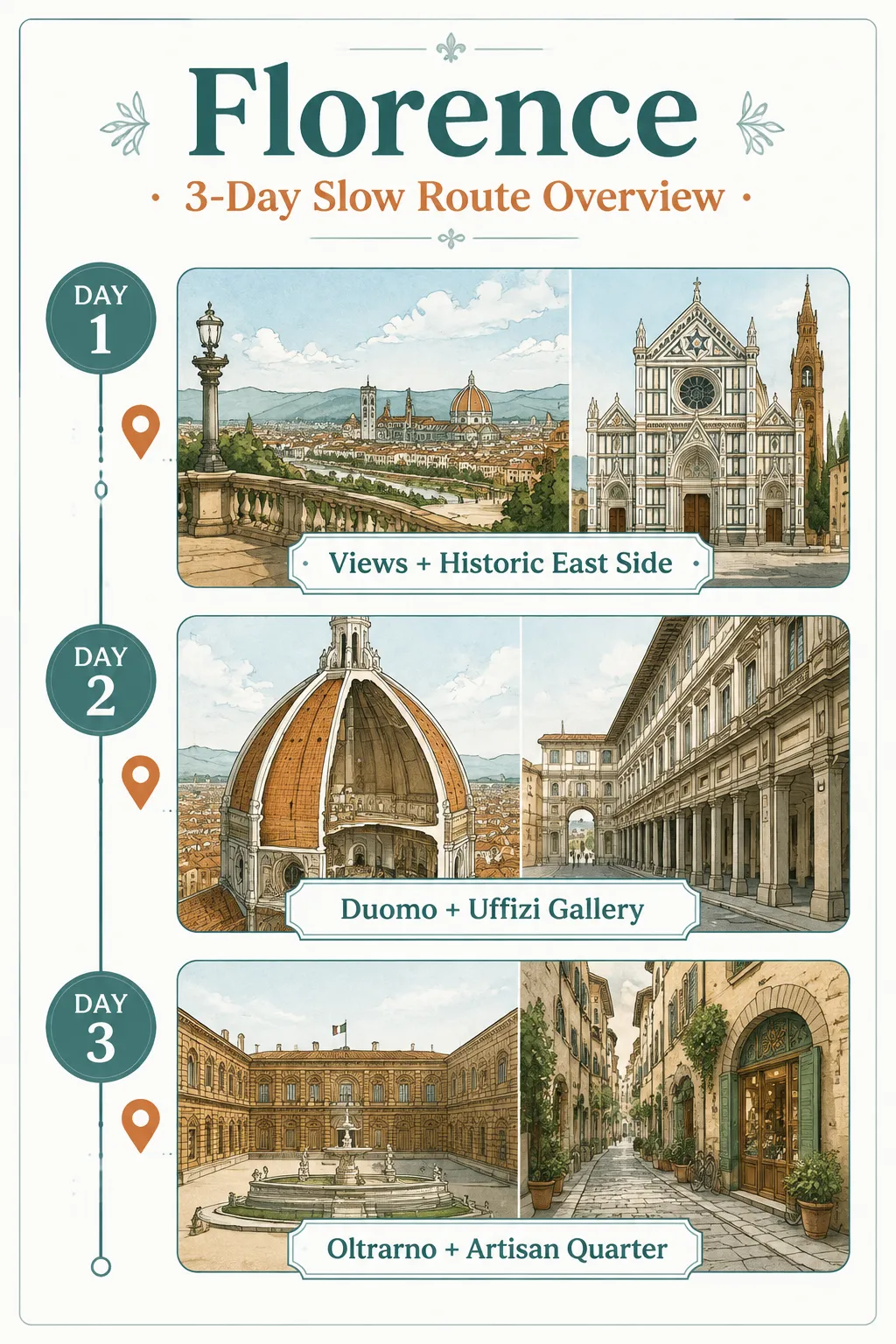
- 🌅 Day 1 focuses on Santa Croce, the east side, and the sunset view from Piazzale Michelangelo
- 🎨 Day 2 covers the Duomo complex, Uffizi, and Piazza della Signoria
- 🛍️ Day 3 is all about Oltrarno – Pitti Palace, Boboli Gardens, artisan shops, and a food tour
- 🏨 Stay in the centro storico or Oltrarno for the best walkability
- 🚆 Day trips to Siena or Tuscany hill towns work well as a bonus fourth day
- 💶 Budget roughly €150-200 per person per day for a mid-range experience in 2026
- ⏰ Arrive the evening before your first full day if possible – Florence rewards early mornings
- 📍 The “slow” philosophy means fewer sites per day, more time per site, and actual lunch breaks
Can You Really See Florence in Just 3 Days?
Yes – three days in Florence is genuinely enough to experience the city’s most important art, architecture, and neighborhoods without rushing. The key is being selective. Florence’s centro storico is compact, and most major sights cluster within a 20-minute walk of each other, so you spend less time in transit and more time actually looking at things.
According to Florence tourism planning resources, the average first-time visitor tries to pack 6-8 attractions per day and ends up exhausted and underwhelmed. The slow approach limits you to 2-3 anchors per day, which means you actually remember what you saw.
Florence has a population of roughly 362,000 residents but welcomes over 10 million tourists annually, making it one of the most visited cities in Europe. That density is exactly why slowing down works – you find the real city in the gaps between the famous sights.
If you have more time, check out our Tuscany Italy travel guide for first-time visitors for ideas beyond the city.
Florence Travel Tips Before You Arrive
Smart preparation makes the difference between a stressful trip and a great one. Here are the things worth knowing before you land in Italy.
Book these in advance – no exceptions:
- Uffizi Gallery tickets (book 2-4 weeks ahead in peak season)
- Accademia Gallery for the Statue of David (sells out fast)
- Brunelleschi Dome climb – timed entry, limited slots per hour
- Baptistery mosaics entry (part of the Duomo complex ticket)
Practical logistics:
- Florence’s main train station is Santa Maria Novella (SMN) – central and walkable to most hotels
- The city center is a ZTL (limited traffic zone) – don’t drive in unless your hotel is inside it
- Most museums close on Mondays – plan accordingly
- Sundays often mean free or reduced entry at state museums, but also bigger crowds
- The Mercato Centrale is open daily; Sant’Ambrogio market runs Tuesday through Saturday
What to pack for Florence specifically:
- Comfortable walking shoes – the cobblestones are beautiful and brutal
- A scarf or shoulder cover for churches
- A reusable water bottle – Florence has free drinking fountains (nasoni) throughout the city
One more thing: the best gelato spots are rarely the ones with the biggest signs. Gelateria dei Neri on Via dei Neri is a local favorite and worth finding on Day 1.
Where to Stay in Florence, Italy
The best neighborhoods to stay in Florence for a 3 day trip are the centro storico (historic center) and Oltrarno, depending on your travel style. Both put you within walking distance of every major sight on this itinerary.
Centro Storico – Stay here if you want to be steps from the Duomo, Piazza della Repubblica, and the Uffizi. It’s the most central option, but also the priciest and busiest. Expect noise from tourists until late evening.
Oltrarno – The south side of the Arno river has a more local feel. You’ll walk across Ponte Vecchio to reach the main sights, which adds about 10 minutes. In return, you get quieter streets, better restaurants, and the feeling of actually living in Florence rather than touring it.
Santa Croce area – Good mid-range hotels here, close to the basilica and Sant’Ambrogio market. Less polished than the center but very walkable.
Where to avoid staying: The area immediately around the train station (Santa Maria Novella) can feel impersonal and has higher petty theft rates. It’s fine for one night if you arrive late, but not ideal as a base for your full stay.
Budget range for 2026:
- Budget: €70-120/night (B&Bs, small guesthouses in Oltrarno)
- Mid-range: €140-220/night (boutique hotels in centro storico)
- Luxury: €280+/night (historic palazzi and five-star properties near the Arno)
Day 1 of Your Florence Itinerary: Santa Croce, Hidden Gems, and Epic Views
Day 1 of this Florence itinerary focuses on the eastern side of the city – the Basilica di Santa Croce, the Museo Nazionale del Bargello, and finishing with the famous sunset view from Piazzale Michelangelo. It’s a day that mixes major sights with quieter streets, and it sets the tone for the whole trip.
Morning: Basilica Santa Croce and the Bargello
Start at the Basilica Santa Croce when it opens at 9:30am. This is the largest Franciscan church in the world and the burial place of Michelangelo, Galileo, and Machiavelli. Budget 45-60 minutes here.
From there, walk 10 minutes to the Museo Nazionale del Bargello. This is Florence’s best-kept secret for sculpture lovers. The Bargello houses Donatello’s bronze David – the first freestanding nude male sculpture of the Renaissance – alongside works by Michelangelo and Ghiberti. Most visitors skip it entirely in favor of the Accademia. Don’t make that mistake.
The Bargello is part of the Museo Nazionale del Bargello network and typically has shorter queues than the Accademia, making it a smart morning choice.
Lunch in the Sant’Ambrogio Area
Head toward the Sant’Ambrogio Santa Croce neighborhood for lunch. The market at Piazza Sant’Ambrogio is where locals actually shop – it’s nothing like the tourist-facing Mercato Centrale. Grab a lampredotto sandwich (Florence’s famous tripe street food) from a market vendor, or sit down at one of the small trattorias on the surrounding streets.
Vini Vecchi Sapori on Via dei Magazzini is a tiny, cash-only lunch spot near Piazza della Signoria that’s beloved by locals. It gets packed by 12:30pm, so go early or late.
Afternoon: Wander and Slow Down
This is where the “slow Florence” philosophy earns its name. After lunch, resist the urge to tick off another museum. Instead, walk through the streets between Santa Croce and the Duomo. Duck into small churches – Orsanmichele on Via dei Calzaiuoli has extraordinary exterior niches with sculptures by Donatello and Ghiberti, and it’s free to enter.
Stop at a café for an espresso standing at the bar, the way Florentines do it. This is not a waste of time – it’s the whole point.
Sunset: Piazzale Michelangelo and San Miniato al Monte
Walk or take bus 13 from the center up to Piazzale Michelangelo about an hour before sunset. The panoramic view over Florence – the Duomo, the Arno, the terracotta rooftops stretching toward the Tuscan hills – is one of the best views in all of Europe.
From Piazzale Michelangelo, it’s a short uphill walk to the Basilica di San Miniato al Monte, one of the finest Romanesque churches in Italy. The monks here still sing Vespers at 5:30pm on weekdays – if your timing lines up, it’s worth staying for.
Dinner: Head back down to the center or Oltrarno. Il Latini on Via dei Palchetti is a classic Florentine trattoria with communal tables and a fixed menu – loud, fun, and very good. Book ahead.
Day 2: The Duomo Complex, Uffizi Gallery, and Piazza della Signoria
Day 2 is the big art day – the Duomo complex in the morning and the Uffizi Gallery in the afternoon. This is the most logistically demanding day, so having pre-booked tickets matters most here.
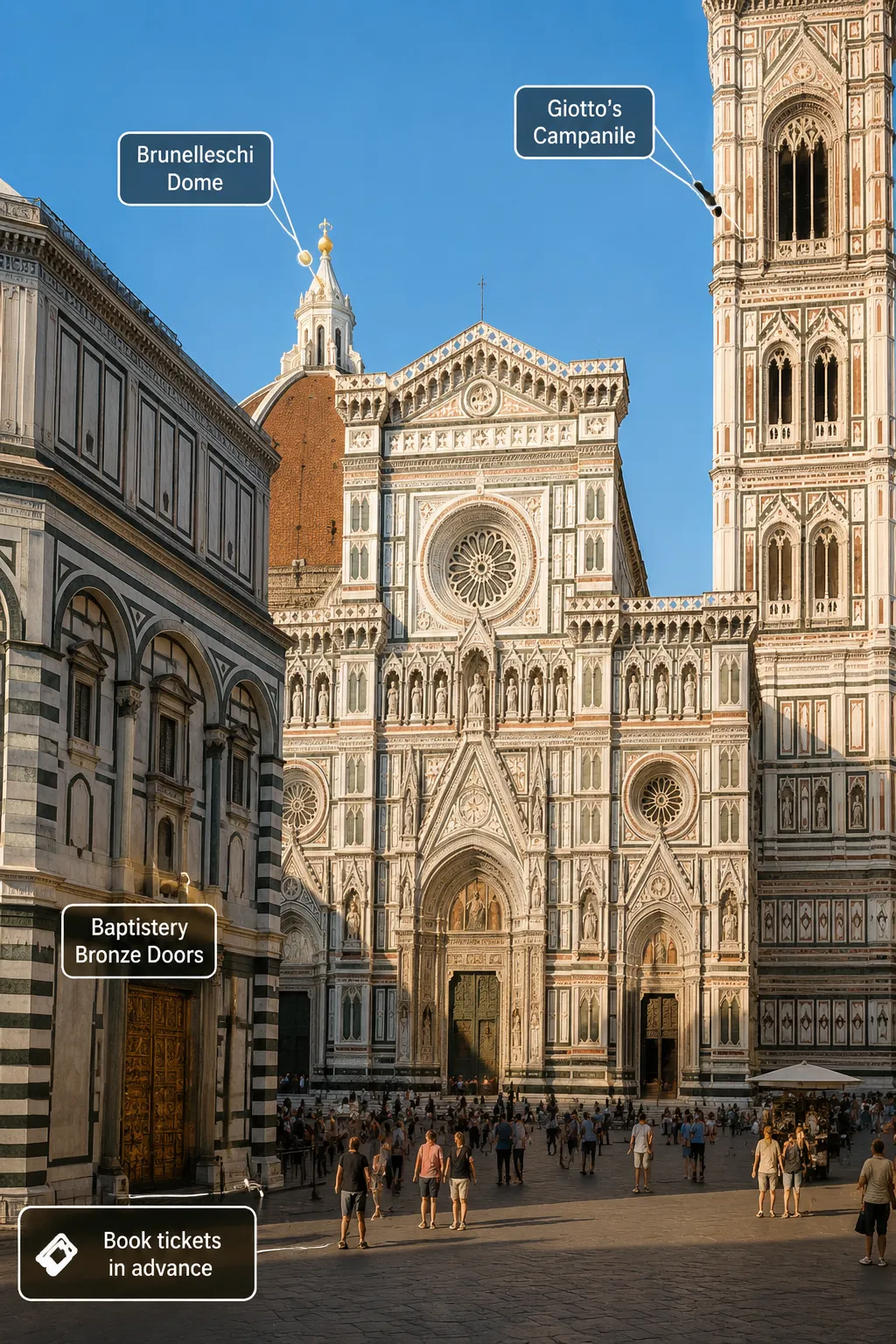
Morning: Climb Brunelleschi’s Dome and the Duomo Complex
Arrive at the Cathedral of Santa Maria del Fiore (the Duomo) at opening time, which is typically 8:15am for the dome climb. The Duomo complex ticket covers the cathedral Santa Maria del Fiore, the Baptistery, Giotto’s Campanile bell tower, the Crypt, and the Opera del Duomo Museum – all on one ticket.
The climb up Brunelleschi’s dome is 463 steps with no elevator. It takes 30-45 minutes up and down, and the view from the top is extraordinary. If heights aren’t your thing, the Campanile (Giotto’s bell tower) offers similar views with a slightly easier climb.
How many hours do you need for the Duomo and cathedral? Budget 2.5 to 3 hours for the full Duomo complex – dome climb, cathedral interior, Baptistery, and a quick look at the Opera del Duomo Museum. If you only have 90 minutes, prioritize the dome climb and the Baptistery bronze doors (the Gates of Paradise by Ghiberti are genuinely jaw-dropping).
Don’t miss the Baptistery interior – the Byzantine gold mosaic ceiling is one of the most stunning things in Florence and takes about 20 minutes to see properly.
Midday: Piazza della Repubblica and Lunch
After the Duomo complex, walk five minutes to Piazza della Repubblica. This is Florence’s main civic square, built on the site of the ancient Roman forum. It’s more modern-feeling than the medieval streets around it, but the historic cafés here (Caffè Gilli, Caffè Paszkowski) are worth a stop.
For lunch, head to the Mercato Centrale on Via dell’Ariento. The ground floor is a traditional food market; the upper floor is a food hall with pasta, pizza, lampredotto, and more. It’s busy but efficient, and the quality is genuinely good. Budget €12-18 per person for a solid lunch here.
Afternoon: Uffizi Gallery and Piazza della Signoria
The Uffizi Gallery is one of the world’s great art museums, and you need at least 2.5 hours to see it without rushing. The highlights are Botticelli’s “Birth of Venus” and “Primavera,” Leonardo da Vinci’s “Annunciation,” and Raphael’s portraits of the Medici.
The Uffizi houses over 1,700 paintings in its permanent collection, but you don’t need to see all of them. Pick up a floor map at the entrance and focus on rooms 10-14 (Botticelli), room 15 (Leonardo), and the Tribune.
After the Uffizi, walk directly into Piazza della Signoria. This outdoor sculpture gallery has been Florence’s political heart for centuries. The Palazzo Vecchio dominates one end; the Loggia dei Lanzi has free outdoor sculptures including a Cellini bronze and a Giambologna. It costs nothing and takes 20 minutes to walk through properly.
Dinner: The Oltrarno neighborhood across Ponte Vecchio has better-value restaurants than the centro storico. Walk across the bridge (stop to look at the jewelry shops) and explore the streets around Piazza Santo Spirito for dinner options.
Day 3: A Full Day in Oltrarno – Pitti Palace, Boboli Gardens, Shopping, and a Food Tour
Day 3 belongs entirely to Oltrarno, Florence’s south-bank neighborhood that has become the unofficial capital of slow travel in the city. This is where you’ll find artisan workshops, quieter piazzas, and the best food tour in Florence.
Morning: Accademia Gallery and the Statue of David
Start Day 3 at the Accademia Gallery when it opens at 8:15am. The Statue of David by Michelangelo is the main draw – and yes, it really is as powerful in person as everyone says. The scale surprises almost everyone: David stands 5.17 meters (17 feet) tall.
Beyond David, the Accademia also has Michelangelo’s unfinished “Prisoners” series, which many visitors find even more moving. Budget 60-90 minutes total.
Mid-Morning: Crossing to Oltrarno
Walk south through the centro storico and cross Ponte Vecchio into Oltrarno. This neighborhood – literally “beyond the Arno” – has a completely different energy from the tourist-heavy north bank. The streets around Via Maggio and Borgo San Jacopo are full of antique dealers, leather craftspeople, and small family restaurants.
Spend 30-45 minutes just walking. Look for the Medici Chapels if you didn’t visit them on Day 1 or 2 – they’re technically on the north side near San Lorenzo, but worth a detour for the Michelangelo-designed New Sacristy.
Late Morning: Pitti Palace and Boboli Gardens
The Pitti Palace is the largest palace in Florence and houses several museums including the Palatine Gallery, which has Raphael and Titian paintings in their original ornate rooms. It feels more like walking through a royal residence than a museum.
The Boboli Gardens behind the palace are one of the finest formal gardens in Italy. Budget 45-60 minutes to walk the main paths and get up to the belvedere for another view over Florence. The palace and gardens share a combined ticket.
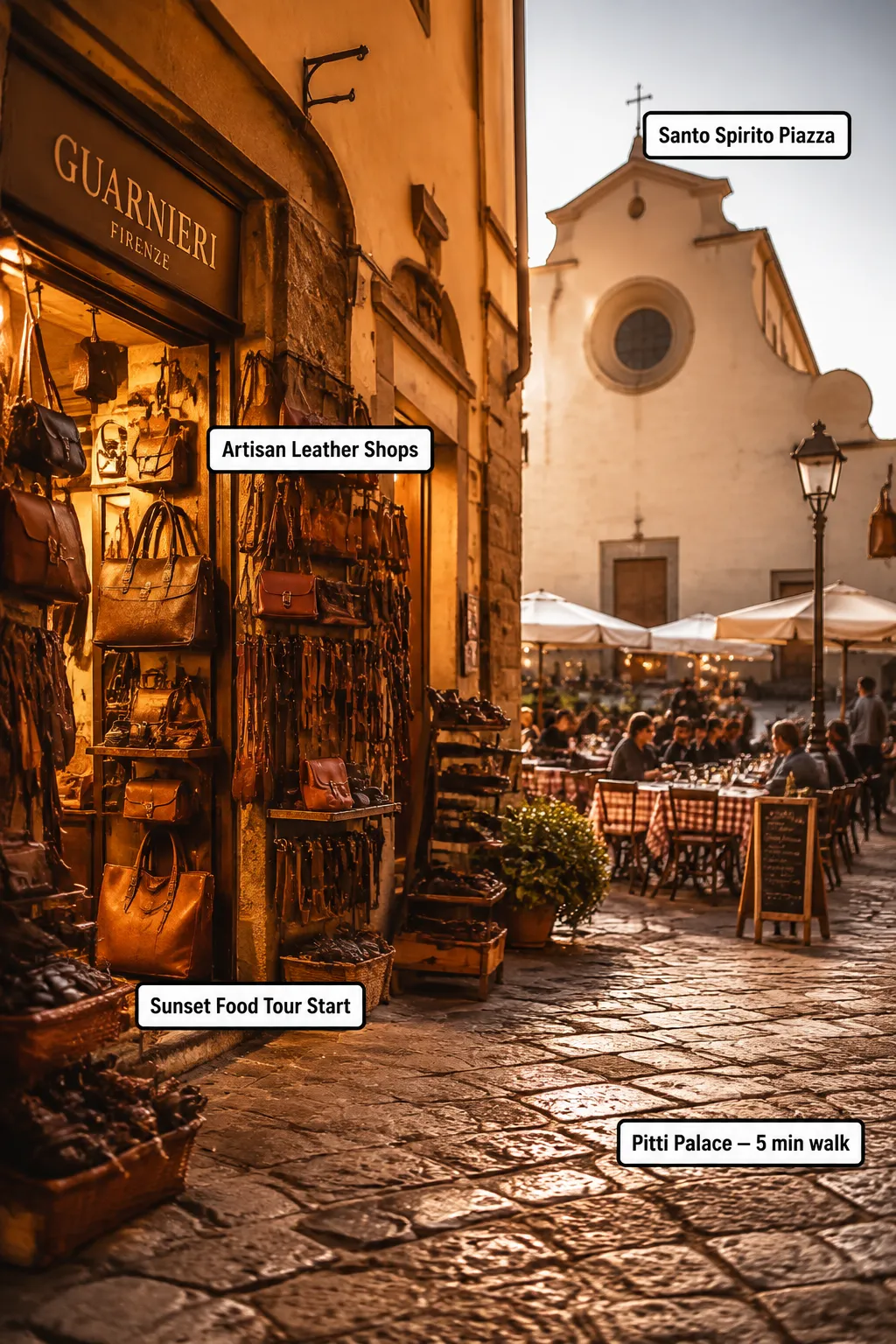
Afternoon: Artisan Shopping and the Food Tour Oltrarno
The streets of Oltrarno are the best place in Florence to buy things that aren’t mass-produced tourist souvenirs. Look for:
- Leather goods on Borgo San Jacopo and Via dello Sprone
- Handmade paper and stationery (Florentine marbled paper is a centuries-old craft)
- Ceramics from small workshops near Piazza Santo Spirito
- Vintage and antique finds along Via Maggio
In the late afternoon, join a sunset food tour Oltrarno – these 3-hour walking tours typically cover 5-7 food stops including wine, cured meats, cheese, street food, and gelato. They run from about 5pm and finish around 8pm, which means dinner is essentially included.
The food tour oltrarno experience is genuinely one of the best ways to end a Florence trip. You’ll try things you wouldn’t have found on your own, and the guides tend to be local food obsessives who know the neighborhood well.
Evening: Santo Spirito at Night
End the day at Piazza Santo Spirito. This is the most local-feeling piazza in Florence – students, artists, and neighborhood residents gather here in the evenings. Grab a final glass of Chianti at one of the bars facing the church and take a moment to appreciate that you’ve spent three days actually experiencing Florence, not just photographing it.
Uffizi Gallery vs Accademia: Which Should You Prioritize?
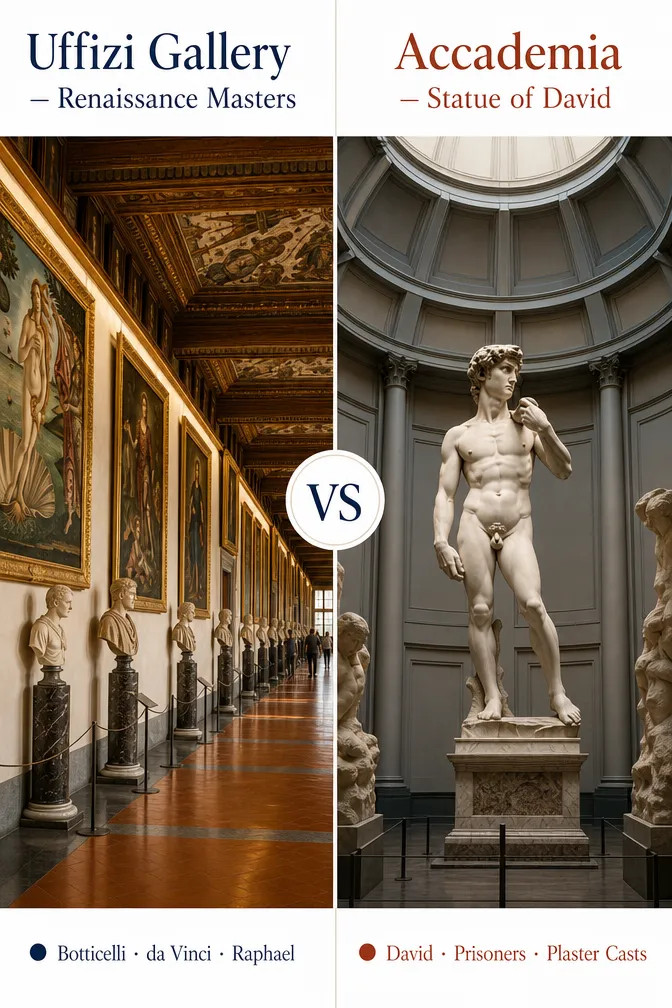
If you only have time for one, choose the Uffizi – it’s the more comprehensive experience and covers a broader sweep of Renaissance art. But for a 3 day Florence itinerary, you have time for both, and they serve completely different purposes.
Choose the Uffizi if you want:
- Botticelli, Leonardo, Raphael, Titian, and Caravaggio under one roof
- A full survey of Italian Renaissance painting
- 2.5-3 hours of immersive gallery time
Choose the Accademia if you want:
- A single, overwhelming masterpiece (Michelangelo’s David)
- A shorter, more focused visit (90 minutes is plenty)
- The emotional impact of seeing one of the world’s most famous sculptures in person
The practical answer for most travelers: do the Accademia on Day 3 morning (it opens at 8:15am and crowds are lighter early), and the Uffizi on Day 2 afternoon with a pre-booked timed entry. Both are essential to a complete Florence experience.
According to detailed Florence itinerary planning guides, visitors who skip one of these two museums consistently report feeling like their trip was incomplete.
Best Day Trips from Florence If You Have More Time
If you have a fourth day or want to extend your trip, Florence is one of the best bases in Europe for day trips. The most popular options are Siena (1.5 hours by bus), San Gimignano (1.5 hours), Lucca (1.5 hours by train), and the Chianti wine region (best by car or tour).
Siena is the top recommendation for most travelers. The medieval city center is a UNESCO World Heritage Site, and the Piazza del Campo is one of the most beautiful public squares in Italy. Take the SITA bus from Florence’s bus station near Santa Maria Novella – it’s cheaper and more direct than the train.
Day trips work best on Day 4, not as a replacement for any of the three core Florence days. The city itself has enough to fill three days comfortably, and rushing out of Florence to see Tuscany on Day 2 means you’ll miss things you’ll regret.
For a deeper look at the region, our Tuscany Italy travel guide covers the best towns, drives, and food experiences across the whole region.
If you’re planning a broader Italy trip, check out our guide to what to see in Rome Italy for first timers and our roundup of hidden gems in Italy that feel absolutely magical.
How to Avoid Crowds in Florence: Practical Tips for 3 Days
Florence is one of the most visited cities in Europe, and crowds at major sights can genuinely affect your experience. The good news is that the slow Florence approach naturally reduces crowd exposure.
The single most effective strategy: arrive at every major site when it opens. The Uffizi, Accademia, and Duomo dome all have significantly smaller crowds in the first 90 minutes of the day. By 10:30am, tour groups have arrived in force.
Specific crowd-avoidance tips:
- Visit the Bargello instead of (or before) the Accademia – it has the same quality of sculpture with a fraction of the visitors
- Walk Ponte Vecchio before 8am or after 9pm – it’s genuinely peaceful at those times
- Eat lunch at 11:45am or 1:30pm rather than at noon – restaurant queues are much shorter
- Avoid Piazza della Signoria on weekend afternoons in July and August
- The Nomado travel guide for Florence recommends booking museum tickets at least 2 weeks ahead during peak season (April-October)
Best time of year to visit Florence for 3 days:
- April-May: Ideal. Warm, green, manageable crowds, long daylight hours
- September-October: Excellent. Harvest season, beautiful light, slightly cooler
- November-March: Quiet and cheap, but some attractions have reduced hours and the weather is cold and wet
- June-August: Hot (Florence hits 35°C/95°F regularly in July), very crowded, but also the most festive
Florence 3 Days: Budget vs. Luxury – How to Plan Your Spending
A 3 day trip to Florence can cost anywhere from €120 to €600+ per person per day depending on how you travel. Here’s a realistic breakdown for 2026.
Budget traveler (€120-160/day per person):
- Accommodation: hostel dorm or budget B&B (€30-50/night)
- Museum entry: combined passes and free Sundays where available
- Food: market lunches, aperitivo happy hours, pizza by the slice
- Transport: walk everywhere (Florence’s center is very compact)
Mid-range traveler (€180-280/day per person):
- Accommodation: boutique hotel in Oltrarno or centro storico (€130-200/night)
- Museum entry: individual tickets for Uffizi, Accademia, Duomo complex (~€60-80 total)
- Food: sit-down lunches at trattorias, wine with dinner, one food tour (~€65)
- Transport: occasional taxi or bus
Luxury traveler (€350+/day per person):
- Accommodation: historic palazzo hotel or five-star property (€280-500+/night)
- Museum entry: private guided tours at Uffizi and Accademia
- Food: Michelin-starred dinners, private food experiences
- Extras: private driver for day trips, exclusive access experiences
The Dream Trip app’s 2026 Florence itinerary guide notes that museum entry prices have increased in 2025-2026, with the Uffizi now charging €25 for standard adult entry and the Accademia at €20.
One money-saving tip that actually works: the combined Duomo complex ticket (covering the dome, cathedral, Baptistery, Campanile, crypt, and museum) costs €30 and represents excellent value compared to buying individual entries.
What “Slow Travel” in Florence Actually Means
Slow travel in Florence means treating the city as a place to inhabit temporarily, not a list of attractions to process. It’s a practical philosophy, not just a vibe.
In practice, it means:
- One anchor attraction per half-day, not three
- Sitting at a café for 20 minutes between sights instead of walking straight to the next one
- Eating where locals eat, which requires walking one or two streets away from any famous landmark
- Revisiting a favorite spot – maybe the same piazza at different times of day
- Talking to people – the artisans in Oltrarno, the market vendors at Sant’Ambrogio, the barista who makes your morning espresso
The slow approach also makes logistical sense. Florence’s museums are dense and visually overwhelming. Seeing the Uffizi and the Accademia on the same day is technically possible but leaves most people unable to remember either clearly. Spacing them out – as this itinerary does – means you actually absorb what you see.
This philosophy applies equally well to other destinations. Our Piedmont Italy itinerary takes the same approach to a less-visited region of northern Italy.
Common Mistakes Tourists Make on a Florence Itinerary
Most Florence itinerary mistakes come from trying to do too much. Here are the ones worth actively avoiding.
Mistake 1: Not booking tickets in advance.
The Uffizi and Accademia sell out weeks ahead in peak season. Showing up without tickets means either paying a premium to a ticket scalper or missing the museum entirely. Book online before you travel.
Mistake 2: Spending too much time near the Duomo.
The Duomo area is beautiful, but it’s also the most crowded square in Florence. Many visitors spend their whole trip within 200 meters of it. The best parts of Florence – Oltrarno, Sant’Ambrogio, the Bargello – are a 10-15 minute walk away.
Mistake 3: Eating at restaurants on Piazza della Signoria or directly facing the Duomo.
These are almost universally overpriced and mediocre. Walk one block in any direction and the quality and value improve dramatically.
Mistake 4: Skipping the Bargello.
The Museo Nazionale del Bargello is one of the world’s great sculpture museums and has shorter queues than almost any other major sight in Florence. It’s a 45-minute visit that punches well above its weight.
Mistake 5: Planning a day trip on Day 1 or Day 2.
Day trips are great, but they work best as an add-on to a solid Florence base. Rushing to Siena on Day 2 means you’ll miss the slower, more rewarding parts of the city. Keep day trips for Day 4 if you have it.
For a broader list of things to avoid across Italy, see our guide to 15 mistakes to avoid in Italy.
Florence 3 Day Itinerary With Kids and Families
Florence works well for families, but the itinerary needs some adjustments. Young children will not enjoy 3-hour museum visits, but they will love gelato, piazzas, and the Boboli Gardens.
Family-friendly adjustments:
- Swap the full Uffizi visit for a 90-minute “highlights only” tour with a family guide – several companies offer these specifically for children
- The Boboli Gardens are excellent for kids – lots of space to run, fountains, and outdoor sculptures
- Piazza della Repubblica has a historic carousel that children love
- The climb up Brunelleschi’s dome is genuinely exciting for older kids (8+) but not suitable for young children or anyone with claustrophobia
- Gelateria dei Neri is a reliable stop for families – it’s a short walk from Santa Croce and has a wide range of flavors
Pacing for families: plan for a rest period between 1pm and 3pm, especially in summer. Florence gets very hot, and Italian culture generally supports a midday slowdown. Use this time for lunch, gelato, and a quiet hour at the hotel before the afternoon activity.
The Bon Traveler Florence itinerary guide recommends building in at least one “free afternoon” per 3-day trip for families – a piazza, a park, or a market visit with no agenda.
What Else to See in Florence If You Have More Time
If you spend days in Florence beyond the core three, these are the sights worth adding to your itinerary.
- Medici Chapels (Cappelle Medicee) – Michelangelo’s New Sacristy is one of his greatest architectural achievements
- San Miniato al Monte – if you didn’t catch it at sunset on Day 1, go back
- Museo dell’Opera del Duomo – the original Ghiberti Gates of Paradise are here (the ones on the Baptistery are replicas)
- Palazzo Vecchio interior – most visitors only see it from Piazza della Signoria; the interior is surprisingly good
- Fiesole – a small hill town 20 minutes by bus from Florence with Roman ruins and panoramic views
- Giardino delle Rose – a free rose garden near Piazzale Michelangelo with great city views
For hidden and lesser-known spots, our what to see in Florence Italy hidden gems guide covers the city’s overlooked corners in detail.
FAQ: 3 Day Itinerary Florence Italy
Is there enough to do in Florence for 3 days?
Yes, absolutely. Florence has enough world-class art, architecture, food, and neighborhood character to fill three full days without any padding. The Duomo complex, Uffizi, Accademia, Bargello, Oltrarno, Pitti Palace, and Piazzale Michelangelo alone represent a full itinerary. A slow approach means you’ll finish the trip feeling satisfied rather than rushed.
What should you not miss in Florence, Italy?
The non-negotiables are: climbing Brunelleschi’s Dome at the cathedral Santa Maria del Fiore, seeing Botticelli’s paintings at the Uffizi Gallery, standing in front of Michelangelo’s David at the Accademia, walking across Ponte Vecchio at dawn or dusk, and spending at least one evening in Oltrarno. The Bargello museum is the most underrated must-see that most visitors skip.
Where to avoid staying in Florence?
Avoid the immediate area around Santa Maria Novella train station if you want a more authentic Florence experience – it’s convenient but impersonal and has a higher incidence of petty theft. Also avoid hotels directly on the main tourist drag between the Duomo and Piazza della Signoria if budget matters; they charge a premium for location and the noise level is high. Oltrarno and the Sant’Ambrogio area offer better value and a more local feel.
How many days do you really need in Florence, Italy?
Three days is the realistic minimum for a first-time visitor who wants to see the major sights without rushing. Two days is possible but means making hard choices between the Uffizi and Accademia. Four days is the ideal for travelers who want to add a day trip to Siena or Tuscany. Five days or more suits people who want to go deep on art history or explore the surrounding region extensively.
Conclusion: The Slow Florence Route Is Worth It Every Time
The best version of a 3 day itinerary Florence Italy trip isn’t the one that covers the most ground. It’s the one where you remember every meal, every view, and every moment of standing in front of something extraordinary.
The slow Florence route – anchored by the Duomo, Uffizi, Accademia, and Oltrarno, with deliberate gaps built in for wandering and eating – gives you the full picture of why this city has been drawing visitors from across Europe and the world for centuries.
Your actionable next steps:
- Book Uffizi, Accademia, and Duomo dome tickets as soon as your travel dates are confirmed
- Choose accommodation in Oltrarno or centro storico based on your budget
- Plan Day 1 around Santa Croce and the Piazzale Michelangelo sunset
- Reserve a table at Il Latini for your first dinner
- Build in at least one unscheduled afternoon – the best Florence moments tend to be unplanned
If you’re building a broader Italy trip around your Florence visit, our what to see in Rome Italy for first timers guide and our 15 mistakes to avoid in Italy are the logical next reads.
Florence rewards the traveler who slows down. Give it three good days, and it’ll give you memories that last considerably longer.