Last updated: September 26, 2026
Quick Answer: A 7-day Europe Christmas market itinerary works best when you anchor in one or two major cities – Frankfurt, Strasbourg, or Vienna – and take short train rides to smaller markets nearby. Most markets run from late November through December 24, with some extending into early January. You don’t need a car, a tour guide, or months of planning to pull this off.
Key Takeaways
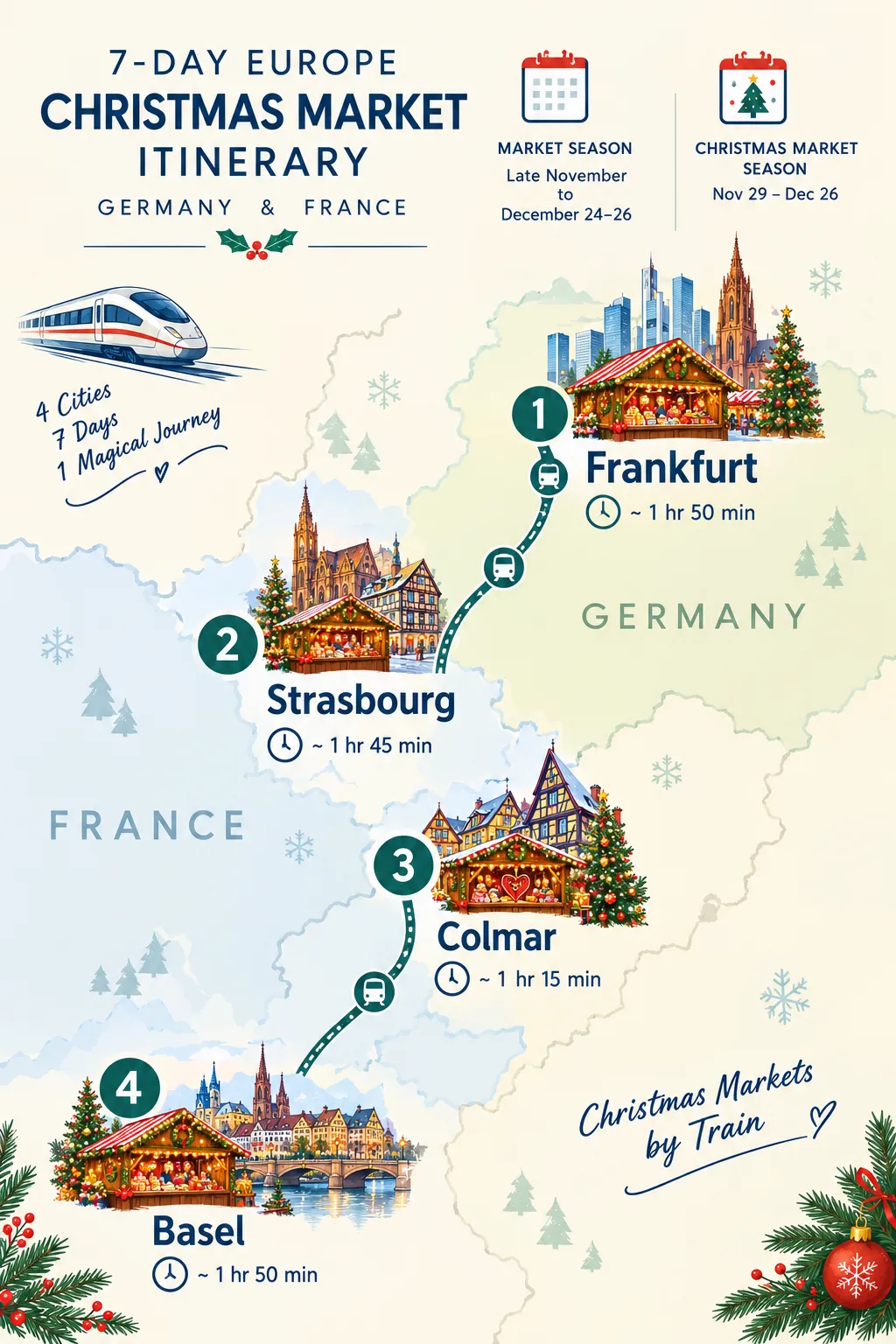
- A classic first-timer route is Frankfurt → Strasbourg → Colmar → Basel, doable entirely by train with short hops under two hours
- Most major European Christmas markets open in late November and close around December 24-26
- Seven days is enough to visit 4-6 markets across two or three countries
- Strasbourg is widely considered the best single base for first-timers, with multiple markets within 30 minutes
- Budget roughly €100-€150 per person per day (accommodation, food, transport, and shopping)
- Train travel beats driving for first-timers – connections are frequent and stress-free
- German, Austrian, and French markets each have a distinct character worth comparing
- Early December weekdays are less crowded and often cheaper than weekends
- Pack waterproof boots – cobblestones plus winter rain or snow is a real combination
- Some markets like Prague, Warsaw, and Zagreb run into early January, giving you more flexible timing
What Are the Best Christmas Markets in Europe to Visit?
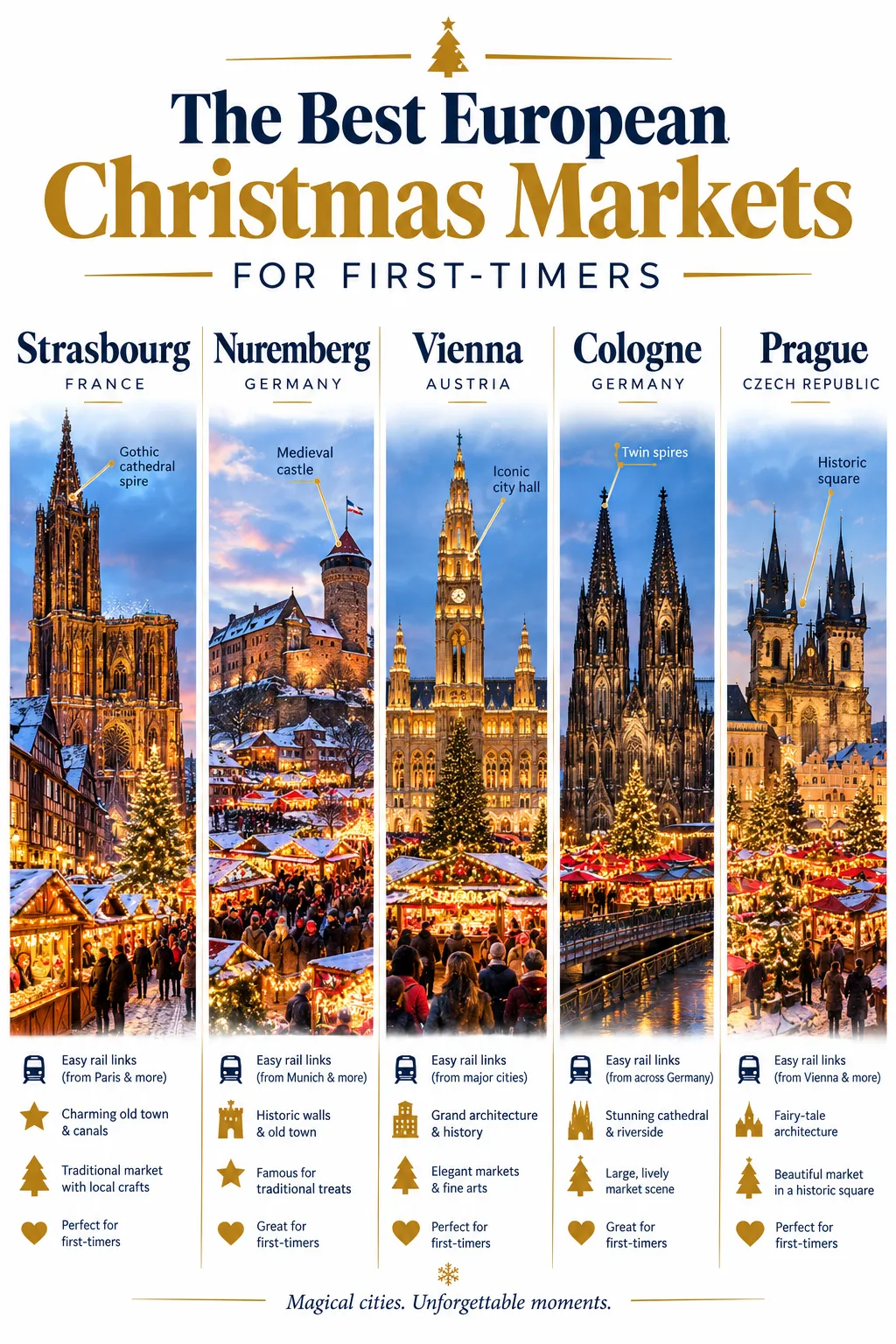
The best European Christmas markets for first-timers are Strasbourg, Nuremberg, Vienna, Cologne, and Prague. These cities combine easy transport links, iconic settings, and enough variety to fill a full day each.
According to Time Out’s best Christmas markets in Europe ranking, top picks include Vienna, Strasbourg, and Prague for atmosphere and accessibility. The Points Guy also highlights Vienna and Nuremberg as standout choices for first-time visitors.
Here are the markets most recommended for a first trip:
- Strasbourg, France – Called the “Capital of Christmas,” with markets spread across the old city
- Nuremberg, Germany – One of the oldest and most famous, known for handcrafted toys and Lebkuchen
- Vienna, Austria – Multiple markets around the Rathaus and Schönbrunn Palace
- Cologne, Germany – Six separate markets, including one at the foot of the cathedral
- Prague, Czech Republic – Old Town Square market with a fairy-tale backdrop
- Colmar, France – A smaller, storybook Alsatian town that feels like a film set
For a broader look at all your options, check out this guide to 17 magical Christmas markets in Europe before you finalize your route.
How Many Days Do You Need for a European Christmas Market Trip?
Seven days is the sweet spot for a first-time Europe Christmas market itinerary. It gives you enough time to visit 4-6 markets without rushing, and still leaves room for a slow morning with a coffee and a pastry.
You can technically do a long weekend (3-4 days) if you pick one city and do day trips. But a full week lets you cross borders, compare different market styles, and actually enjoy the experience rather than race through it.
A realistic 7-day breakdown:
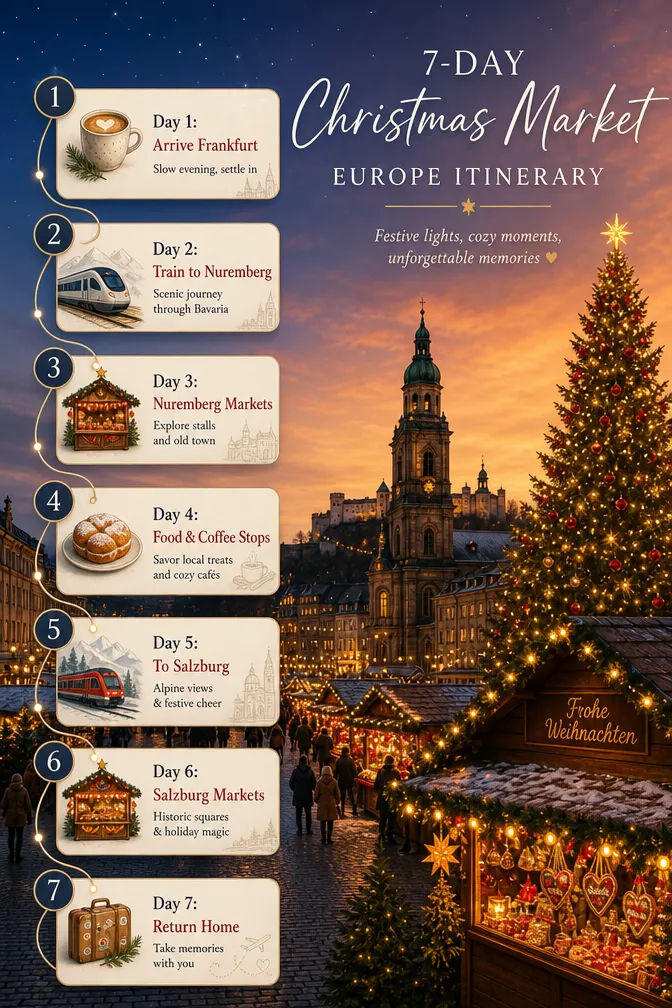
- Days 1-2: Arrive in Frankfurt, explore Römerberg Christmas market
- Day 3: Train to Strasbourg (roughly 2 hours), evening at the main market
- Day 4: Day trip to Colmar or Eguisheim from Strasbourg
- Day 5: Explore more of Strasbourg or hop to Basel
- Day 6: Basel or Zurich markets
- Day 7: Travel home or extend to Munich
This Frankfurt → Strasbourg → Colmar → Basel loop is promoted as the classic “unhurried” route for newcomers, combining Germany, France, and Switzerland in one manageable trip.
Christmas Market Itinerary 7 Days Europe: Which Cities Work Best Together?
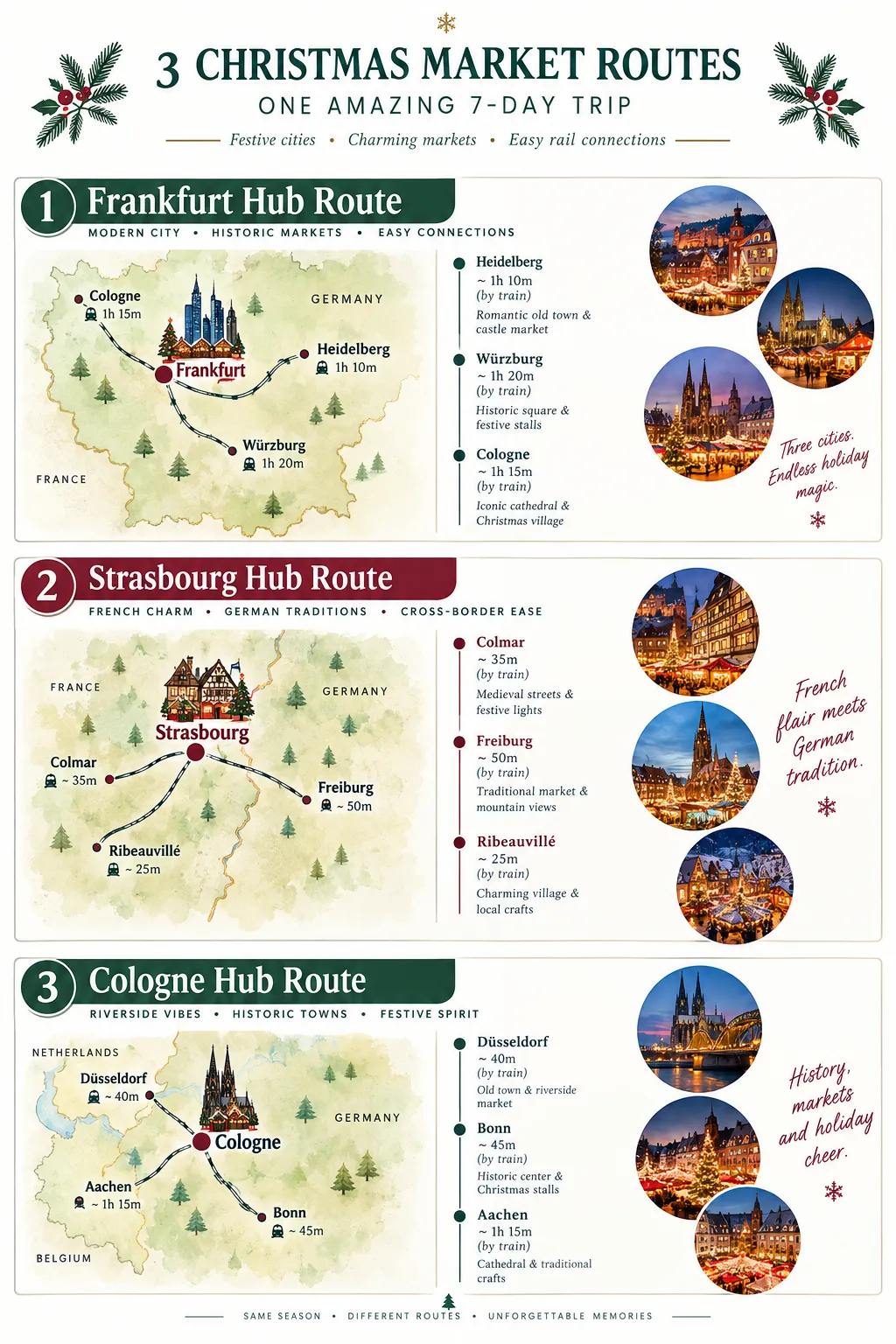
The best 7-day Europe Christmas market itinerary pairs a major hub city with 2-3 smaller nearby destinations. Frankfurt, Strasbourg, and Cologne each work well as anchor points because they have excellent rail connections in multiple directions.
Here are three proven 7-day routes for first-timers:
Route 1 – The Alsace Classic (France + Germany + Switzerland)
Frankfurt (2 nights) → Strasbourg (2 nights) → Colmar day trip → Basel (1 night) → Zurich (1 night)
Route 2 – The German Heartland
Frankfurt (1 night) → Nuremberg (2 nights) → Rothenburg ob der Tauber day trip → Munich (2 nights)
Route 3 – The Rhine and Belgium Loop
Cologne (2 nights) → Aachen day trip → Brussels (2 nights) → Bruges or Ghent day trip
All three routes use trains exclusively and keep daily travel under two hours. Route 1 is the most popular for absolute beginners because Strasbourg alone has multiple distinct markets within walking distance.
If you want to extend your trip beyond Christmas markets, this 1-month Central Europe itinerary shows how to build a longer route around the same region.
What’s the Difference Between German, Austrian, and French Christmas Markets?
German, Austrian, and French markets each have a distinct personality. Knowing the difference helps you choose which to prioritize – and what to eat.
German markets are the archetype: wooden stalls, carved nutcrackers, Glühwein (mulled wine) served in collectible mugs, and Lebkuchen (spiced gingerbread). Nuremberg’s Christkindlesmarkt is the most famous, dating back to the 16th century.
Austrian markets lean more elegant. Vienna’s Rathausplatz market is theatrical, with baroque architecture as a backdrop, punch tents instead of Glühwein stalls, and a strong tradition of handmade glass ornaments.
French Alsatian markets feel intimate and village-like. Strasbourg and Colmar serve vin chaud, bredele cookies, and tarte flambée. The half-timbered buildings and canal reflections make them the most photogenic of the three.
Belgian markets add waffles, frites, and often an ice rink. Brussels and Bruges both run large markets with a festive, social atmosphere.
“The best first-timer strategy is to experience at least two of these styles in one trip – the contrast makes each one more memorable.”
When Do European Christmas Markets Open and Close?
Most European Christmas markets open in late November – typically the last week – and close on December 24 or 26. Some extend into early January.
The Post Office Travel Money Christmas Markets Report confirms that markets in Berlin, Vienna, Prague, Budapest, Riga, Warsaw, and Zagreb typically run from mid-to-late November through Christmas, with Prague, Warsaw, and Zagreb sometimes extending to early January.
Key opening windows:
| City | Typical Opening | Typical Closing |
|---|---|---|
| Strasbourg | Late November | December 24 |
| Nuremberg | Late November | December 24 |
| Vienna | Mid-November | December 26 |
| Prague | Late November | Early January |
| Cologne | Late November | December 23 |
| Zagreb | Late November | January 7 |
| Brussels | Late November | Early January |
If your work schedule only frees up between Christmas and New Year’s, Prague, Warsaw, and Zagreb are your best bets – all three keep their markets running into the new year.
How to Get Between European Christmas Markets by Train
Train travel is the easiest and most stress-free way to move between markets for first-timers. Most key routes take under two hours, and you don’t need to book far in advance outside of peak weekends.
Key journey times to know:
- Frankfurt to Nuremberg: roughly 2 hours by ICE high-speed train
- Strasbourg to Colmar: about 30 minutes by regional train
- Cologne to Aachen: around 1 hour
- Nuremberg to Munich: about 1 hour by ICE
A detailed European Christmas market itinerary guide from Bon Traveler recommends booking ICE tickets in advance for the Frankfurt-Nuremberg-Munich corridor, especially on Friday afternoons and Sunday evenings in December.
Rail pass vs. point-to-point tickets:
- If you’re doing 5+ train journeys across multiple countries, a Eurail pass can save money
- For a focused 2-country route (Germany + France), point-to-point tickets often work out cheaper
- Always check the Deutsche Bahn (DB) website for German routes and SNCF for French legs
Car rental is an option for routes like Frankfurt → Cologne → Aachen → Monschau, but it’s better suited to repeat visitors who are comfortable driving in European cities. For first-timers, stick to trains.
What to Pack for a Week at European Christmas Markets
Pack for cold, wet, and cobblestone conditions. That’s the honest summary.
The non-negotiables:
- Waterproof ankle boots with grip – cobblestones get slippery when wet or icy
- Thermal base layers – you’ll be standing outside for hours
- A compact crossbody bag – keeps your hands free and reduces pickpocket risk
- Foldable tote bag – for market purchases (wooden ornaments, food, gifts)
- Power bank – cold weather drains phone batteries fast
- Small umbrella or rain poncho – December in Europe means rain as often as snow
What to skip:
- Heavy suitcases – you’ll be dragging them over cobblestones between train stations
- High heels or dress shoes – save them for a restaurant dinner, not market browsing
- Too many “just in case” outfits – pack light and do a quick laundry mid-week
For a broader European packing reference, this 2-week Europe spring packing guide covers layering strategies that apply to winter travel too.
Which European Christmas Markets Have the Best Food and Drinks?
Strasbourg and Nuremberg consistently top the list for food. Strasbourg offers tarte flambée, bredele, and vin chaud. Nuremberg is famous for its Bratwurst and Lebkuchen.
Best food by market:
- Nuremberg – Nuremberger Bratwurst (small grilled sausages), Lebkuchen, Glühwein
- Strasbourg – Tarte flambée, foie gras, bredele cookies, vin chaud
- Vienna – Kaiserschmarrn (shredded pancake), Punsch (hot punch), roasted chestnuts
- Brussels – Belgian waffles, speculoos, hot chocolate, frites
- Prague – Trdelník (chimney cake), svařák (Czech mulled wine), roasted pork
Budget roughly €10-€20 per person for a proper market meal with a drink. It adds up across a week, so factor it into your daily spending.
Are European Christmas Markets Worth the Cost and Crowds?
Yes – for most travelers, the experience is worth both the cost and the crowds, especially if you time your visit well. The atmosphere at a well-chosen market is genuinely unlike anything else in Europe.
The honest caveats:
- Weekends in early December are the busiest – if you can go on weekdays, do it
- Prices at markets are higher than supermarkets, but you’re paying for the experience and handmade quality
- Smaller markets like Colmar or Eguisheim offer the same magic with far fewer crowds than Nuremberg or Vienna
Kempinski’s guide to the best Christmas markets in Europe recommends pairing a flagship city market with at least one smaller village market to balance the experience.
If you’re traveling with family, the 15 best Christmas getaways for families has specific tips on which markets work best with kids in tow.
How Much Money Should You Budget for a European Christmas Market Week?
A realistic budget for a 7-day Europe Christmas market trip is €700-€1,050 per person, excluding flights. That covers accommodation, food, transport, and moderate shopping.
Rough daily breakdown:
- Accommodation: €60-€100/night (mid-range hotel or guesthouse)
- Food and drinks: €30-€50/day (mix of market food and one sit-down meal)
- Transport: €15-€30/day (trains, trams, occasional taxi)
- Market shopping/activities: €20-€40/day
Ways to keep costs down:
- Book accommodation 6-8 weeks ahead – December prices spike fast
- Travel on weekdays rather than weekends
- Use a Eurail pass if crossing three or more countries
- Eat your main meal at a market stall rather than a restaurant
The cheapest time to visit is the first week of December on weekdays. The most expensive is the weekend of December 10-12, when most markets are at peak attendance.
Is It Better to Book a Guided Tour or Plan Your Own Christmas Market Trip?
For most first-timers, a self-guided rail trip is better value and more flexible than a guided tour. But guided tours make sense in specific situations.
Choose a guided tour if:
- You want zero planning stress
- You’re traveling solo and want a built-in group
- You prefer a fixed itinerary with accommodation included
Plan your own trip if:
- You want to linger longer at markets you love
- You’re comfortable booking trains and hotels online
- You want to mix market days with other sightseeing
The Seven Corners Christmas in Europe itinerary guide notes that self-guided travelers on the Frankfurt-Nuremberg-Munich corridor can replicate most guided tour routes for significantly less cost by booking ICE trains in advance.
If you’re new to European solo travel, also check out 17 magical things to do in London at Christmas – London makes an easy warm-up stop before heading to the continent.
Can You Do Multiple Christmas Markets in One Week?
Yes – visiting 4-6 markets in one week is completely realistic. The key is keeping travel days short and not over-scheduling.
A common mistake is booking a different city every night. That burns time and energy on logistics. Instead:
- Use 2-3 base cities and do day trips from each
- Limit yourself to one new market per day – two if they’re close together
- Build in one slow afternoon mid-week to recharge
The Strasbourg base strategy works especially well: you can visit Colmar, Eguisheim, Kaysersberg, and Riquewihr all as day trips from Strasbourg, returning each evening to the same hotel. That’s four distinct markets without changing accommodation once.
FAQ
When is the best time to visit European Christmas markets?
The first two weeks of December on weekdays offer the best balance of atmosphere and manageable crowds. Weekends from December 8-17 are the busiest across all major markets.
Do I need to speak German or French to enjoy the markets?
No. English is widely spoken at market stalls in all major cities. Smaller village markets may have less English, but pointing and smiling works fine.
How do I get a Eurail pass?
Buy directly at eurail.com before your trip. A 7-day pass within one country (Germany, for example) or a multi-country pass both work. Compare it against point-to-point ticket prices for your specific route first.
Are Christmas markets free to enter?
Yes – almost all European Christmas markets are free to enter. You only pay for food, drinks, and items you buy.
What currency do I need at Christmas markets?
Most markets in Germany, France, Austria, and Belgium accept euros. Some stalls in smaller markets prefer cash, so carry €50-€100 in small bills.
Is Prague or Vienna better for a first-time Christmas market visit?
Both are excellent. Vienna has more markets spread across the city and a grander setting. Prague is slightly cheaper and the Old Town Square market is more compact and walkable. Choose Vienna if budget is flexible; Prague if you want a more intimate first experience.
Can I visit Christmas markets after Christmas Day?
Yes – Prague, Warsaw, Brussels, and Zagreb all run markets into late December or early January. Zagreb’s market typically runs until around January 7.
What’s the best way to avoid pickpockets at Christmas markets?
Use a crossbody bag worn in front of your body, keep your phone in an inside pocket, and be extra alert in crowded areas around market entrances and mulled wine stalls.
Are Christmas markets suitable for children?
Yes – most markets have carousels, ice rinks, and child-friendly food stalls. Vienna and Cologne are particularly family-friendly.
How far in advance should I book hotels near Christmas markets?
Book at least 6-8 weeks ahead for December dates, especially in Strasbourg, Nuremberg, and Vienna. Prices and availability get difficult after mid-October.
Conclusion
A 7-day Europe Christmas market itinerary is one of the most rewarding winter trips you can take as a first-timer. The combination of glowing lights, warm drinks, handcrafted gifts, and medieval architecture is genuinely hard to replicate anywhere else.
Your next steps:
- Pick your base city – Strasbourg, Frankfurt, or Vienna all work brilliantly
- Choose your route – the Frankfurt → Strasbourg → Colmar → Basel loop is the easiest starting point
- Book accommodation 6-8 weeks ahead – especially for December weekends
- Sort your rail tickets – check ICE train options on Deutsche Bahn and compare against a Eurail pass
- Pack light, pack warm, pack waterproof
Whether you spend a week in Alsace or loop through Bavaria and Switzerland, the magic of these markets is real – and very much worth the trip. Start planning now so December doesn’t sneak up on you.