Last updated: August 30, 2026
Most travelers waste their personal item allowance without realizing it. A well-planned personal item packing list can carry everything you need for a weekend trip – or even a full week – without ever touching the overhead bin.
Quick Answer: A smart personal item packing list includes 27 carefully chosen essentials across five categories: documents, tech, comfort, hygiene, and health. The key is choosing multi-use, compact items that do more with less space. This guide covers every sub-category – from TSA rules to airline size limits – so you can pack one small bag and feel completely prepared.
Key Takeaways
- A personal item must fit under the seat in front of you – most airlines allow roughly 18 x 14 x 8 inches, but sizes vary
- The best personal item bags are slim backpacks, crossbody bags, or structured totes with multiple compartments
- You CAN bring electronics and TSA-compliant liquids (3.4 oz or less) in a personal item
- Multi-use items – like a scarf that doubles as a blanket – are the single biggest space multipliers
- Packing cubes, even mini ones, make a small bag feel dramatically more organized
- Business travelers and leisure travelers need slightly different item mixes
- The most common mistake is packing duplicates and forgetting to use the bag’s exterior pockets
- Long-haul flights demand more comfort items; short hops need fewer
What Counts as a Personal Item on a Plane
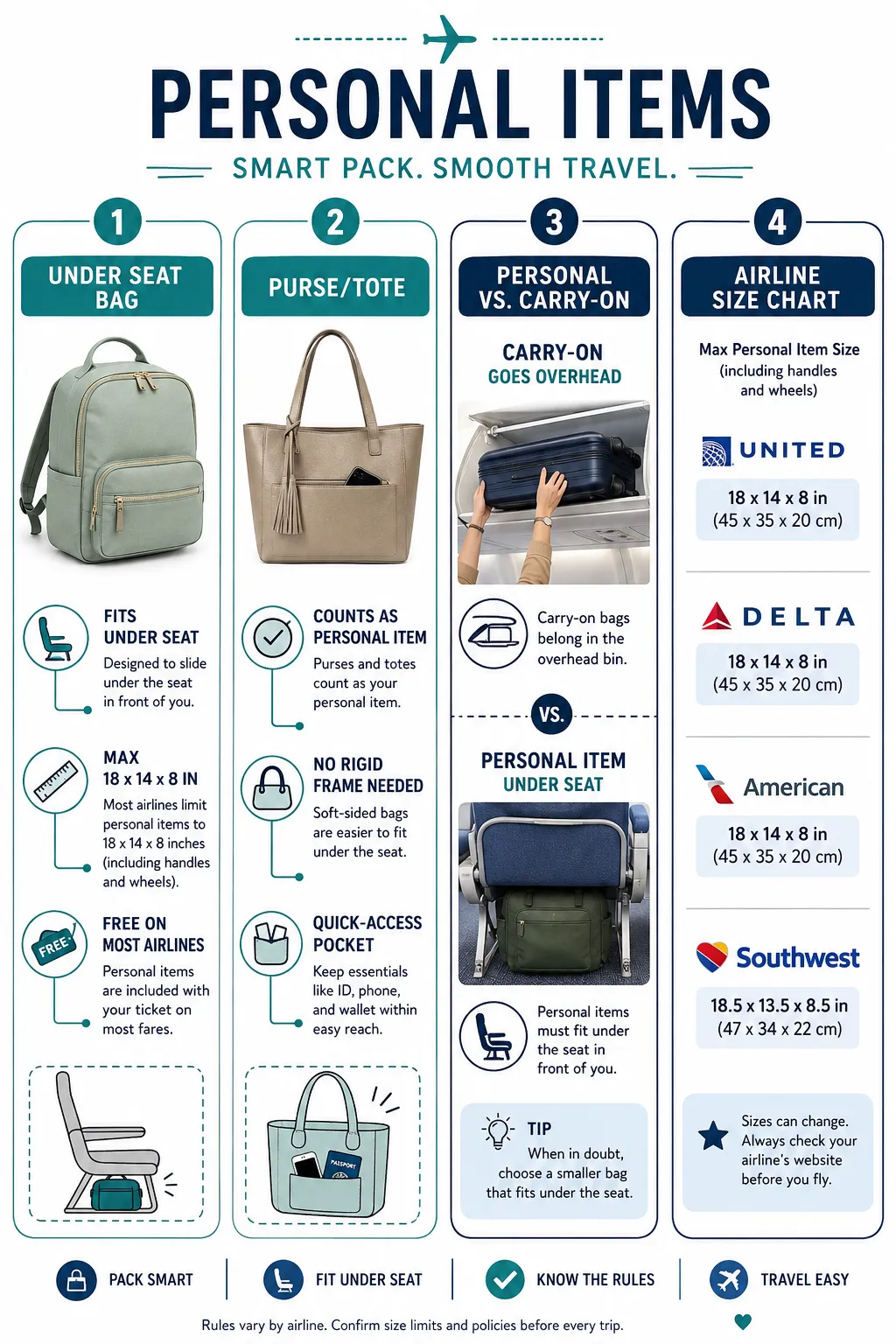
A personal item is any bag small enough to fit under the seat in front of you. Most airlines define it as a second, smaller bag that travels with you at no extra charge alongside a carry-on.
Common personal item types include:
- Small backpacks or daypacks
- Crossbody bags and shoulder bags
- Laptop bags and briefcases
- Large purses and structured totes
- Camera bags
A diaper bag or medical bag typically does NOT count against your personal item allowance on most U.S. carriers.
Personal Item Size Limits by Airline
Size limits differ by airline, and getting this wrong can mean a gate-check fee. Here is a quick comparison of the most common limits in 2026:
| Airline | Personal Item Max Size |
|---|---|
| American Airlines | 18 x 14 x 8 in |
| Delta Air Lines | Must fit under the seat |
| United Airlines | 17 x 10 x 9 in |
| Southwest Airlines | 18.5 x 8.5 x 13.5 in |
| Spirit Airlines | 18 x 14 x 8 in |
Always check your airline’s website before you fly. Delta’s policy is notably vague, which means gate agents have discretion. When in doubt, go smaller.
Personal Item vs Carry-On: What Is the Difference
The difference is simple: a carry-on goes in the overhead bin, and a personal item goes under the seat. You are typically allowed one of each on most U.S. airlines.
- Carry-on: Usually up to 22 x 14 x 9 inches, stored overhead
- Personal item: Smaller, stored under the seat, always within reach
The personal item is actually the more valuable of the two for quick-access items. Your passport, phone, snacks, and headphones should always live here – not buried in the overhead bin.
For more packing strategy, check out this guide on how to organize your carry-on bag.
Can You Bring Liquids and Electronics in a Personal Item
Yes to both – with conditions.
Liquids: TSA’s 3-1-1 rule applies to ALL carry-on bags, including personal items. Each liquid must be 3.4 oz (100ml) or less, all containers must fit in one clear quart-sized bag, and one bag per person. This rule applies on all U.S. domestic and most international flights.
Electronics: Laptops, tablets, e-readers, phones, and portable chargers are all allowed. Laptops must be removed from your bag at the security checkpoint and placed in a separate bin for screening.
According to Pack Hacker’s guide to tiny travel accessories, compact electronics like mini power banks and foldable cables are among the highest-value items you can carry in a personal bag.
How to Pack a Personal Item Efficiently for Travel
The most efficient personal item bags are packed in layers, with the heaviest items at the bottom and the most-used items on top.
Step-by-step method:
- Lay everything out flat before you pack
- Group items by category: tech, documents, comfort, health
- Place heavy items (laptop, charger) at the bottom
- Use a mini packing cube or zip pouch for hygiene items
- Tuck soft items (scarf, socks) into gaps
- Keep your passport, boarding pass, and phone in the top or exterior pocket
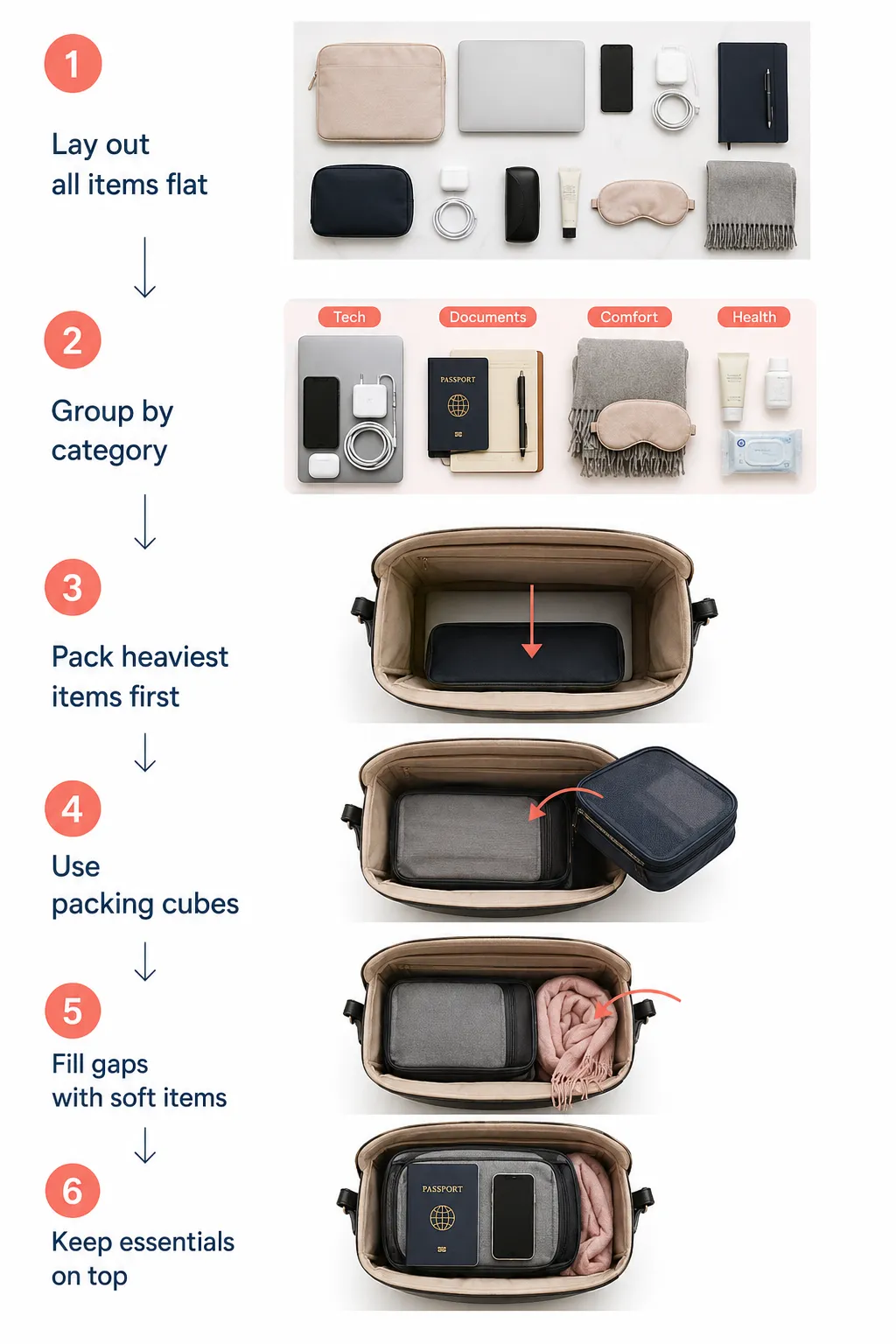
Always Pack Tissues recommends keeping your most-reached-for items in an exterior pocket so you never have to dig through the whole bag at security or boarding.
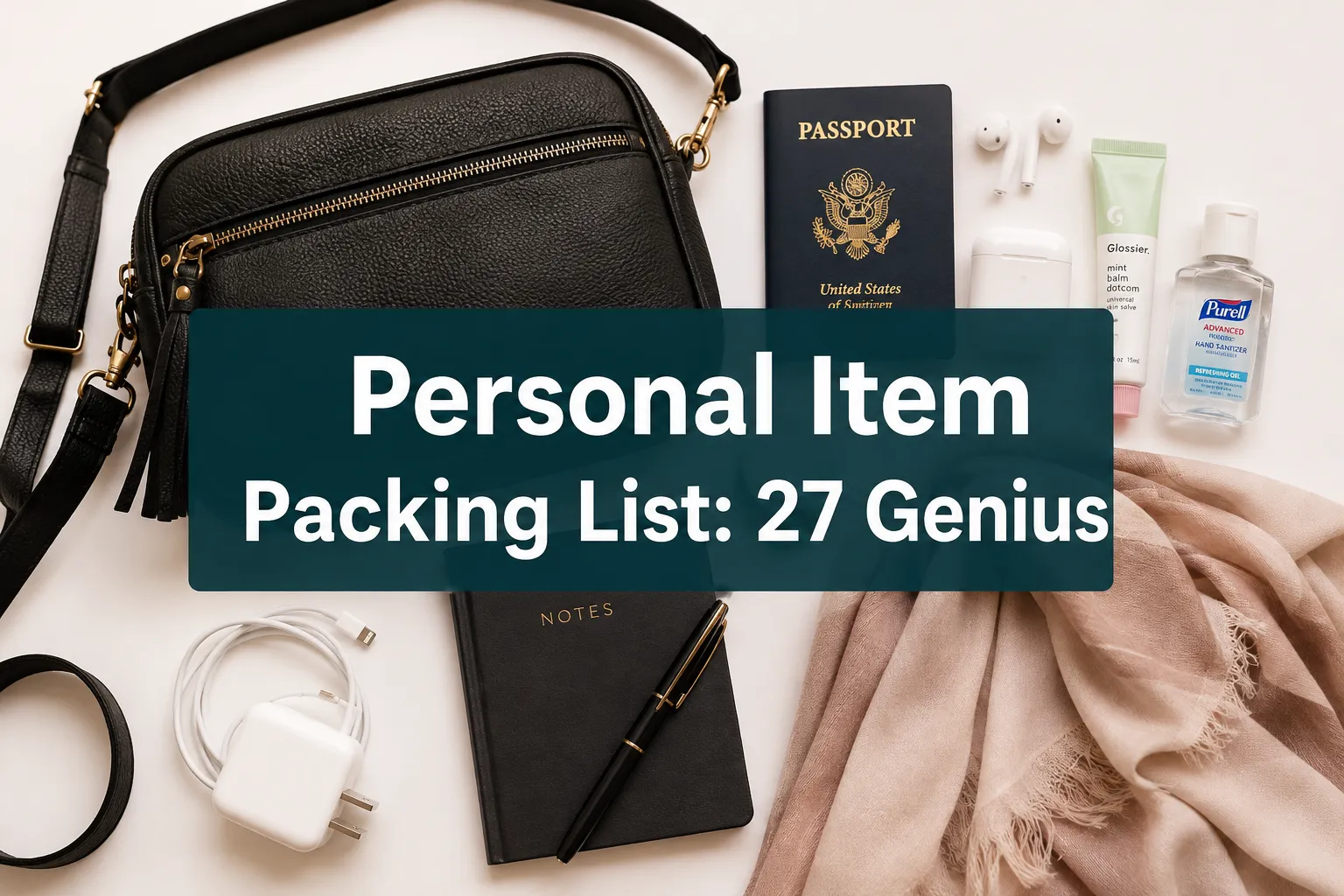
The Full Personal Item Packing List: 27 Genius Items
This personal item packing list is built around five core categories. Every item earns its place by being compact, multi-use, or genuinely hard to replace on the road.
Documents and Security (5 items)
- Passport or ID – always in a RFID-blocking sleeve
- Boarding pass (digital or printed backup)
- Travel insurance card or app
- Credit/debit cards in a slim card holder
- Emergency cash in a small folded envelope
Tech and Power (7 items)
- Compact laptop or tablet (if needed)
- Noise-canceling earbuds – a near-universal recommendation from BuzzFeed’s tiny travel essentials roundup
- Portable charger (10,000 mAh or less)
- Universal travel adapter (foldable, flat design)
- USB-C cable that charges multiple devices
- E-reader or loaded phone for entertainment
- Earplug case for backup quiet
Comfort and Wellness (6 items)
- Packable neck pillow (compresses to fist size)
- Lightweight scarf (doubles as blanket or sun cover)
- Eye mask
- Compression socks for flights over 3 hours
- Lip balm – frequently cited as a top overlooked essential
- Reusable water bottle (collapsible saves the most space)
Hygiene and Health (5 items)
- Mini hand sanitizer (under 3.4 oz)
- Travel-size deodorant
- Pain reliever and any prescription meds in original packaging
- Facial wipes or cleansing wipes (multi-use)
- Tissues – a small pack fits anywhere and solves many problems
Organization and Extras (4 items)
- Mini packing cube or zip pouch for hygiene items
- Snack bar or two (saves money and hunger meltdowns)
- Pen (customs forms, notes, everything)
- Reusable tote bag (folds to wallet size, useful at destination)
According to One Small Bag’s minimalist travel essentials guide, the items that consistently make the cut across all travel styles are power management tools, hygiene basics, and one comfort item tailored to your specific trip length.
Best Personal Item Bag for Air Travel
The best personal item bag has multiple compartments, fits within airline size limits, and stays comfortable to carry. Top picks in 2026 fall into three categories:
- Slim backpack – best for tech-heavy travelers; distributes weight well
- Crossbody bag – best for light packers and city trips; easy security access
- Structured tote – best for business travelers; professional look, good capacity
Choose a slim backpack if you carry a laptop and need both hands free.
Choose a crossbody if you are doing a quick trip and want minimal bulk.
Choose a tote if you need to look polished and pack moderately.
Look for a bag with a dedicated laptop sleeve, a front zip pocket for documents, and water-resistant material.
Personal Item Packing List for Business Travel vs Leisure
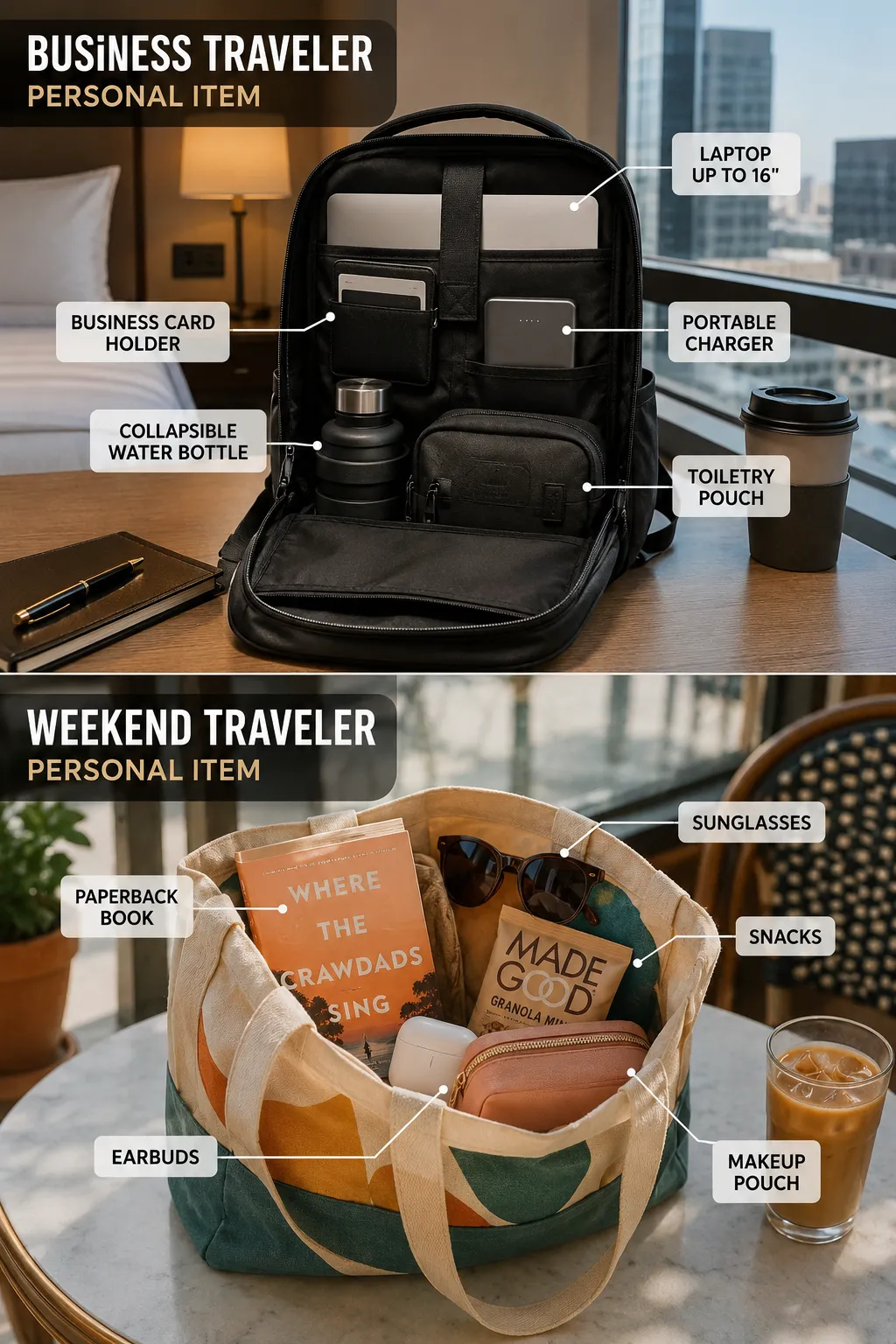
Business travelers and leisure travelers need different mixes from the same small bag.
Business personal item priorities:
- Laptop and charger
- Business cards
- Portable charger
- Collapsible water bottle
- Slim toiletry pouch
- Noise-canceling earbuds
Leisure/weekend travel priorities:
- E-reader or book
- Snacks
- Sunglasses
- Packable tote for shopping
- Comfort items (eye mask, neck pillow)
For weekend trip inspiration, see 25 weekend girls trip ideas that feel like a real vacation.
Personal Item Packing Tips for Women vs Men
The core list is nearly identical, but a few items shift based on personal needs.
Items women often add:
- Mini dry shampoo (under 3.4 oz)
- Compact makeup essentials (mascara, tinted lip balm)
- Hair ties and bobby pins (weigh almost nothing)
- Feminine hygiene products
Items men often swap in:
- Razor (disposable, TSA-approved)
- Slightly larger portable charger
- Compact grooming kit
The real difference is not gender – it is trip length and personal routine. A BuzzFeed roundup of genius travel upgrades found that the most universally loved additions are items that solve specific annoyances: dry skin, dead batteries, and uncomfortable seats.
How to Maximize Space in a Small Personal Item Bag
Maximizing space is about strategy, not just choosing small items.
Top space-saving moves:
- Wear your bulkiest items on the plane (jacket, boots, chunky headphones)
- Use every pocket – exterior pockets are often underused
- Roll soft items instead of folding to reduce bulk
- Choose flat, flexible items over rigid ones where possible
- Eliminate duplicates – one multi-use charger beats three single-use cables
For a broader packing strategy, the only travel essential list you’ll ever need is a solid companion resource.
Personal Item Essentials for Long Flights
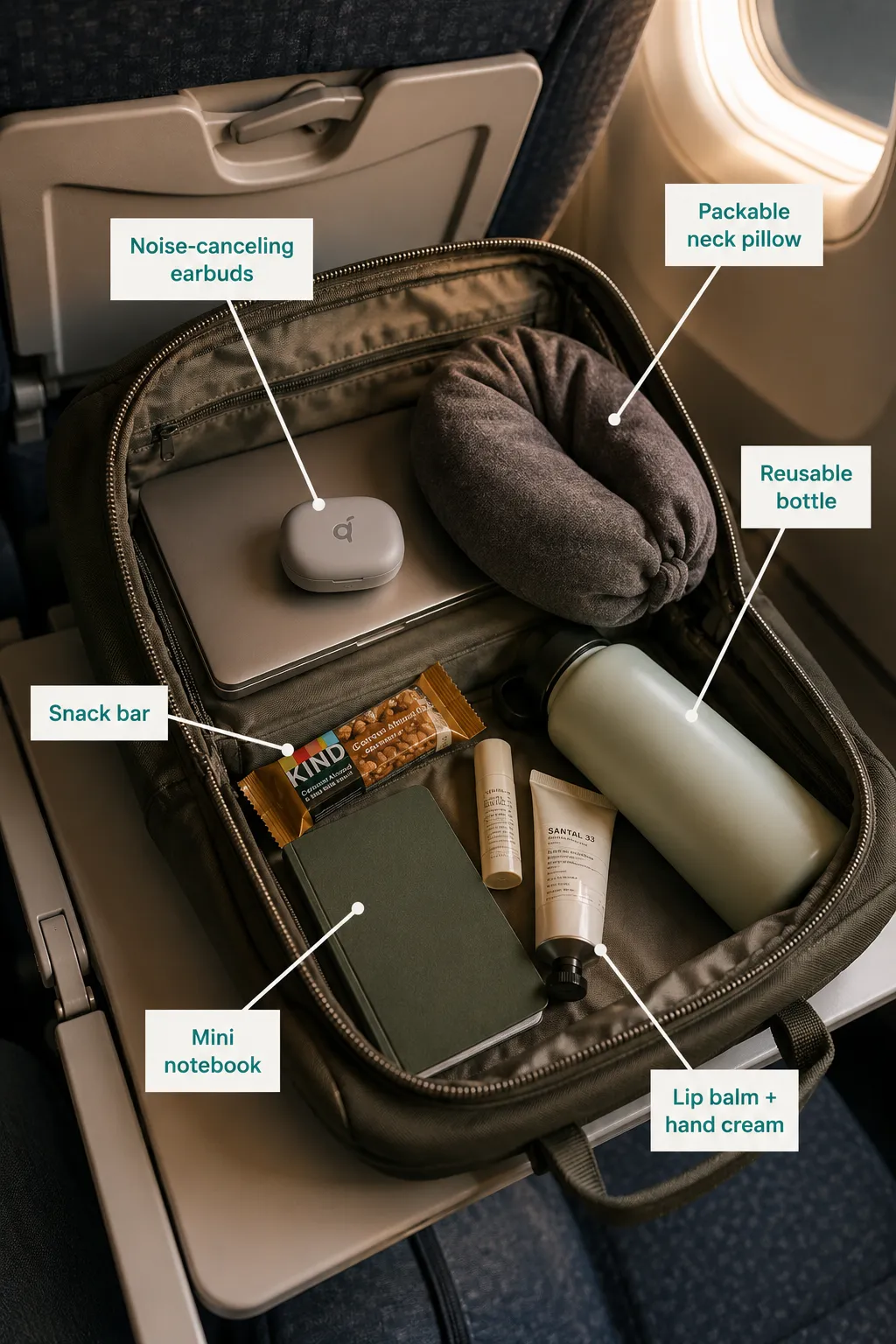
Long flights (over 5 hours) demand more from your personal item. Comfort items move from optional to essential.
Must-haves for long-haul:
- Noise-canceling earbuds or headphones
- Neck pillow (compressible)
- Eye mask
- Compression socks
- Snacks (airline food timing is unpredictable)
- Lip balm and hand cream (cabin air is very dry)
- Melatonin or sleep aid if you use one
- Fully charged portable charger
Planning a long trip to Europe? The ultimate 2 weeks in Europe spring packing guide pairs well with this list.
Personal Item Packing Mistakes to Avoid
Even experienced travelers make these errors.
Common mistakes:
- Packing full-size toiletries – they will be confiscated at security
- Ignoring the exterior pockets – your most-used items should live here
- Forgetting a pen – customs forms and check-in kiosks still need them
- Overpacking tech cables – one multi-device cable replaces three
- Packing items you can buy at the destination – saves space for what matters
- Not checking airline size limits – a bag that fits United may not fit Spirit
The biggest mistake of all is treating the personal item as an overflow bag for your carry-on. It should be a curated, intentional kit.
FAQ
What is the standard personal item size?
Most U.S. airlines allow roughly 18 x 14 x 8 inches, but this varies. Always check your specific airline before you fly.
Does a purse count as a personal item?
Yes. A purse, tote, or handbag counts as your personal item on most airlines, as long as it fits under the seat.
Can I bring a laptop in my personal item?
Yes. Laptops are allowed in personal items. You will need to remove the laptop from your bag at TSA screening.
Can I bring food in my personal item?
Yes. Solid food is allowed through TSA. Liquids and gels (like yogurt or peanut butter) must follow the 3-1-1 rule.
What happens if my personal item is too big?
Gate agents may ask you to check it, which can mean a checked bag fee. Measure your bag before you travel.
Is a backpack considered a personal item or a carry-on?
It depends on size. A small backpack (under airline limits) is a personal item. A larger backpack is treated as a carry-on.
Can I bring a portable charger in my personal item?
Yes, but lithium-ion batteries must travel in carry-on or personal item bags – never in checked luggage.
Do personal item rules apply on international flights?
Yes, though international airlines may have different size limits. Budget carriers in Europe and Asia often have stricter rules.
What is the lightest personal item bag?
Packable nylon bags and ultralight crossbody bags can weigh under 0.5 lbs empty, leaving more of your weight allowance for contents.
Should I use packing cubes in a personal item?
Mini packing cubes or zip pouches work well in personal items. They keep hygiene items and cables from tangling and make the bag easier to search at security.
Conclusion
A great personal item packing list is not about cramming more in – it is about choosing smarter. The 27 items in this guide cover every situation from a 2-hour hop to a 14-hour overnight flight, and every item earns its place by being compact, multi-use, or genuinely hard to replace.
Your next steps:
- Print or save this list and cross off anything that does not fit your specific trip
- Measure your bag against your airline’s published size limits
- Do a dry pack the night before – lay everything out, then only put back what you actually need
- Wear your bulkiest items on travel day to free up space
- Revisit the list after your trip and note what you never touched – those items get cut next time
The best personal item bag is the one you barely notice carrying. Pack light, pack smart, and enjoy the freedom of never waiting at baggage claim.