


Last updated: September 26, 2026
Quick Answer: Jet lag happens when your internal body clock is out of sync with the local time at your destination. The most effective way to avoid jet lag is to start shifting your sleep, light exposure, and meal timing at least 24 hours before you fly – not after you land. A structured pre-flight reset, combined with smart in-flight habits, can cut recovery time significantly.
Key Takeaways
- Jet lag is a circadian rhythm disruption – your body clock needs time to catch up to a new time zone.
- Flying east is harder on your body than flying west, because it requires advancing your clock rather than delaying it.
- Start your reset 24-48 hours before departure by shifting bedtime, meals, and light exposure toward destination time.
- Melatonin (0.5-3 mg) taken at destination bedtime is one of the few jet lag remedies with solid clinical backing.
- Light exposure is the single most powerful tool for resetting your circadian clock – timing it correctly matters.
- Staying hydrated, avoiding alcohol, and eating meals on destination time during the flight all help.
- Most people recover from jet lag at roughly one day per time zone crossed, though this varies by individual.
- Older adults and people with irregular sleep schedules tend to experience more severe jet lag.
- Prescription options like low-dose melatonin or short-acting sleep aids exist but should be discussed with a doctor.
- The 24-hour reset method works best when you commit to it consistently – skipping steps reduces its effectiveness.
What Is Jet Lag and Why Does It Happen?
Jet lag is a temporary sleep disorder caused by rapid travel across multiple time zones. Your body’s internal clock – known as the circadian rhythm – stays anchored to your home time zone while the outside world shifts around you.
Your circadian rhythm controls more than just sleep. It regulates body temperature, digestion, hormone release, and even mood. When you land in Tokyo after flying from New York, your body still thinks it’s 3 a.m. even if the local clock says 5 p.m.
Research published in Frontiers in Behavioral Neuroscience confirms that the molecular clock in your cells responds slowly to environmental time cues, which is why jet lag can linger for days even after you’ve arrived.
The main symptoms include:
- Daytime fatigue and brain fog
- Difficulty falling or staying asleep
- Digestive issues and appetite changes
- Mood dips and irritability
- Reduced concentration
How Long Does Jet Lag Last?
Most travelers recover at a rate of about one day per time zone crossed. A five-hour time difference typically means five days to fully adjust, though many people feel significantly better after two to three days.
That said, direction matters a lot. Flying east generally takes longer to recover from than flying west. A large dataset study from NUS Medicine found that sleep timing re-alignment after long-haul travel is a gradual process, not an overnight fix, and that both sleep duration and timing play separate roles in recovery.
Individual factors also affect recovery time:
- Age – older adults tend to recover more slowly
- Direction of travel – eastward is harder
- Number of time zones crossed – more zones, longer recovery
- Your baseline sleep health – poor sleepers struggle more
- Pre-flight preparation – people who prep in advance recover faster
Best Ways to Prevent Jet Lag Before Flying
The single most effective strategy for how to avoid jet lag is starting your reset before you ever board the plane. Most travelers wait until they land to deal with it – that’s too late.
The CDC Yellow Book 2026 recommends a pre-flight phase shift approach: gradually move your bedtime and wake time toward destination time starting two to three days before departure. Even a one-hour shift per day makes a real difference.
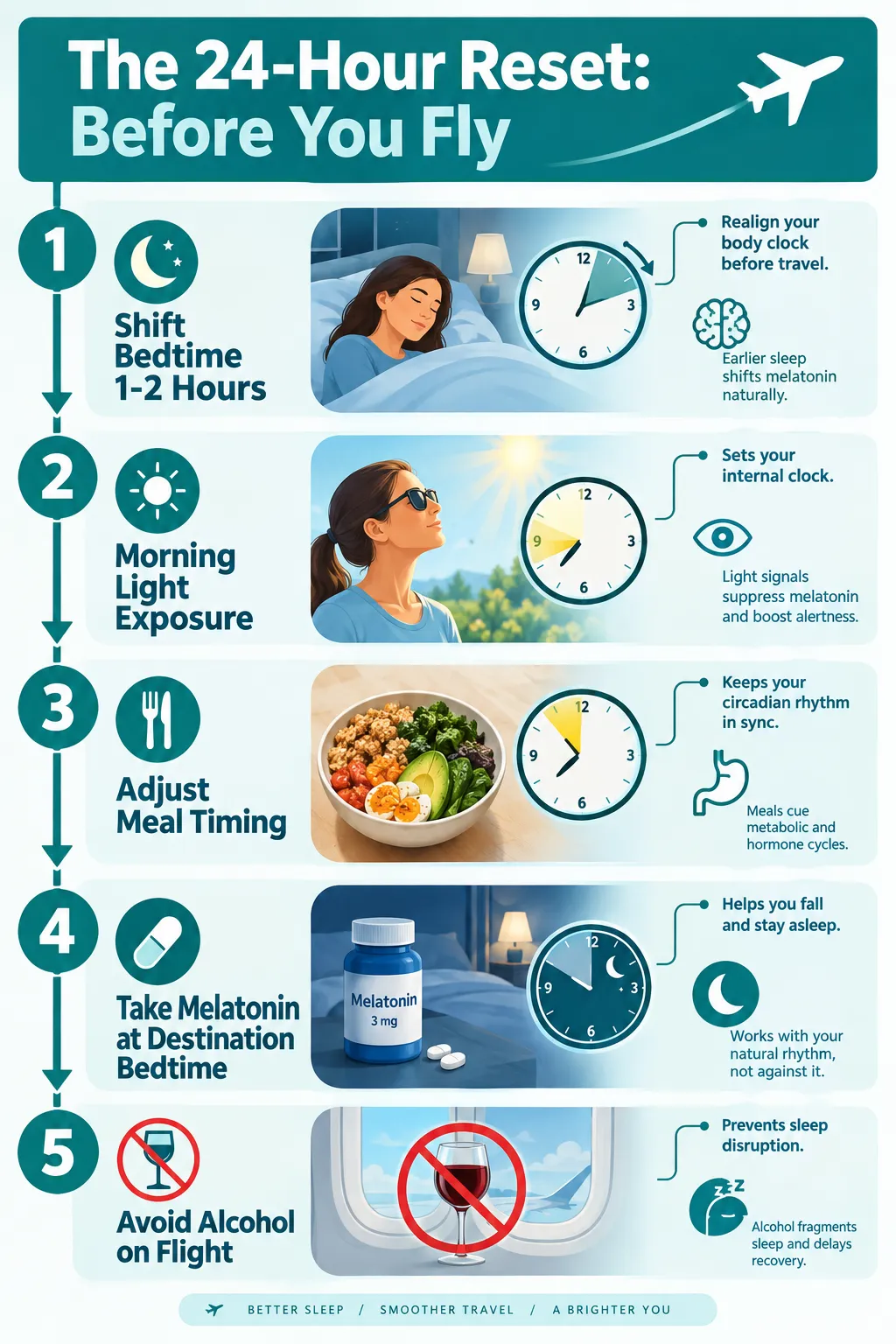
Here’s a simple pre-flight checklist:
- Two to three days out – Shift your bedtime 1-2 hours earlier (eastward travel) or later (westward travel).
- The day before – Eat your meals on destination time, not home time.
- Morning of departure – Get bright light exposure at the time that matches your destination’s morning.
- On the plane – Set your watch to destination time immediately and behave accordingly.
- Avoid alcohol and heavy meals on the flight – both disrupt sleep quality.
Harvard Health research also recommends a concrete bedtime schedule for eastward travel: if you’re flying from New York to London (five hours ahead), try going to bed at 11 p.m., then 10 p.m., then 9 p.m. on the three nights before your flight.
Planning a big trip soon? If you’re heading to Europe, check out affordable hotels in Paris that won’t drain your budget – arriving well-rested makes exploring so much better.
Flying East vs. West: Which Direction Is Worse for Jet Lag?
Flying east is harder on your body than flying west – this is one of the most consistent findings in circadian science. The reason comes down to how your internal clock naturally runs.
Most people’s circadian rhythm runs slightly longer than 24 hours – closer to 24.2 hours on average. That means it’s naturally easier to delay your clock (stay up later, as you do flying west) than to advance it (go to bed earlier, as you do flying east).

A quick comparison:
| Direction | Clock Adjustment | Difficulty | Recovery Estimate |
|---|---|---|---|
| Flying East | Phase advance (earlier) | Harder | ~1.5 days per zone |
| Flying West | Phase delay (later) | Easier | ~1 day per zone |
Research from Nature Communications (2025) found that circadian robustness – how strongly your body clock responds to environmental cues – plays a key role in how quickly you adapt, especially across large time-zone shifts going east.
Choose your strategy based on direction:
- Flying east? Prioritize morning bright light at your destination and take melatonin earlier in the evening.
- Flying west? Stay up as late as possible on arrival day and seek evening light to delay your clock naturally.
Does the 24-Hour Reset Method Actually Work?
Yes – when done consistently, the 24-hour reset method is one of the most practical and evidence-backed approaches for how to avoid jet lag. It combines sleep timing shifts, strategic light exposure, meal timing, and melatonin into a single coordinated protocol starting the day before your flight.
The method works because it gives your circadian clock a head start. Instead of landing completely misaligned, you arrive partially adjusted – which means your body has less catching up to do.
The Mayo Clinic recommends a three-day pre-trip light therapy reset for frequent long-haul travelers, which aligns with the core principle: use environmental cues (light, meals, activity) to nudge your clock before the flight, not after.
The key steps of the 24-hour reset:
- Evening before departure – Shift bedtime 1-2 hours toward destination time.
- Morning of departure – Get 20-30 minutes of bright natural light at the time matching destination morning.
- On the plane – Eat and sleep on destination time, not home time.
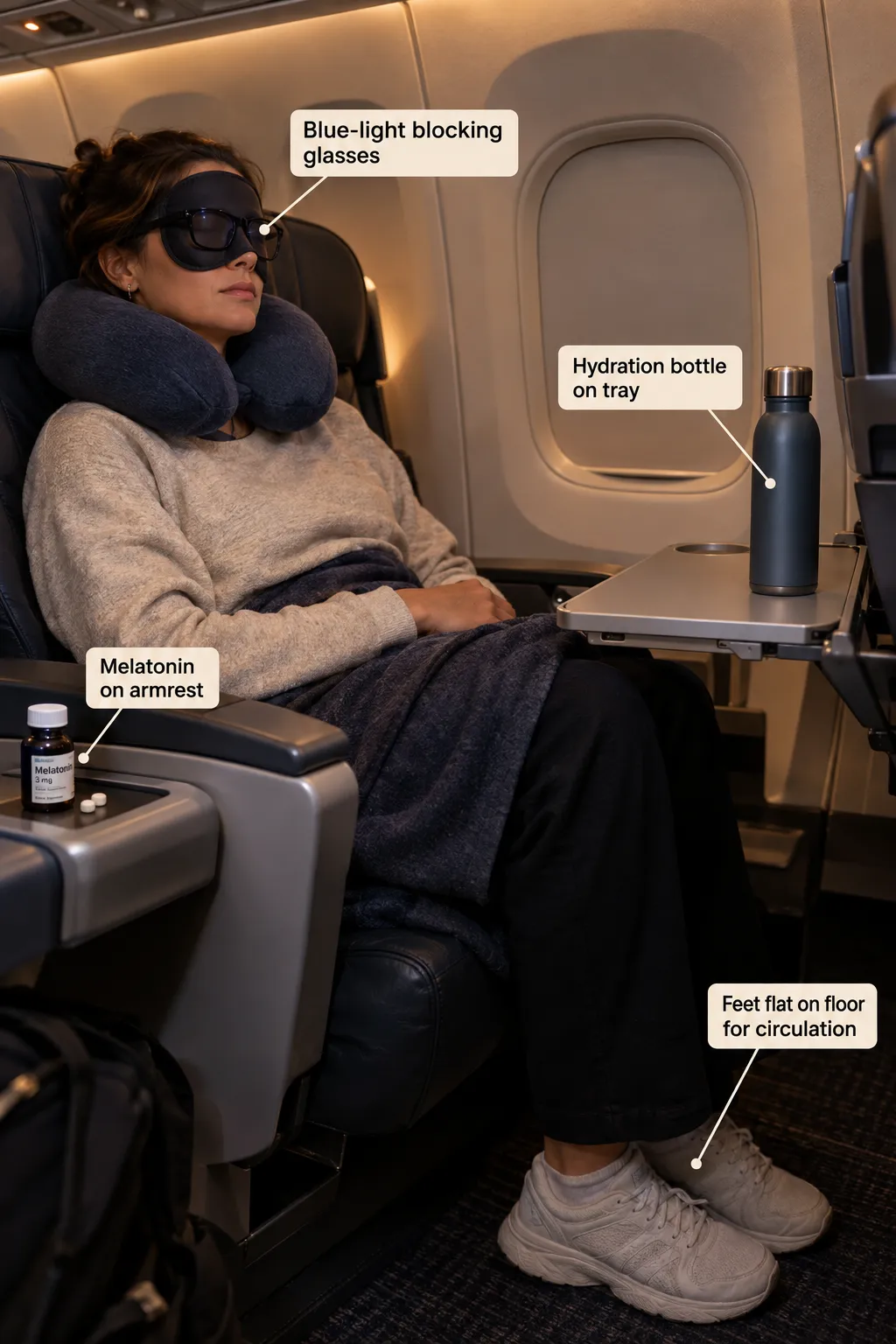
- Hydrate consistently – Cabin air is very dry and dehydration worsens fatigue.
- Take melatonin at destination bedtime, even while still on the plane.
Light Exposure for Jet Lag: Getting the Timing Right
Light is the most powerful signal your body uses to set its internal clock. Getting light exposure at the wrong time can actually make jet lag worse – timing is everything.
A 2025 study published in the Journal of Biological Rhythms found that the molecular clock in cells responds to light cues in a time-dependent way – meaning the same light exposure can advance or delay your clock depending on when it occurs.
General light timing rules:
- Flying east – Seek bright light in the morning at your destination. Avoid bright light in the evening for the first two days.
- Flying west – Seek bright light in the evening at your destination. Avoid early morning light on arrival day.
- On the plane – Use a sleep mask during what would be nighttime at your destination, even if it’s daytime outside the window.
- Blue light from screens delays melatonin release – use blue-light blocking glasses or night mode after 8 p.m. destination time.
Light therapy lamps (10,000 lux) can substitute for sunlight when natural light isn’t available at the right time – useful for winter arrivals or indoor-heavy schedules.
Melatonin for Jet Lag: How Much Should I Take?
Melatonin is one of the most well-supported jet lag remedies available without a prescription. It works by signaling to your brain that it’s time to sleep, helping shift your circadian clock toward the new time zone.
Clinical guidance from the NIH recommends low doses of 0.5 to 3 mg taken at bedtime in the destination time zone. Higher doses (5-10 mg) are widely sold but don’t appear to work better – and may cause next-day grogginess.
Melatonin timing tips:
- Take it 30 minutes before your target bedtime in the destination time zone.
- Start on the plane if your destination bedtime falls during the flight.
- Use it for two to four nights after arrival, then stop.
- Avoid taking it at the wrong time – melatonin taken in the morning can worsen adjustment.
Who should be cautious:
- Pregnant or breastfeeding travelers
- People taking blood thinners or immunosuppressants
- Anyone with autoimmune conditions
Always check with your doctor before adding melatonin if you take other medications.
Jet Lag Medication: Prescription Options
Prescription options exist for travelers who need stronger support, particularly for long-haul or multi-leg trips crossing many time zones.
The most commonly prescribed options include:
- Zolpidem (Ambien) – A short-acting sleep aid used to force sleep on the plane or at destination bedtime. Not for long-term use.
- Tasimelteon (Hetlioz) – A melatonin receptor agonist approved for circadian rhythm disorders. Less commonly prescribed for travel jet lag.
- Modafinil – A wakefulness-promoting drug sometimes used to manage daytime sleepiness after arrival.
These are not first-line options for most travelers. They’re better suited for business travelers, flight crew, or athletes who cross many time zones frequently and can’t afford days of impaired performance.
A 2026 Delphi consensus for athletes recommended a structured sleep and jet lag strategy that combines behavioral approaches (light, meal timing, sleep scheduling) with pharmacological support only when necessary – not as a substitute for the behavioral work.
Speak with a travel medicine doctor before your trip if you’re considering prescription options.
Is Jet Lag Worse for Older Adults or Certain People?
Yes – jet lag affects some people more than others, and age is one of the biggest factors. Older adults tend to have less flexible circadian rhythms, which makes clock re-alignment slower and harder.
Research published in Sleep (2025) found that individual differences in sleep timing recovery after long-haul travel are significant – meaning two people on the same flight can have very different recovery experiences.
Groups who tend to experience more severe jet lag:
- Adults over 60 – Circadian flexibility decreases with age.
- People with irregular sleep schedules – Night shift workers or chronic late sleepers.
- Frequent flyers – Accumulated circadian disruption adds up.
- People with anxiety or depression – Circadian misalignment worsens mood disorders. A 2025 University of Sydney study found a direct link between internal jet lag (social vs. biological clock mismatch) and depression risk.
If you fall into one of these groups, start your pre-flight reset earlier (three to four days out) and be more deliberate about light exposure and melatonin timing.
Jet Lag Remedies That Actually Work vs. Myths
Not every jet lag remedy you’ve heard of is backed by evidence. Here’s a straight breakdown:
What actually works:
- ✅ Melatonin (low dose, correctly timed)
- ✅ Strategic light exposure
- ✅ Pre-flight sleep schedule shifting
- ✅ Meal timing on destination time
- ✅ Staying hydrated on the flight
- ✅ Short-acting sleep aids (with doctor guidance)
What doesn’t work (or has weak evidence):
- ❌ Fasting for the entire flight (the “Argonne diet” – not well supported)
- ❌ Drinking alcohol to sleep on the plane (worsens sleep quality)
- ❌ Caffeine as a long-term fix (masks fatigue, doesn’t reset the clock)
- ❌ “Sleeping it off” for a full day after landing (delays adjustment)
- ❌ High-dose melatonin (no added benefit over low dose)
Gut jet lag is also real – your digestive system has its own circadian rhythm, and disrupting meal timing causes constipation, bloating, and appetite changes. Eating on destination time from day one helps your gut clock catch up alongside your brain clock.
How to Recover from Jet Lag Faster After Landing
Once you’ve landed, your goal is to reinforce the new time zone as quickly as possible. Every behavioral cue you give your body – light, meals, exercise, social interaction – helps lock in the new schedule.
Post-landing recovery checklist:
- Get outside in natural light as soon as possible, timed to your direction of travel.
- Stay awake until local bedtime on arrival day, even if you’re exhausted. A short 20-minute nap before 3 p.m. local time is okay.
- Eat meals on local time from day one – don’t skip breakfast or eat dinner at midnight.
- Exercise lightly – a 20-30 minute walk in daylight helps reset your clock and boosts mood.
- Avoid heavy alcohol for the first two to three days – it fragments sleep and slows adjustment.
- Keep your room dark during local nighttime and bright during the day.
If you’re visiting a new city and want to make the most of your first alert day, having a solid plan helps. For example, if you’re landing in San Francisco, knowing the first-time San Francisco mistakes to avoid can save you from wasting your limited energy on the wrong things.
Jet Lag Hacks for Frequent Flyers
Frequent flyers deal with jet lag differently from occasional travelers – accumulated circadian disruption is a real health concern, not just a travel inconvenience.
A 2025 study on circadian biology found that repeated large time-zone shifts without adequate recovery time can impair immune function, metabolic health, and cognitive performance over time.
Smart habits for frequent flyers:
- Anchor to one time zone when trips are short (under 48 hours) – don’t bother trying to adjust.
- Use a jet lag calculator app (like Timeshifter) to get a personalized light and melatonin schedule for each trip.
- Protect sleep quality with a consistent pre-flight routine, blackout eye mask, and earplugs or noise-canceling headphones.
- Build in buffer days before important meetings or events – never schedule critical work on arrival day.
- Track your patterns – some people are naturally more sensitive to eastward travel; knowing your pattern helps you prep better.
For travelers who combine frequent flying with adventure travel, having solid destination knowledge helps you hit the ground running. If Switzerland is on your list, the hidden gems in Switzerland are worth planning around your most alert days. And if you’re doing a girls’ trip or bachelorette getaway, check out these weekend girls trip ideas that feel like a real vacation to match your energy levels to the right activities.
Common Jet Lag Mistakes to Avoid
Even well-prepared travelers make these mistakes. Knowing them in advance is half the battle.
- Waiting until you land to start adjusting – The pre-flight window is the most valuable and most ignored.
- Drinking alcohol on the flight – It may help you fall asleep faster but dramatically reduces sleep quality.
- Sleeping through the day at your destination – This locks in the wrong time zone.
- Ignoring meal timing – Eating at your home-time schedule delays gut clock adjustment.
- Taking melatonin at the wrong time – Melatonin taken in the morning can push your clock the wrong direction.
- Over-relying on caffeine – It masks fatigue without fixing the underlying circadian mismatch.
- Skipping light exposure – Staying indoors all day at your destination slows recovery significantly.
How to Adjust Your Sleep Schedule Before an International Flight
Adjusting your sleep schedule before flying is the most underused and most effective jet lag prevention tool available. Most travelers skip it because it requires discipline in the days before a trip – but even one to two days of adjustment makes a measurable difference.
For eastward travel (e.g., US to Europe):
- Move bedtime 30-60 minutes earlier each night for two to three nights before departure.
- Wake up earlier to match – don’t just go to bed early and sleep in.
- Get bright light in the morning and dim lights in the evening.
For westward travel (e.g., US to Asia heading west):
- Move bedtime 30-60 minutes later each night.
- Seek evening light and avoid bright morning light.
If you’re planning a trip to Italy and want to arrive ready to explore, pairing your sleep schedule adjustment with solid trip planning pays off. Take a look at the mistakes to avoid in Italy so your first jet-lag-free days are spent on the right experiences.
FAQ
How many time zones do you need to cross to get jet lag?
Most people start noticing jet lag symptoms after crossing two or more time zones. Crossing five or more time zones typically causes significant disruption that takes several days to resolve.
Is it better to sleep on the plane or stay awake?
It depends on your destination time. If it’s nighttime at your destination when you’re flying, sleep on the plane. If it’s daytime at your destination, try to stay awake and save your sleep for local bedtime.
Does drinking lots of water prevent jet lag?
Hydration alone won’t prevent jet lag, but dehydration worsens fatigue and brain fog. Drink water regularly throughout the flight – aim for about 8 oz per hour of flying.
Can you get jet lag on a domestic flight?
Typically no – domestic flights usually don’t cross enough time zones to cause true jet lag. However, a cross-country US flight (three time zones) can cause mild symptoms in sensitive individuals.
Does the direction of your seat on the plane affect jet lag?
No – seat direction doesn’t affect circadian adjustment. However, window seats allow you to control light exposure by managing the window shade, which is genuinely useful.
How does fasting affect jet lag?
Some protocols suggest time-restricted eating to help shift your circadian clock, but the evidence is mixed. What’s clearer is that eating meals on destination time – rather than fasting entirely – helps your gut clock adjust alongside your brain clock.
Is jet lag worse on the way home than on the way out?
It depends on direction. If you traveled east to get there, you’ll be traveling west to return – which is typically easier. Many travelers feel worse on the outbound trip than the return for this reason.
Can kids get jet lag?
Yes – children experience jet lag too, and it can disrupt their sleep and behavior significantly. The same principles apply: shift bedtimes gradually before the trip and use light exposure strategically.
Does exercise help with jet lag?
Light exercise – especially a walk in natural daylight – helps reinforce circadian cues and improves mood. Intense exercise late in the evening at your destination can delay sleep onset, so keep workouts earlier in the day.
What’s the fastest way to recover from jet lag after landing?
Get outside in natural light at the correct time for your direction of travel, eat meals on local time immediately, stay awake until local bedtime, and take low-dose melatonin at destination bedtime for two to three nights.
Does caffeine help with jet lag?
Caffeine can help you stay awake and function during the day, but it doesn’t reset your circadian clock. Use it strategically – avoid caffeine after 2 p.m. local time so it doesn’t interfere with your target bedtime.
Are jet lag apps worth using?
Apps like Timeshifter use your specific flight schedule and chronotype to generate a personalized light and melatonin plan. For frequent flyers or anyone crossing five or more time zones, they’re genuinely useful.
Conclusion
Jet lag doesn’t have to ruin the first few days of your trip. The key insight is simple: your body clock responds to consistent cues – light, meals, sleep timing – and you can start sending it the right signals before you ever leave home.
The 24-hour reset method works because it turns the pre-flight window into an active recovery tool instead of wasted time. Shift your sleep schedule, time your light exposure, eat on destination time, and take low-dose melatonin correctly – and you’ll land ahead of the curve instead of behind it.
Your action plan:
- Start shifting your bedtime two to three nights before departure.
- Set your watch to destination time when you board.
- Eat and sleep on destination time during the flight.
- Get outside in natural light on arrival day – timed to your direction of travel.
- Take 0.5-3 mg melatonin at destination bedtime for two to three nights.
The more time zones you’re crossing, the more important it is to start early. Whether you’re heading to hidden gems in Italy or spending a day in Zermatt on a tight itinerary, arriving rested and alert makes every experience better.
Safe travels – and may your first morning abroad actually feel like morning.