
Last updated: September 15, 2026
Quick Answer: A 2 week Northern Spain itinerary covers four Atlantic regions – Basque Country, Cantabria, Asturias, and Galicia – in roughly 14 days. The classic route runs west from Bilbao or San Sebastián to Santiago de Compostela, mixing world-class food, medieval coastal towns, and green mountain scenery. Two weeks is the sweet spot: enough time to slow down and eat well without rushing every stop.
Key Takeaways
- Start in Bilbao or San Sebastián and move west toward Santiago de Compostela for the most logical flow.
- Recommended split: 3 nights Basque Country, 2 nights Cantabria, 3 nights Asturias, 4 nights Galicia.
- Food is the backbone of this trip – pintxos in Basque Country, anchovies in Cantabria, fabada and cider in Asturias, seafood in Galicia.
- You can do this trip without a car, using Renfe trains and the FEVE narrow-gauge coastal rail.
- September and October are the best months for lower prices, smaller crowds, and comfortable temperatures.
- Hidden gems to prioritize: Getaria, Cudillero, Ribadesella, and the Rías Baixas coastline.
- Skip Barcelona on this itinerary – it’s a different region entirely and will break your flow.
- Budget estimate: roughly €100-150 per person per day for mid-range travel, including accommodation and food.
- Two weeks is enough if you keep one-night stops to a minimum and base yourself in key hubs.
- Families are well-catered for – the Picos de Europa, Urdaibai Bird Center, and Galician beaches work brilliantly with kids.
What’s the Best Way to Spend 2 Weeks in Northern Spain?
The best approach is to follow the Atlantic coast from east to west, starting in the Basque Country and finishing in Galicia. This direction keeps driving distances manageable and lets the landscape and food evolve naturally as you travel.
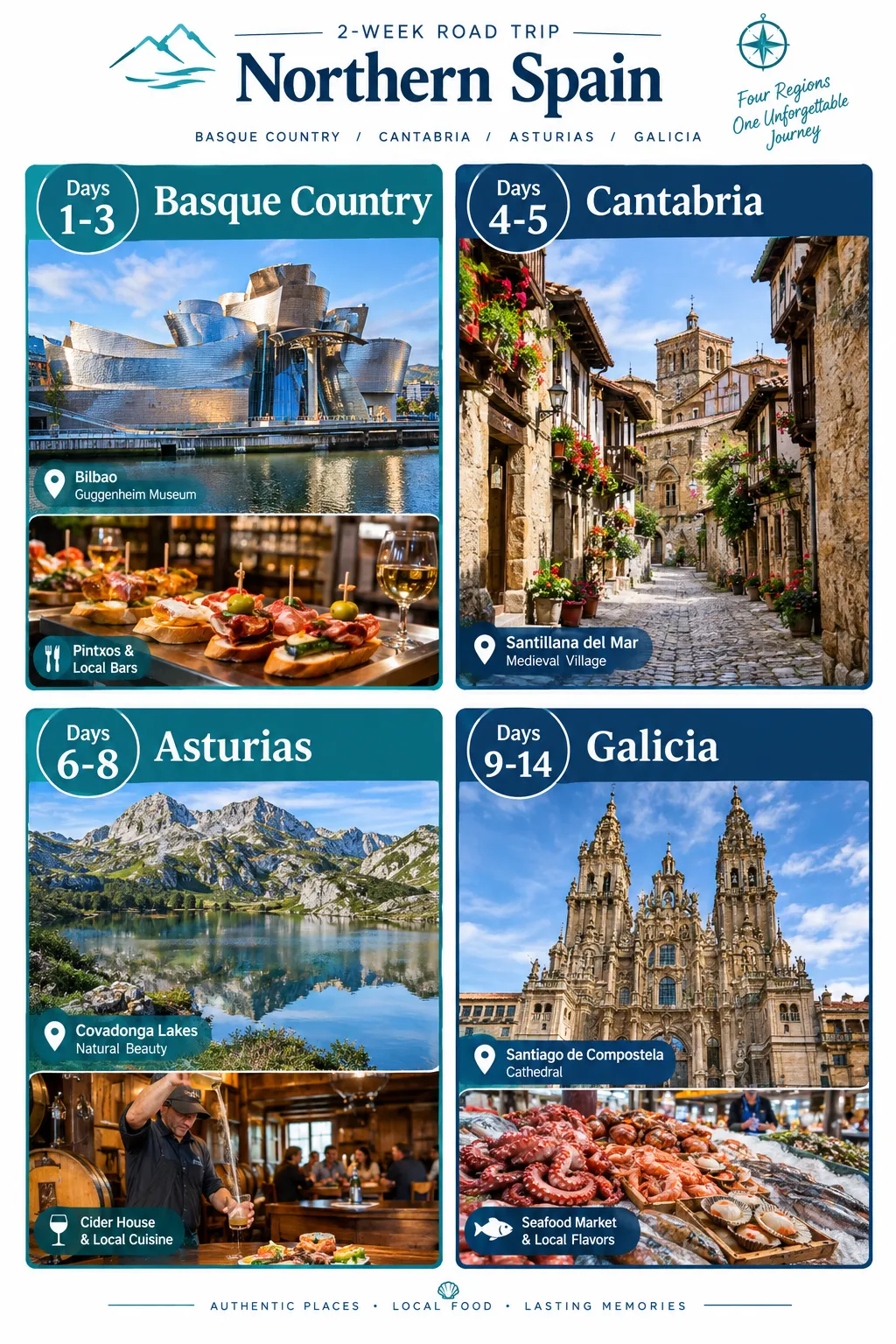
According to updated Green Spain itineraries for 2026, the ideal structure is roughly 3 nights in the Basque Country, 2 in Cantabria, 3 in Asturias, and 4 in Galicia. That gives you enough time to actually settle in rather than just check boxes.
A few principles that make this route work:
- Base yourself in hubs like San Sebastián, Oviedo, and Santiago rather than moving every night.
- Structure days around meals – a long lunch at a sidería (cider house) or a pintxos crawl is the activity, not just a break from sightseeing.
- Leave one full free day in your itinerary for spontaneous discoveries – a fishing village you stumble on, a beach that looks too good to pass.
How Many Days Should I Spend in Each City in Northern Spain?
Here’s a practical breakdown for a 14-day trip:
| Region | Base City | Nights | Day Trips |
|---|---|---|---|
| Basque Country | San Sebastián + Bilbao | 3 | Getaria, Mundaka |
| Cantabria | Santander or Santillana del Mar | 2 | Altamira, Picos foothills |
| Asturias | Oviedo or Cangas de Onís | 3 | Covadonga, Ribadesella, Cudillero |
| Galicia | Santiago + coastal town | 4 | Rías Baixas, Ribadeo, Finisterre |
Days 1-2: Arrive in Bilbao. Visit the Guggenheim, explore the Casco Viejo, and eat your way through Mercado de la Ribera.
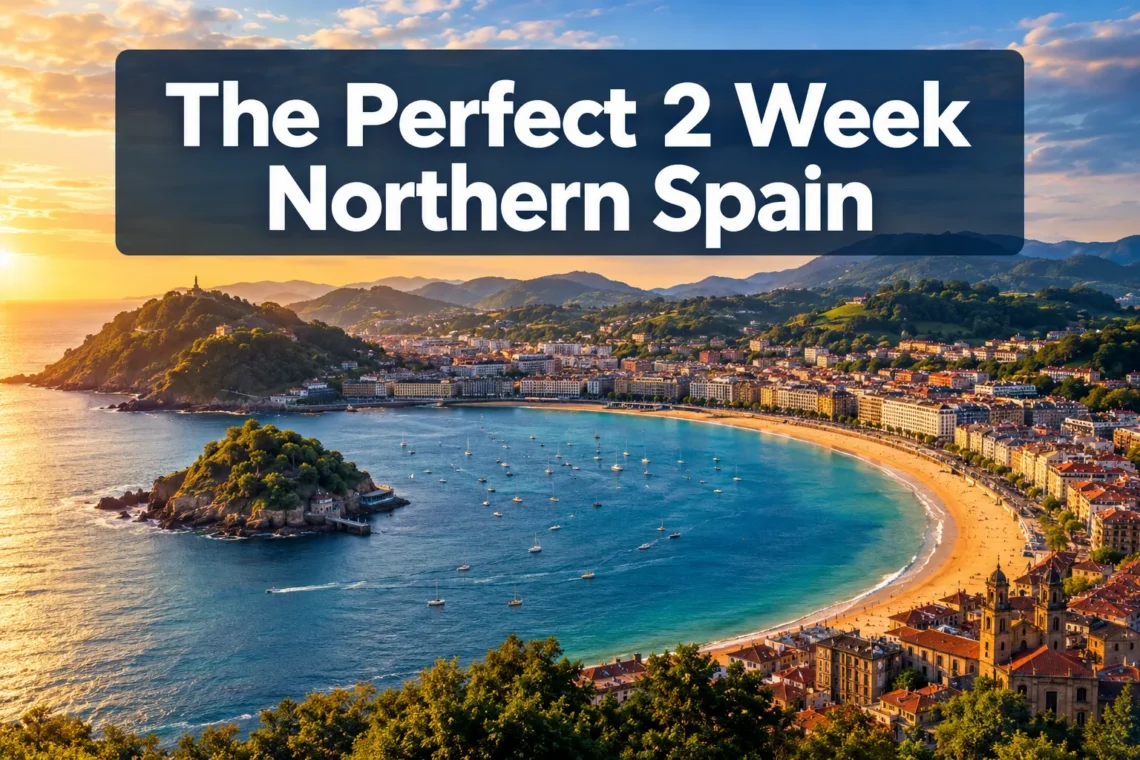
Day 3: Move to San Sebastián. Spend the afternoon on La Concha beach and the evening doing a pintxos crawl in Parte Vieja.
Days 4-5: Drive or take the train west to Cantabria. Base in Santillana del Mar – one of Spain’s best-preserved medieval towns.
Days 6-8: Asturias. Stay near Cangas de Onís for Picos de Europa access, or in Oviedo for city comforts and Calle Gascona’s cider bars.
Days 9-12: Galicia. Split time between Santiago de Compostela and a coastal base like Cambados or Baiona.
Days 13-14: Slow down. Explore the Rías Baixas, eat a proper mariscada (shellfish feast), and catch a sunset at Cabo Fisterra.
San Sebastián vs Bilbao: Which Is Better for Food?
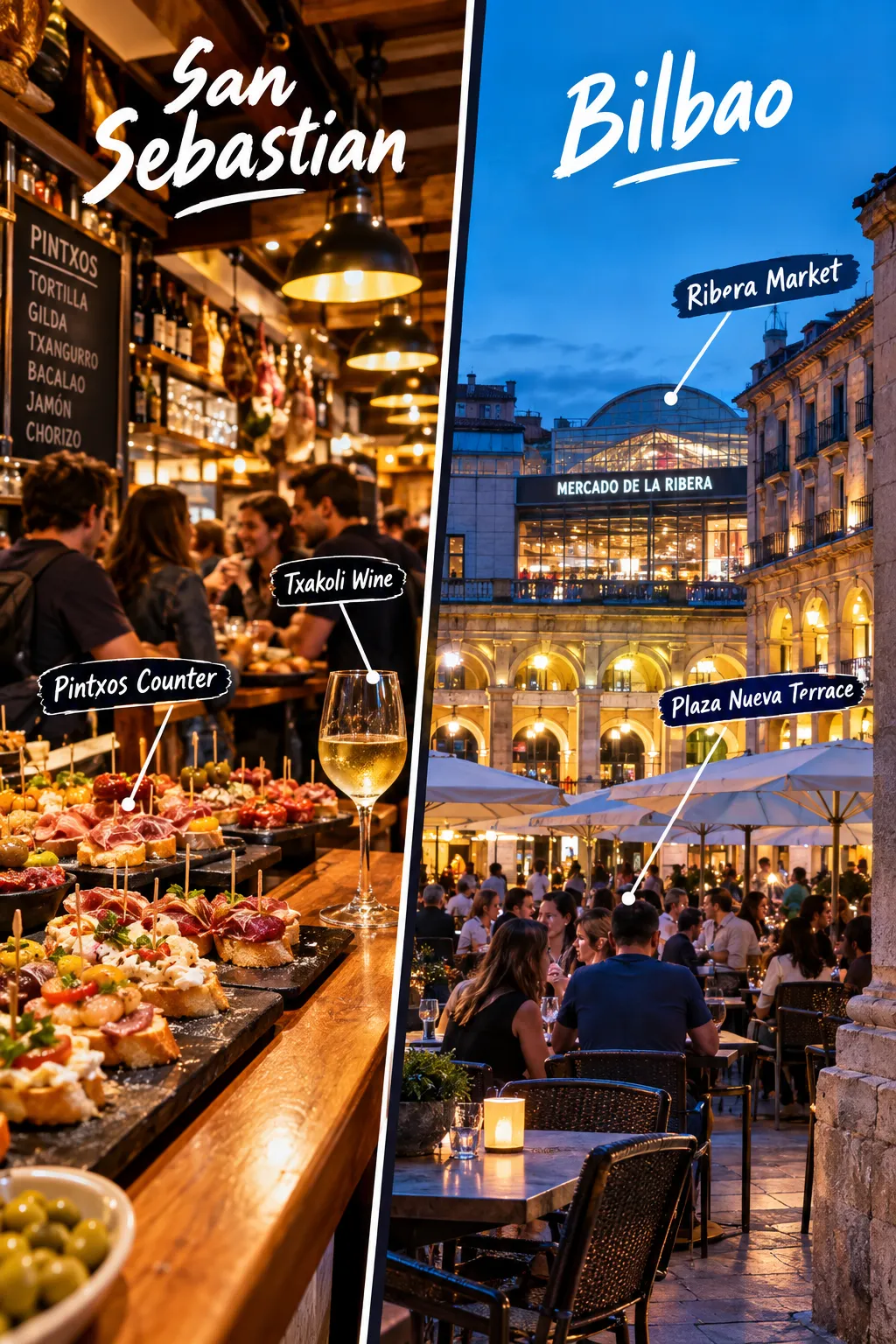
Both cities are exceptional, and the honest answer is: visit both. San Sebastián has the highest concentration of Michelin stars per capita of any city in the world, while Bilbao offers a more local, unpretentious food scene with incredible pintxos and the Mercado de la Ribera.
Food-focused 2026 Northern Spain guides consistently highlight Parte Vieja in San Sebastián and Plaza Nueva in Bilbao as the two essential pintxos destinations on any itinerary.
Choose San Sebastián if you want fine dining, beach walks between meals, and a more polished atmosphere.
Choose Bilbao if you prefer grittier local bars, world-class art (the Guggenheim), and slightly lower prices.
The smart move? Spend 1-2 nights in each and treat them as a food double-header to kick off your trip.
“The pintxos counter at a good Parte Vieja bar is one of the most joyful things in European food culture – small plates piled high, cold txakoli wine, and zero pretension.”
Can I Do Northern Spain Without a Car?
Yes, you can do a solid 2 week Northern Spain itinerary without renting a car, though a car does unlock more coastal villages and mountain scenery.
The main train options:
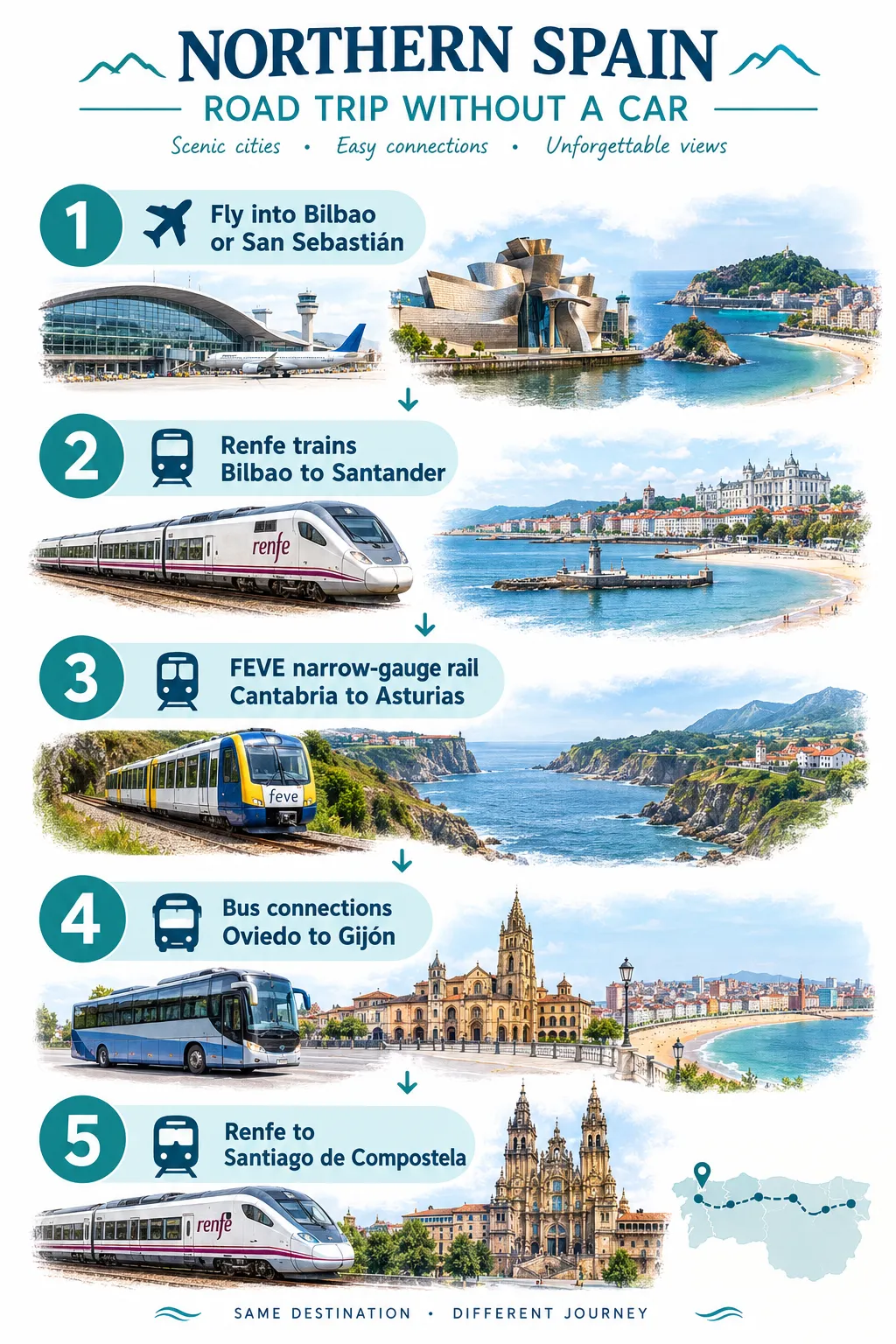
- Renfe connects Bilbao, Santander, and Oviedo with fast, comfortable services.
- FEVE narrow-gauge rail runs a scenic coastal route from Bilbao all the way to Ferrol in Galicia – slow but beautiful.
- Renfe Alvia connects Oviedo to Santiago de Compostela in about 4 hours.
Northern Spain road trip guides note that a car is most valuable in Asturias and rural Galicia, where the best villages sit off main rail lines. If you’re car-free, base yourself in Oviedo and Gijón for Asturias, and use Santiago as your Galicia hub with day-trip buses.
Practical tip: Book FEVE tickets in advance in summer – it’s a popular route and carriages are small.
Best Coastal Towns to Visit in Asturias and Cantabria
The best coastal towns in Asturias and Cantabria are the ones most tourists skip entirely. The big cities get the attention, but the real character of the north lives in these smaller ports.
Top picks:
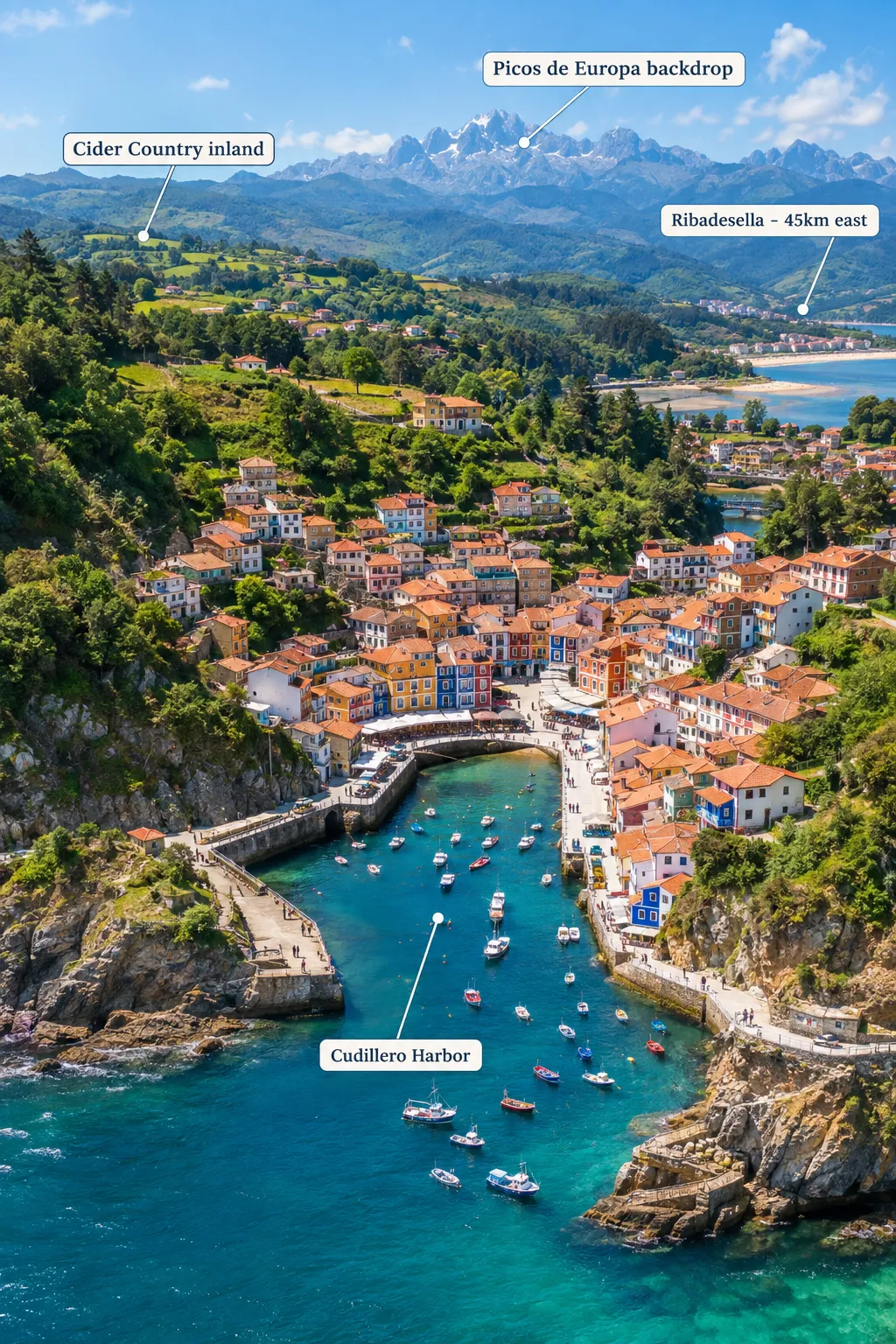
- Cudillero (Asturias) – a cliffside fishing village built into an amphitheater of green hills. Arrive early morning to watch the boats come in.
- Ribadesella (Asturias) – a charming estuary town with a great beach and excellent seafood restaurants along the harbourfront.
- Llanes (Asturias) – medieval walls, a pretty harbor, and the famous painted cubes (cubos de la memoria) on the breakwater.
- Santillana del Mar (Cantabria) – technically inland but close to the coast; arguably Spain’s most beautiful medieval village.
- Comillas (Cantabria) – a Modernista gem with a Gaudí building (El Capricho) that most visitors have never heard of.
According to 2026 coastal town round-ups, Getaria in the Basque Country also deserves a spot on this list – famous for charcoal-grilled turbot and the birthplace of Juan Sebastián Elcano.
If you’re planning a broader Spanish adventure, the Andalusia Spain itinerary covers a completely different side of the country worth comparing.
Should I Include Barcelona or Stick to the North?
Stick to the north. Barcelona is in Catalonia, on the Mediterranean coast, and adding it to a Northern Spain itinerary means a 6-8 hour train journey each way – time that’s far better spent in Galicia or Asturias.
Northern Spain and Barcelona are genuinely different trips. The north is green, Atlantic, food-driven, and relatively uncrowded. Barcelona is Mediterranean, beach-focused, and very busy in summer.
If you want to see both, plan separate trips. For your first visit to Spain’s must-see places, the north alone is more than enough for two weeks.
Exception: If you’re flying in and out of different airports, a Barcelona arrival or departure can work logistically. But don’t try to sightsee there and do the full northern route in 14 days – something will feel rushed.
What’s the Cheapest Time to Visit Northern Spain – and How Much Does It Cost?
September and October are the best months for value. Crowds thin out after the Spanish summer holidays end in late August, and prices for accommodation drop noticeably.
Flight-fare data from late August 2026 showed Asturias flights dropping from around €299 in July to €106 in September – a drop of over 60% – making shoulder season significantly cheaper for budget-conscious travelers.
Rough daily budget estimates for 2026:
- Budget traveler: €60-80/day (hostels, pintxos bars, self-catering some meals)
- Mid-range: €100-150/day (3-star hotels, restaurant lunches and dinners, day trips)
- Comfortable/luxury: €200-300+/day (boutique hotels, Michelin dining, private transfers)
What drives costs up:
- One-night hotel stops (always more expensive than multi-night stays)
- Dining at Michelin-starred restaurants without booking ahead
- Renting a car in peak July-August
What keeps costs down:
- Eating the menú del día (set lunch menu) – usually €12-15 for three courses with wine
- Staying in smaller towns rather than San Sebastián city center
- Traveling in September or October
How Do I Get Around Northern Spain by Train?
Northern Spain has two main rail systems that work well together for a 2 week itinerary.
Renfe (the national network) handles the main city connections – Bilbao to Santander, Santander to Oviedo, and Oviedo to Santiago. These are fast, reliable, and bookable online at renfe.com.
FEVE (Ferrocarriles de Vía Estrecha) runs a narrow-gauge coastal line hugging the Atlantic from Bilbao to Ferrol. It’s slower than Renfe but passes through tiny villages and coastal scenery that the main line misses entirely. Think of it as the scenic option.
Northern Spain itinerary guides recommend combining both: use Renfe for the longer legs and FEVE for a day or overnight trip through Cantabria or Asturias.
Key train times to know:
- Bilbao to San Sebastián: 1 hour (Renfe)
- San Sebastián to Santander: 2.5 hours (Renfe)
- Santander to Oviedo: 3 hours (Renfe)
- Oviedo to Santiago: 4 hours (Renfe Alvia)
What Hidden Gems Do Most Tourists Miss in Northern Spain?
Most tourists stick to San Sebastián, Bilbao, and Santiago. The real discoveries happen in between.
Hidden gems worth going out of your way for:
- Mundaka (Basque Country) – a tiny surf village at the mouth of the Urdaibai estuary, home to one of Europe’s best left-hand waves.
- Getaria (Basque Country) – charcoal-grilled turbot on a terrace above the sea. Order the rodaballo and don’t argue with the waiter about how it’s cooked.
- Potes (Cantabria) – a mountain village in the Liébana valley, gateway to the Picos de Europa and home to orujo liqueur distilleries.
- Taramundi (Asturias) – a Celtic-heritage village famous for hand-forged knives and traditional hórreos (raised granaries).
- Cambados (Galicia) – the albariño wine capital of the Rías Baixas, with a beautiful ruined church and excellent seafood.
- Ribadeo (Galicia/Asturias border) – the Cathedrals Beach (Playa de las Catedrales) here has rock arches that look almost impossible.
For more inspiration on finding what crowds miss, check out hidden gems in Italy – a similar approach works brilliantly in northern Spain.
Is Northern Spain Good for Families with Kids?
Northern Spain works very well for families. The pace is slower than Mediterranean resorts, the beaches are less crowded, and there’s a good mix of outdoor activities and cultural stops.
Family-oriented 2026 itineraries highlight the Urdaibai Bird Center near Mundaka, the Covadonga Lakes in the Picos de Europa, and farm stays in rural Asturias as particularly good with children.
Kid-friendly highlights:
- San Juan de Gaztelugatxe (the Game of Thrones island) – a dramatic rock connected by a stone bridge, great for older kids
- Picos de Europa – hiking, wildlife spotting, and cable cars
- Galician beaches – calmer and less crowded than Costa del Sol
- Cider house visits in Asturias – kids love watching the cider poured from height
The food culture is also family-friendly. Pintxos bars welcome children, lunch is the main meal (so early dinners aren’t an issue), and the menú del día is always good value for a family.
Is 2 Weeks Enough for Northern Spain?
Two weeks is enough if you’re selective. It’s not enough if you try to do everything.
The classic mistake is treating Northern Spain like a checklist – trying to hit every coastal village, every cathedral, and every food market in 14 days. That leads to long drives, rushed meals, and exhaustion.
Expert guides for 2026 consistently advise spending several nights in key hubs rather than moving every day. Three nights in San Sebastián feels luxurious; one night feels like you barely arrived.
If you want more time: A third week lets you add the Ribeira Sacra wine region in inland Galicia, the Camino del Norte walking stages between Santander and Ribadesella, or a deeper dive into the Picos de Europa.
If you only have 10 days: Cut Cantabria to one night (Santillana del Mar only) and compress Galicia to Santiago plus one coastal town.
Two weeks is the sweet spot. You’ll leave wanting more – which is exactly how a good trip should feel.
If you enjoy this style of itinerary planning, our solo travel in Spain guide covers the logistics side in more detail.
FAQ
What’s the best month to visit Northern Spain?
September is the best overall month – warm enough for beaches, cool enough for hiking, and significantly cheaper than July or August. October is excellent for foliage and even fewer crowds.
Do I need to speak Spanish in Northern Spain?
Basic Spanish gets you far. In the Basque Country, you’ll see Euskera (Basque language) on signs, but everyone speaks Spanish. English is common in tourist areas of San Sebastián and Bilbao, less so in smaller villages.
Is Northern Spain safe for solo travelers?
Yes, very. Northern Spain has low crime rates and is well-set-up for solo travel. San Sebastián and Santiago are particularly welcoming cities for people traveling alone.
What’s the Camino del Norte?
It’s the coastal pilgrim route to Santiago de Compostela, running along the northern coast from the French border. You can walk sections of it and combine them with a broader road trip itinerary.
Can I visit the Picos de Europa in 2 weeks?
Yes. Base yourself in Cangas de Onís or Potes for 2 nights and you can do the Covadonga Lakes, the Cares Gorge hike, and a cable car ride without feeling rushed.
What’s a menú del día?
A set lunch menu – usually three courses with bread, water, and wine – offered by most Spanish restaurants on weekdays. It typically costs €12-15 and is one of the best-value meals in Europe.
Is Northern Spain vegetarian-friendly?
It’s improving but still meat and seafood-heavy. Vegetarians do well with pintxos (many are cheese or vegetable-based), but ordering à la carte in smaller towns requires more effort. Galicia’s vegetable-based caldo gallego soup is a reliable option.
How far is it from San Sebastián to Santiago de Compostela?
About 600km by road. Driving straight through takes around 7 hours, but the whole point of this itinerary is to stop often and make it a 14-day journey.
What’s the difference between pintxos and tapas?
Pintxos (Basque) are typically served on bread or skewers and displayed on the bar counter – you pick what you want. Tapas (more common in southern Spain) are usually ordered from a menu or brought automatically with drinks.
Should I book restaurants in advance?
For Michelin-starred restaurants in San Sebastián, book months ahead. For regular pintxos bars and seafood restaurants, a same-day reservation or early arrival is usually enough.
Conclusion
A 2 week Northern Spain itinerary is one of the best trips you can plan in Europe right now. The food alone justifies the flight, and the combination of dramatic coastline, medieval towns, and genuine local culture puts it in a different league from more crowded destinations.
Your next steps:
- Book flights into Bilbao and out of Santiago de Compostela (or vice versa) to avoid backtracking.
- Reserve accommodation in San Sebastián and Santiago at least 2-3 months ahead – these fill up fast.
- Pick your shoulder season dates – September gives you the best balance of weather, value, and crowd levels.
- Plan one Michelin restaurant booking in San Sebastián if that’s on your list – the waiting lists are long.
- Download the Renfe app and book your main train legs before you leave home.
The north rewards slow travel. Give it the two weeks it deserves, eat everything, and don’t rush the cider.


