


Last updated: September 16, 2026
Quick Answer: A well-planned Kyoto itinerary 4 days route divides the city into four geographic zones – East, Northwest, Central, and South – so each day stays in one area. This approach cuts transit time significantly, lets you walk between most sites, and avoids the exhausting zig-zagging that wastes hours on Kyoto’s busy bus network.
Key Takeaways
- Split your 4 days by district: East (Day 1), Northwest (Day 2), Central (Day 3), South/East (Day 4)
- Arrive at Fushimi Inari by 6:00 AM – crowds build fast after 9:00 AM
- Stay near Kyoto Station or central Kyoto for the best rail and bus access
- A 1-day bus pass works well for central days; JR lines are faster for Arashiyama and Fushimi Inari
- You can realistically visit 4-6 major sites per day without rushing
- 4 days is the sweet spot – enough to see iconic temples plus quieter corners
- Families and solo travelers can both follow this route with minor adjustments
- Booking Kinkaku-ji and Kiyomizu-dera early morning avoids the worst crowds
- A Nara day trip fits naturally into Day 3 or Day 4 without breaking the structure
- Budget roughly 8,000-12,000 yen per day for entry fees, transport, and food (estimate based on 2026 typical costs)
What’s the Best Way to Spend 4 Days in Kyoto Without Wasting Time Traveling
The single best strategy is to assign each day to one geographic zone and never cross the city twice. Kyoto looks compact on a map, but bus travel between distant districts can eat 45-60 minutes each way.
According to multiple 2026 itinerary guides, the most efficient macro-pattern runs: Day 1 in East Kyoto (Fushimi Inari, Kiyomizu-dera, Gion), Day 2 in Northwest (Kinkaku-ji, Ryoan-ji, Arashiyama), Day 3 in Central (Philosopher’s Path, Nijo Castle, Nishiki Market), and Day 4 in South/East (Sanjusangen-do, Nanzen-ji, Higashiyama).
Why this works:
- Most sites within each zone are walkable from each other
- You use one bus line or one train line per day
- Evening dining naturally stays in the same neighborhood
- No early morning rush across the city
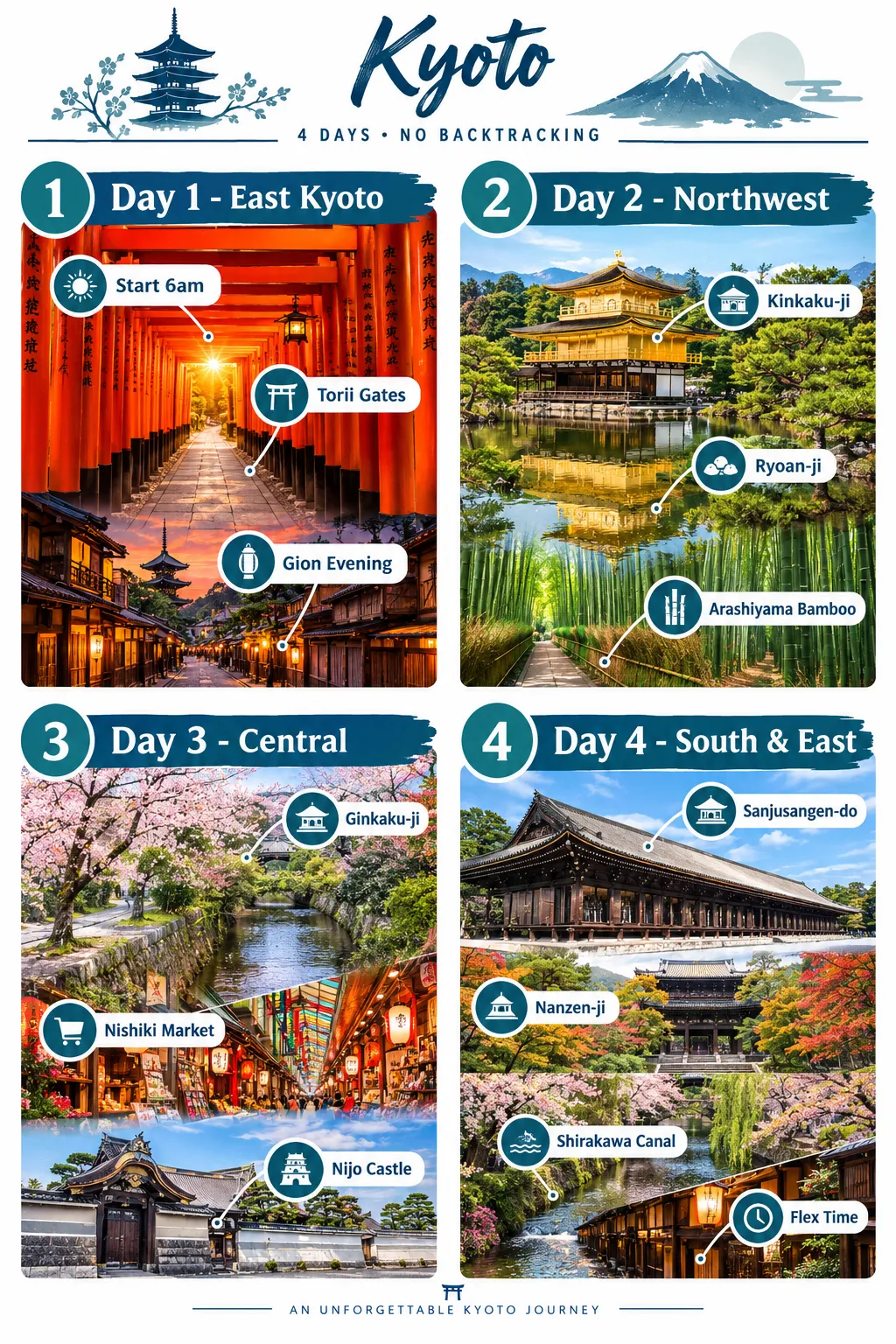
“The biggest mistake first-timers make in Kyoto is building a wish list without checking where things actually are on the map.” – common advice from experienced Japan travelers
The Day-by-Day Kyoto Itinerary 4 Days Breakdown
This is the core of the no-backtracking route. Each day is a tight geographic cluster.
Day 1 – East Kyoto and Gion
Start at Fushimi Inari Taisha by 6:00 AM. The famous torii gate tunnels are genuinely magical before tour groups arrive. A February 2026 Reddit trip report describes a 6:00 AM start as essential, not optional.
After Fushimi, take the JR Nara Line north to Tofuku-ji, then walk or bus to Kiyomizu-dera. The temple opens at 6:00 AM and gets busy quickly, so aim to arrive by 8:30 AM.
Afternoon: walk Ninenzaka and Sannenzaka lanes, then head into Gion for early evening. Finish with dinner on Pontocho Alley.
Day 2 – Northwest: Kinkaku-ji, Ryoan-ji, Arashiyama
Take a direct bus from central Kyoto to Kinkaku-ji (the Golden Pavilion) first thing. Then walk 20 minutes to Ryoan-ji for the famous rock garden.
Afternoon: take the bus or a taxi to Arashiyama. Walk the bamboo grove, visit Tenryu-ji’s garden, and stroll along the Oi River. This northwest cluster is a textbook no-backtracking design because all three major sites sit within a 4 km radius.
Day 3 – Central: Philosopher’s Path, Nijo Castle, Nishiki Market
Start at Ginkaku-ji (Silver Pavilion) and walk south along the Philosopher’s Path. This 2 km canal-side walk links several smaller temples and is best mid-morning before the heat.
After lunch, head west to Nijo Castle, then south to Nishiki Market for an afternoon food crawl. This day has the most walking but the least transit stress.
Day 4 – South and East: Sanjusangen-do, Nanzen-ji, Shirakawa Canal
Open with Sanjusangen-do, one of Kyoto’s most underrated temples (1,001 wooden statues). Then move north to Nanzen-ji and its famous aqueduct. End the afternoon along the Shirakawa Canal in Gion Shimbashi – one of Kyoto’s most photogenic streets.
This day also works as a flex day for revisiting a favorite neighborhood or doing a short e-bike tour.
How Many Temples Can You Realistically Visit in 4 Days in Kyoto
Realistically, 4-6 major sites per day is comfortable without rushing. That adds up to 16-24 sites over four days.
The key is not counting every sub-temple or garden as a separate “site.” For example, the walk from Kinkaku-ji to Ryoan-ji to Ninna-ji is one continuous experience, not three separate trips.
Realistic daily site count:
- Day 1: Fushimi Inari, Tofuku-ji, Kiyomizu-dera, Ninenzaka, Gion, Pontocho = 5-6 sites
- Day 2: Kinkaku-ji, Ryoan-ji, Arashiyama bamboo grove, Tenryu-ji = 4 sites (but very full)
- Day 3: Ginkaku-ji, Philosopher’s Path temples, Nijo Castle, Nishiki Market = 4-5 sites
- Day 4: Sanjusangen-do, Yasaka Pagoda, Nanzen-ji, Shirakawa Canal = 4 sites
Don’t over-schedule. Kyoto rewards slow walking, not speed-running.
Kyoto Itinerary 4 Days vs 3 Days: What’s the Difference
Three days in Kyoto means cutting one full zone. Most 3-day plans drop either the Central day or the South/East day, which means missing either Nijo Castle and Nishiki Market or Sanjusangen-do and Nanzen-ji.
Four days gives you one extra zone plus breathing room. Expert guides from 2026 consistently frame 3 days as a minimum and 4 days as the comfortable standard for first-time visitors who want both iconic sites and quieter corners.
Choose 3 days if: you’re combining Kyoto with Tokyo, Osaka, and Nara in a tight Japan itinerary.
Choose 4 days if: Kyoto is a primary destination and you want to explore beyond the top 5 temples.
If you’re planning a broader trip, check out this Edinburgh itinerary 4 days guide for how a similar zone-by-zone approach works in another historic city.
Best Neighborhoods to Stay in Kyoto for a 4-Day Trip
Kyoto Station area is the top pick for a no-backtracking itinerary. JR lines run directly to Arashiyama (Saga-Arashiyama Station) and Fushimi Inari (Inari Station), which means two of your four days start with a fast, direct train instead of a slow bus.
A 4-day itinerary anchored at a Kyoto Station hotel confirms that using JR lines from the station keeps transfers linear and predictable.
Gion/Higashiyama is the most atmospheric option. You’re walking distance from Day 1 and Day 4 sites. The tradeoff is slightly longer transit to Arashiyama and Kinkaku-ji.
Downtown (Kawaramachi/Shijo) splits the difference – central for buses, good food scene, easy access to Nishiki Market.
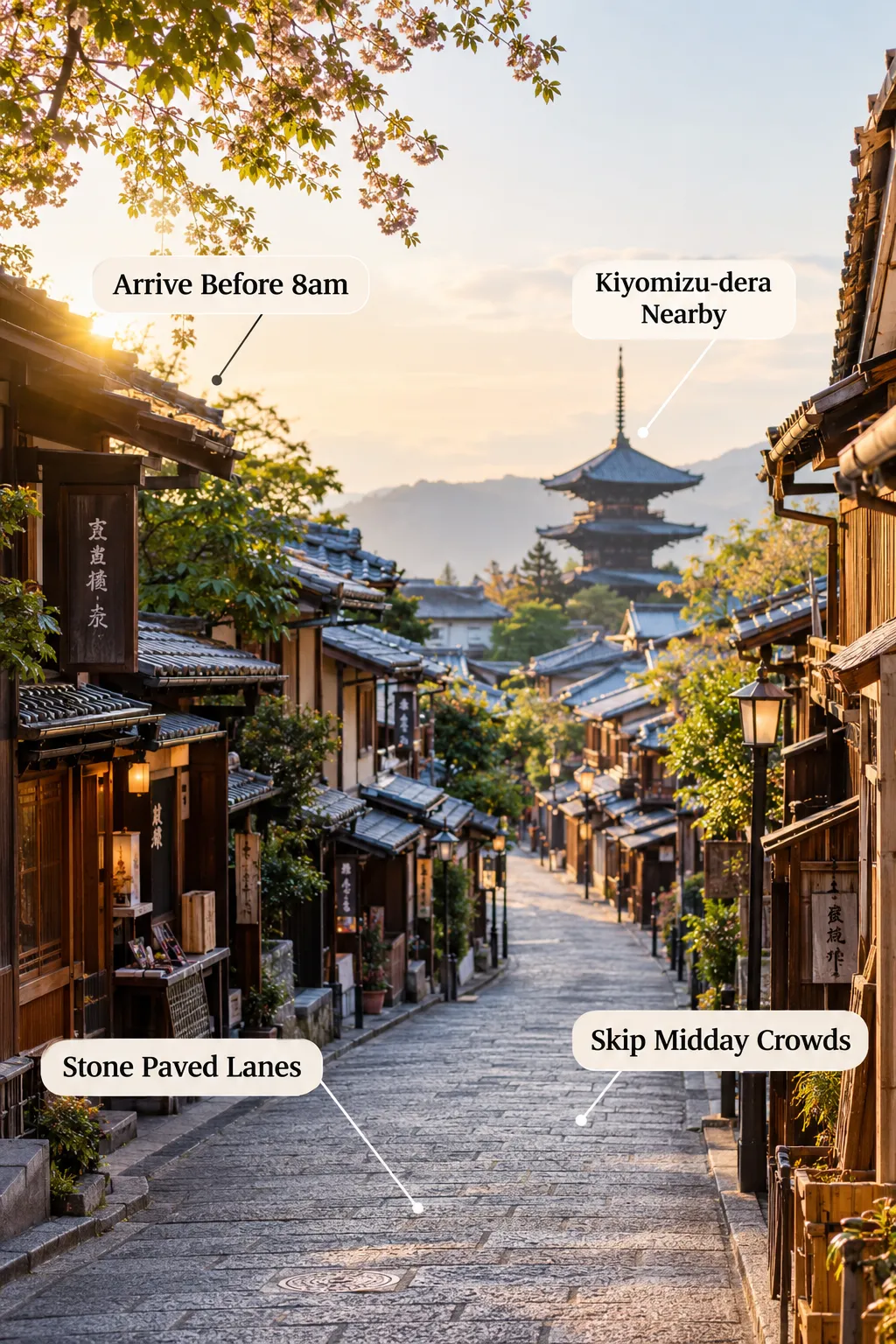
Quick rule: Stay near Kyoto Station if you prioritize efficiency. Stay in Gion if you prioritize atmosphere.
Should I Get a Kyoto Bus Pass for 4 Days or Just Pay Per Ride
The answer depends on which days you’re planning. A 1-day bus pass (currently 700 yen per day as of 2026) makes sense for Central days when you’re hopping between Nijo Castle, Nishiki Market, and Ginkaku-ji.
For Arashiyama and Fushimi Inari days, the JR lines from Kyoto Station are faster and more direct than buses – and a bus pass doesn’t cover JR.
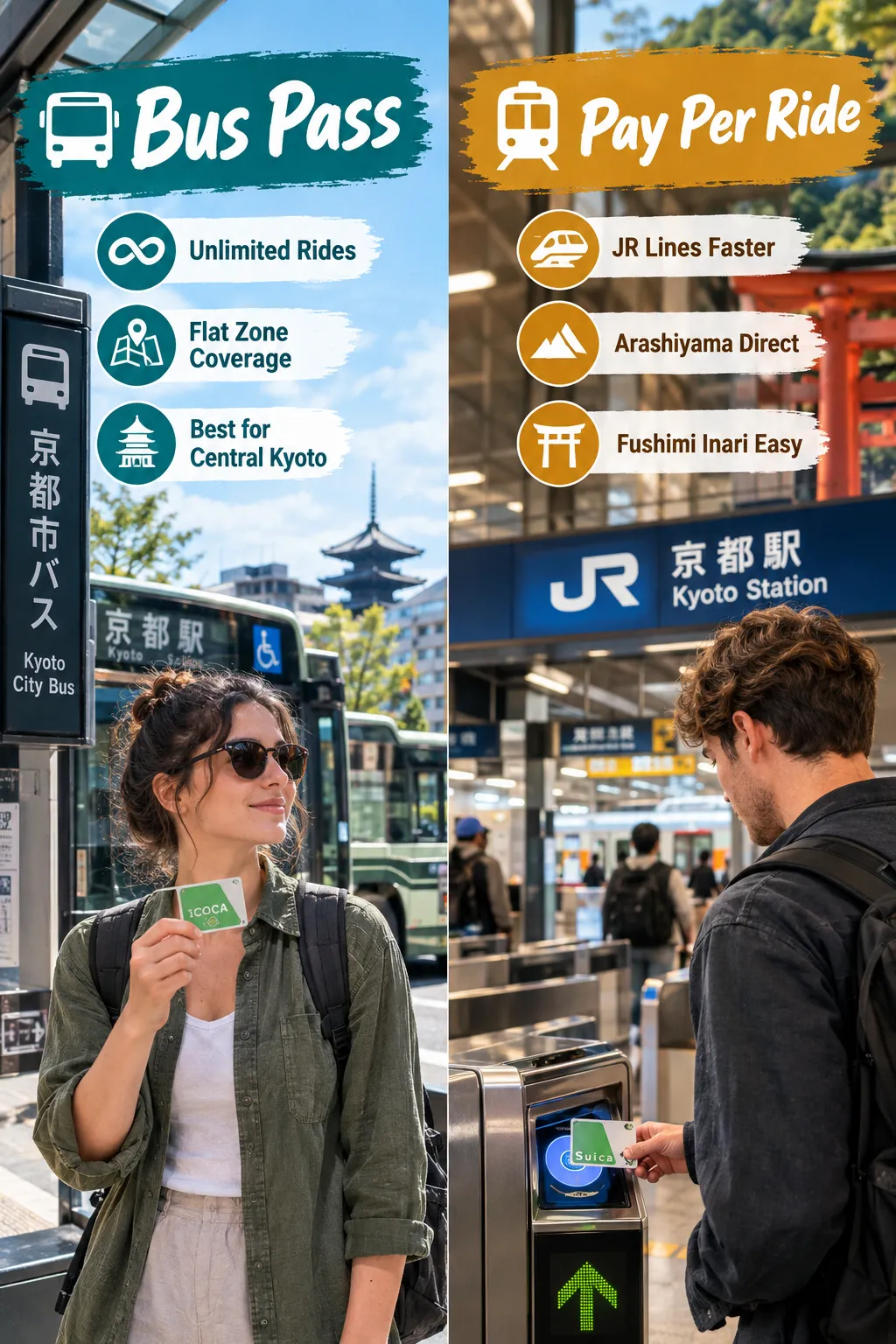
Practical breakdown:
- Day 1 (Fushimi Inari, East Kyoto): Use JR + pay-per-ride bus or walk
- Day 2 (Kinkaku-ji, Arashiyama): Mix of bus pass and JR
- Day 3 (Central): 1-day bus pass makes sense
- Day 4 (South/East): Pay-per-ride or walk between sites
An IC card (Suica or ICOCA) loaded with credit is the most flexible option overall. You can tap in and out of buses, subways, and JR lines without fumbling for exact change.
Kyoto Itinerary 4 Days for First-Time Visitors: What Not to Miss
For first-timers, the non-negotiables are Fushimi Inari, Kinkaku-ji, Kiyomizu-dera, Arashiyama bamboo grove, and Gion. Those five cover the “classic Kyoto” experience most people come for.
A first-timer guide updated in August 2026 treats four days as the standard and designs each day to avoid rushing or unnecessary zig-zagging.
Don’t miss these underrated spots:
- Sanjusangen-do – 1,001 warrior statues, almost never crowded
- Philosopher’s Path in spring (cherry blossoms) or autumn (maples)
- Pontocho Alley at dusk – narrow lantern-lit dining lane
- Nishiki Market – Kyoto’s “kitchen,” great for a food crawl lunch
Skip if time is tight:
- Heian Shrine (beautiful but large and time-consuming)
- Nijo Castle interior (impressive but can feel rushed in 45 minutes)
Is 4 Days Enough Time in Kyoto or Should I Stay Longer
Four days is enough for a thorough first visit. You’ll cover all major districts, see the headline temples, and still have time for food, shopping, and wandering.
Five or more days makes sense if you want to add a Nara day trip, explore Uji (matcha culture and Byodoin Temple), or revisit favorites at a slower pace.
A comprehensive 4-or-5-day Kyoto plan updated in September 2026 frames four days as the sweet spot and five days as a luxury add-on rather than a necessity.
Kyoto Itinerary 4 Days with Kids: What Works Best
The no-backtracking structure actually works better with kids because it reduces time on crowded buses and keeps each day geographically simple.
Family-friendly adjustments:
- Swap Ryoan-ji (abstract rock garden) for Ninna-ji (beautiful and less crowded)
- Add Kyoto Railway Museum near Kyoto Station – kids love it
- Arashiyama is excellent for families: bamboo grove, river boats, monkey park
- Avoid Fushimi Inari’s full hike with young children – the lower torii section (30-45 minutes) is enough
Build in longer lunch breaks and one “slow afternoon” per two days. Kids tire faster in heat, and Kyoto in summer is genuinely hot.
How to Avoid Crowds in Kyoto During a 4-Day Visit
The most effective tactic is shifting popular sites to the very start of the day. Multiple 2026 guides recommend taking the earliest train to Fushimi Inari to beat tour groups, which typically arrive after 9:00 AM.
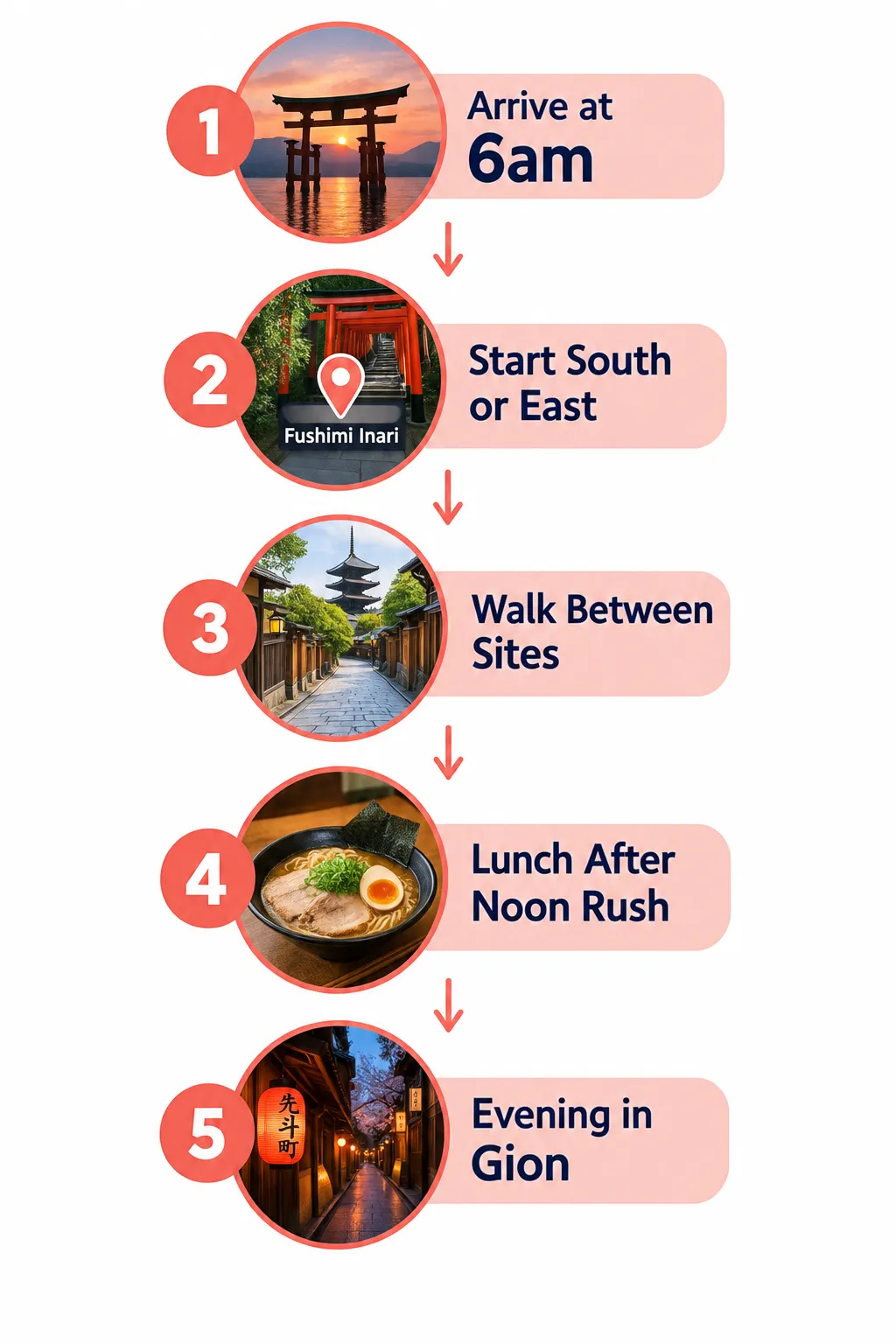
Crowd-beating tactics that actually work:
- Arrive at Fushimi Inari by 6:00 AM – the upper gates are nearly empty
- Visit Kiyomizu-dera before 8:30 AM (it opens at 6:00 AM)
- Do the Arashiyama bamboo grove before 8:00 AM
- Save Nishiki Market for late morning (11:00 AM-12:00 PM) when it’s lively but not packed
- Walk Gion streets after 7:00 PM for the best atmosphere with fewer tour groups
Weekdays are noticeably less crowded than weekends. If your trip overlaps with a Japanese public holiday, adjust by front-loading popular sites even earlier.
Kyoto 4-Day Itinerary in Spring vs Autumn: Which Is Better
Both seasons are genuinely excellent, but they offer different experiences.
Spring (late March to mid-April): Cherry blossoms transform the Philosopher’s Path, Maruyama Park, and Arashiyama into something extraordinary. Crowds are at their peak, and accommodation prices spike. Book 3-6 months ahead.
Autumn (mid-November to early December): Maple foliage turns Tofuku-ji, Eikan-do, and Arashiyama vivid red and orange. Crowds are slightly smaller than spring, and the light is softer. Many photographers consider autumn the better season.
Summer (June-August): Hot and humid, but fewer foreign tourists. Gion Matsuri festival in July is spectacular.
Winter (December-February): Occasional snow on temple rooftops is magical. Very few crowds. Some gardens close or reduce hours.
For a first visit, autumn edges out spring slightly because the foliage is more spread across the city, giving you great visuals on every day of your itinerary.
Common Mistakes People Make Planning a 4-Day Kyoto Trip
Most mistakes come from treating Kyoto like a checklist rather than a city with geography.
Top mistakes to avoid:
- Mixing distant sites on the same day – e.g., Fushimi Inari in the morning and Kinkaku-ji in the afternoon means 90+ minutes of transit
- Underestimating Fushimi Inari – the full hike to the summit takes 2-3 hours; plan accordingly
- Skipping early mornings – the best light and smallest crowds are before 8:30 AM
- Over-relying on buses – JR lines are faster for key sites and less affected by traffic
- Not booking accommodation early – Kyoto fills up fast in spring and autumn, especially near Gion and Kyoto Station
A detailed trip report from a 2026 traveler also notes that leaving one afternoon unscheduled – a “flex window” – consistently leads to better experiences than cramming in extra sites.
Can You Do Kyoto in 4 Days Without a Tour Guide
Absolutely. Kyoto is one of the most solo-traveler-friendly cities in Japan. Signage at major temples is in English, IC cards handle all transport payments, and Google Maps works reliably for bus and train navigation.
A fully self-guided 4-day Kyoto itinerary updated in August 2026 confirms that first-timers can navigate the entire route independently with basic preparation.
What you actually need:
- A downloaded offline map (Google Maps or Maps.me)
- An IC card (buy at any major station)
- A few key phrases in Japanese (thank you, excuse me, where is…)
- Pre-booked accommodation in a central neighborhood
Tour guides add value for deep cultural context at specific sites like Nijo Castle or Ryoan-ji, but they’re not necessary for logistics.
Kyoto 4-Day Itinerary Budget: How Much Should I Spend
A realistic daily budget for Kyoto in 2026 breaks down roughly as follows (these are estimates based on typical costs reported by travelers):
| Category | Estimated Daily Cost |
|---|---|
| Temple entry fees (3-5 sites) | 1,500-3,000 yen |
| Transport (bus/train) | 500-1,000 yen |
| Lunch | 1,000-2,000 yen |
| Dinner | 2,000-5,000 yen |
| Snacks/drinks | 500-1,000 yen |
| Total per day | ~5,500-12,000 yen |
Accommodation adds 8,000-25,000 yen per night depending on hotel vs. guesthouse vs. ryokan.
A 4-day Kyoto itinerary guide notes that many of Kyoto’s best experiences – walking Ninenzaka, the Philosopher’s Path, Gion streets at dusk – are completely free. Budget travelers can keep costs low by focusing on these and limiting paid temple entries to 2-3 per day.
Planning a multi-country trip? The 3-day Florence Italy itinerary uses a similar zone-by-zone approach that pairs well with a Japan trip.
FAQ
How many days is ideal for Kyoto?
Four days is the widely recommended sweet spot for first-time visitors. It covers all major districts without rushing, and gives you one flex day for Nara or a revisit.
What is the best first day in Kyoto?
Start with East Kyoto: Fushimi Inari at 6:00 AM, Kiyomizu-dera by 8:30 AM, then Gion in the evening. This keeps your entire first day in one corridor.
Is Kyoto walkable?
Within each district, yes. Between districts, no – use buses or JR trains. The no-backtracking approach maximizes walking and minimizes transit.
Do I need a JR Pass for Kyoto?
Not for Kyoto alone. An IC card covers all city buses, the subway, and local JR lines. A JR Pass is worth it only if you’re also traveling between cities (e.g., Tokyo-Kyoto-Osaka).
When should I book Kyoto accommodation?
At least 3 months ahead for spring and autumn visits. For summer and winter, 4-6 weeks is usually sufficient.
Can I do a Nara day trip from Kyoto?
Yes. Nara is 45 minutes from Kyoto by JR or Kintetsu train. It fits naturally into Day 3 or as a Day 4 option without disrupting the rest of your Kyoto structure.
Is Kyoto safe for solo travelers?
Kyoto is extremely safe. Solo travelers, including solo female travelers, report feeling comfortable throughout the city at all hours.
What’s the best way to get from Osaka to Kyoto?
The JR Shinkaisoku (Special Rapid) train runs from Osaka to Kyoto in about 15 minutes and costs roughly 580 yen. It’s the fastest and cheapest option.
Are Kyoto temples open year-round?
Most major temples are open year-round, though hours vary. Some gardens have reduced winter hours. Always check the official site before visiting.
What should I eat in Kyoto?
Kyoto specialties include kaiseki (multi-course cuisine), tofu dishes, matcha sweets, yudofu (hot tofu), and obanzai (small vegetable dishes). Nishiki Market is the best place to sample all of these in one walk.
Conclusion
A Kyoto itinerary 4 days built around the no-backtracking principle genuinely saves hours – and more importantly, it saves energy. By staying in one zone per day, you spend more time walking through beautiful streets and less time wedged into a crowded city bus.
Your action steps:
- Map your four zones: East, Northwest, Central, South/East
- Book accommodation near Kyoto Station or central Kyoto
- Load an IC card the moment you arrive
- Set your alarm for 5:45 AM on Day 1 – Fushimi Inari at dawn is worth it
- Leave at least one afternoon unscheduled as a flex window
Kyoto rewards the traveler who slows down. Four days, done right, gives you exactly enough time to do that.
If you’re building a longer Asia itinerary, the 2 weeks in Australia itinerary is another great zone-by-zone route worth reading before you finalize your plans.