
Last updated: September 19, 2026
Quick Answer: A well-planned Joshua Tree National Park itinerary covers the west and central sections on Day 1, then the south and north sections on Day 2. Start each day before 8 AM to beat the heat and crowds. Two full days is the sweet spot – enough time to hike, boulder-watch, stargaze, and actually feel the desert without rushing.
Key Takeaways
- 🌵 Two days is the expert-recommended minimum for a satisfying Joshua Tree visit
- 🚗 The park has no gas stations – fill up before you enter
- 🌅 Sunrise at Keys View and sunset at Skull Rock are the two anchor moments of any good itinerary
- 💧 Bring at least 1 liter of water per person per hour of hiking in warm weather
- 🎟️ The entrance fee is $35 per vehicle (valid for 7 days) as of 2026
- 🏕️ Camping inside the park is the best way to catch the night sky – book months in advance
- 🌡️ October through April offers the most comfortable temperatures for hiking
- 📍 The north entrance (Twentynine Palms) and west entrance (Joshua Tree town) are the two main access points
- 👨👩👧 Families with kids should prioritize Barker Dam, Cap Rock, and Skull Rock – all easy walks
- ⛽ Plan for roughly 50 miles of driving inside the park across two days
How Much Time Do You Actually Need at Joshua Tree National Park?
Most visitors need at least two full days to see the highlights without feeling rushed. One day is possible but requires skipping major stops. Three days lets you explore more remote areas.
The park covers over 790,000 acres, and the main scenic corridor alone is about 50 miles from the west entrance to the south exit. According to experienced Joshua Tree route planners, a two-day visit hits all the iconic spots while leaving room to actually slow down and enjoy them.
If you only have one day, check out this Yosemite National Park 1-day itinerary for tips on maximizing a single-day national park visit – the same principles apply.
Can You Do Joshua Tree in One Day, or Do You Need Two?
One day is technically doable, but you’ll miss a lot. Two days is the right call for most travelers.
In a single day, you can realistically hit Skull Rock, Keys View, and Hidden Valley. But you’d skip Barker Dam, Cholla Cactus Garden, Cottonwood Spring, and any meaningful stargazing. One-day Joshua Tree guides consistently note that visitors who rush through in a day often wish they’d stayed longer.
Two days lets you:
- Hike at a comfortable pace in the cooler morning hours
- Catch both sunrise and sunset at iconic viewpoints
- Explore both the Mojave Desert section (north) and Colorado Desert section (south)
- Actually stargaze without exhaustion
What’s the Best Route for a 2-Day Joshua Tree National Park Itinerary?
The most efficient two-day route follows a west-to-east flow on Day 1, then a north-south loop on Day 2. This minimizes backtracking and keeps driving time under 2 hours each day.
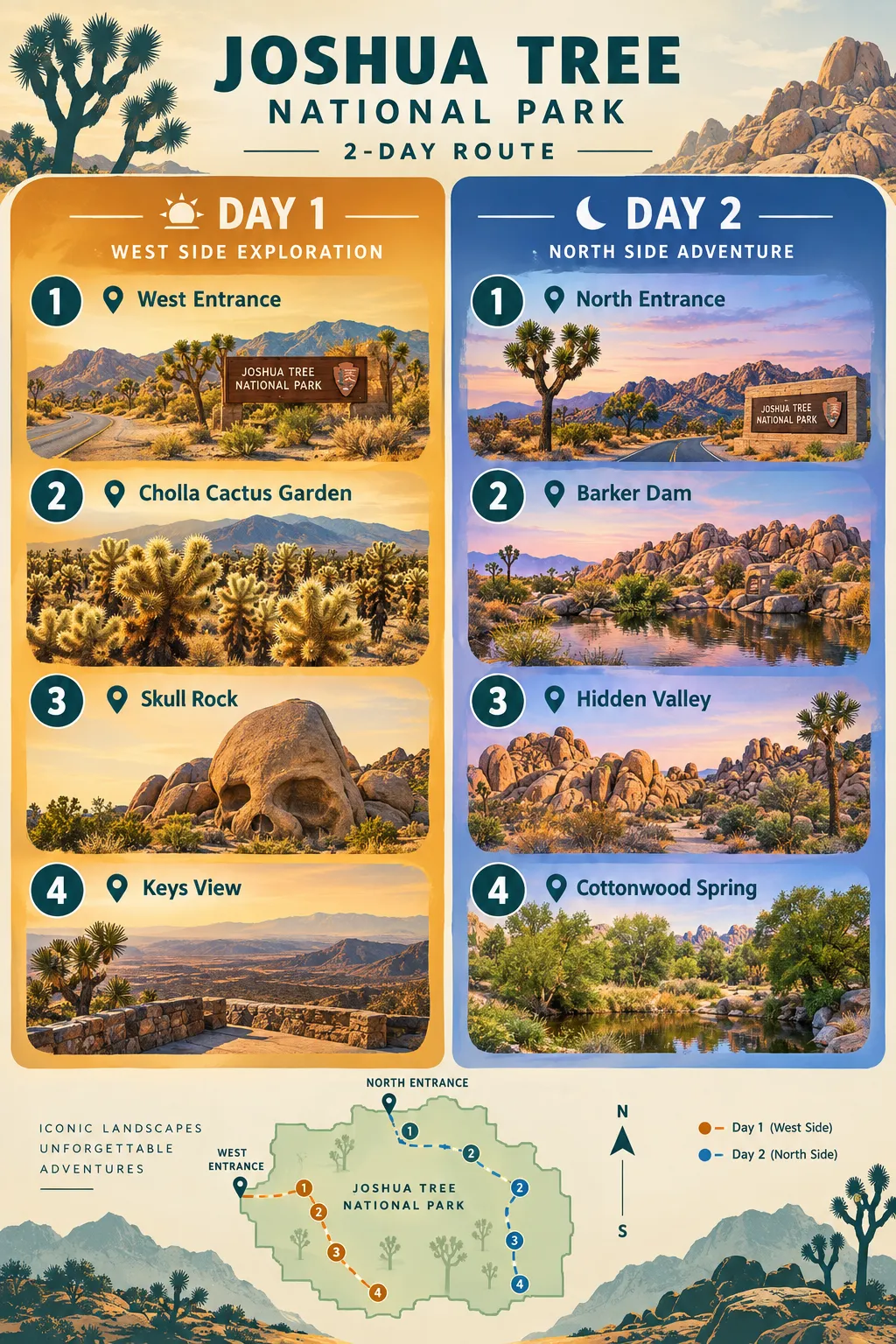
Day 1 – West and Central (Enter from the West Entrance):
- Arrive at the West Entrance by 7:30 AM
- Stop at the Cholla Cactus Garden (20 min)
- Hike Hidden Valley Trail (1 hour)
- Drive to Keys View for panoramic desert views (30 min)
- Lunch at a shaded picnic area near Jumbo Rocks
- Explore Skull Rock Trail in the late afternoon (1.5 hours)
- Stay for sunset near Skull Rock or Jumbo Rocks campground
Day 2 – North and South:
- Early start at Barker Dam Trail by 7 AM (wildlife is most active at dawn)
- Drive south through the park toward Cottonwood Spring
- Short walk at Cottonwood Spring Oasis (45 min)
- Return north and stop at Cholla Cactus Garden if you skipped it
- End the day at the north entrance area for dinner in Twentynine Palms
Detailed Joshua Tree itinerary guides confirm this west-central-south structure as the most time-efficient approach for a 2-day visit.
What’s the Difference Between North and South Joshua Tree?
The north section sits in the Mojave Desert and features the iconic Joshua trees, granite boulders, and most of the park’s popular hiking trails. The south section is Colorado Desert – flatter, hotter, and home to different plant life including the Cholla cactus and Cottonwood Spring oasis.
Most visitors spend 80% of their time in the north and central sections. The south is worth a half-day detour on Day 2, especially for the Cottonwood Spring oasis, which feels like a completely different park.
Choose the north if you’re there for the classic Joshua tree scenery and boulder scrambling.
Choose the south if you want fewer crowds and a more remote desert feel.
Joshua Tree Sunrise vs. Sunset – Which Is Better?
Both are worth experiencing, and a 2-day itinerary gives you the chance to do both. Sunrise at Keys View is cooler, quieter, and offers views of the Salton Sea and San Jacinto Mountains. Sunset near Skull Rock or Jumbo Rocks turns the boulders a deep orange-red.
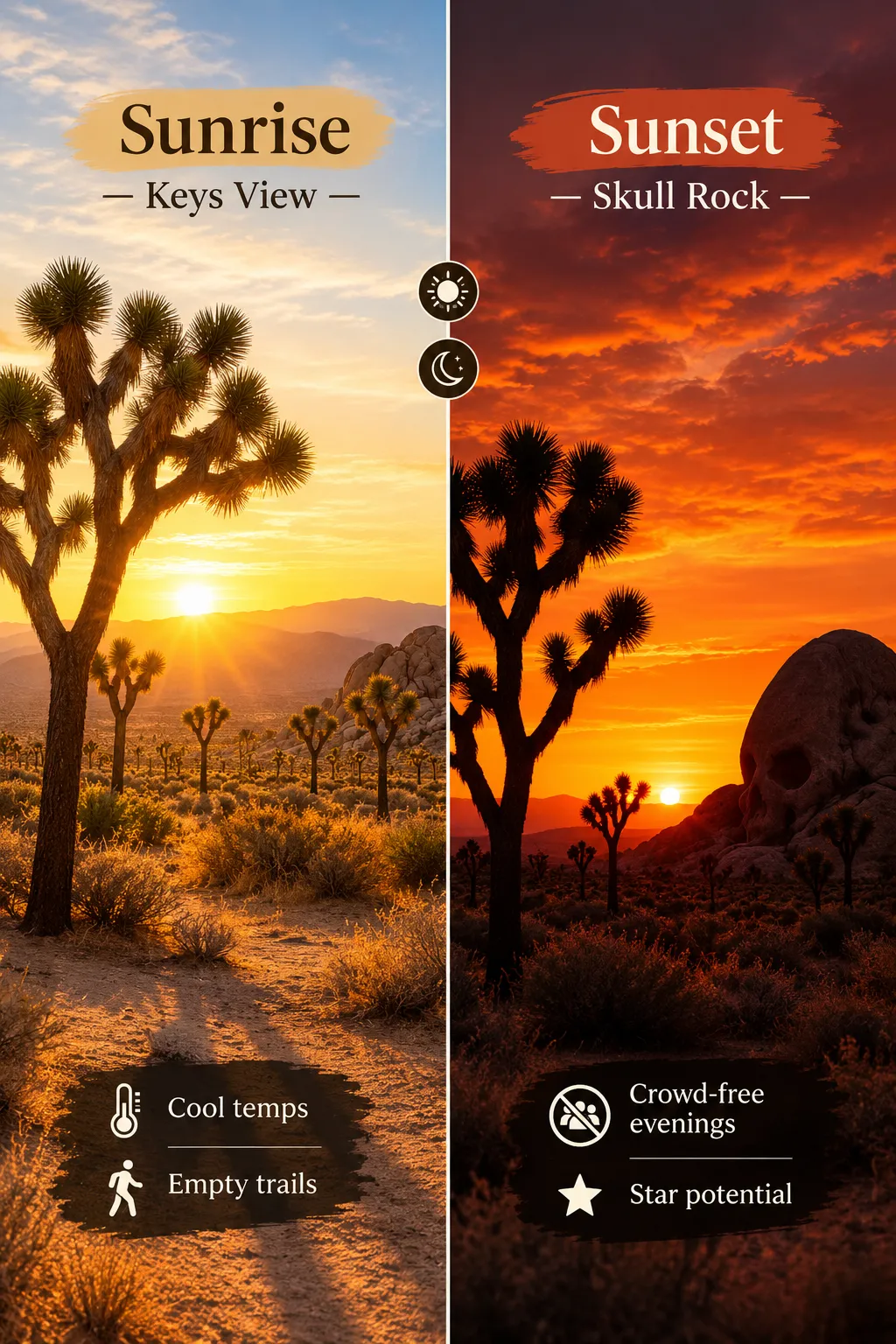
Sunrise wins for photographers and anyone who wants solitude. Sunset wins for dramatic color and the transition into stargazing.
Practical tip: Keys View sits at 5,185 feet elevation. It’s noticeably cooler than the valley floor, especially at sunrise. Bring a layer even in summer.
Best Hikes in Joshua Tree for Beginners
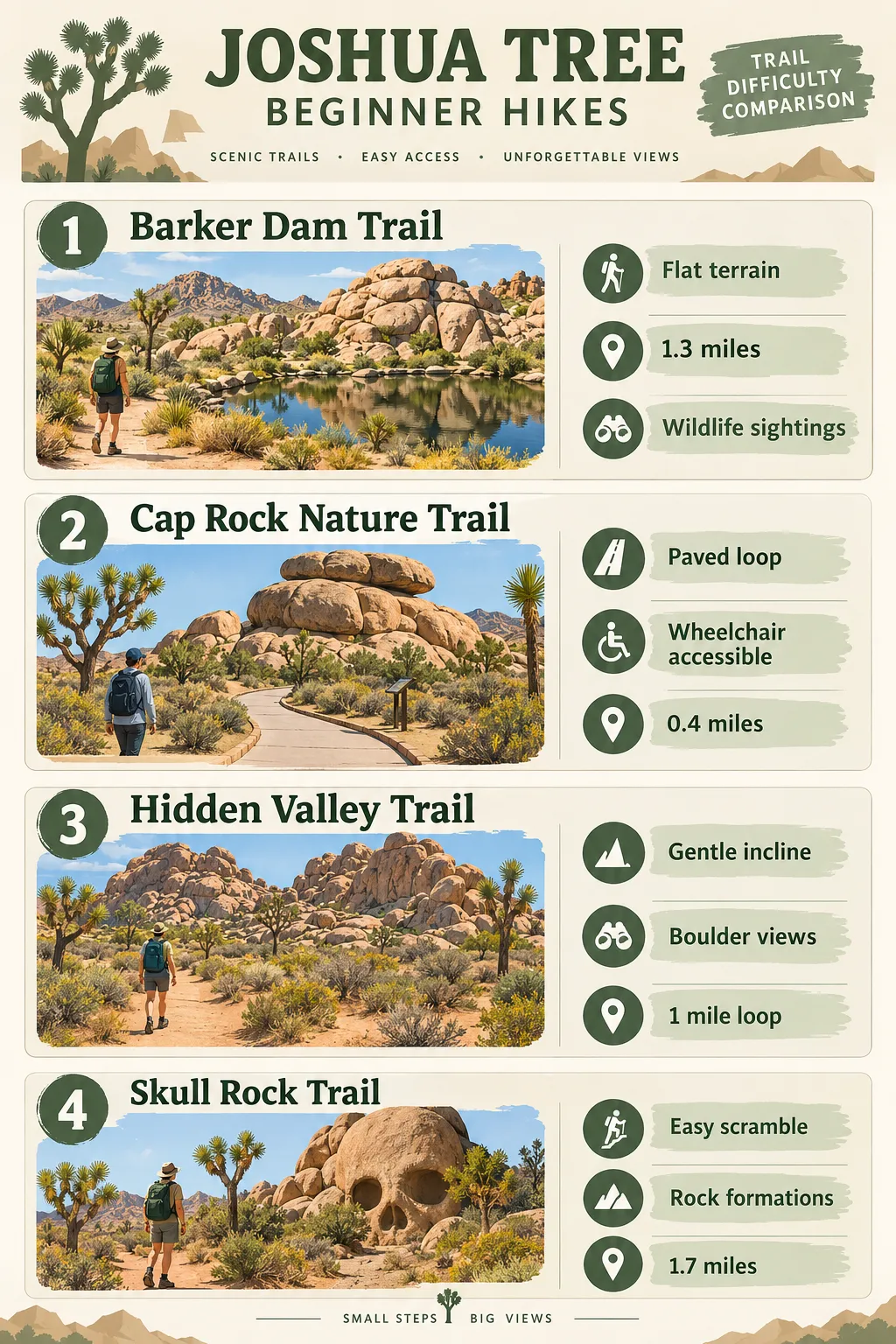
The best beginner hikes in Joshua Tree are Barker Dam Trail (1.3 miles, flat), Cap Rock Nature Trail (0.4 miles, paved), Hidden Valley Trail (1 mile loop), and Skull Rock Trail (1.7 miles, easy). All four are well-marked and require no technical skill.
Expert hiking guides for Joshua Tree consistently recommend these four as the core beginner circuit. Here’s a quick breakdown:
| Trail | Distance | Difficulty | Best For |
|---|---|---|---|
| Cap Rock | 0.4 miles | Very Easy | Families, wheelchair accessible |
| Hidden Valley | 1 mile | Easy | First-timers, classic scenery |
| Barker Dam | 1.3 miles | Easy | Wildlife, petroglyphs |
| Skull Rock | 1.7 miles | Easy | Boulder views, sunset |
Common mistake: People underestimate sun exposure on flat, easy trails. Even a 1-mile walk at noon in summer can be dangerous without water and sun protection.
Joshua Tree Itinerary with Kids – What Should You Skip?
With kids, skip the longer scrambles like Ryan Mountain (3 miles, steep) and focus on Skull Rock, Barker Dam, and Cap Rock. These three stops cover the best scenery with minimal physical demand.
Kids tend to love the boulder formations – there’s plenty of safe scrambling at Skull Rock and around Jumbo Rocks campground. Barker Dam also has a small lake that often attracts birds and bighorn sheep, which makes it a hit with younger visitors.
Skip with kids:
- Ryan Mountain (too long and exposed)
- Cottonwood Spring (long drive south, less visual payoff for children)
- Any trail that starts after 10 AM in summer
For more ideas on budget-friendly family vacations, that guide covers parks and destinations that work well for all ages.
Joshua Tree Park Entrance Fees and Hours
As of 2026, the entrance fee is $35 per vehicle, valid for 7 days. The park is open 24 hours a day, 365 days a year. Visitor centers have limited hours – the Oasis Visitor Center in Twentynine Palms is typically open 8:30 AM to 5 PM.
You can pay at the entrance station or in advance at recreation.gov. The America the Beautiful annual pass ($80) covers entry and is worth it if you’re visiting multiple national parks. If you’re planning a broader California road trip, see this 10-day California road trip itinerary for parks that pair well with Joshua Tree.
Note: Some facilities and roads may have seasonal restrictions. Check the official NPS website before your visit, especially for summer 2026 conditions.
How to Avoid Crowds on Your Joshua Tree Itinerary
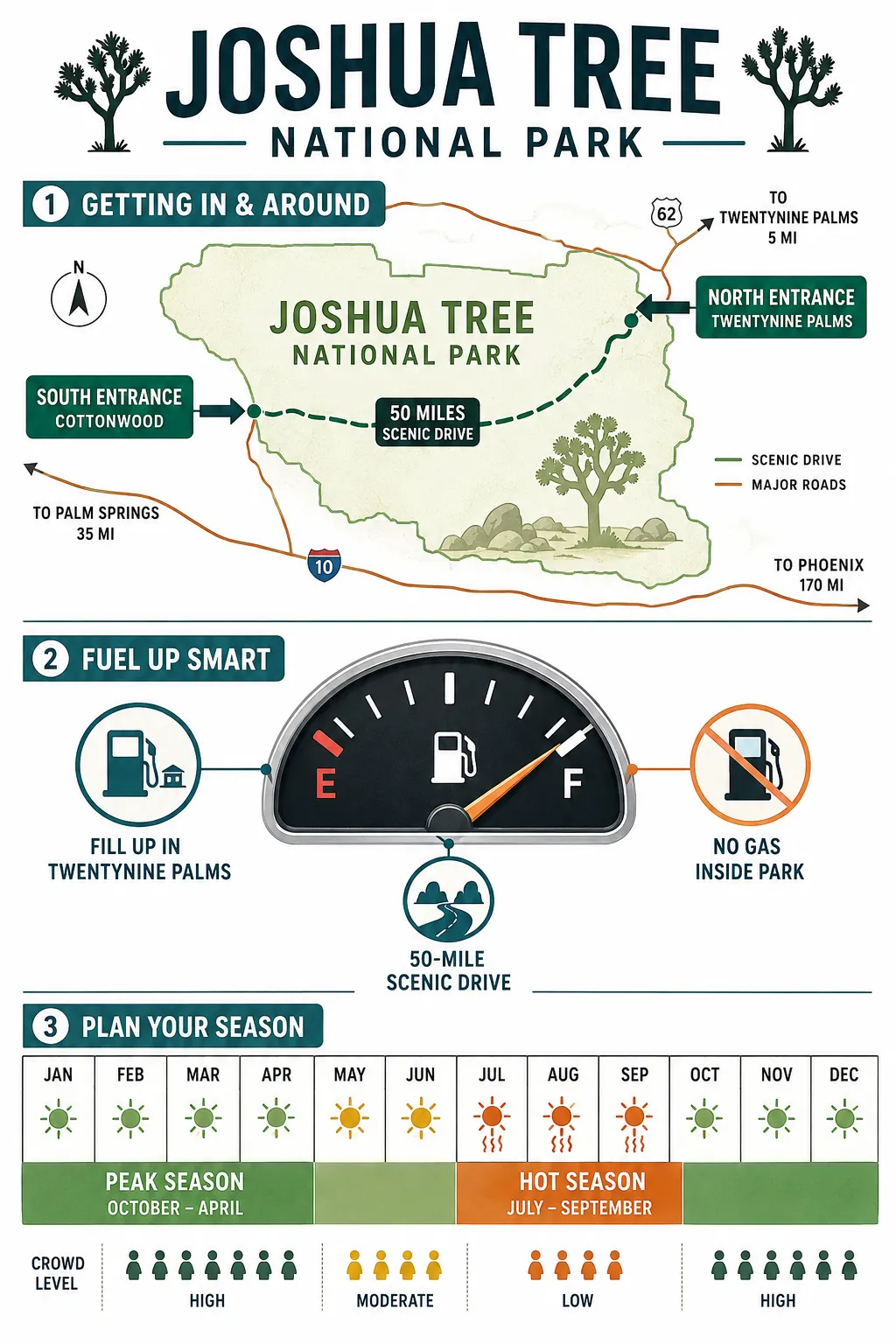
The single best crowd-avoidance strategy is an early start. Arrive at trailheads before 8 AM and you’ll often have them to yourself. Weekday visits are significantly quieter than weekends.
Park crowd data for September shows moderate visitor levels compared to the spring peak season, making fall a solid choice for a quieter experience.
Additional crowd-avoidance tips:
- Enter from the less-used north entrance (Twentynine Palms) rather than the west
- Hike Barker Dam on weekday mornings – it’s one of the most crowd-free popular trails
- Avoid the Hidden Valley parking lot between 10 AM and 2 PM on weekends
- Skull Rock is busiest at sunset on Saturdays – arrive 30 minutes early or go Sunday
Best Time of Year to Visit Joshua Tree
October through April is the best time to visit Joshua Tree. Temperatures are comfortable for hiking (50-75°F during the day), wildflowers bloom in March and April, and the skies are clear for stargazing.
AccuWeather’s Joshua Tree September data shows average highs around 95°F in September, with cooler mornings in the low 70s. That makes early-morning hiking viable in early fall, but midday heat is still intense.
Season summary:
- Spring (March-May): Best overall. Wildflowers, mild temps, higher crowds
- Fall (Oct-Nov): Great temperatures, fewer crowds than spring
- Winter (Dec-Feb): Cold nights, uncrowded, stunning clear skies
- Summer (June-Sept): Very hot midday. Only viable with very early starts
Joshua Tree 2-Day Itinerary with Camping or Hotels Nearby
Camping inside the park is the best option for stargazers and budget travelers. The closest hotels are in Twentynine Palms, Joshua Tree town, and Yucca Valley – all within 15-20 minutes of the park entrances.
Inside the park – campgrounds:
- Jumbo Rocks Campground (most popular, central location)
- Hidden Valley Campground (walk to trailheads)
- Cottonwood Campground (south entrance, quieter)
Book campsites months in advance for spring weekends. Cruise America’s Joshua Tree guide notes that RV camping is popular and the park accommodates larger vehicles at several campgrounds.
Hotels nearby:
- Twentynine Palms: budget-friendly motels and small inns
- Joshua Tree town: boutique vacation rentals and desert cabins
- Yucca Valley: chain hotels and more amenities
How Much Gas Do You Need for the Joshua Tree Scenic Drive?
Plan for at least half a tank before entering the park. There are no gas stations inside Joshua Tree National Park. The full scenic drive from west to south entrance is roughly 50 miles, but with detours and backtracking, most visitors drive 60-80 miles over two days.
Fill up in Twentynine Palms, Joshua Tree town, or Yucca Valley before entering. Don’t rely on finding gas at the last minute – the nearest stations outside the park are 15-20 miles from the entrances.
Quick rule: If your tank is below half when you reach the entrance, go back and fill up. It’s not worth the risk in desert heat.
What Do People Regret Not Doing at Joshua Tree?
The most common regret is skipping the night sky. Joshua Tree is one of the best stargazing spots in Southern California, and most day visitors never experience it. The second most common regret is not doing Keys View at sunrise.
Experienced Joshua Tree visitors consistently mention these missed moments:
- Stargazing – the Milky Way is visible on clear nights from late summer through winter
- Keys View at sunrise – most people sleep in and miss it
- Barker Dam at dawn – wildlife is active and the light is stunning
- Slowing down – rushing between stops means missing the silence and scale of the desert
If you’re combining Joshua Tree with a broader Southwest trip, pairing it with Death Valley is a popular route that detailed Southwest itineraries cover well.
Joshua Tree Itinerary If You Only Like Easy Walks
If you prefer easy, low-effort walks, focus on Cap Rock (0.4 miles, paved), Skull Rock (1.7 miles, flat), and the Cholla Cactus Garden boardwalk (0.25 miles). These three stops cover the park’s most iconic scenery with minimal physical effort.
You can also drive the entire scenic corridor and stop at pullouts for views without hiking at all. The park is genuinely beautiful from the car, and many of the best boulder formations are visible right from the road.
Easy walk itinerary (Day 1):
- Cap Rock loop (30 min)
- Drive to Keys View (no hiking, just a short walk to the viewpoint)
- Skull Rock from the parking lot (45 min)
- Cholla Cactus Garden boardwalk (20 min)
This covers 4 of the park’s best stops in under 4 hours of total activity.
Conclusion
A well-structured Joshua Tree National Park itinerary makes the difference between a rushed drive-through and a genuinely memorable desert experience. Two days is the sweet spot – enough time to hike, stargaze, catch a sunrise, and actually feel the scale of the place.
Your action plan:
- Book your campsite or hotel at least 2-3 months ahead for spring visits
- Fill up your gas tank before entering the park
- Set an alarm for sunrise on at least one morning
- Pack more water than you think you need
- Download offline maps – cell service is unreliable inside the park
If you’re building a bigger California trip around this visit, the 10-day California road trip itinerary is a great starting point. And if you love national park adventures, the 3-day Lassen Volcanic National Park itinerary and Mount Rainier National Park itinerary are worth adding to your list.
The desert rewards patience. Go slow, start early, and stay for the stars.
FAQ
How many days should I spend at Joshua Tree National Park?
Two full days is the recommended minimum for most visitors. One day is possible but requires strict prioritization. Three days allows for more remote exploration and a relaxed pace.
What is the entrance fee for Joshua Tree in 2026?
The entrance fee is $35 per vehicle, valid for 7 days. The America the Beautiful annual pass ($80) covers entry and is worth it if you visit multiple national parks.
Is Joshua Tree good for beginners?
Yes. Several trails are flat, well-marked, and under 2 miles. Barker Dam, Cap Rock, Hidden Valley, and Skull Rock are all beginner-friendly and cover the park’s best scenery.
Can you see Joshua Tree in one day?
You can see the highlights in one day if you start early and skip the south section. But most visitors who do one day wish they’d stayed for two.
Where should I stay for Joshua Tree?
Camping inside the park (Jumbo Rocks or Hidden Valley campgrounds) is ideal for stargazing. Hotels in Twentynine Palms and Joshua Tree town are 15-20 minutes from the entrances.
Is there cell service in Joshua Tree?
Cell service is unreliable inside the park. Download offline maps (Google Maps or AllTrails) before you enter.
What time does Joshua Tree open?
The park is open 24 hours a day, 365 days a year. Visitor centers typically open at 8:30 AM.
Is Joshua Tree worth visiting in summer?
It’s manageable with very early starts (before 8 AM) and avoiding midday activity. Fall and spring are significantly more comfortable for hiking.
What should I bring to Joshua Tree?
Water (at least 1 liter per person per hour of hiking), sunscreen, a hat, snacks, a fully charged phone with offline maps, and a jacket for cool mornings and evenings.
Is Joshua Tree good for families with kids?
Yes. Skull Rock, Barker Dam, and Cap Rock are all kid-friendly. The boulder formations are a natural playground. Avoid long or exposed trails during midday heat.
Are there restaurants inside Joshua Tree National Park?
No. There are no restaurants or food vendors inside the park. Stock up on food and snacks in Twentynine Palms, Joshua Tree town, or Yucca Valley before entering.
What’s the best spot for stargazing in Joshua Tree?
Jumbo Rocks and the area around Keys View are popular stargazing spots. The park has minimal light pollution, and the Milky Way is visible on clear nights from late summer through winter.


