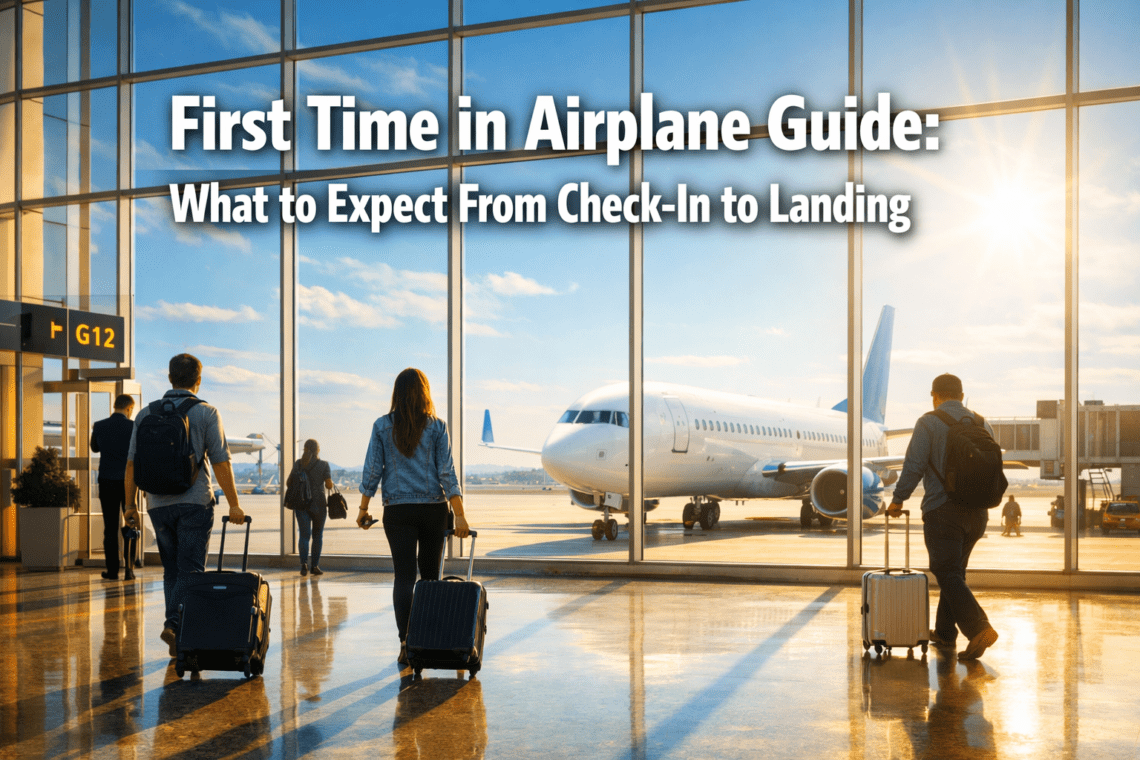
Quick Answer: Flying for the first time feels overwhelming, but the process is actually straightforward once you know what to expect. This first time in airplane guide walks you through every stage — check-in, security, boarding, the flight itself, and landing — so you arrive confident instead of confused. Arrive at least 2 hours before a domestic flight or 3 hours before an international one, and you’ll have plenty of time for each step.
Key Takeaways
- Arrive at the airport 2 hours early for domestic flights, 3 hours early for international flights [1]
- Check your airline’s website in advance to confirm your terminal and baggage allowances [1]
- Pack liquids in a clear, resealable bag and keep documents in an easy-to-reach pocket [2]
- Dress in loose, comfortable layers — cabin pressure can cause bloating and temperatures vary [1]
- Know your boarding group number before you reach the gate [2]
- Stow your carry-on in the overhead bin, but keep essentials (headphones, documents, snacks) at your seat [2]
- Turbulence is normal and rarely dangerous — seats near the front or center of the plane feel it less [1]
- The landing process takes about 20–30 minutes from descent to the gate; stay seated until the seatbelt sign turns off
How Do You Prepare Before You Even Get to the Airport?
Good preparation starts at home, not at the terminal. Before your travel day, confirm your flight details, pack strategically, and sort your documents.
Documents to have ready:
- Government-issued photo ID or passport
- Boarding pass (printed or saved to your phone)
- Visa or entry documents if traveling internationally
- Travel insurance confirmation (optional but smart)
Pack using a checklist so nothing gets forgotten. Focus on versatile, wrinkle-resistant clothing you can mix and match. Keep toiletries in a clear plastic bag — airport security requires liquids to be in containers of 100ml or less, all fitting in one quart-sized bag [1]. For a complete packing reference, the Travel Essential List covers everything from carry-on must-haves to destination-specific gear.
Choose your seat wisely:
- Tall travelers: pick an aisle or extra-legroom seat
- Nervous flyers: choose a seat near the front or center of the plane, where turbulence feels milder [1]
- Want a quick exit: front rows board last but deplane first
Also check your airline’s baggage policy before you pack. Weight and size limits differ by airline and ticket type, and fees for overweight bags can be steep [1].
What Happens at Airport Check-In?
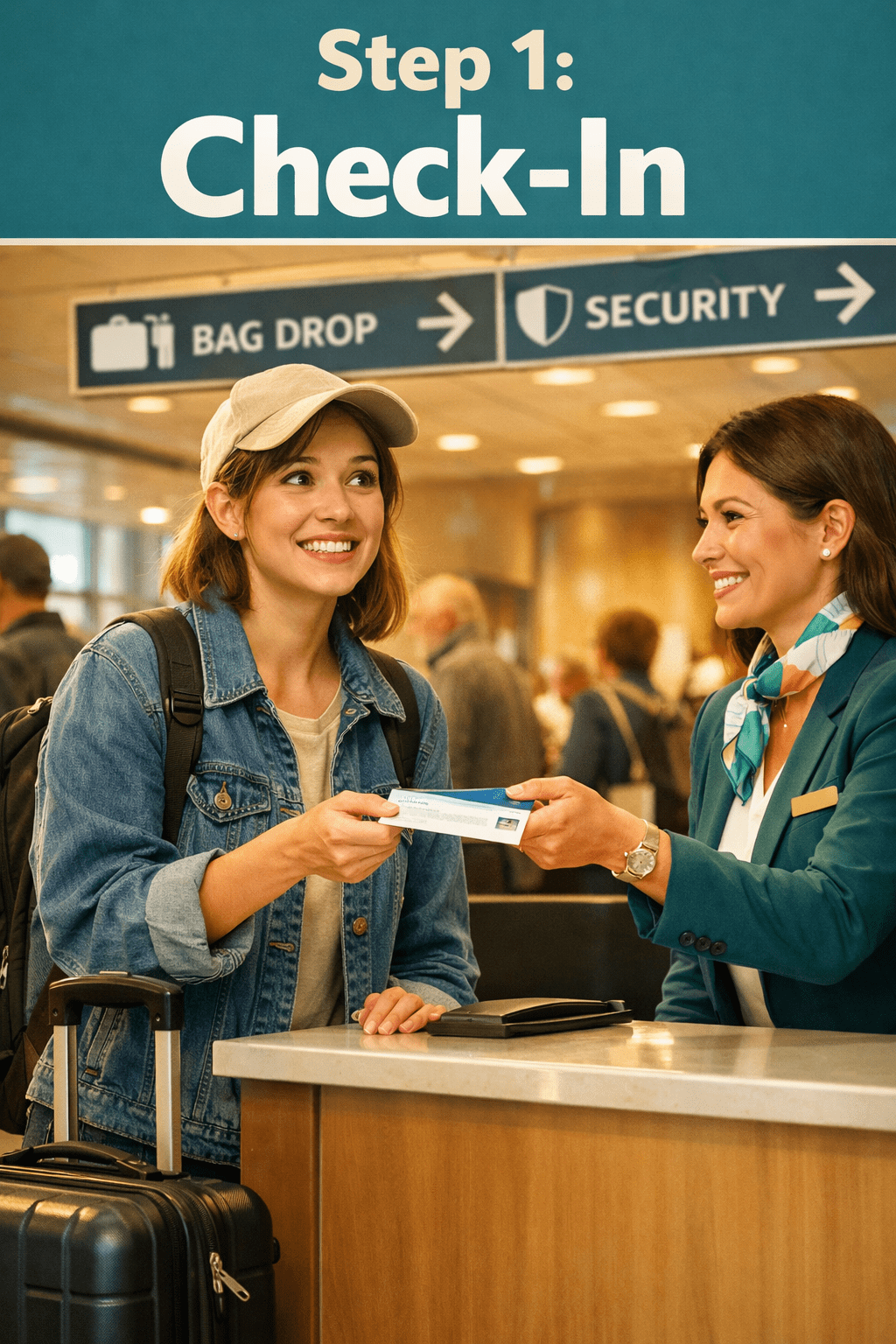
Check-in is simply the process of confirming your presence on the flight and getting your boarding pass. Most airlines let you check in online 24 hours before departure, which saves time at the airport.
Two ways to check in:
| Method | Best For | What You Get |
|---|---|---|
| Online / app | Most travelers | Mobile boarding pass, seat selection |
| Airport kiosk or desk | Checked bags, name changes | Printed boarding pass, bag tags |
If you’re checking a bag, you’ll still need to drop it at the airline’s baggage counter even after online check-in. The agent will weigh your bag, attach a tag, and send it on its way. You won’t see it again until baggage claim at your destination.
Common mistake: Forgetting to check which terminal your flight departs from. Large airports have multiple terminals, sometimes requiring a shuttle or train between them. Check your airline’s website or app the night before [1].
How Does Airport Security Work for First-Time Flyers?
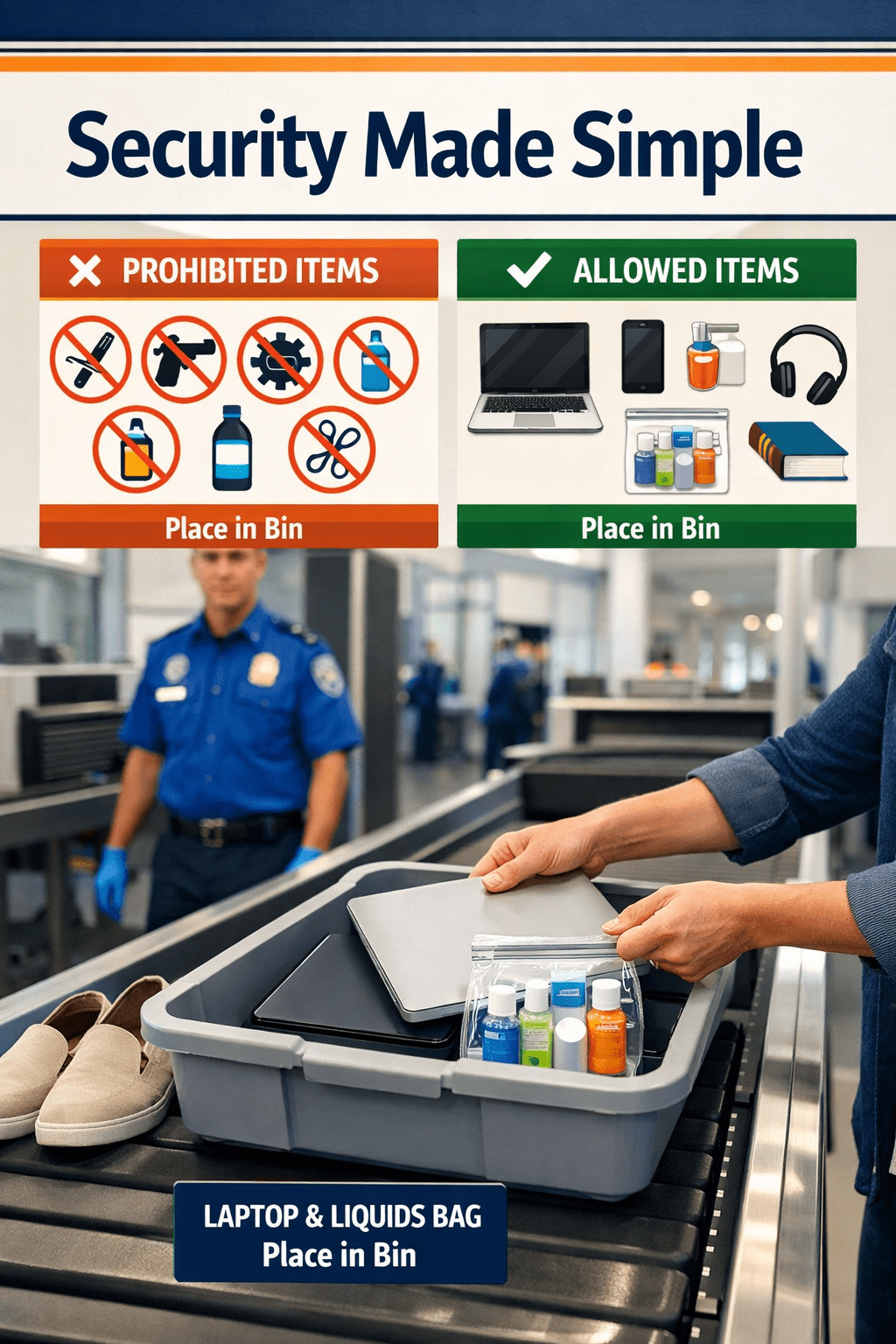
Security screening is the step that worries most first-time flyers, but it moves quickly once you know the routine. You’ll pass through a checkpoint run by airport security staff, where your carry-on bags are X-rayed and you walk through a body scanner.
Step-by-step security process:
- Have your boarding pass and ID ready to show the officer at the entrance
- Place your carry-on and personal item on the conveyor belt
- Remove your laptop and place it in a separate bin
- Put your clear liquids bag in a bin on its own
- Remove your shoes (required at most airports) and place them in a bin
- Walk through the body scanner when directed
- Collect your belongings on the other side
What you cannot bring through security:
- Liquids over 100ml in your carry-on
- Sharp objects (knives, scissors with blades over 6cm)
- Flammable items
Keep your documents in a travel wallet or a dedicated pocket in your bag so you’re not digging through everything at the checkpoint [2]. Once through security, you’re in the departure area — this is where your gate is located.
What Should You Do at the Gate Before Boarding?
Arriving at your gate early gives you time to relax, charge your devices, and listen for boarding announcements. Gates are numbered and displayed on screens throughout the terminal — match the gate number on your boarding pass.
Airlines board by group or zone, not all at once. Your boarding group is printed on your boarding pass. When your group is called, join the line and have your boarding pass and ID ready to scan [2].
While you wait at the gate:
- Grab water or a snack (airport prices are high, so buying a bottle before security saves money)
- Charge your phone and download any entertainment you want offline
- Confirm your gate hasn’t changed — gates do switch, especially for delays
Edge case: If you have a connecting flight (meaning you change planes at a different airport), pay close attention to your layover time. A connection under 60 minutes at a large, unfamiliar airport is tight for a first-time flyer. If you booked through a single airline, they’re responsible for rebooking you if you miss it due to a delay.
If you’re still planning your destination, check out our guides to popular first-timer trips like What to See in Rome, What to See in Japan, or What to See in London in 3 Days.
What Happens When You Board the Plane?
Boarding methods vary by airport and airline. You might walk directly to the aircraft across the tarmac, ride a shuttle bus to the plane, or walk through a jetbridge (a covered tunnel connecting the terminal to the plane door) [1].
Once on board, a flight attendant or signage will direct you to your seat. Seat rows are numbered from front to back, and seats are labeled A through F (or similar) from window to aisle.
When you reach your seat:
- Lift your carry-on into the overhead bin above your row (wheels facing in to save space)
- Keep your personal item (backpack, purse) under the seat in front of you
- Stow your passport, headphones, and snacks within reach — not in the overhead bin [2]
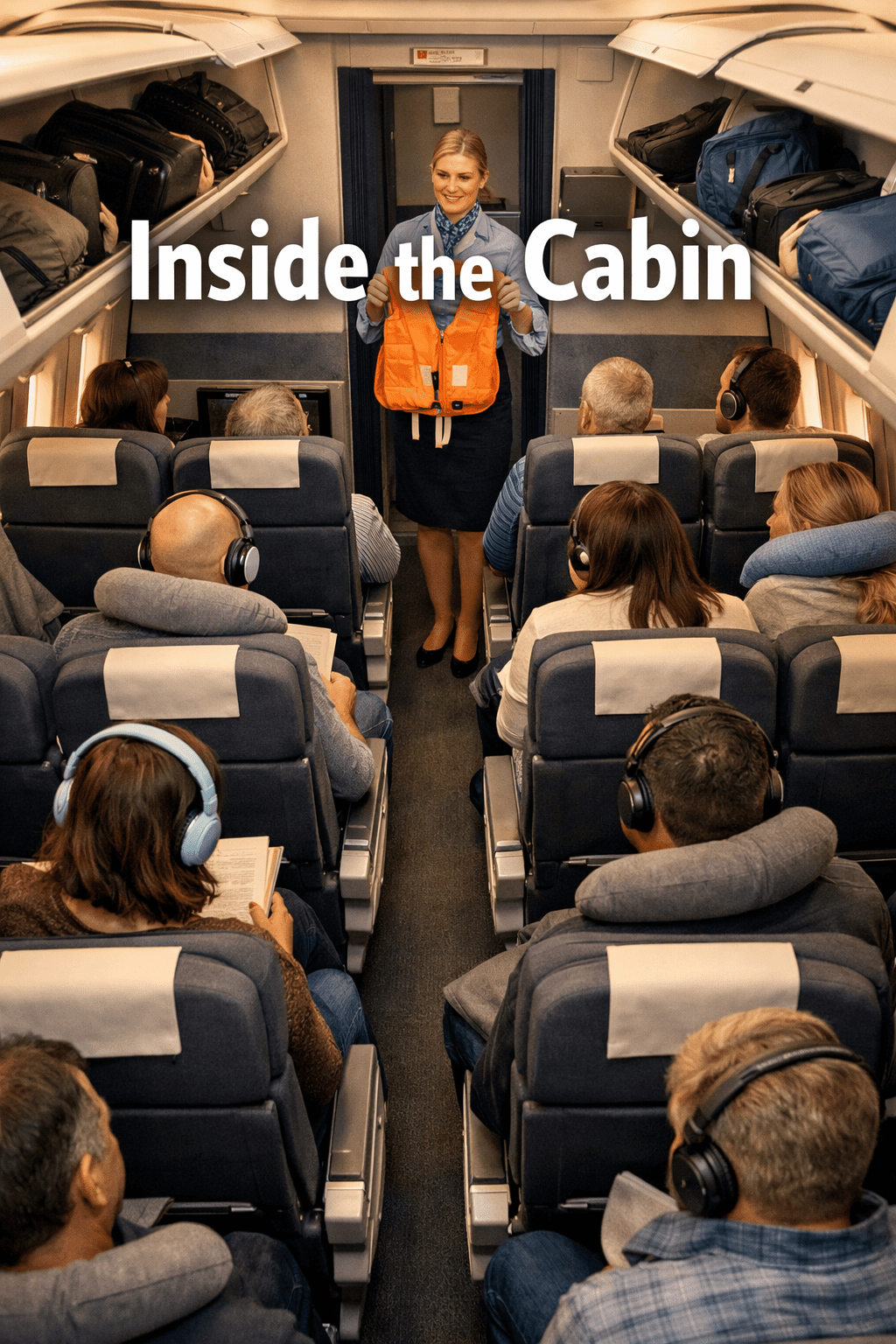
Before takeoff, the cabin crew performs a safety demonstration covering seatbelts, emergency exits, oxygen masks, and flotation devices. Watch it even if you’ve seen it before — exit locations differ by aircraft. You’ll also need to switch your phone to airplane mode and keep your seatbelt fastened during taxi and takeoff [1].
What takeoff feels like: The plane accelerates quickly down the runway, which feels more intense than you might expect. Your ears may pop as the aircraft climbs — swallowing, yawning, or chewing gum helps equalize the pressure.
What Is the Flight Experience Actually Like? (Your First Time in Airplane Guide to the Air)
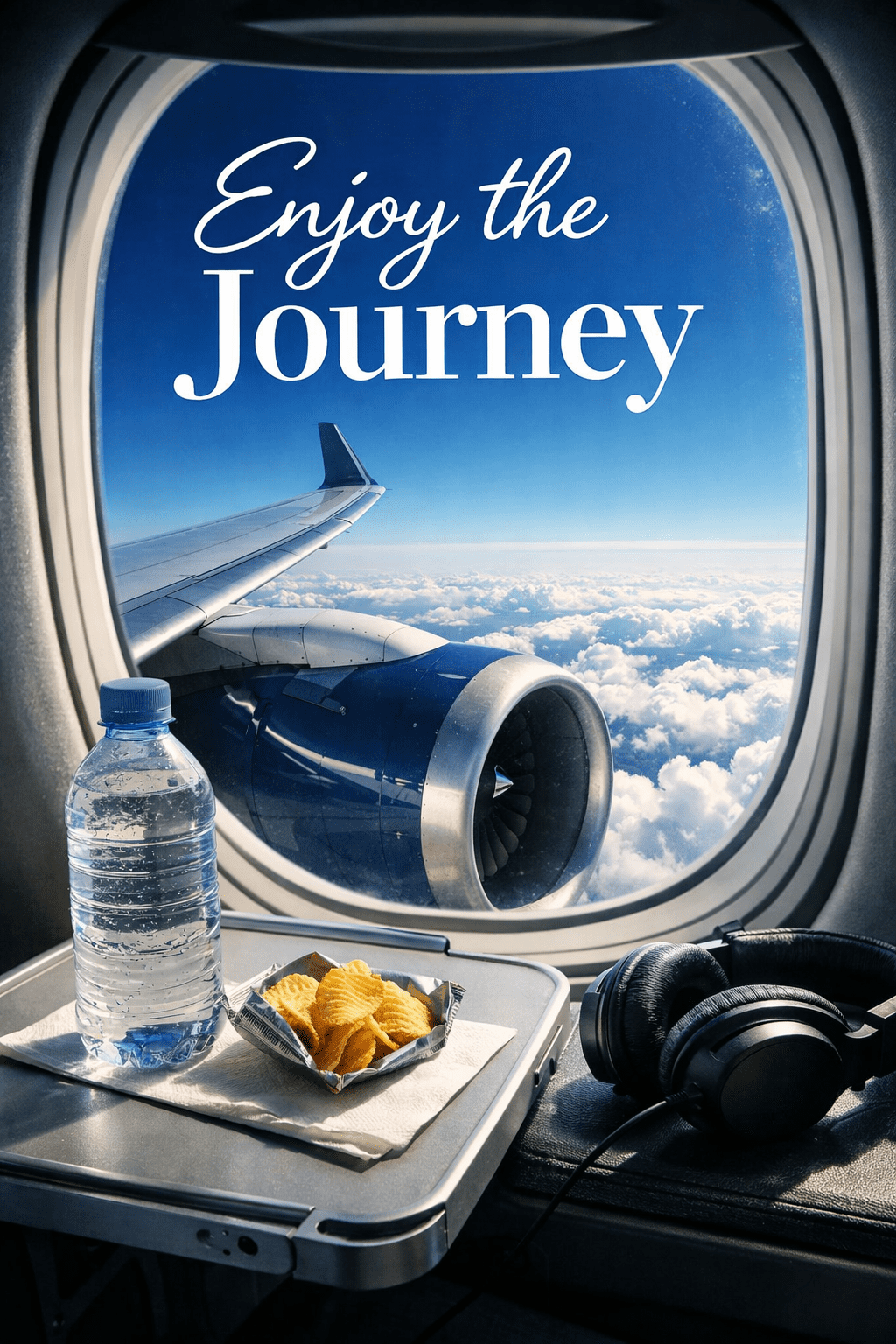
Once the plane reaches cruising altitude (typically 30,000–38,000 feet for commercial flights), the seatbelt sign usually turns off and the cabin settles into a routine. This is where your first time in airplane guide really pays off — knowing what’s normal makes everything less stressful.
Typical in-flight sequence:
- Seatbelt sign turns off after reaching cruise altitude
- Flight attendants serve drinks and, on longer flights, meals or snacks
- Entertainment screens activate (on equipped aircraft)
- Passengers sleep, read, or watch movies
- Roughly 30–45 minutes before landing, trays are collected and seats returned upright
- Seatbelt sign comes back on for descent
Turbulence: This is the thing most new flyers worry about most. Turbulence is essentially air bumps — the plane shaking or dropping slightly due to air pressure changes. It’s uncomfortable but extremely rarely dangerous. If you’re prone to anxiety about it, seats near the wings or toward the front of the plane experience less movement [1].
Comfort tips for longer flights:
- Bring a neck pillow, eye mask, and earplugs or noise-canceling headphones [2]
- Drink water regularly — cabin air is very dry
- Get up and walk the aisle every hour or two on flights over 3 hours
- Wear compression socks if you’re prone to swollen feet
Dress in loose, breathable layers. Low cabin pressure can cause mild bloating, so tight waistbands become uncomfortable quickly [1].
What Happens During Landing and After You Land?
Landing is the final stage of your first airplane experience, and it’s more gradual than most people expect. The descent begins 30–45 minutes before landing. You’ll feel the plane tilt downward, hear the engines change pitch, and notice the landing gear deploy (a loud mechanical thud — completely normal).
The landing sequence:
- Seatbelt sign turns on — stay buckled
- Tray tables up, seats upright, window shades open
- The plane touches down — expect a firm bump and loud braking
- The aircraft taxis to the gate (this can take 5–20 minutes)
- Seatbelt sign turns off — you can stand and retrieve your bag
Don’t rush to stand up the moment the plane stops. The aisle fills quickly and you’ll be waiting anyway. Use those few minutes to gather your things calmly.
If you checked a bag, follow signs to baggage claim. Your flight number will be displayed above a carousel — wait there for your bag. For international arrivals, you’ll also pass through passport control and customs before reaching baggage claim.
Once you’re through, you’re done. That’s the full journey — and it’s genuinely less complicated than it sounds when you know what’s coming. If you’re still looking for cheap flights to make your trip happen, our guide on where to find cheap flights is a great next step.
FAQ: First Time Flying Questions Answered
Q: How early should I arrive at the airport for my first flight?
Arrive 2 hours before domestic flights and 3 hours before international flights. First-time flyers benefit from the extra buffer to navigate check-in and security without rushing [1].
Q: Can I bring food through airport security?
Yes, solid food is generally allowed through security. Liquids like soups or large drinks are not. Buy beverages after the security checkpoint.
Q: What if I’m scared of flying?
Fear of flying is common. Choosing a seat near the front or center of the plane reduces turbulence sensation [1]. Breathing exercises, noise-canceling headphones, and informing a flight attendant can all help.
Q: Do I need to print my boarding pass?
Not necessarily. Most airlines accept a digital boarding pass on your phone. However, having a printed backup is wise if your battery dies or you lose signal.
Q: What is airplane mode and do I really need it?
Airplane mode disables your phone’s cellular and Wi-Fi signals. Airlines and aviation authorities require it during flight. Many aircraft now offer in-flight Wi-Fi you can reconnect to after enabling airplane mode.
Q: Will my ears hurt during the flight?
Ear pressure changes during ascent and descent are normal. Swallowing, yawning, chewing gum, or using the Valsalva maneuver (gently pinching your nose and blowing) equalizes the pressure.
Q: Can I bring my carry-on bag on every flight?
Most airlines allow one carry-on bag and one personal item in economy. Size and weight limits vary by airline, so check before you pack [1].
Q: What happens if I miss my flight?
Go immediately to your airline’s customer service desk. If the airline caused the delay (mechanical issue, crew shortage), they’re typically required to rebook you at no cost. If you simply arrived late, rebooking fees may apply.
Q: Is turbulence dangerous?
Commercial aircraft are engineered to handle turbulence far beyond what passengers ever experience. Turbulence injuries are rare and almost always occur when passengers aren’t wearing seatbelts. Keep yours fastened when seated as a precaution.
Q: What should I keep in my personal item during the flight?
Keep your passport, phone charger, headphones, a snack, any medication, and a light layer accessible in your under-seat bag [2].
Conclusion: You’re More Ready Than You Think
Flying for the first time is one of those experiences that sounds complicated until you actually do it. Once you’ve been through check-in, security, boarding, and landing once, it becomes second nature.
Your action plan:
- Book your seat strategically (aisle or front for comfort)
- Check in online 24 hours before departure
- Arrive 2–3 hours early depending on your flight type
- Pack your liquids bag and keep documents accessible
- Dress in comfortable layers and bring a neck pillow for longer flights
- At the gate, know your boarding group before your group is called
- On board, relax — the crew is there to help and turbulence is normal
Once you land, the world opens up. Whether you’re heading to Rome for the first time, planning a South of France itinerary, or exploring Lisbon, the flight is just the beginning. Safe travels. ✈️
References
[1] What To Expect When Its Your First Time Flying – https://www.booking.com/guides/article/flights/what-to-expect-when-its-your-first-time-flying.html
[2] International Air Travel Tips – https://www.goabroad.com/articles/international-air-travel-tips