

Last updated: October 3, 2026
Most visitors who spend one day in Bath, England walk the same six-block loop. Roman Baths, the Abbey, Pulteney Bridge, the Royal Crescent, a cream tea, then the train home. That route is lovely, but it skips half the city that makes Bath genuinely magical, from hidden Georgian gardens to a riverside brass mill most guidebooks never mention.
Quick Answer
Yes, one day in Bath, England is enough to see the city’s core landmarks if you plan a tight, walkable loop and start early. You can realistically cover the Roman Baths, Bath Abbey, the Circus, the Royal Crescent, and at least two hidden-gem stops like Alexandra Park or Prior Park, all on foot in about seven to eight hours.
Key Takeaways
- Bath’s historic center is compact. Most major sights sit within a 20-minute walk of each other.
- Start before 9:30 a.m. to beat tour bus crowds at the Roman Baths and Abbey.
- Skip the car. Bath’s old town has narrow streets, limited parking, and ongoing active travel upgrades to walking and cycling routes.
- Book timed-entry tickets for the Roman Baths at least a few days ahead, especially in summer.
- Hidden gems like Saltford Brass Mill and Cleveland Pools rarely make a one-day itinerary, but both are easy add-ons.
- Check rail disruption notices before you travel. Engineering works have affected Great Western Railway routes into Bath Spa through 2026 and 2027.
- A small visitor levy is likely coming to Bath, Bristol, and South Gloucestershire, though it had not started as of September 2026.
Is One Day in Bath, England Really Enough Time?
One day is enough to see Bath’s headline sights, but it’s tight if you also want hidden gems. The city center is small enough to cross on foot in under half an hour, which is exactly why a single-day visit works better here than in most English cities.
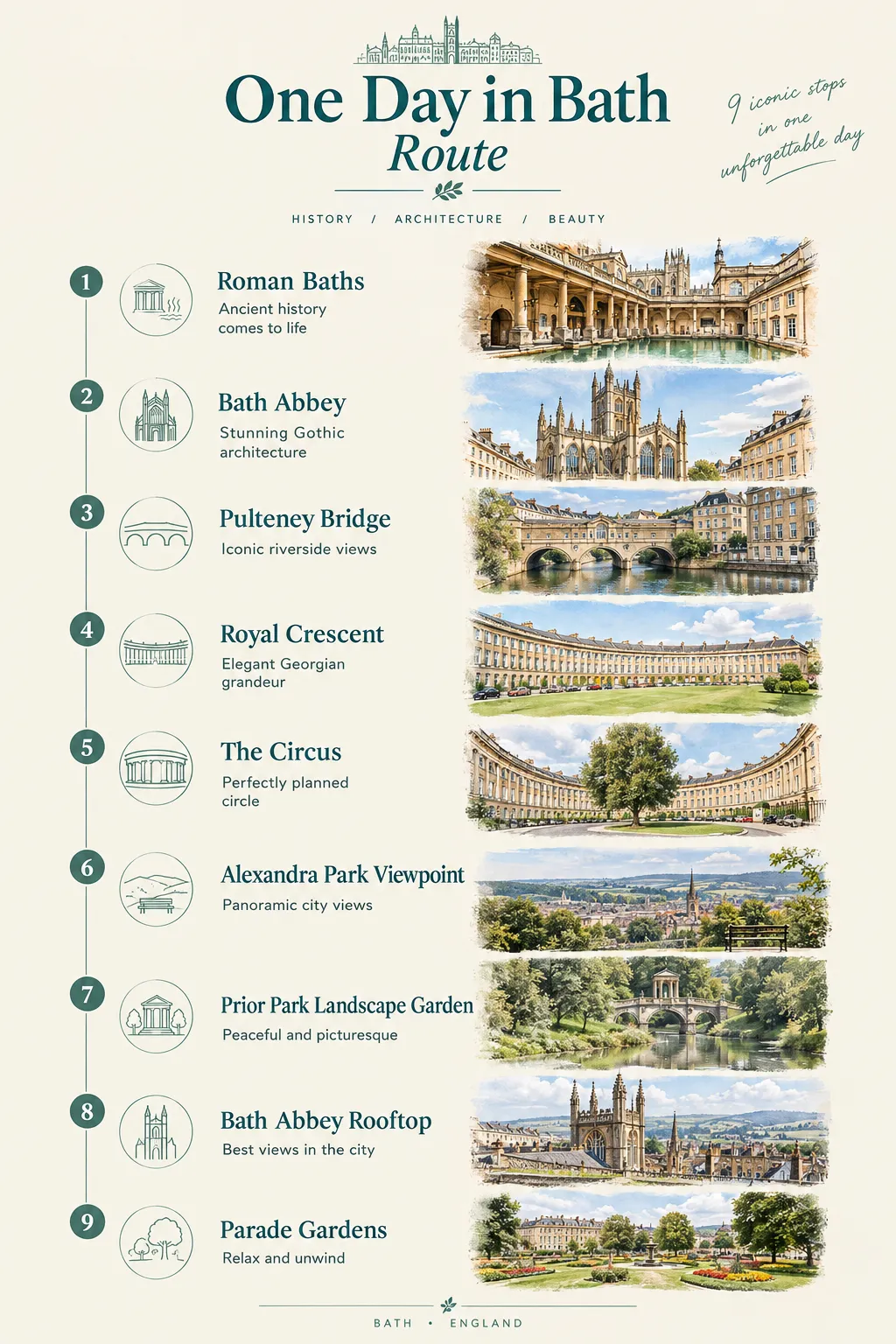
The trick is picking a route instead of trying to see everything. I’d rather see eight stops well than twelve stops rushed. If you only have one day, treat it as a loop, not a checklist.
A day trip works especially well if you’re already staying in London or Bristol, since Bath sits close enough for a round trip without an overnight stay.
How Long Does It Take to See Bath City Center?
Walking Bath’s full historic center, from the train station to the Royal Crescent and back, takes about 90 minutes without stops. Add museum visits, lunch, and photo breaks, and a relaxed loop fills roughly six to seven hours.
Here’s a rough breakdown:
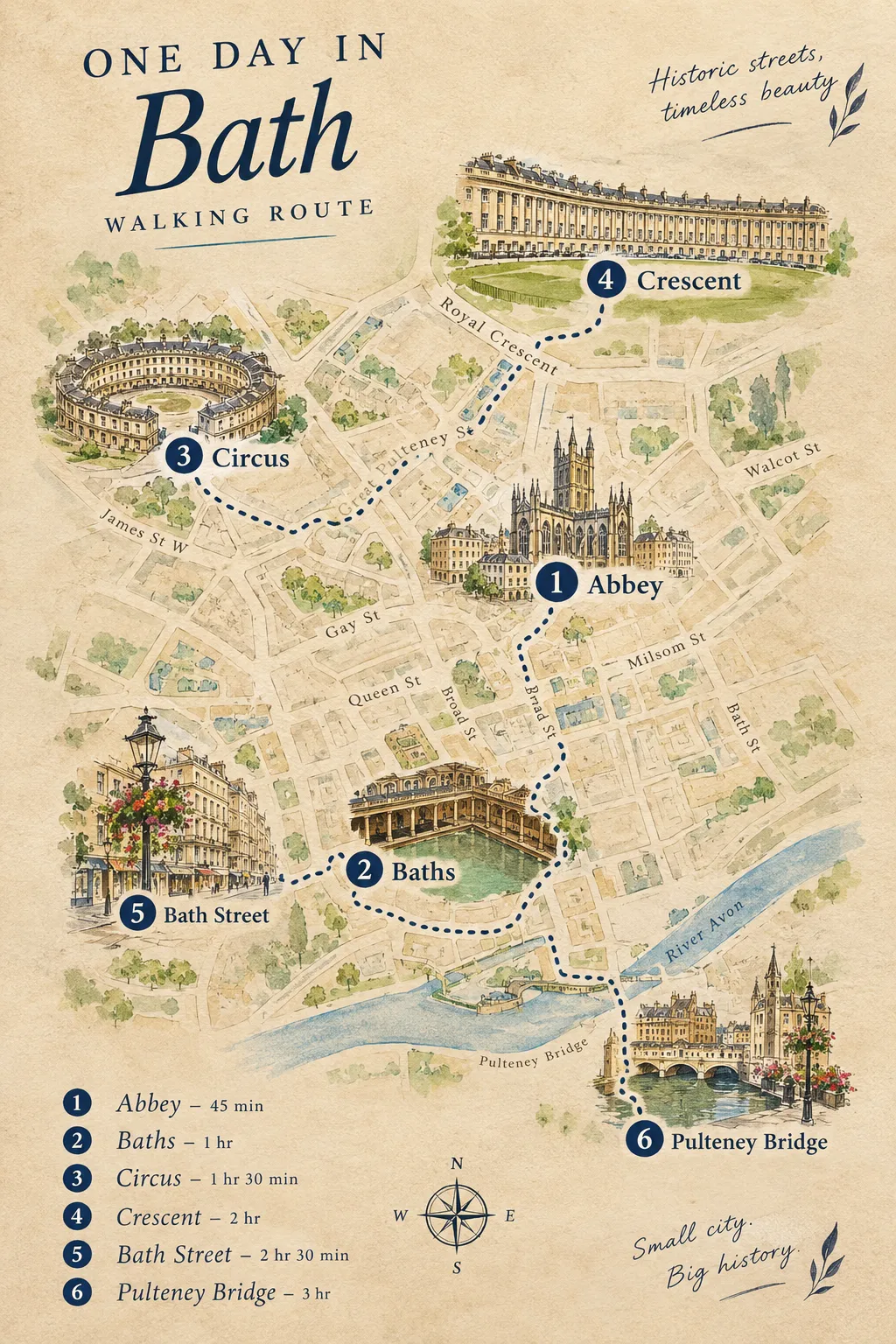
- Station to Abbey and Roman Baths: 10 minutes on foot
- Abbey and Roman Baths visit: 1.5 to 2 hours
- Walk to the Circus and Royal Crescent: 15 minutes
- Royal Crescent area, including photos: 30 to 45 minutes
- Lunch break: 45 minutes to 1 hour
- Pulteney Bridge and riverside walk: 20 to 30 minutes
That leaves roughly two to three hours free for the hidden-gem stops covered below.
What Are the Best Things to Do in Bath, England in One Day?
The best one-day plan mixes the famous sights with at least two or three lesser-known stops that most tour buses skip entirely. Here are nine stops worth building your day around.
- Roman Baths – the ancient bathing complex that gives the city its name. Go early to avoid tour groups.
- Bath Abbey – Gothic architecture right next door, with a rooftop tower tour if you have 45 extra minutes.
- Pulteney Bridge – one of the few bridges in the world lined with shops on both sides.
- The Circus – a perfectly circular row of Georgian townhouses, often photographed but rarely explained.
- Royal Crescent – the city’s most famous curve of honey-colored stone houses.
- Alexandra Park – a short bus or taxi ride up, with a compact skyline view that shows off Bath’s Georgian grid layout.
- Prior Park Landscape Garden – a National Trust green space with a Palladian bridge, far quieter than the city center.
- Parade Gardens – riverside lawns next to Pulteney Bridge, good for a sandwich break.
- Cleveland Pools – Britain’s oldest surviving lido, recently reopened, with occasional talks and guided trails.
Bath’s official tourism board also publishes an updated list of seasonal experiences each year, including new events like the Festival of Choirs, which is worth checking before you go through Visit Bath’s current guide to things to do.
Bath England Hidden Gems Off the Beaten Path
Bath’s real hidden gems sit just outside the usual tourist corridor, and most are free or very cheap to visit. These stops rarely appear on packaged city tours, which is exactly why they feel special.
Worth seeking out:
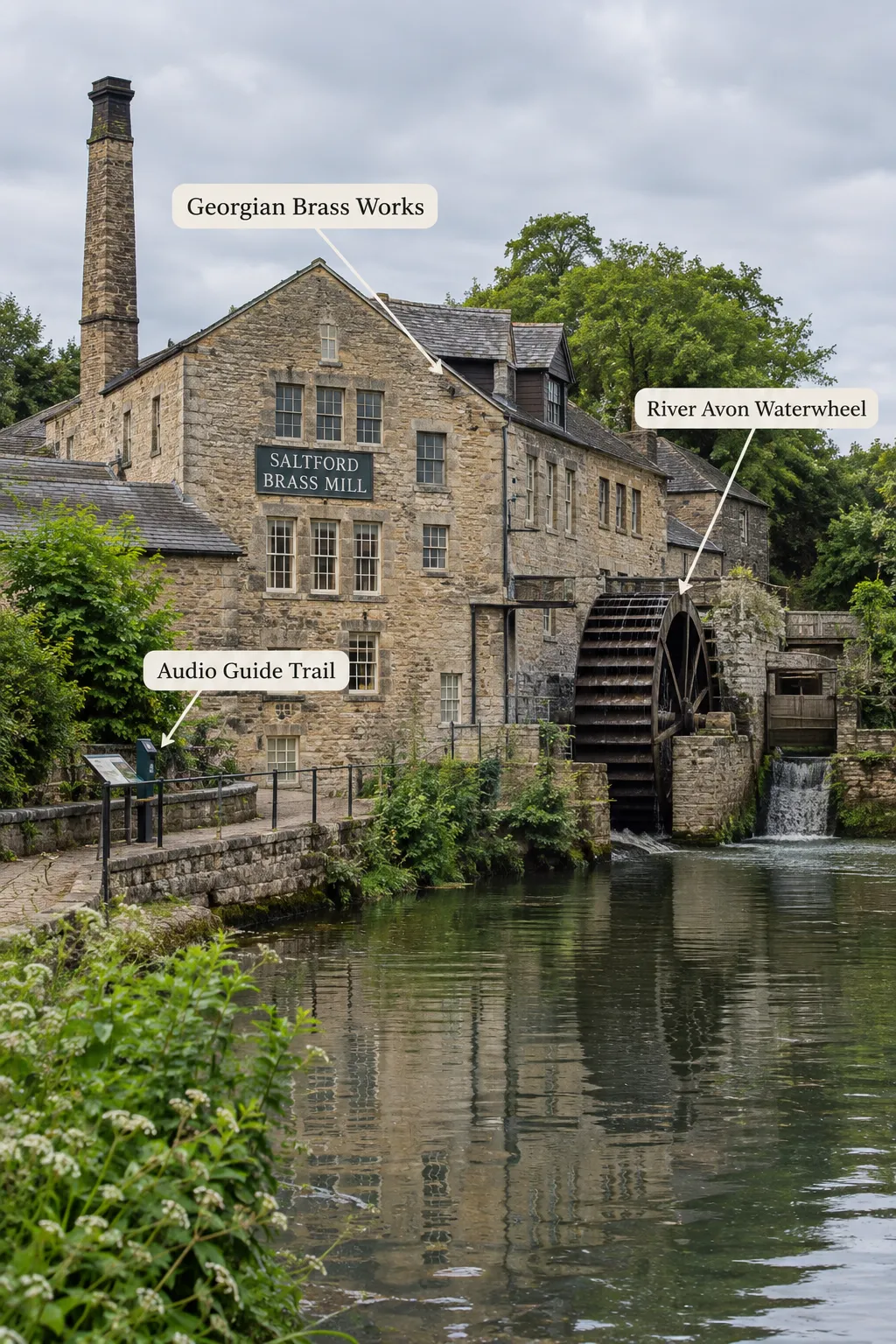
- Saltford Brass Mill – an old industrial site with audio guides explaining Bath’s manufacturing history.
- Keynsham Abbey – medieval gardens and a “Monks’ Trail” walk, a short ride from the center.
- American Museum & Gardens – overlooks Bath from a hillside estate, with rotating exhibits.
- The Mayor’s Parlour, Guildhall – rarely open to the public outside special events.
Many of these became accessible through the 2026 Heritage Open Days program, which ran from September 11 to 20 and included free guided access to sites that are normally closed or easy to overlook.
“The stops most day-trippers miss aren’t hidden because they’re hard to reach. They’re hidden because nobody tells you they exist.”
Best Time of Day to Visit Bath Attractions
The best time to visit Bath’s main attractions is before 10 a.m. or after 4 p.m., when tour buses from London and Bristol have either not arrived yet or already left. The Roman Baths and Abbey get noticeably busier between 11 a.m. and 3 p.m.
If you’re prioritizing photos of the Royal Crescent or the Circus, early morning light also works better since the honey-colored stone glows warmer before midday sun flattens it out.
Mistake to avoid: showing up at the Roman Baths at noon in July without a pre-booked ticket. You’ll wait, and walk-up tickets may sell out.
How to Get Around Bath Without a Car
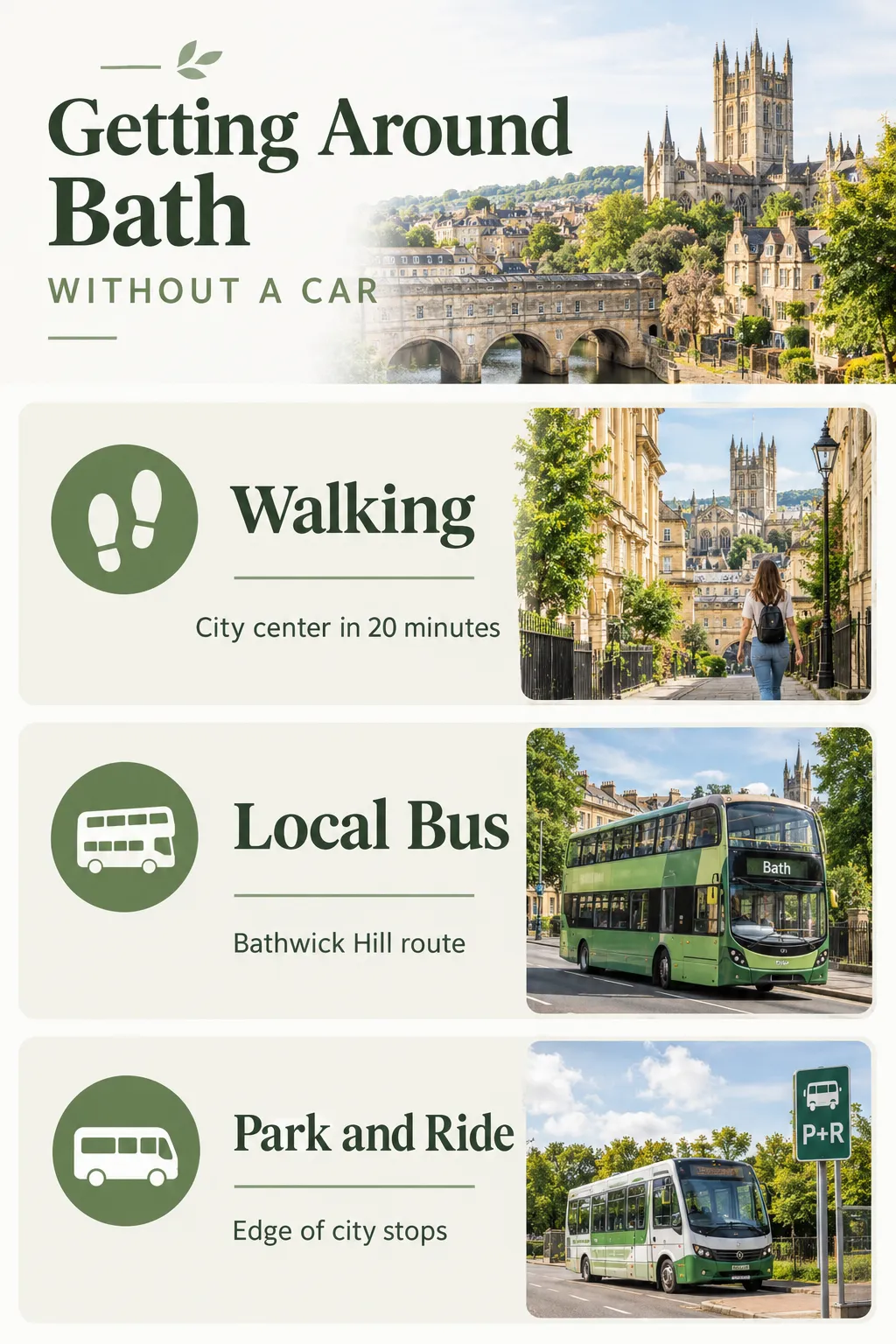
You don’t need a car in Bath, and honestly, a car makes things harder. The historic center has narrow one-way streets, limited parking, and an active push toward pedestrian and cycling access.
Your realistic options:
- Walking – covers 80% of a typical one-day itinerary.
- Local buses – useful for reaching Alexandra Park, Bathwick Hill, and university-area viewpoints. Services on routes like U1 and U3 returned to normal patterns after summer roadworks near the University of Bath, which had affected access to higher ground east of the center through essential campus and road improvement works.
- Park and Ride – good if you’re driving in from outside the region, since it avoids city-center parking entirely.
- Taxis – handy for Prior Park Landscape Garden, which sits uphill from the center.
Before you travel, check current service disruption notices and local roadworks updates, since overnight street works have been scheduled through mid-October 2026 to improve walking and cycling links.
What’s the Difference Between a Bath City Tour and Self-Guided Visit?
A guided city tour gives you context and history without research, while a self-guided day lets you move at your own pace and skip crowded stops. Neither is objectively better, it depends on how much flexibility you want.
| Factor | Guided Tour | Self-Guided |
|---|---|---|
| Pace | Fixed schedule | Flexible, your call |
| Hidden gems | Rarely included | Easy to add |
| Context and history | Strong | Needs your own research |
| Best for | First-time visitors wanting depth | Repeat visitors or flexible planners |
Choose a guided tour if you’re visiting Bath for the first time and want the history explained as you walk. Choose self-guided if you already know the main sights and want to prioritize hidden stops like Saltford Brass Mill or Prior Park.
Themed walking tours, like a Bath History & Scandals tour, also exist for travelers who want a guided experience without committing a full day to it.
Can You Do Bath as a Day Trip From London?
Yes, Bath works well as a day trip from London, with direct trains from London Paddington taking around 90 minutes each way under normal timetables. That leaves roughly six to seven usable hours in Bath after accounting for travel.
Keep in mind that rail works have disrupted parts of the Great Western route intermittently through 2026, including days with no trains between Swindon and Bath Spa, replaced by buses instead. Always check live timetables the morning you travel, especially around mid-September dates when disruption notices flagged closures on routes serving Bath.
If you’re comparing other single-day rail trips from a major city, the logic is similar to planning a day trip from Madrid to Toledo: tight train windows reward a pre-planned route over wandering.
How Much Does It Cost to Visit Bath Attractions?
Costs vary by attraction, but Bath can be done on a moderate budget since several standout stops, like Alexandra Park, the Circus, and Parade Gardens, are free to visit. The Roman Baths and Abbey tower tours are the main paid attractions most visitors budget for.
Good to know:
- Free stops: The Circus, Royal Crescent (exterior), Alexandra Park, Parade Gardens, Pulteney Bridge.
- Paid stops: Roman Baths, Abbey tower tour, American Museum & Gardens.
- Possible future cost: West of England officials have said a visitor levy is “likely” for Bath, Bristol, and South Gloucestershire, though as of September 2026 the tourist tax proposal had not yet launched and would most likely apply to overnight stays rather than day visitors.
Edge case: if the levy does roll out as a per-night accommodation charge, it won’t affect pure day-trippers who don’t book a hotel in Bath.
What Do Most Tourists Miss? Best Neighborhoods to Explore in Bath
Most tourists miss Walcot Street and the area around Green Park Station, both of which sit just outside the main tourist loop but pack in better food and local character. These neighborhoods reward a 15-minute detour.
Worth exploring:
- Walcot Street – independent bakeries and boutiques, including newer spots like Landrace and Morso Bakery.
- Green Park Station area – home to seasonal events like the Festival of Choirs.
- South Stoke and Millennium Viewpoint – a short bus or walk out of the center, pairing a countryside panorama with the community-owned Packhorse pub.
Recent food and drink coverage has also highlighted Beckford Canteen and OAK Restaurant as modern dining spots worth working into a one-day loop, alongside Condé Nast Traveller’s updated roundup of Bath’s bakeries and pubs.
If you enjoy stitching food-focused detours into a city walk, it’s a similar approach to exploring Bavaria’s lesser-known corners or finding the parts of Bergen that most tourists skip entirely.
The Easiest Route to See Bath in a Day
The easiest route starts at the train station, moves uphill toward the Royal Crescent, then loops back down through the river gardens. This avoids backtracking and keeps walking time efficient.
A simple step-by-step flow:
- Arrive and walk to the Abbey and Roman Baths (10 minutes).
- Explore the Baths and Abbey (1.5 to 2 hours).
- Walk uphill to the Circus and Royal Crescent (15 to 20 minutes).
- Detour to Alexandra Park by bus or taxi if you want the skyline view (add 45 minutes).
- Walk back down toward Pulteney Bridge (20 minutes).
- Lunch near Parade Gardens or Walcot Street (45 minutes to 1 hour).
- Finish with Prior Park Landscape Garden if time allows, or swap it for Cleveland Pools.
This structure mirrors the kind of tight, point-to-point planning used in multi-stop European itineraries, similar in logic to a nine-stop European itinerary built for efficient one-day loops.
Do You Need Tickets in Advance for Bath Museums?
Yes, booking ahead for the Roman Baths is strongly recommended, especially from May through September. Walk-up tickets can sell out on busy weekends, which can derail a tight one-day schedule.
Quick rules of thumb:
- Roman Baths: book online a few days ahead in peak season.
- Bath Abbey tower tour: book same week, slots are limited and weather-dependent.
- American Museum & Gardens: advance booking helpful but less urgent.
- Free sights (Circus, Crescent, parks): no ticket needed at all.
Common mistake: assuming you can buy Roman Baths tickets at the door in August. You usually can, but you’ll lose time standing in line that could’ve gone toward a hidden-gem stop.
Frequently Asked Questions
Is one day enough to see Bath, England?
Yes, one day covers the main landmarks comfortably if you start early and stick to a planned loop rather than wandering.
What’s the single best thing to do in Bath in one day?
The Roman Baths remain the top single attraction, but pairing them with a free viewpoint like Alexandra Park gives better overall value for your time.
Can I see Bath without booking anything in advance?
You can, but you risk missing timed-entry slots at the Roman Baths during peak season. Booking even a day ahead reduces that risk.
Is Bath walkable in one day?
Yes, Bath’s historic center is compact and walkable, with most major sights within a 20-minute radius of each other.
Do I need a car to visit Bath for a day?
No. A car adds parking stress in the historic core. Walking, local buses, and Park and Ride cover everything you need.
What do most day-trippers skip in Bath?
Most skip Walcot Street, Alexandra Park, Prior Park Landscape Garden, and heritage sites like Saltford Brass Mill, all of which add real character without much extra time.
Is Bath good for a day trip from London?
Yes, with direct trains around 90 minutes each way, though you should check current rail disruption notices before traveling.
Will Bath get more expensive to visit soon?
Possibly for overnight stays. A visitor levy is under active discussion for Bath, Bristol, and South Gloucestershire, though it hadn’t launched as of mid-September 2026 and would likely target accommodation rather than day visits.
Conclusion
A single day in Bath, England works, but only if you plan it like a local instead of following the standard tourist loop. Hit the Roman Baths early, walk the Georgian core, then spend your remaining hours on at least two or three of the hidden-gem stops most day-trippers never find.
Start with the Roman Baths before 10 a.m., end at a viewpoint like Alexandra Park or Prior Park, and fill the middle with Walcot Street or a riverside walk. Check current transport and ticket notices the morning you travel, since timetables and roadworks shift throughout 2026.
If you’re building out a broader UK itinerary around this trip, it’s worth comparing notes with other compact city guides like a four-day Edinburgh itinerary or a coastal day beyond Brighton’s pier to see how similar one-day loops get structured elsewhere in England.