Last updated: August 19, 2026
Quick Answer: A solid 1-month Central Europe itinerary covers 9 main stops – Prague, Český Krumlov, Vienna, Salzburg, Budapest, Eger, Krakow, Ljubljana, and Lake Bled – in roughly 30 days. You can connect every stop by train without a single domestic flight. Budget between $2,500 and $5,000 USD depending on your travel style, and aim for April through October for the best weather.
Key Takeaways
- 🗺️ 9 stops in 30 days is realistic and not rushed if you spend 2-4 days per city
- 🚂 Trains connect everything – the Prague to Vienna leg takes about 4 hours, Vienna to Budapest about 2.5 hours
- 💰 Budget travelers can do this trip for around $2,500-$3,500; mid-range travelers should plan for $4,000-$6,000
- 🌤️ September and October are the best months to visit Central Europe for a month-long trip – great weather, fewer crowds
- 🏰 Prague and Budapest are the anchor cities – plan 3-4 days in each
- 🎒 Pack light – you’ll be moving every 2-4 days, so a 40L carry-on backpack is ideal
- 📅 Book accommodation 4-6 weeks ahead for summer travel, especially in Vienna and Prague
- 🧳 First timers should stick to the classic Prague-Vienna-Budapest core; experienced travelers can add Krakow and Ljubljana
- 🚌 No car needed – Central Europe has excellent rail and bus connections between all major stops
- 🇪🇺 Schengen rules apply – most of these countries share the Schengen Area, so one entry covers the majority of your trip
What’s the Best Route for a Month in Central Europe?
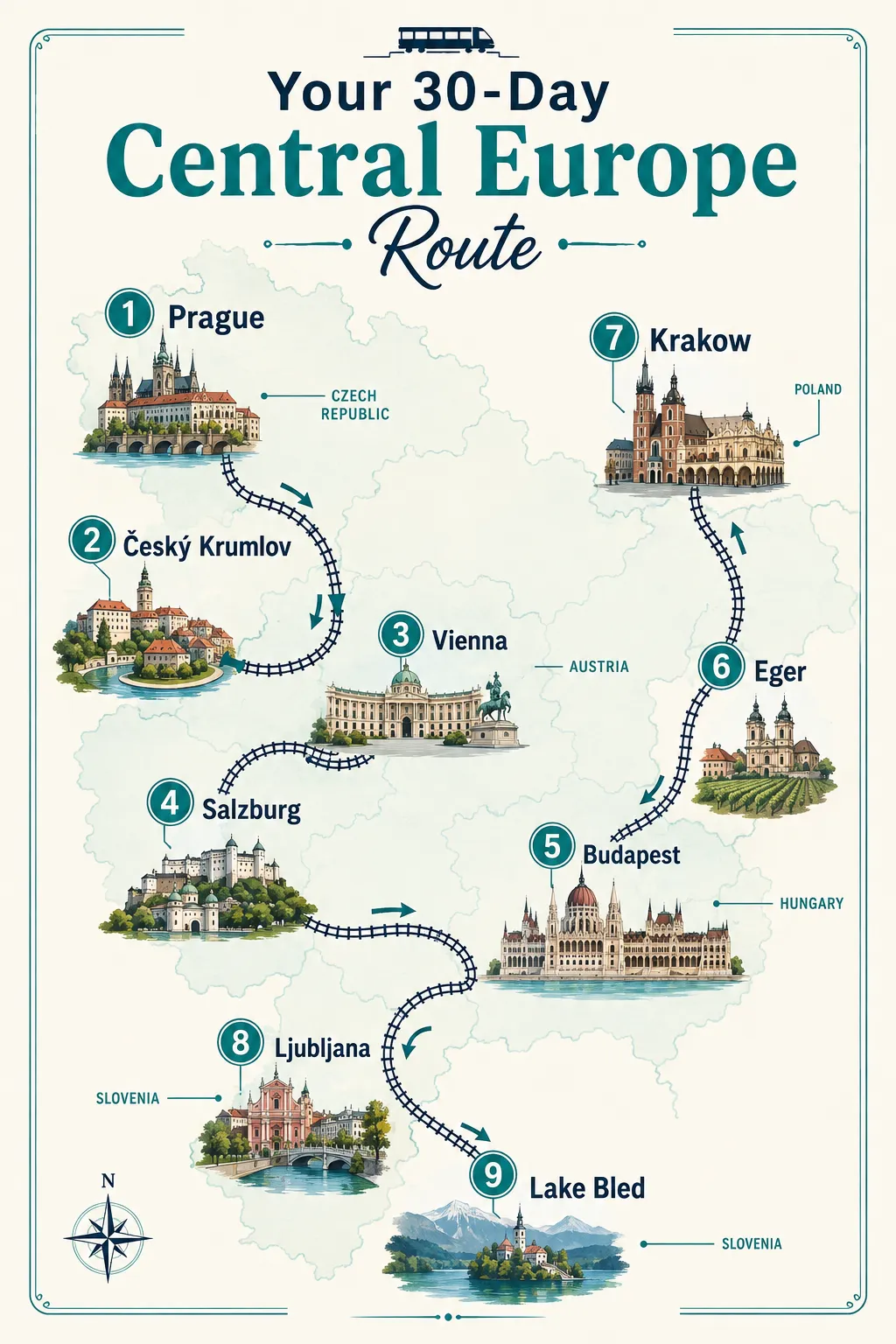
The best route for a 1-month Central Europe itinerary runs roughly west-to-east (or east-to-west), linking 9 cities in a logical chain that avoids backtracking. Starting in Prague and ending at Lake Bled – or reversing it – gives you a natural geographic flow through the Czech Republic, Austria, Hungary, Poland, and Slovenia.
Here’s the recommended sequence for your Central Europe itinerary:
| Stop | City/Region | Country | Days |
|---|---|---|---|
| 1 | Prague | Czech Republic | 4 days |
| 2 | Český Krumlov | Czech Republic | 2 days |
| 3 | Vienna | Austria | 3 days |
| 4 | Salzburg | Austria | 2 days |
| 5 | Budapest | Hungary | 4 days |
| 6 | Eger | Hungary | 1 day |
| 7 | Krakow | Poland | 3 days |
| 8 | Ljubljana | Slovenia | 2 days |
| 9 | Lake Bled | Slovenia | 2 days |
That’s 23 nights of actual city time, leaving about 7 days for travel days, rest, and spontaneous detours. This is exactly the kind of framework that Rick Steves’ Eastern-Central Europe itinerary recommends as a 21-day arc, expanded here to a full month.
Why this order works:
- You fly into Prague (one of Europe’s cheapest entry points) and fly out of Ljubljana or nearby Venice
- Every connection is under 5 hours by train or bus
- You move from the Czech Republic south through Austria, then loop east into Hungary and Poland before finishing in Slovenia
- The scenery changes dramatically – medieval old towns, alpine lakes, baroque palaces, thermal baths
Alternative starting points:
- Flying into Vienna: Skip Prague first, do Vienna → Salzburg → Budapest → Krakow → Prague → Český Krumlov → Ljubljana → Lake Bled
- Flying into Budapest: Start in Hungary, move west to Vienna, then north to Prague, then east to Krakow, then south to Slovenia
If you’re traveling from the UK, flying into Prague or Vienna tends to offer the best value on budget airlines. More on that in the section below on flying in.
How Many Days Should You Spend in Each Central European City?
Spending the right amount of time in each city is the difference between a rushed trip and a genuinely satisfying one. As a general rule, give your anchor cities (Prague, Vienna, Budapest) at least 3-4 full days each, and smaller stops like Český Krumlov or Eger just 1-2 days.
Here’s a city-by-city breakdown for your Europe itinerary:
Paris – 4 Days (If You’re Adding Western Europe)
Paris is not a Central Europe stop, but many travelers tack it onto a month-long Europe itinerary as a starting or ending point. If you include Paris in your trip, plan for 4 days minimum. That gives you time to see the Eiffel Tower, the Louvre, Montmartre, and the Seine without feeling like you’re sprinting.
For accommodation options in Paris, you’ll find great choices around the Marais and Saint-Germain neighborhoods. There are plenty of accommodation options to suit all budgets – from budget hostels around Bastille to mid-range hotels near the Pompidou Centre. I’d recommend checking out centrally located, highly rated options that come with excellent facilities and easy Metro access.
Suggested Paris tours: A Seine River cruise, a guided Louvre tour (book ahead), and a Versailles day trip are the top three.
Bruges – 2 Days
Bruges is another popular add-on for travelers who fly into London or Brussels first. Two days here is perfect – you can see the medieval canal city, climb the Belfry, and eat your weight in waffles without overstaying.
Suggested Bruges tours: A canal boat tour and a chocolate workshop are the highlights.
Amsterdam – 3 Days
Amsterdam fits naturally into a month-long Europe trip if you’re routing through the Netherlands. Three days lets you visit the Anne Frank House (book weeks in advance), cycle along the canals, and see the Rijksmuseum.
Suggested Amsterdam tours: A canal bike tour and a guided Anne Frank House visit.
Berlin – 3 Days
Berlin is a natural add-on if you’re routing through Germany. Three days gives you time to visit the Brandenburg Gate, the Berlin Wall Memorial, and Museum Island. Berlin connects well to Prague by train (about 4.5 hours).
Suggested Berlin tours: A Third Reich walking tour and a street art tour of Kreuzberg.
Prague – 3 to 4 Days
Prague is the heart of any Central Europe itinerary. Three days is the minimum; four is better. You can walk across the Charles Bridge at dawn (before the crowds arrive), visit Prague Castle, explore the Old Town Square, and take a half-day trip to Kutná Hora.
Suggested Prague tours: A Prague Castle guided tour and an evening food and beer walk.
Salzburg – 2 Days
Salzburg is compact and walkable. Two days is enough to see the Hohensalzburg Fortress, Mozart’s birthplace, and the Mirabell Gardens. It’s also a great base for a day trip to the Salzkammergut lake district.
Suggested Salzburg tours: A Sound of Music tour (yes, it’s genuinely fun) and a Hohensalzburg Castle tour.
Venice – 2 Days
Venice works as a side trip or end point if you’re finishing your Central Europe trip in Slovenia. Two days is tight but doable for the Grand Canal, St. Mark’s Basilica, and the Rialto Market.
Suggested Venice tours: A gondola ride and a Doge’s Palace guided tour.
Rome – 4 Days
Rome is worth adding if you have extra time at the end of your trip. Four days lets you visit the Colosseum, the Vatican, the Pantheon, and Trastevere without rushing.
Best Time of Year to Visit Central Europe for a Month
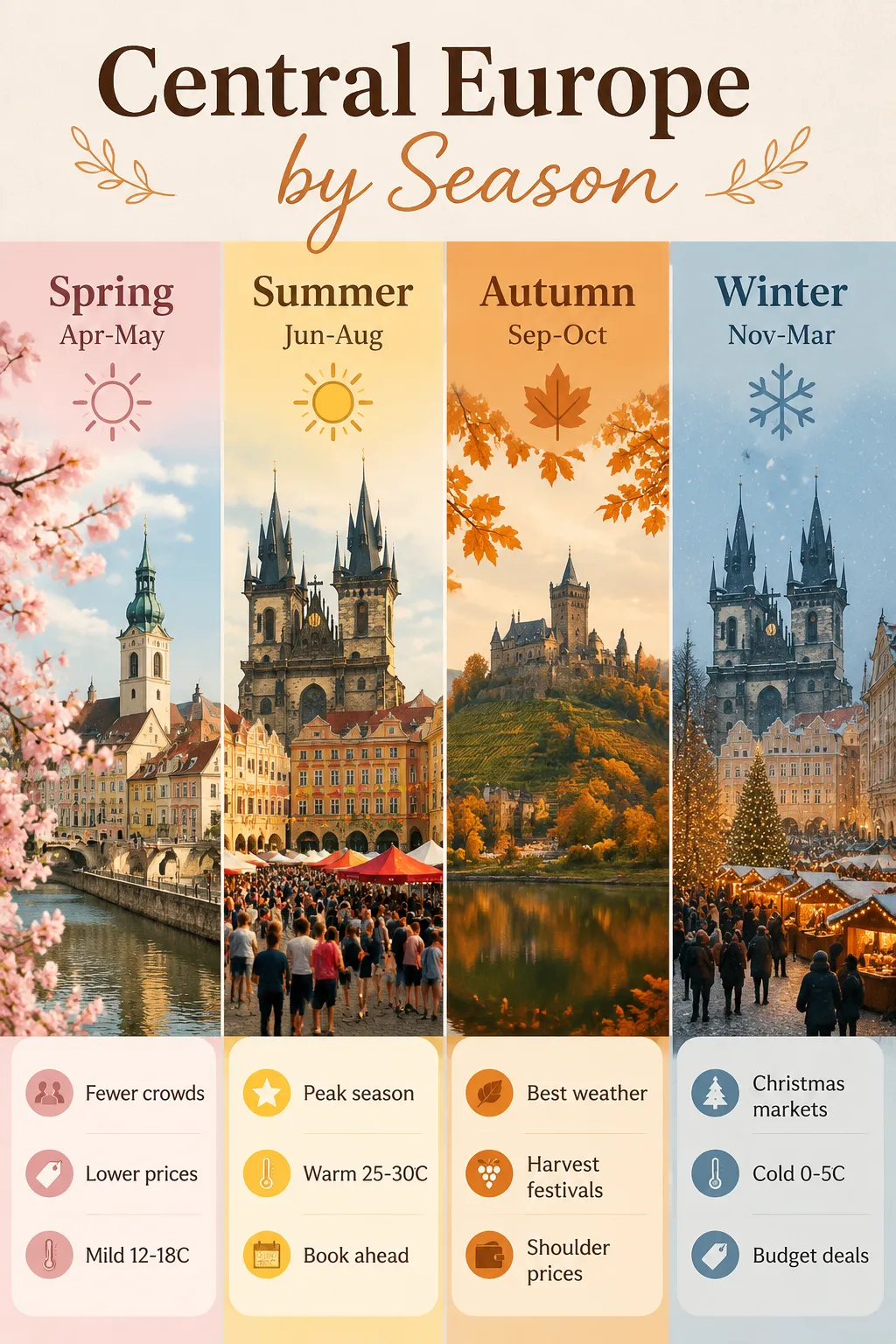
September and October are the best months to visit Central Europe for a month-long trip. You get warm, stable weather (typically 15-22°C / 59-72°F), far fewer tourists than in July and August, and lower prices on accommodation. Spring (April and May) is the second-best window.
Here’s how each season plays out:
Spring (April and May)
April and May bring mild temperatures around 12-18°C (54-64°F) and blooming gardens across Vienna, Prague, and Budapest. Crowds are manageable, and prices are lower than summer. Easter can get busy in Prague and Krakow, so book accommodation early if your trip falls around that time.
Best for: First timers who want to avoid peak-season crowds but still get pleasant weather.
Summer (June, July, and August)
Summer is peak season across Central Europe. Temperatures reach 25-30°C (77-86°F), and popular spots like Charles Bridge in Prague and the Buda Castle in Budapest can feel overwhelmingly crowded. That said, summer brings outdoor festivals, long daylight hours, and a vibrant atmosphere.
August travel data for Central Europe shows typical daytime temperatures of 18-27°C (65-80°F) with heavy tourist presence in historic cities – so if you’re traveling in summer, book accommodation 6-8 weeks ahead and visit major sights early in the morning.
Best for: Travelers who want festivals, outdoor events, and the liveliest atmosphere.
Autumn (September and October)
September is arguably the single best month for a Central Europe trip. The summer crowds thin out after the first week of September, prices drop, and the light is beautiful for photography. October adds golden foliage and harvest festivals, especially in Hungary’s wine regions around Eger.
Best for: Almost everyone – this is the sweet spot for weather, value, and experience.
Winter (November through March)
Winter in Central Europe means Christmas markets in Vienna, Prague, and Budapest – some of the best in Europe. Temperatures drop to 0-5°C (32-41°F), and some outdoor attractions are less enjoyable. But accommodation is cheap, crowds are thin, and the Christmas market season (late November through December) is genuinely magical.
Best for: Budget travelers and anyone who loves the Christmas market atmosphere.
Should You Fly into Prague or Vienna for a Month-Long Trip?
Prague is generally the better entry point for a 1-month Central Europe itinerary because it’s cheaper to fly into from most international hubs, and it sits naturally at the start of the west-to-east route. Vienna is the better choice if you’re flying from the US East Coast or if you want to start with Austria and work your way north.
Flying into Prague:
- Cheaper flights from the UK, Ireland, and most of Western Europe
- Budget airlines like Ryanair and Wizz Air serve Prague Václav Havel Airport heavily
- Natural start of the Prague → Vienna → Budapest chain
- Easy onward connections to Český Krumlov by bus (3 hours)
Flying into Vienna:
- Better connections from North America (direct flights from New York, Chicago, Toronto)
- Vienna Airport is one of Europe’s most efficient hubs
- Lets you start with Austria and move east into Hungary, then north to Czech Republic and Poland
- Slightly more expensive than Prague for European short-haul flights
The verdict: If you’re coming from the UK or Europe, fly into Prague. If you’re coming from North America, Vienna or Budapest often offer better value. Either way, your 1-month Central Europe itinerary works – just reverse the order if you start in Vienna.
Flying out: Ljubljana’s Jože Pučnik Airport is small, so check connections carefully. Many travelers end their Slovenia leg and take a 2-hour bus to Venice Marco Polo Airport for cheaper onward flights.
Can You Do Central Europe in 30 Days or Is It Too Rushed?
30 days in Central Europe is not rushed at all – it’s actually a generous amount of time for 9 stops. The key is building in rest days and not treating every day as a sightseeing marathon.
Community trip-planning discussions on Reddit’s Shoestring travel forum consistently highlight Vienna, Bratislava, Budapest, Krakow, and Prague as a practical cluster for a month-long trip – and that’s only 5 cities. Adding 4 more (Český Krumlov, Salzburg, Eger, Ljubljana, and Lake Bled) still leaves you with 2-4 days per stop, which is plenty.
Here’s what makes 30 days work:
- You’re not rushing if you average 3 days per stop
- Train journeys between cities are short (2-5 hours), so travel days don’t eat up full days
- Smaller stops like Eger and Český Krumlov can be done as day trips from nearby cities if you prefer fewer hotel changes
What can feel rushed:
- Trying to add too many Western Europe cities (Paris, London, Amsterdam) to the same trip
- Booking non-refundable accommodation every night with no flexibility
- Scheduling major sights back-to-back without rest time
The honest answer: If you’re a first timer, 9 stops in 30 days is ideal. If you’ve done Central Europe before, you might prefer going deeper in fewer cities rather than wider.
How Much Does a 1-Month Central Europe Trip Cost?
A 1-month Central Europe trip costs roughly $2,500 to $6,500 USD depending on your travel style. Budget travelers staying in hostels and cooking some meals can get around Europe for about $80-100 per day; mid-range travelers staying in 3-star hotels and eating out most meals should budget $130-180 per day.
Here’s a realistic breakdown:
Budget traveler (hostel dorms, street food, free sights):
- Accommodation: $25-40/night
- Food: $20-30/day
- Transport: $15-20/day (train passes, buses)
- Activities: $10-15/day
- Total: roughly $70-105/day, or $2,100-$3,150 for 30 days
Mid-range traveler (private hotel rooms, restaurant meals, paid tours):
- Accommodation: $70-120/night
- Food: $40-60/day
- Transport: $20-30/day
- Activities: $20-30/day
- Total: roughly $150-240/day, or $4,500-$7,200 for 30 days
Key cost-saving tips:
- Book trains in advance – early booking discounts on European rail can save 30-50%
- Use a Eurail Global Pass for unlimited train travel across multiple countries
- Stay in apartments (Airbnb or local booking sites) for groups of 2+ – often cheaper than two hotel rooms
- Eat lunch as your main meal – many Central European restaurants offer lunch specials at half the dinner price
- Visit free sights: most city parks, many churches, and several museums in Budapest and Prague have free entry days
Currency note: You’ll deal with multiple currencies on this trip – Czech Koruna (CZK), Euros (EUR in Austria and Slovenia), Hungarian Forint (HUF), Polish Zloty (PLN). Always pay in local currency and use a no-fee travel card.
For a detailed packing guide that fits this kind of multi-stop trip, check out The Ultimate 2 Weeks in Europe Spring Packing guide – most of those tips apply directly to a month-long trip too.
Do You Need a Car, or Can You Use Trains and Buses?
You do not need a car for a 1-month Central Europe itinerary. The region has excellent rail and bus connections between all 9 major stops, and a car actually creates more problems than it solves in historic city centers where parking is expensive and driving is stressful.
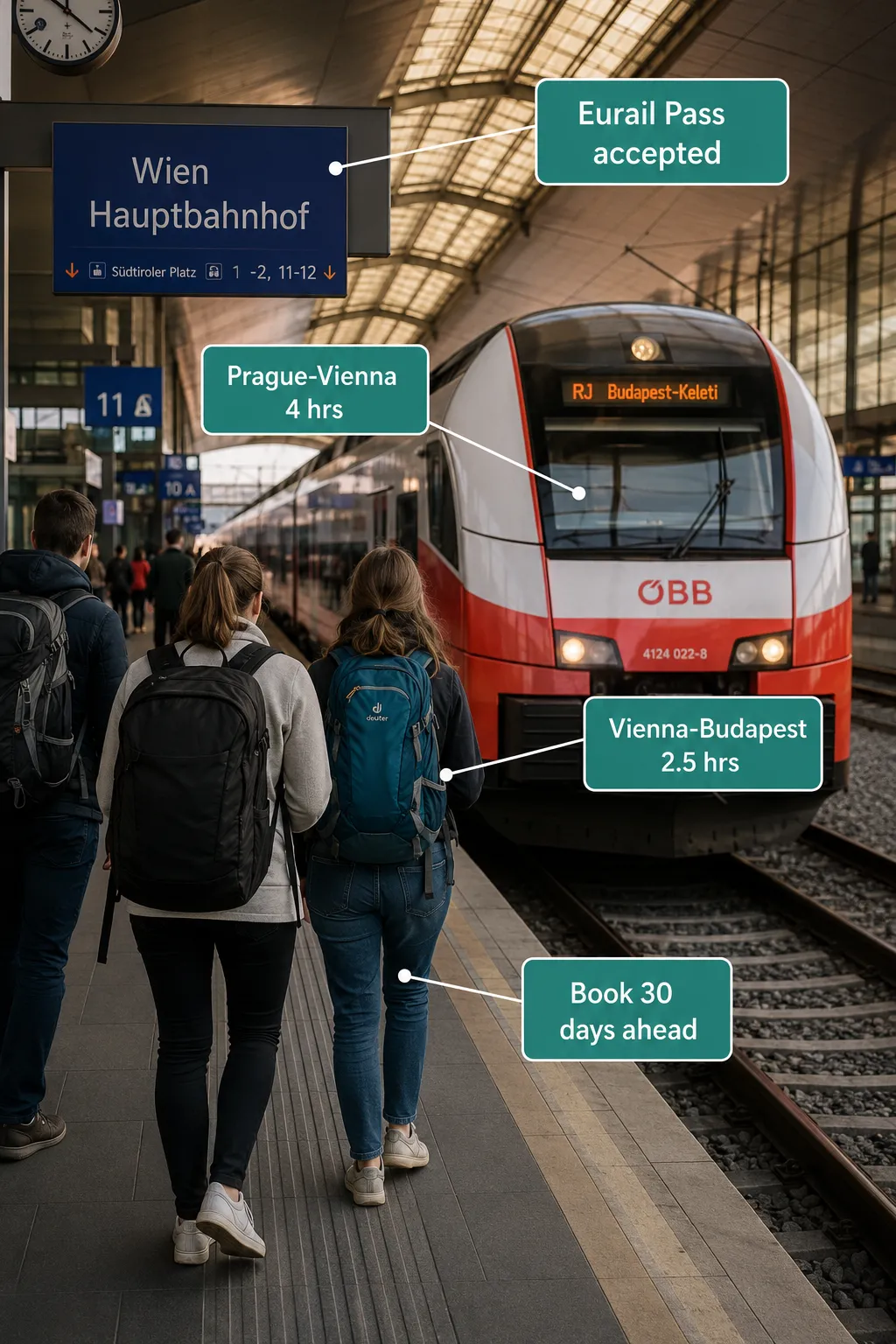
A 2026 Central Europe trip guide recommends using trains as the primary mode of transport, noting convenient connections such as the roughly 4-hour train between Prague and Vienna and about 2.5 hours between Vienna and Budapest – both comfortable, scenic, and easy to book online.
Key train and bus connections:
- Prague to Český Krumlov: Bus (Flixbus or RegioJet), about 3 hours, very cheap
- Český Krumlov to Vienna: Bus or train via Linz, about 3.5-4 hours
- Vienna to Salzburg: Train, about 2.5 hours, frequent departures
- Vienna to Budapest: Train (Railjet), about 2.5 hours, very comfortable
- Budapest to Eger: Train, about 2 hours, cheap and scenic
- Budapest to Krakow: Train or overnight bus, about 6-7 hours
- Krakow to Ljubljana: This is the longest leg – train via Vienna or Bratislava, about 8-10 hours, or fly (1.5 hours)
- Ljubljana to Lake Bled: Bus or train, about 1.5 hours
When a car makes sense:
- If you want to explore rural areas of Slovenia (beyond Lake Bled)
- If you’re traveling with young children and lots of luggage
- If you want to visit smaller villages in the Czech or Hungarian countryside
The bottom line: Book trains in advance (especially the Prague-Vienna and Vienna-Budapest legs), and you’ll get around Europe smoothly without ever needing to rent a car.
Central Europe Itinerary for First Timers vs. Experienced Travelers
First timers should focus on the classic Prague-Vienna-Budapest triangle, while experienced travelers can expand into Poland, Slovenia, and Croatia for a richer, less-touristed experience.
For First Timers: The Classic One Month Europe Itinerary
If this is your first time in Central Europe, the core three cities give you the best introduction to the region’s history, architecture, and food. A 2026 Central Europe travel guide structures its multi-city journey around Prague, Vienna, and Budapest as essential anchors – and for good reason. These three cities are easy to navigate, well-connected by train, and packed with world-class sights.
Recommended first-timer itinerary (30 days):
- Prague – 4 days: Charles Bridge, Prague Castle, Old Town Square, Josefov
- Český Krumlov – 2 days: The castle, the old town, a canoe trip on the Vltava
- Vienna – 4 days: Schönbrunn Palace, the Kunsthistorisches Museum, the Naschmarkt, a coffee house
- Salzburg – 2 days: The Fortress, Mirabell Gardens, Mozart’s birthplace
- Budapest – 4 days: The Parliament Building, Fisherman’s Bastion, a thermal bath, the ruin bars
- Eger – 1 day: The castle, the wine cellars of the Valley of Beautiful Women
- Krakow – 3 days: The Old Town, Wawel Castle, Auschwitz-Birkenau (a sobering but important visit)
- Ljubljana – 2 days: Ljubljana Castle, the Triple Bridge, the Central Market
- Lake Bled – 2 days: The island church, Bled Castle, a walk around the lake
That’s 24 nights of city time, with 6 days for travel and flexibility.
For Experienced Travelers: Expanding the Central Europe Itinerary
If you’ve already done the big three, consider these additions:
- Bratislava (Slovakia): Just 1 hour from Vienna by train – a compact, underrated capital worth 1-2 days
- Wrocław (Poland): A beautiful university city with a charming old town, 3 hours from Krakow by train
- Plitvice Lakes (Croatia): A UNESCO World Heritage site, 2-3 hours from Ljubljana – one of the most beautiful natural sights in all of Europe
- Dubrovnik (Croatia): If you want to extend into the Balkans, TourRadar’s 29-day Central Europe trip visits 9 countries and 13 destinations from Vienna to Dubrovnik – a great template for a more ambitious itinerary
- Dresden (Germany): A stunning baroque city, 2.5 hours from Prague by train
The key difference between a first-timer trip and an experienced traveler trip isn’t just the cities – it’s the pace. First timers often try to see everything; experienced travelers know that sitting in a Budapest ruin bar for 3 hours or wandering Krakow’s Kazimierz district without a plan is often the best part of the trip.
Central Europe vs. Eastern Europe: What’s the Difference for Travel?
Central Europe and Eastern Europe overlap significantly in travel discussions, but they’re not the same region. Central Europe typically refers to the Czech Republic, Austria, Hungary, Poland, Slovakia, and Slovenia – countries that are generally more developed, more expensive, and more tourist-friendly than the broader Eastern Europe category.
Eastern Europe in a travel context usually includes Romania, Bulgaria, the Baltic states, Ukraine, and the Western Balkans – countries that tend to be cheaper, less visited, and require more planning.
For a 1-month Central Europe itinerary, here’s what matters:
- Schengen Area: Austria, Czech Republic, Hungary, Poland, Slovenia, and Slovakia are all in the Schengen Area, so you cross borders without passport checks. Croatia joined Schengen in 2023.
- Currency: Austria and Slovenia use Euros; Czech Republic uses Koruna; Hungary uses Forint; Poland uses Zloty. Budget for currency exchange fees.
- Safety: Central Europe is generally very safe for solo travelers, families, and LGBTQ+ travelers. Petty theft (pickpocketing) is the main risk in tourist areas.
- English: Widely spoken in tourist areas across all 9 stops on this itinerary.
Central Europe is better for:
- First-time European travelers
- Travelers who want excellent infrastructure and easy navigation
- Anyone who values history, architecture, and food culture
Eastern Europe is better for:
- Budget travelers who want to stretch their money further
- Adventurous travelers who prefer off-the-beaten-path experiences
- Travelers who’ve already done Central Europe and want something new
What Documents Do You Need for a Month in Central Europe?
For most travelers, a valid passport is all you need for a 1-month Central Europe trip. Citizens of the US, Canada, Australia, UK, and most EU countries can enter all 9 stops on this itinerary without a visa for stays up to 90 days.
Key document checklist:
- ✅ Passport: Valid for at least 6 months beyond your return date
- ✅ Travel insurance: Essential – get coverage that includes medical evacuation
- ✅ Schengen 90-day rule: You can stay in the Schengen Area for up to 90 days in any 180-day period. A 30-day trip is well within this limit.
- ✅ ETIAS (European Travel Information and Authorisation System): As of 2026, non-EU travelers (including US and UK citizens) are required to obtain ETIAS authorization before entering the Schengen Area. It costs €7 and is valid for 3 years. Apply at least a few weeks before you travel.
- ✅ Rail tickets or Eurail Pass: Not a document per se, but you’ll want these organized before you go
- ✅ Accommodation confirmations: Some border officials ask for proof of where you’re staying
For UK travelers specifically:
Post-Brexit, UK citizens are treated as third-country nationals in the Schengen Area. The 90-day rule applies, and ETIAS will be required. A 30-day trip is fine within these rules. Flying from the UK into Prague or Vienna is straightforward, with no additional visa requirements beyond ETIAS.
Travel insurance note: Don’t skip this. A single hospital visit in Vienna or Budapest can cost thousands of euros without coverage. Look for policies that cover trip cancellation, medical emergencies, and lost luggage.
Solo Travel and Family Travel in Central Europe: What Changes?
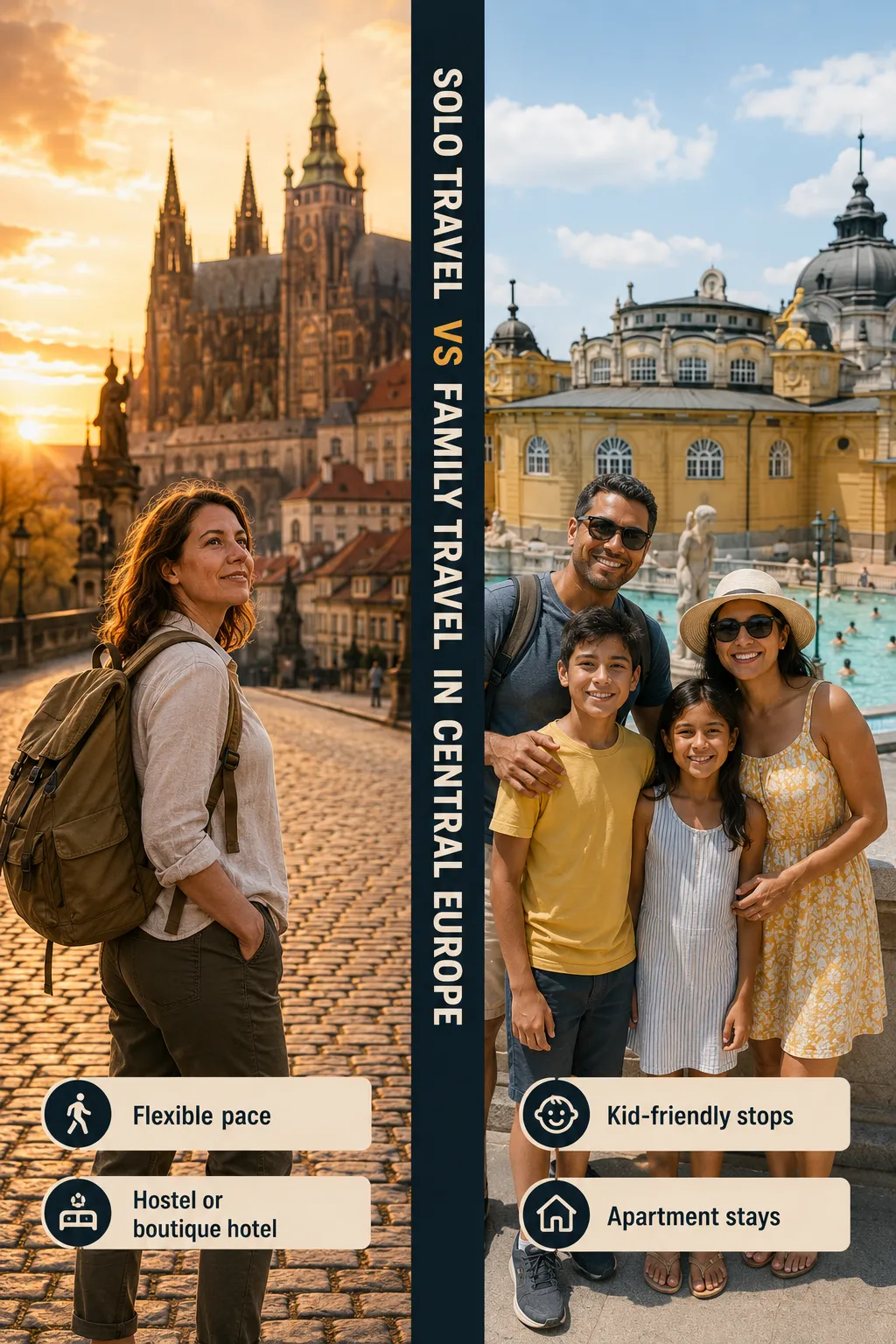
Central Europe works brilliantly for both solo travelers and families, but the logistics and priorities differ significantly. Solo travelers can move faster and stay in hostels; families need more planning around kid-friendly activities and accommodation options.
Solo Travel in Central Europe
Solo travel in Central Europe is one of the most rewarding ways to see the region. Cities like Prague, Vienna, and Budapest have thriving hostel scenes where it’s easy to meet other travelers. Safety is generally excellent, and public transport is easy to navigate alone.
Solo travel tips:
- Stay in social hostels (Generator, Wombat’s, and Mosaic House are great options) to meet other travelers
- Join free walking tours in every city – they’re a great way to get oriented and meet people
- Use apps like Couchsurfing Hangouts or Meetup to connect with locals
- Book overnight buses or trains between distant cities to save on accommodation costs
- Prague, Budapest, and Krakow have particularly vibrant solo traveler communities
Budget for solo travel: Solo travelers pay a single supplement at many hotels, so hostels or Airbnb private rooms often offer better value. Expect to spend $80-120/day as a solo budget traveler.
Family Travel in Central Europe
Central Europe is a genuinely great destination for families. The cities are compact and walkable, public transport is stroller-friendly, and there’s a huge range of kid-friendly sights.
Best family stops on this itinerary:
- Prague: The castle complex is great for kids, and the tram system is fun to ride
- Vienna: The Natural History Museum, the Prater amusement park, and Schönbrunn Palace (with its zoo) are all excellent for children
- Budapest: The thermal baths (look for family-friendly ones like Széchenyi), the castle district, and the Hungarian Parliament tour
- Lake Bled: Rowing a boat to the island church is a highlight for kids of all ages
Family accommodation tip: Apartments through Airbnb or booking.com often work better than hotels for families – you get a kitchen for breakfast and snacks, more space, and often a washing machine. Here are accommodation options to suit all budgets: from family apartments in Budapest’s 5th district to centrally located, highly rated aparthotels in Vienna that come with excellent facilities like kitchenettes and extra beds.
For more inspiration on family-friendly European trips, the Edinburgh Itinerary 4 Days guide has some great tips on navigating historic cities with kids.
Common Mistakes People Make on Month-Long Central Europe Trips
The most common mistake on a month-long Central Europe trip is over-scheduling – trying to see too many cities and not leaving room for the unexpected. Other frequent errors include ignoring travel time between cities, booking non-refundable accommodation for every night, and underestimating how much walking you’ll do.
Here are the top mistakes to avoid:
1. Packing too much
You will walk 15,000-20,000 steps per day in Central European cities. Cobblestones are everywhere. A heavy suitcase will ruin your trip. Pack in a 40L backpack and use the one-week rule: if you haven’t worn it in a week, you don’t need it.
2. Not booking trains in advance
The Prague-Vienna and Vienna-Budapest trains fill up fast in summer. Book at least 2-3 weeks ahead to get the best prices and guaranteed seats. Use the Rail Europe or Eurail websites for multi-country bookings.
3. Skipping smaller stops
Český Krumlov and Eger are two of the most charming places in Central Europe, and many travelers skip them to spend more time in the big cities. Don’t. Two days in Český Krumlov is worth more than an extra day in Prague.
4. Ignoring the Schengen 90-day rule
If you’re a non-EU traveler planning a longer European trip, track your Schengen days carefully. A 30-day Central Europe trip uses 30 of your 90 allowed days.
5. Not getting travel insurance
This is a genuine mistake that can cost thousands. Get comprehensive travel insurance before you go.
6. Booking accommodation too far from the center
In cities like Budapest and Vienna, being centrally located saves hours of commute time. Look for accommodation options that are centrally located, highly rated, and come with excellent facilities – even if they cost a bit more per night.
7. Trying to visit every museum
Central Europe has world-class museums, but you don’t need to see all of them. Pick one or two per city and spend the rest of your time walking, eating, and sitting in cafes.
8. Not learning a few words of the local language
“Please,” “thank you,” and “hello” in Czech, Hungarian, and Polish go a long way. Locals genuinely appreciate the effort.
If you’ve made mistakes on a previous road trip and want to avoid repeating them, the New England Road Trip: Mistakes to Avoid guide has a great framework for trip planning that applies to European travel too.
Is 1 Month in Central Europe Enough, or Should You Extend?
One month in Central Europe is enough for a thorough, satisfying trip across 9 stops. You won’t see everything, but you’ll get a genuine feel for each place rather than a rushed highlight reel.
When 1 month is enough:
- If you’re a first timer and want a well-rounded introduction to the region
- If you’re covering all 9 stops on this itinerary
- If you want time to slow down, sit in cafes, and not feel rushed
When you might want to extend:
- If you want to add Croatia (Dubrovnik, Split, or Plitvice Lakes) – add 5-7 days
- If you want to explore Romania (Transylvania, Bucharest) – add 5-7 days
- If you want to go deeper in Poland (Gdansk, Warsaw, Wrocław) – add 3-4 days
- If you fall in love with Budapest (very common) – add 2-3 days
The honest take: Most travelers who do a month in Central Europe say they wish they’d had more time in Budapest and Lake Bled specifically. If you can extend, add those extra days there first.
A 2018 one-month Central Europe inspiration piece updated in 2026 still advocates beginning in Salzburg and Munich and then spreading out across nearby regions – demonstrating that even older itineraries are being refreshed to reflect current travel norms while maintaining the idea of a month split across roughly 8-10 bases plus day trips.
How to Pack for a Month in Central Europe Across Different Seasons
Packing for a month in Central Europe requires a layering strategy rather than packing for one specific weather type. Temperatures can vary by 15-20°C (27-36°F) between morning and evening, and between your first stop (Prague in April) and your last (Lake Bled in May).
The golden rule: pack for the coldest expected temperature, not the warmest.
Spring Packing (April and May)
- Light waterproof jacket (essential – spring rain is frequent)
- 2-3 long-sleeve shirts or light sweaters
- 1-2 pairs of comfortable walking pants or jeans
- 1 pair of walking shoes (waterproof if possible)
- 1 pair of casual shoes or sandals
- Light scarf (doubles as warmth and modesty in churches)
Summer Packing (June, July, August)
- 3-4 lightweight t-shirts or tops
- 1 light cardigan or layer for air-conditioned museums and trains
- 1-2 pairs of shorts or light trousers
- Comfortable walking shoes (break them in before you go)
- Sandals
- Sun hat and sunscreen (Prague and Budapest in July are hot)
Autumn Packing (September and October)
- Medium-weight jacket or fleece
- 3-4 long-sleeve tops
- 1 pair of waterproof shoes
- Light gloves and a hat for October evenings
- Layers that can be added or removed easily
Winter Packing (November through March)
- Warm coat (down or wool)
- Thermal base layers
- Waterproof boots
- Hat, gloves, and scarf
- Warm socks (you’ll be walking on cold cobblestones)
Universal packing tips for any season:
- Use packing cubes to stay organized across 9 hotel changes
- Bring a small day pack for city exploring (separate from your main bag)
- Pack a universal power adapter (Type C plugs are standard across Central Europe)
- Bring a reusable water bottle – tap water is safe to drink in all 9 cities on this itinerary
For a comprehensive packing guide specifically for European travel, the Ultimate 2 Weeks in Europe Spring Packing guide covers most of what you need for a longer trip too.
Rick Steves’ Best Three-Week Eastern-Central Europe Trip: What to Borrow
Rick Steves’ Eastern-Central Europe itinerary is one of the most referenced planning frameworks for this region, and for good reason. His 21-day arc runs Kraków → Prague → Český Krumlov → Vienna → Budapest → Ljubljana → Lake Bled, and it maps almost perfectly onto the 9-stop itinerary in this guide.
What to borrow from Rick Steves’ approach:
- Start in Krakow, not Prague: Steves starts in Poland and moves west, which can work well if you’re flying into Warsaw or Krakow. It also means you finish in the beautiful Slovenian countryside rather than a busy city.
- The Český Krumlov stop: Steves consistently recommends this small Czech town as a highlight, and he’s right. Don’t skip it.
- The Ljubljana-Lake Bled finish: Ending in Slovenia is a beautiful way to close out a Central Europe trip. The pace slows, the scenery is stunning, and it feels like a reward after the busier cities.
Where to expand beyond Steves’ 21-day template:
- Add Salzburg (2 days) between Vienna and Budapest
- Add Eger (1 day) as a side trip from Budapest
- Add an extra day each in Prague and Budapest
The Central Europe guidebook question: Steves’ Central Europe guidebook is genuinely useful for planning, especially for practical details like opening hours, ticket prices, and neighborhood guides. The 2026 edition covers Prague, Vienna, Budapest, Krakow, Ljubljana, and Bled. It’s worth buying before you go, even if you use it mainly for reference.
About the 20-year anthology: Rick Steves has been documenting Central Europe travel for over two decades. His 20-year anthology of travel content – available through his website and as DVD box sets – remains one of the most comprehensive resources for understanding the history and culture of the region. It’s not just a travel guide; it’s a genuine education in Central European history.
Getting Around Europe: Transport Tips for Your 1-Month Trip
Getting around Central Europe by train is the most practical, scenic, and enjoyable way to travel. The rail network connects all 9 stops on this itinerary, and booking in advance keeps costs manageable.
Rail options:
- Eurail Global Pass: Good value if you’re doing 8+ train journeys. A 1-month continuous pass covers unlimited travel across 33 European countries.
- Point-to-point tickets: Often cheaper than a pass for a focused Central Europe route. Book through Rail Europe, the national rail websites (ČD for Czech Republic, ÖBB for Austria, MÁV for Hungary, PKP for Poland, SŽ for Slovenia), or the Eurail app.
- RegioJet and FlixBus: Budget bus options for routes like Prague to Český Krumlov and Budapest to Krakow. Comfortable, cheap, and often faster than you’d expect.
City transport:
- Prague, Vienna, Budapest, and Krakow all have excellent metro and tram systems
- Buy multi-day passes rather than single tickets – they’re almost always better value
- In Ljubljana and Lake Bled, walking and cycling are the best ways to get around
Flying within Central Europe:
You generally don’t need to fly between cities on this itinerary. The one exception is the Krakow to Ljubljana leg, which can take 8-10 hours by train. A budget flight (Wizz Air or Ryanair often serves this route) can cut that to 1.5 hours and sometimes costs less than the train.
Taxis and rideshares:
- Bolt (the European equivalent of Uber) operates in Prague, Vienna, Budapest, Krakow, and Ljubljana
- Always use the app rather than hailing a cab on the street in tourist areas – street taxis in Central European cities have a well-documented history of overcharging tourists
1-Month Central Europe Itinerary: 1 Month Central Europe from the UK
Traveling from the UK to Central Europe is straightforward and affordable. Budget airlines including Ryanair, Wizz Air, and easyJet fly directly from London (Stansted, Gatwick, Luton), Manchester, Edinburgh, and Bristol to Prague, Vienna, Budapest, and Krakow.
Best UK entry points:
- London to Prague: Ryanair and Wizz Air from Stansted, from about £30-80 one way if booked 6-8 weeks ahead
- London to Vienna: British Airways, Austrian Airlines, and Ryanair all serve this route, from about £50-120
- London to Budapest: Ryanair and Wizz Air from Luton and Stansted, often the cheapest option
Post-Brexit travel notes:
UK citizens need a valid passport (not just an ID card) for all Central European countries. ETIAS authorization is required as of 2026. The 90-day Schengen rule means a 30-day trip is well within limits.
The Reddit community perspective: A 1-month Central Europe itinerary from the UK is one of the most discussed topics in travel communities. Reddit’s Shoestring travel forum threads on this topic consistently recommend the Prague-Vienna-Budapest core as the essential starting point, with Krakow and Slovenia as the most popular additions. Many UK travelers also add a few days in Germany (Berlin or Munich) either at the start or end of the trip.
From other UK cities:
- Edinburgh to Prague: Ryanair flies direct from Edinburgh Airport, making this a great option for Scottish travelers
- Manchester to Budapest: Jet2 and Ryanair both serve this route
- Bristol to Vienna: Ryanair flies direct from Bristol Airport
If you’re planning a broader European adventure that starts or ends in the UK, the Edinburgh Itinerary 4 Days guide is a great read for adding Scotland to your trip.
FAQ
What is a good itinerary for a one-month trip to Europe?
A good one-month Europe itinerary covers 8-10 cities across 2-4 countries, spending 2-4 days per stop. A classic Central Europe route includes Prague (4 days), Český Krumlov (2 days), Vienna (3 days), Salzburg (2 days), Budapest (4 days), Eger (1 day), Krakow (3 days), Ljubljana (2 days), and Lake Bled (2 days). Use trains to connect cities and leave 5-7 days flexible for travel and rest.
How much would a 1 month Europe trip cost?
A 1-month Europe trip costs roughly $2,500-$7,000 USD depending on travel style. Budget travelers staying in hostels and eating street food can manage $80-100 per day (about $2,400-$3,000 total). Mid-range travelers in 3-star hotels with restaurant meals should budget $150-200 per day (about $4,500-$6,000 total). Flights, travel insurance, and activities add $500-$1,500 on top of daily costs.
Is $5000 enough for 2 weeks in Europe?
Yes, $5,000 is more than enough for 2 weeks in Europe, especially in Central Europe. That works out to about $357 per day, which covers comfortable mid-range accommodation, good restaurant meals, paid tours, and transport with money to spare. In cities like Prague, Budapest, and Krakow – which are cheaper than Western Europe – $5,000 for 2 weeks is actually a generous budget that allows for some luxury experiences.
What is the best month to visit Central Europe?
September is the best month to visit Central Europe. The summer crowds have thinned, temperatures are warm and stable (typically 15-22°C / 59-72°F), and prices drop compared to July and August. October is the second-best choice, with beautiful autumn foliage and harvest festivals. April and May are also excellent for spring blooms and manageable crowds. Avoid August if you dislike crowds, especially in Prague and Vienna.
Conclusion: Your 1-Month Central Europe Itinerary Starts Here
A 1-month Central Europe itinerary covering 9 stops is one of the most rewarding ways to travel in Europe. You get the grand historic cities – Prague, Vienna, Budapest – alongside the quieter gems like Český Krumlov, Eger, and Lake Bled. You travel almost entirely by train. You eat extraordinary food, drink excellent local wine and beer, and walk through some of the most beautiful architecture on earth.
The key takeaways:
- Start planning 6-8 weeks ahead for summer travel, 3-4 weeks ahead for spring or autumn
- Book your trains early, especially Prague-Vienna and Vienna-Budapest
- Don’t over-schedule – leave at least 5-7 days of flexibility in a 30-day trip
- Fly into Prague or Vienna from most international hubs
- September is the best month – warm, uncrowded, and affordable
Whether you’re a first timer using this as your introduction to Central Europe or an experienced traveler looking to go deeper into the region, this itinerary gives you a solid, tested framework to build from.
For more European trip inspiration, check out the Dolomites Italy Itinerary if you want to extend into northern Italy from Slovenia, or the 3-Day Nice France guide if you’re adding the French Riviera to your trip.
Now go book that train ticket from Prague to Vienna. Your Central Europe adventure is waiting.