
Last updated: August 17, 2026
Quick Answer: Rome on a budget tips really do work – a realistic daily spend of around €60-€80 per person is achievable when you mix free sights, smart food choices, and advance booking. The city’s best experiences – the Colosseum, Pantheon, Spanish Steps, Trevi Fountain – cost little to nothing if you plan right. You don’t need to sacrifice quality to save money here.
Key Takeaways
- 🏛️ Rome’s most iconic sights – Trevi Fountain, Spanish Steps, Piazza Navona, and St. Peter’s Basilica – are completely free to visit
- 🍕 Eat like a local with pizza al taglio and supplì for just a few euros; skip sit-down tourist restaurants near major monuments
- 🚇 The BIT single-ride transit ticket costs just €1.50 – one of the lowest fares in Europe
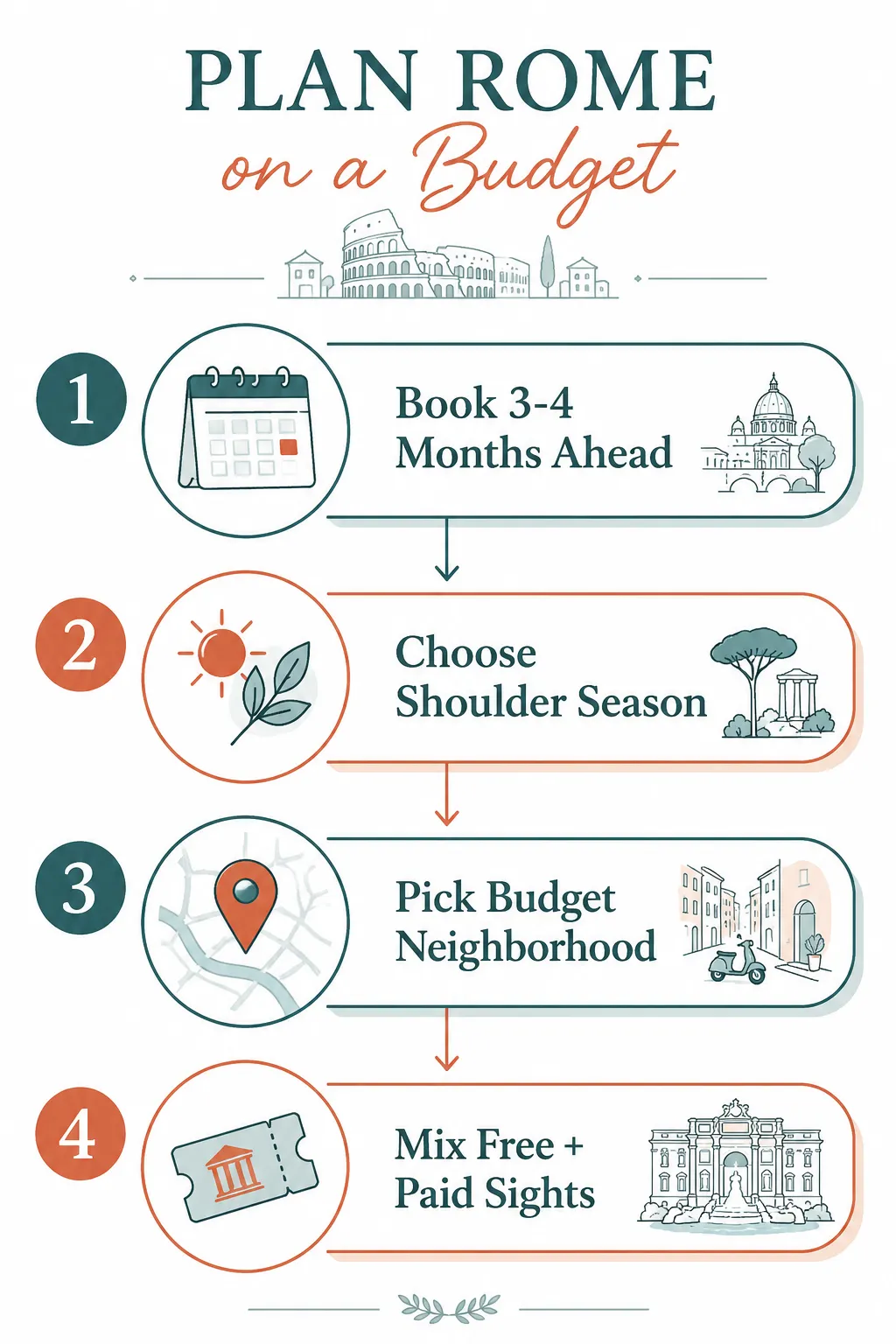
- 📅 Book accommodation and paid attractions 3-4 months ahead to save roughly 20-30% compared to walk-up prices
- 🗓️ Visit on the first Sunday of the month for free civic museums, and the last Sunday for free Vatican Museums
- 🏨 Stay in Testaccio or near Garbatella instead of Centro Storico – similar comfort, around €50 cheaper per night
- 💧 Drink Rome’s free tap water from nasoni fountains instead of buying bottled water every day
- ✈️ Travel in shoulder season (April-May or September-October) for the best flight and hotel deals
- 💳 Always pay in euros at ATMs and card terminals to avoid dynamic currency conversion fees
- 🗺️ A three-day core itinerary – Centro Storico on foot, Vatican day, Colosseum/Forum day – covers the highlights efficiently
How Many Days Do You Actually Need in Rome?
Three to four days is the sweet spot for a first trip rome, giving you enough time to walk the main historical sights without feeling rushed. If you’re tight on budget, three focused days let you hit every major landmark while keeping hotel costs down.
For visiting rome on a first trip, here’s a simple framework:
- Day 1: Centro Storico on foot – Pantheon, Piazza Navona, Campo de’ Fiori, Trevi Fountain, Spanish Steps
- Day 2: Vatican City – Vatican Museum, Sistine Chapel, Peter x27 Basilica (St. Peter’s Basilica)
- Day 3: Colosseum, Roman Forum, Palatine Hill, Trastevere in the evening
- Day 4 (optional): Villa Borghese gardens, Piazza del Popolo, or a day trip out of the city
This structure concentrates your paid entries (Vatican Museum and Colosseum) into single days, so you get the most out of each ticket. The rest of the time, you’re walking free streets and soaking up the city.
If you only have three days in Rome on a budget, skip the day trip and spend that extra afternoon wandering Trastevere or exploring Via dei Coronari – one of the most atmospheric streets in the city, lined with antique shops and old Roman architecture.
Check out our guide on what to see in Rome Italy for first timers for a more detailed day-by-day breakdown.
What’s the Cheapest Time to Visit Rome?
Shoulder season – April to May and September to October – offers the best balance of lower prices and good weather for budget travel in Rome. Flights and hotels drop noticeably compared to the peak summer months, and the city is far less crowded around major sights.
Here’s how the seasons break down:
| Season | Months | Crowd Level | Budget Impact |
|---|---|---|---|
| Shoulder (Spring) | April – May | Moderate | Best value |
| Peak (Summer) | June – August | Very High | Most expensive |
| Shoulder (Fall) | Sept – October | Moderate | Great value |
| Low (Winter) | Nov – March | Low | Cheapest flights |
Pro tip: January and February are the absolute cheapest for flights and hotels, but some attractions have reduced hours. If your main goal is saving money and you don’t mind cooler weather, winter can work very well.
Rome’s climate is Mediterranean – hot dry summers and mild winters. The city gets around 2,500 hours of sunshine per year, so there’s rarely a truly bad time to go. Spring and fall just hit that sweet spot where the weather is great and the prices aren’t.
Best Neighborhoods to Stay in Rome on a Budget
The best budget neighborhoods in Rome are Testaccio, Pigneto, and the area around Termini station – all within easy reach of the historic center but significantly cheaper than staying in the Centro Storico. Accommodation experts consistently recommend booking just outside the historic center to save around €50 per night without sacrificing convenience.
Where to stay based on your travel style:
- Testaccio – Authentic working-class Roman neighborhood, great local food scene, close to the Colosseum and Roman Forum. Very popular with budget travelers who want to get around like a local.
- Prati – Just across the Tiber from Vatican City, good for Vatican-focused trips, with decent mid-range options
- Near Termini – Central, well-connected by metro and bus, lots of budget hostels and guesthouses
- Trastevere – Charming and walkable, slightly pricier but worth it if you want atmosphere. Great for an Airbnb stay.
- Garbatella – Further out but genuinely local, metro-connected, and noticeably cheaper
Hostel picks for budget travelers:
- Alessandro Palace – Popular, social hostel near Termini with dorms and private rooms
- Generator Rome – Stylish budget option, great common areas, reliable wi-fi
- The Yellow – One of Rome’s most well-known party hostels, central location, lively atmosphere
Hotel pick:
- Mario de’ Fiori 37 – Boutique hotel near the Spanish Steps, good value for a mid-range splurge
Airbnb tip: Trastevere and Testaccio have some of the best Airbnb options in Rome. Look for apartments at least 2-3 weeks ahead and filter by “entire place” for the best value per night when traveling as a couple or small group.
Booking 3-4 months in advance can cut accommodation costs by 20-30%, especially for spring and fall dates when demand is high.
Free Things to Do in Rome – The List Is Longer Than You Think
Rome is genuinely one of the most generous cities in Europe for free sightseeing. Most of the city’s most famous landmarks cost nothing to see, and there’s enough free content here to fill several days without spending a euro on entry fees.
Completely free sights and experiences:
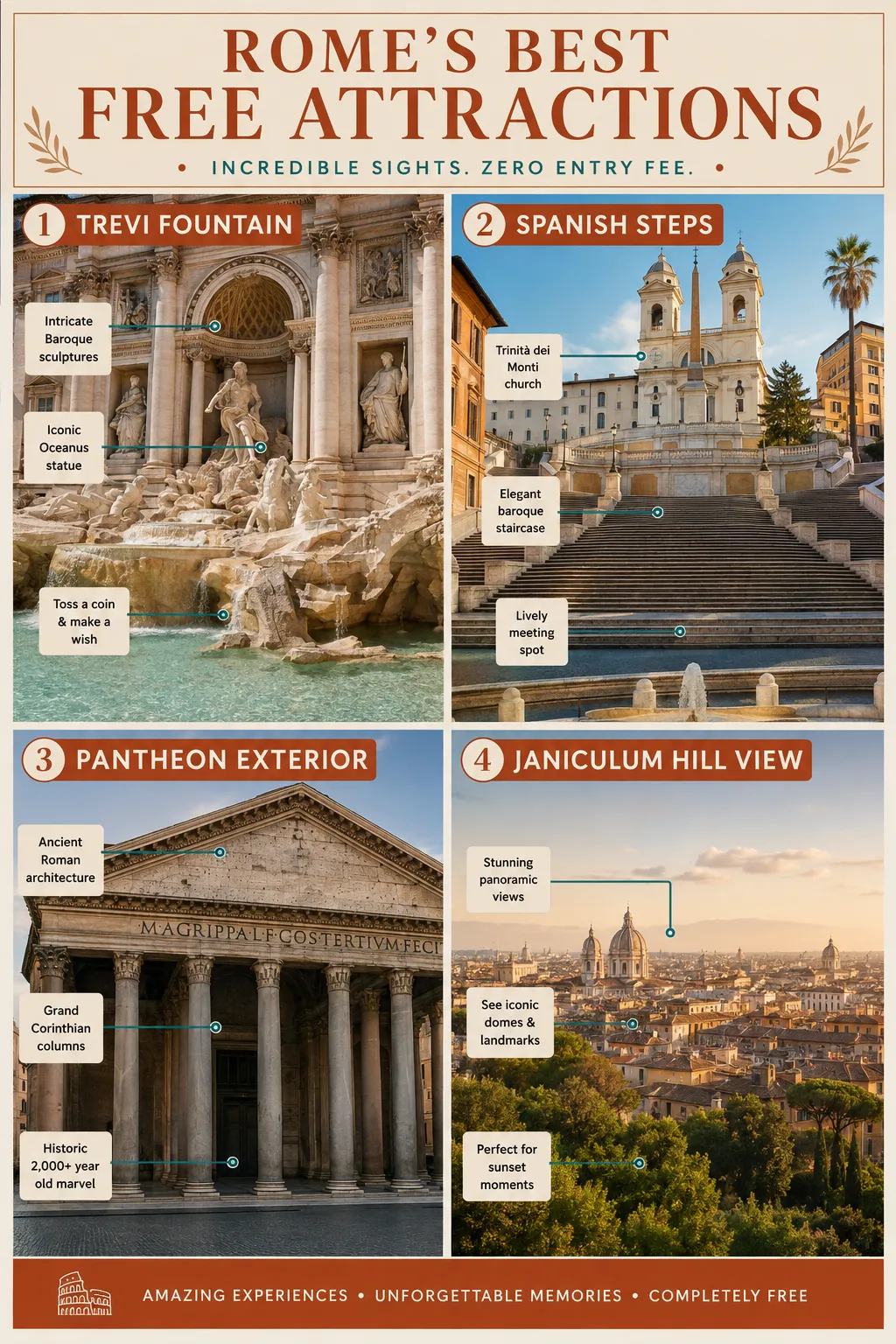
- Trevi Fountain – Still free to visit (though there’s now a small crowd-management fee at peak times – check current rules before you go)
- Spanish Steps – Walk up, sit down, take it all in
- Pantheon exterior – The interior now charges entry, but the piazza and facade are free
- Piazza Navona – One of Rome’s great public squares, free to walk around any time
- St. Peter’s Basilica – Free entry to the basilica itself (queues can be long; arrive early)
- Campo de’ Fiori – Lively market square, free to browse
- Trastevere neighborhood – Just walk and get lost here
- Villa Borghese gardens – Beautiful free park, great for a picnic
- Piazza del Popolo – Stunning twin churches and open piazza, no charge
- Janiculum Hill – One of the best free viewpoints in Rome, overlooking the whole city
- Largo Torre Argentina – Ancient Roman ruins right in the city center, free to view from street level (and home to a cat sanctuary)
- Via dei Coronari – One of the most photogenic streets in Rome, completely free to walk
Free museum days:
Rome operates a First Sunday of the month initiative where many civic museums are free. The Vatican Museums also open for free on the last Sunday of each month – but arrive very early (before 7am) because queues get extreme.
Get a Great View of the Roman Forum and Watch the Sunset at the Colosseum
The best free view of the Roman Forum is from the Capitoline Hill overlook – you can see the entire ancient site spread out below without paying for entry. For the Colosseum at sunset, position yourself on the Via Sacra side around golden hour for a view that looks like it belongs on a postcard.
How to view Roman Forum for free:
Walk up to the Capitoline Hill (Campidoglio) and find the terrace behind the Palazzo Senatorio. From here, you get a sweeping view roman forum panorama that’s honestly better than what you see from inside at ground level. It’s completely free and most tourists walk right past it.
The Colosseum – what you actually need to pay for:
The Colosseum is not free, and anyone telling you otherwise is out of date. However, there x27 a way to make the most of your ticket:
- Book the “Full Experience” ticket in advance – it includes the Colosseum, Roman Forum, and Palatine Hill
- Advance booking is essential – walk-up tickets often sell out and cost more
- Visit on a weekday morning to avoid the worst crowds
- The exterior of the Colosseum is free to walk around and photograph from outside
Can you visit the Colosseum for free?
No – but the Roman Forum and Palatine Hill are included in the same ticket, so you get three major historical sights for one price. That’s genuinely good value. The monument to Victor Emmanuel II (Vittoriano) nearby is free to enter and has a rooftop terrace with great city views.
Visit the Historical Sights Without Overpaying
Rome’s historical sights can eat your budget fast if you buy tickets at the door – but with a little planning, you can see almost everything for under €150 per person on a short trip. The key is combining free sights with strategic paid entries and using passes where they genuinely save money.
The Pantheon:
The Pantheon now charges a modest entry fee (around €5 for most visitors, free for under-18s). It’s still one of the most extraordinary buildings in the world – a 2,000-year-old temple with a perfectly preserved concrete dome designed by Michelangelo’s ancient predecessors. Book online to skip the queue.
The Vatican / St. Peter’s Basilica:
- St. Peter’s Basilica – Free entry, but expect queues. Arrive before 8am or after 4pm.
- Vatican Museum + Sistine Chapel – Not free, but absolutely worth it. Book well in advance – same-day tickets are significantly more expensive and often unavailable.
- St. Peter’s dome climb – Small fee, great view, far fewer people than the main basilica floor
Is the Roma Pass worth it?
The Roma Pass and Omnia Card bundle entrance fees with public transport. They’re genuinely useful if you plan to visit several paid sites in 2-3 days. Run the math on your specific itinerary before buying – for some trips they save money, for others they don’t.
Free walking tour tip:
Rome has several free walking tour operators (tip-based). These are a great way to get oriented on your first day and learn the stories behind the piazza, streets, and monuments. Search for “free walking tour Rome” and book a spot in advance – they fill up fast in peak season.
Best Food to Try in Rome (Without Falling Into Tourist Traps)
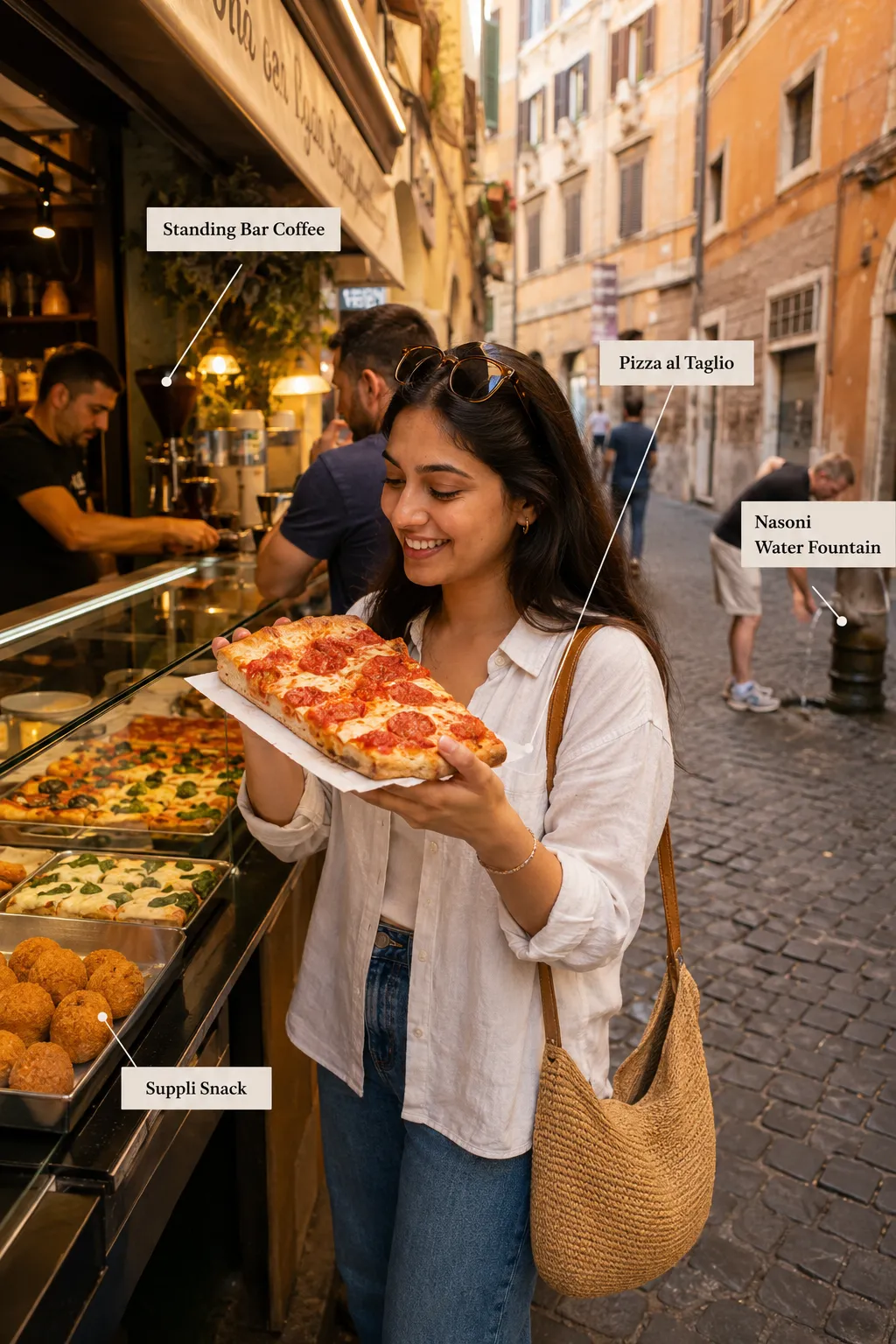
The best food in Rome is cheap, unpretentious, and found away from the main tourist squares. Pizza al taglio (pizza by the slice), supplì (fried rice balls), and a standing espresso at a local bar are the holy trinity of Rome budget eating – and they all cost just a euro or two each.
What to eat and where to find it:
- Pizza al taglio – Sold by weight at hole-in-the-wall spots all over the city. Look for places with a queue of locals.
- Supplì – Deep-fried rice balls with tomato and mozzarella. Get them at any good pizza al taglio spot.
- Cacio e pepe / carbonara / amatriciana – The classic Roman pasta dishes. Find them at trattorias in Testaccio and Trastevere, not near the Colosseum or Piazza Navona.
- Pastificio Guerra – Near Piazza di Spagna, this tiny spot sells takeaway pasta for just a few euros. It’s a genuine Rome legend and one of the best rome budget food hacks around.
- Gelato – Avoid anywhere that piles gelato in huge mounds in the window (that’s a tourist trap). Look for “artigianale” signs and gelato stored in covered metal containers.
How to save money on food every day:
- Have your coffee standing at the bar – around €1.20 instead of €3-4 at a table
- Explicitly decline the bread basket at restaurants – it often adds €1-3 per person to the bill
- Buy wine at a supermarket for €6-10 per bottle instead of paying restaurant markups
- Use Rome’s free nasoni tap water fountains – carry a reusable bottle and refill throughout the day
- Eat your main meal at lunch (many trattorias offer a “pranzo” fixed-price lunch menu)
Is Rome expensive for food and drink?
It depends entirely on where you eat. A tourist-facing restaurant near the Colosseum or Piazza Navona can charge €18-25 for a pasta dish. The same dish at a local trattoria in Testaccio costs €10-12. Budget guides consistently highlight that food is one of the easiest areas to save money in Rome with just a little local knowledge.
How to Get Around Rome Without Paying Much
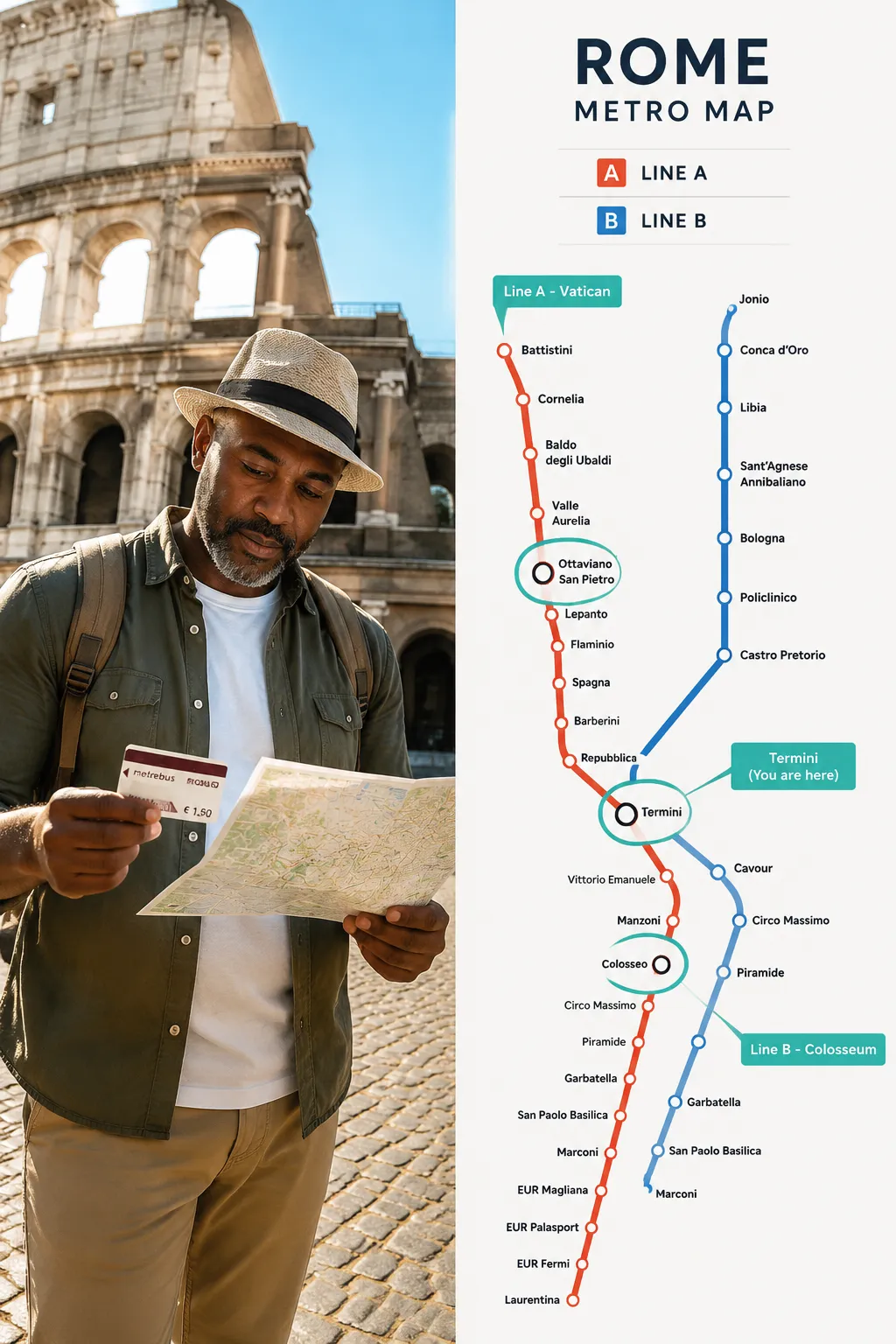
Rome is one of the most walkable major cities in Europe – most of the historic center is compact enough to cover on foot, which means your transport costs can stay very low. When you do need public transit, the BIT single-ride ticket at €1.50 is still among the cheapest single fares on the continent.
Rome public transport options and costs (2026 fares):
- BIT single ticket – €1.50, valid for 100 minutes on buses, trams, and metro
- 24-hour pass – €8.50
- 48-hour pass – €15.00
- 72-hour pass – €22.00
- 7-day CIS pass – €29.00
When to buy a pass vs. single tickets:
Tourist passes rose in price as of July 2025. Transport experts now recommend mixing walking with targeted use of single BIT tickets rather than automatically buying a multi-day pass. Only buy a 24 or 48-hour pass if you’re certain you’ll make enough journeys to justify it.
Getting around tips:
- The metro has just two main lines (A and B) – Line A covers Vatican and Spanish Steps, Line B covers the Colosseum
- Buses cover more of the city but can be slow in traffic
- Walking between Trevi Fountain, Pantheon, Piazza Navona, and Campo de’ Fiori takes about 20-30 minutes on foot – don’t bother with a bus for these
- Taxis are metered but expensive – use them only for airport transfers or late-night trips
- Avoid unofficial taxis at the airport – always use official white cabs or pre-booked transfers
Rome in 3 days on a budget – transport strategy:
On a three-day trip, you might only need 4-6 metro or bus rides total. At €1.50 each, that’s well under €10 for the whole trip. Walk everything you can – Rome rewards walkers with unexpected piazza discoveries, street art, and neighborhood life that you’d miss on the metro.
Where to Splurge and Where to Save in Rome
Not everything in Rome deserves the budget treatment – some experiences are worth paying full price for, while others are classic tourist traps. Knowing the difference is one of the most useful Rome on a budget tips you can take away from this guide.
Worth splurging on:
- Vatican Museum + Sistine Chapel – Book the best ticket you can afford here. The Sistine Chapel is genuinely one of the most extraordinary things you’ll ever see, and Michelangelo’s ceiling deserves your full attention. Don’t rush it with a budget group tour.
- One great Roman dinner – Pick one evening to sit down at a proper trattoria in Trastevere and order the full works. It’s worth it.
- Travel insurance – Never skip this. Medical costs in Italy for tourists without insurance can be significant. Get a policy before you go.
- Colosseum timed-entry ticket – Book in advance to avoid queues and potential sellouts
Save your money here:
- Bottled water (use nasoni fountains instead)
- Coffee at tourist-facing cafes near major monuments
- Guided tours of free sights like the Spanish Steps or Trevi Fountain
- Souvenir shops immediately adjacent to the Colosseum or Vatican
- Restaurant set menus near Piazza Navona – usually overpriced for what you get
For more smart saving strategies across different trip types, see our solo travel budget ideas guide and how to plan a cheap vacation.
Currency, Banking, and Avoiding Hidden Fees in Rome
Italy uses the euro, and the smartest way to access cash in Rome is through ATMs (called Bancomat) from major Italian banks like UniCredit or Intesa Sanpaolo. Always choose to be charged in euros – never in your home currency – to avoid dynamic currency conversion fees that can add several percent to every transaction.
Banking tips for Rome:
- Use ATMs attached to major Italian bank branches, not standalone machines in tourist areas
- When the ATM or card terminal asks “charge in euros or your home currency?” – always choose euros
- Notify your bank before you travel to avoid cards being blocked
- Carry some cash for small purchases – many smaller trattorias, pizza al taglio spots, and market stalls are cash-only
- Credit cards are widely accepted at hotels, larger restaurants, and shops
Tipping culture in Rome:
Tipping is not mandatory in Italy the way it is in the US. Leaving a euro or two at a sit-down restaurant is appreciated but not expected. Never feel pressured to tip at a bar or cafe.
Stroll the Streets – Rome’s Free Outdoor Experiences
Rome’s streets are the attraction. The city’s historic center is essentially an open-air museum, and some of the best things to do here cost nothing beyond the energy to walk around and look up.
Best free walks and areas to explore:
- Trastevere – Cobblestone streets, ivy-covered buildings, tiny piazza after piazza. Best explored in the evening when the neighborhood comes alive. The church of Santa Maria in Trastevere is stunning and free to enter.
- Campo de’ Fiori – Lively morning market, free to browse. Great place to pick up fresh fruit and snacks for a picnic.
- Via dei Coronari – Running from Piazza Navona toward the Tiber, this street is lined with antique dealers and Renaissance-era buildings. One of Rome’s hidden gems.
- Pigneto – Rome’s hip, artsy neighborhood. Street art, independent cafes, and a very local feel. Great for an afternoon walk away from the tourist trail.
- Piazza del Popolo – Arrive early morning when it’s quiet and the light is beautiful. The twin churches of Santa Maria dei Miracoli and Santa Maria in Montesanto frame the piazza perfectly.
- Largo Torre Argentina – Ancient Roman ruins in the middle of a busy square, free to view from the surrounding walkways. This is where Julius Caesar was assassinated.
The Janiculum Hill sunset walk:
Walk up to Janiculum Hill (Gianicolo) in the late afternoon for one of the best free views in Rome. The panorama takes in the entire city – domes, towers, and terracotta rooftops stretching to the horizon. It’s far less crowded than the Spanish Steps or Pincian Hill and the view is arguably better.
Visit Another Country – Vatican City as a Day Trip Within Rome
Vatican City is technically a separate sovereign state, making it the world’s smallest country – and you can visit it as part of your Rome trip without any border formalities. It’s a 20-minute walk from Trastevere or a short metro ride on Line A to Ottaviano station.
What to see in Vatican City:
- St. Peter’s Basilica – Free entry, extraordinary architecture, Michelangelo’s Pieta inside. Arrive before 8am to beat the queues.
- Vatican Museum + Sistine Chapel – Paid entry, book well in advance. The museum is vast – allow at least 3-4 hours.
- St. Peter’s Square (Piazza San Pietro) – Free to walk around, one of the great public spaces in the world
- Castel Sant’Angelo – Just outside Vatican City proper, this ancient mausoleum-turned-fortress has great views from the top and is worth the entry fee
Budget tip for the Vatican:
The last Sunday of the month offers free entry to the Vatican Museums – but queues start forming before dawn and can stretch for hours. If you’re visiting in shoulder season and willing to arrive very early (before 7am), it’s a real saving. Otherwise, book a standard timed-entry ticket in advance.
If you love Italy and want to explore beyond Rome, check out our guide to 10 hidden gems in Italy that feel absolutely magical and our Piedmont Italy itinerary for a quieter, less expensive Italian experience.
How Much Does a Week in Rome Actually Cost?
A realistic week in Rome on a budget costs around €420-€560 per person (roughly €60-€80 per day), covering a hostel or budget guesthouse, local transport, simple meals, and selective paid attractions. Recent 2026 budget breakdowns confirm this range for travelers who rely on free sights and avoid tourist-trap dining.
Sample weekly budget breakdown (per person):
- Accommodation (hostel dorm or budget guesthouse): €15-€35/night = €105-€245 for 7 nights
- Food (mix of street food, supermarket, one sit-down meal per day): €20-€30/day = €140-€210
- Transport (walking + selective BIT tickets): €10-€15 total for the week
- Paid attractions (Colosseum/Forum, Vatican Museum, Pantheon): €50-€80 total
- Miscellaneous (coffee, gelato, a glass of wine here and there): €30-€50
Total estimate: €335-€595 for one week
For two people, double these figures – though you’ll save on accommodation if sharing a room or Airbnb.
Is Rome cheaper than other European cities?
Rome sits in the mid-range for European capital cities. It’s generally cheaper than Paris, London, or Amsterdam for food and accommodation, but more expensive than cities in Eastern Europe like Krakow or Budapest. Compared to Milan (Italy’s most expensive city), Rome is noticeably more affordable for day-to-day spending.
Rome Budget Tips That Don’t Work Anymore
Some popular budget travel advice for Rome is simply out of date in 2026. Knowing what no longer works saves you from planning around hacks that’ll leave you disappointed.
Outdated tips to ignore:
- “The Vatican Museums are free on the last Sunday” – Still technically true, but the queues are now so extreme that you’ll spend 3-4 hours waiting. Factor that into your decision.
- “Just buy a multi-day transit pass” – Since the July 2025 fare increases, tourist passes are significantly more expensive. Do the math first.
- “The Pantheon is free” – It now charges entry (around €5). Still worth it, but budget accordingly.
- “Walk-up tickets to the Colosseum are fine” – They often sell out entirely in peak season. Always book in advance.
- “Trevi Fountain is free to visit any time” – Crowd management measures have been introduced. Check current rules before your trip.
What budget travelers get wrong about Rome:
The biggest mistake is underestimating how much the tourist-restaurant premium costs. Eating at restaurants within 200 meters of the Colosseum, Trevi Fountain, or Vatican can cost 2-3x more than the same food two streets away. Walk one or two blocks off the main tourist path and prices drop dramatically.
The second biggest mistake is not booking ahead. Rome is one of the most visited cities on earth – the Colosseum, Vatican Museums, and many popular restaurants fill up weeks in advance, especially in spring and fall.
Guided Tours and Getting the Most From Rome on a Budget
Free and low-cost guided tours are genuinely one of the best Rome on a budget tips that many travelers overlook. A good guide transforms a walk past old stones into a living story – and you don’t need to spend a lot to get that.
Free and budget tour options:
- Free walking tours – Tip-based tours run daily from Piazza Navona and near the Colosseum. Quality varies, but the best ones are excellent. Book a spot online in advance.
- Self-guided audio tours – Apps like Rick Steves Audio Europe offer free audio guides for Rome’s major sights. Download before you go.
- Context Travel – Higher-end small-group tours focused on depth rather than crowds. Worth it for the Vatican or Forum if you want real historical context.
When a paid tour is worth it:
- Vatican Museums: A skip-the-line guided tour often costs only slightly more than a standard ticket and saves hours of queuing
- Colosseum underground or arena floor access: Only available as part of a guided experience, and genuinely different from the standard visit
For more ideas on making the most of European city trips, see our 15 best things to do in Dublin Ireland on a budget for comparison.
Culture, Climate, and “Surprises” to Be Aware of in Rome
Rome has a few quirks that catch first-time visitors off guard. Knowing them in advance saves both money and frustration.
Cultural things to know:
- Dress codes at religious sites – Shoulders and knees must be covered to enter St. Peter’s Basilica, the Vatican Museums, and most churches. Carry a light scarf or sarong.
- Coperto charge – Many sit-down restaurants add a “coperto” (cover charge) of €1-3 per person just for sitting down. This is legal and normal – just factor it in.
- Coffee culture – Italians drink espresso standing at the bar. Sitting down costs more. Order “un caffè” and you’ll get an espresso.
- Pickpockets – Common around the Colosseum, Trevi Fountain, and on crowded buses. Use a money belt or keep valuables in a front pocket.
- Riposo – Many smaller shops close between 1pm and 4pm. Plan your shopping and errands around this.
Climate overview:
- Spring (April-May): 15-22°C, some rain, beautiful light – best overall time to visit
- Summer (June-August): 28-35°C, very hot and crowded, busiest season
- Fall (September-October): 18-25°C, warm and pleasant, great light for photos
- Winter (November-March): 5-15°C, quiet, cheapest prices, occasional rain
Surprises that catch budget travelers off guard:
- ATMs near tourist sights often charge higher fees – walk to a bank branch instead
- Tap water in restaurants is not automatically free – ask for “acqua del rubinetto” (tap water) explicitly
- Many museums are closed on Mondays – check opening days before planning your itinerary
- The metro stops running around midnight – plan late nights in Trastevere around bus routes or a taxi budget
Enjoy Rome on a Budget – Your New Favorite Destination Awaits
Rome on a budget tips work because the city’s greatest assets are largely free. The streets, the piazzas, the views, the food culture, the sheer density of history around every corner – none of that requires a big spend. What it requires is a little planning and the willingness to eat where locals eat, walk where locals walk, and skip the overpriced coffee next to the Colosseum.
There x27 something genuinely special about this city. Even on a tight budget, Rome delivers experiences that feel extravagant – a sunset over the Roman Forum, a perfect cacio e pepe in a candlelit trattevere trattoria, the first time you walk into St. Peter’s Basilica and your jaw drops at the scale of it.
For more inspiration on budget travel in Europe and beyond, explore our guides to hidden gems in Italy and solo travel budget ideas.
FAQ – People Also Ask About Rome on a Budget
Is $1000 enough for 10 days in Italy?
$1000 for 10 days in Italy is very tight but possible if you stay in hostels, eat street food and cook some meals, use public transport, and focus on free sights. Budget around $80-100 per day minimum for a comfortable experience. Sticking to one or two cities (like Rome and Florence) rather than traveling widely helps keep transport costs down.
What I wish I knew before going to Rome?
The biggest things first-time visitors wish they’d known: book the Vatican Museums and Colosseum weeks in advance (not days), dress codes at churches are strictly enforced, the coperto restaurant charge is normal and legal, tap water from nasoni fountains is safe and free, and walking is almost always faster than the bus in the historic center. Also – coffee at the bar costs half what it costs at a table.
How much money will I need for 4 days in Rome?
For 4 days in Rome on a budget, plan for roughly €240-€320 per person total – around €60-€80 per day. This covers a hostel or budget guesthouse, local transport (mostly walking with a few metro rides), street food and one sit-down meal per day, and entry to the main paid attractions (Colosseum, Vatican Museum). Couples sharing accommodation can often do it for less.
Is $5000 enough for two weeks in Italy?
Yes, $5000 for two weeks in Italy for two people is a comfortable mid-range budget. Split between two people, that’s around $178 per person per day – enough for a decent hotel or Airbnb, good restaurant meals, paid attractions, and inter-city trains. If you travel as a solo traveler, $5000 for two weeks gives you significant flexibility to splurge on experiences while still keeping overall costs reasonable.
Conclusion – Your Rome Budget Trip Starts Here
Rome doesn’t reward big spenders any more than it rewards careful ones. The Pantheon looks just as extraordinary whether you’ve spent €5 to get in or walked past it for free. The supplì tastes just as good from a €2 street counter as it would from a €20 restaurant plate. And Michelangelo’s Sistine Chapel ceiling hits just as hard whether you booked a budget ticket or a premium tour.
Your action plan before you go:
- Book accommodation 3-4 months ahead – aim for Testaccio, Pigneto, or near Termini
- Reserve Vatican Museum and Colosseum tickets online immediately after booking flights
- Download a free audio guide app for self-guided walks
- Pack a reusable water bottle for the nasoni fountains
- Get travel insurance – non-negotiable
- Tell your bank you’re traveling to Italy
- Learn three Italian phrases: “un caffè per favore,” “acqua del rubinetto,” and “il conto per favore”
There’s a reason Rome has been drawing travelers for two thousand years. Go find out why – without breaking the budget to do it.