


Last updated: September 14, 2026
Quick Answer: The best things to buy in Greece are extra virgin olive oil, thyme honey, handmade leather sandals, hand-painted ceramics, and local spirits like ouzo and mastiha liqueur. These items are genuinely useful at home, strongly tied to Greek culture, and far more satisfying long-term than generic tourist trinkets.
Key Takeaways
- Extra virgin olive oil from Crete or the Aegean islands is the single most recommended Greek purchase in 2026 guides
- Thyme honey is a gold-standard food souvenir – intense flavor, long shelf life, and hard to find elsewhere
- Athens leather sandals, especially custom-fitted ones from Plaka workshops, are a top wearable souvenir
- Hand-painted ceramics from island workshops beat mass-produced trinkets for long-term satisfaction
- Ouzo, mastiha liqueur, and tsipouro are iconic gift-friendly bottles that travel well
- Dried oregano, mountain tea (sideritis), and Kozani saffron are lightweight and high-impact
- Mati (evil eye) charms and komboloi worry beads carry real cultural meaning – buy from small shops, not tourist stalls
- Aegina pistachios and Greek sweets like loukoumia make excellent shareable gifts
- Natural sea sponges and olive-oil soaps are practical, light, and easy to gift
- Avoid overpriced tourist-area versions of anything – shop in Monastiraki, Psyrri, or local markets instead
What Are the Best Souvenirs to Buy in Greece?
The best souvenirs to buy in Greece combine authenticity, practicality, and a genuine connection to the place. Think food, handmade goods, and culturally meaningful objects – not plastic Parthenon replicas.
Here are 17 things to buy in Greece that you’ll genuinely use and appreciate after you’re home:
- Extra virgin olive oil
- Thyme honey
- Handmade leather sandals
- Hand-painted ceramics and pottery
- Ouzo
- Mastiha products from Chios
- Tsipouro or raki
- Dried oregano and mountain tea
- Kozani saffron
- Mati (evil eye) charms
- Komboloi worry beads
- Natural sea sponges
- Olive-oil soaps and cosmetics
- Aegina pistachios and Greek sweets
- Olive-wood kitchenware
- Museum-quality replica artifacts
- Greek wine
What Should I Buy in Greece That’s Actually Worth It – Food Edition
Greek food souvenirs are the most universally appreciated things to buy in Greece. They’re useful every day, they taste exceptional, and most aren’t available in the same quality back home.
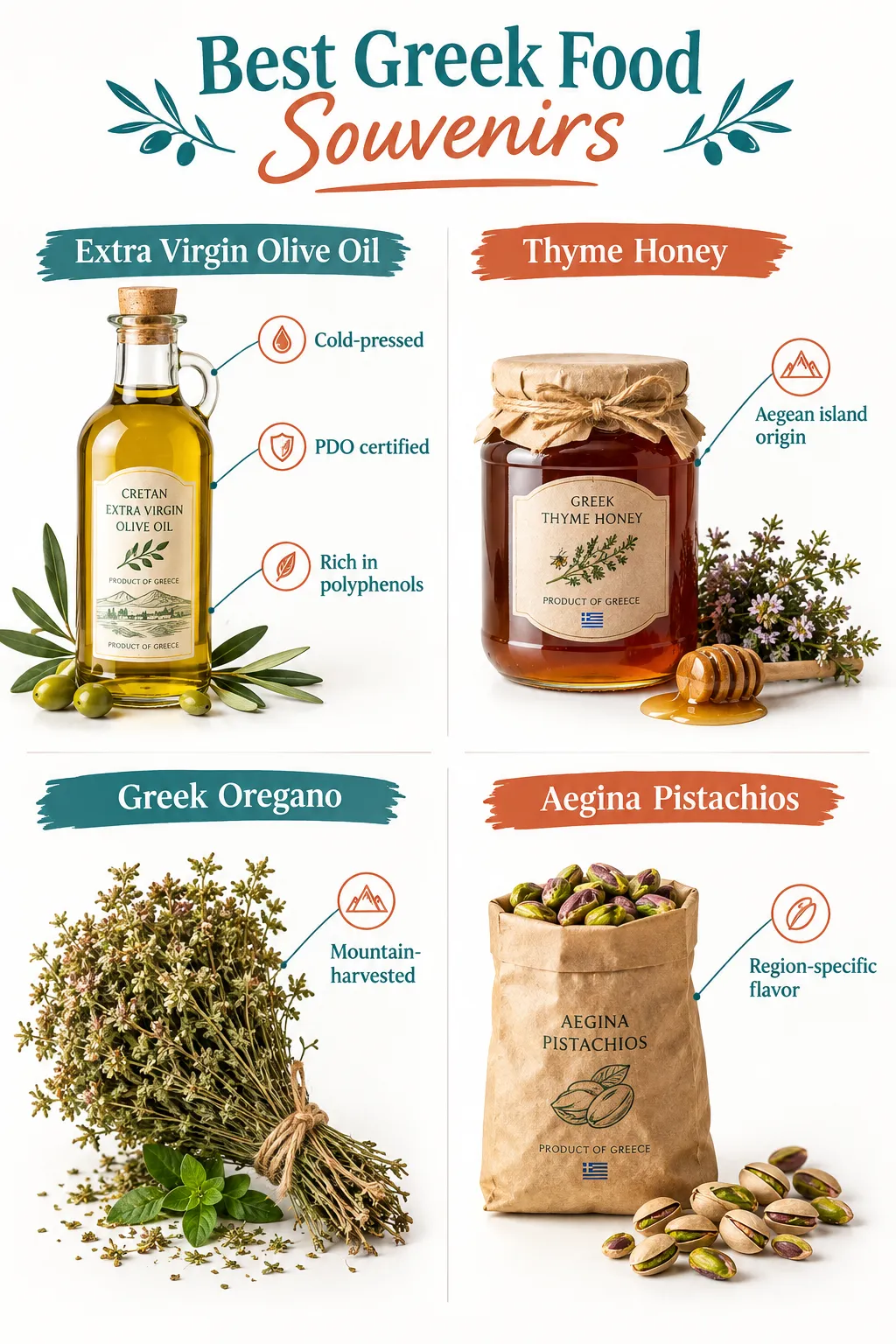
Extra virgin olive oil tops every 2026 list for good reason. Cretan olive oil in particular travels well, has a distinct flavor profile, and delivers more daily satisfaction than any decorative item. Look for cold-pressed, PDO-certified bottles. Budget around 10-25 EUR for a quality 500ml bottle.
Thyme honey is the benchmark Greek honey, especially from Crete and the Aegean islands. According to GreekReporter’s June 2026 guide to authentic Greek souvenirs, it ranks just behind olive oil as a top purchase. The flavor is intensely floral and unlike supermarket honey anywhere else.
Aegina pistachios are region-specific and noticeably different from Turkish or California pistachios – sweeter, smaller, and more aromatic. Grab a bag from a market stall rather than a tourist shop.
Greek sweets – loukoumia (Turkish delight-style confections), baklava, and spoon sweets (glyka tou koutaliou) – come in beautiful gift boxes and travel well in checked luggage. These classic, tasty treats are crowd-pleasers for anyone back home.
“Anything related to the olive tree – oil, wood, soap – is among the most famous and used categories of Greek souvenirs.”
Are Greek Spices and Herbs Worth Buying?
Yes, absolutely. Greek herbs and spices are lightweight, cheap, and deliver a strong sense of place every time you cook with them.
Dried oregano and mountain tea (sideritis) are the two most recommended picks. Greek oregano is more pungent than the dried oregano sold in most Western supermarkets. Mountain tea is a mild, earthy herbal tea made from sideritis plants grown at altitude – it’s a daily ritual for many Greeks and nearly impossible to find fresh outside the country.
Kozani saffron is a higher-value option. Grown in northern Greece, it’s one of the few PDO saffrons in Europe and is considered premium quality. A small tin costs around 8-15 EUR and makes an exceptional gift for food lovers.
Where to buy: Skip the tourist souvenir shops. Go to small deli shops (delikatessen), farmers markets, or neighborhood grocery stores for better quality and lower prices.
Where to Buy Authentic Greek Products in Athens
Athens has distinct shopping neighborhoods, and knowing which one to visit saves a lot of time.
| Neighborhood | Best For |
|---|---|
| Plaka | Leather goods, ceramics, Mati charms, komboloi |
| Monastiraki | Flea market finds, antiques, herbs, olive wood |
| Psyrri | Independent artisan shops, jewelry, design objects |
| Kolonaki | High-end leather, jewelry, fashion |
| Ermou Street | Mainstream shopping, leather accessories |
For food products specifically, the Athens Central Market (Varvakios Agora) is the best spot. You’ll find fresh herbs, honey, spices, and regional specialties at local prices.
Museum shops – especially at the National Archaeological Museum and the Acropolis Museum – are excellent for high-quality replica artifacts, jewelry, and art books. They’re often overlooked by tourists but consistently recommended by experts for quality and authenticity.
If you’re planning your Athens visit, check out this Athens Greece walking tour covering 11 hidden stops – it passes through several of these shopping neighborhoods naturally.
Greek Leather Goods – Quality and Where to Find Them
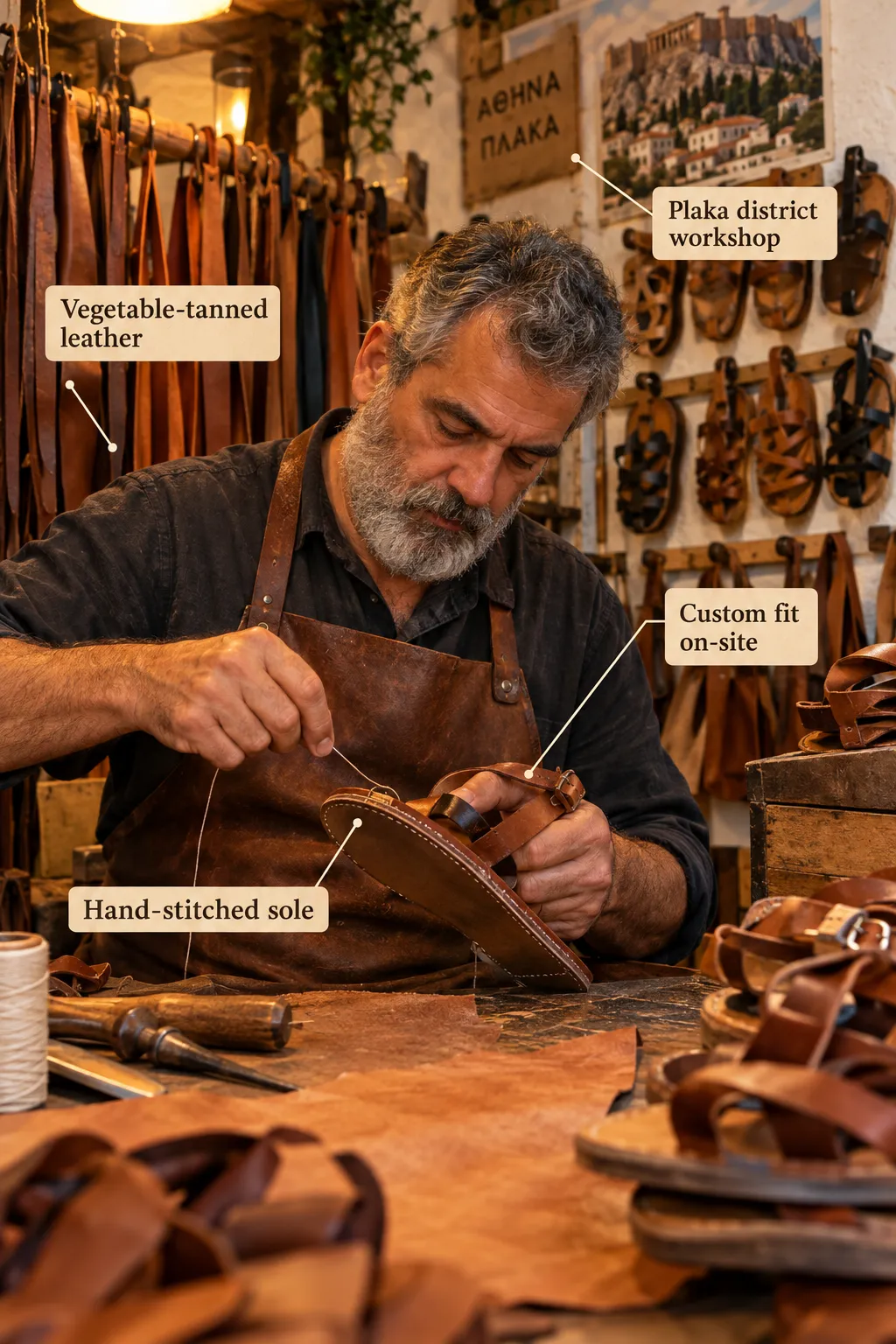
Handmade leather sandals are one of the strongest non-food purchases you can make in Greece. Athens craftsmen – particularly in the Plaka neighborhood – make sandals to order, adjust the fit on the spot, and use vegetable-tanned leather that lasts for years.
A July 2026 deep-dive on what to buy in Greece calls Athens leather sandals one of the best wearable souvenirs, especially when custom-fitted. Prices typically run 30-80 EUR depending on style and complexity.
Beyond sandals, look for leather belts, bags, and wallets from small workshops in Psyrri and Kolonaki. These are noticeably better quality than mass-market equivalents and carry a clear sense of origin.
Choose leather sandals if: you want a souvenir you’ll actually wear for years. Choose a leather bag if you want something functional and gift-worthy.
Best Places to Buy Traditional Greek Ceramics and Pottery
Hand-painted ceramics from Greek island workshops are one of the most satisfying things to buy in Greece. They’re practical, beautiful, and unmistakably Greek.
Sifnos has the strongest ceramics tradition in Greece – the island has been producing pottery for centuries. If you’re island-hopping, it’s worth picking up a piece there directly. Several 2025-2026 sources specifically recommend Sifnos ceramics as beautiful, practical pieces that still feel genuinely local.
In Athens, look for ceramics in Monastiraki and Plaka. The key is to look for handmade, small-batch pieces rather than factory-produced plates with generic Greek motifs.
Signs of handmade quality:
- Slight irregularities in shape
- Hand-painted (not printed) designs
- Signed or stamped by the maker
- Sold in small workshops, not large tourist shops
Is Greek Wine a Good Souvenir to Bring Home?
Greek wine is an excellent souvenir – and it’s genuinely underrated internationally. Varieties like Assyrtiko (from Santorini), Xinomavro, and Agiorgitiko are distinct, food-friendly wines that most people back home have never tried.
A standard bottle costs 8-20 EUR in a wine shop. Buying at a winery or directly from a producer on an island like Santorini adds a story to the bottle.
Practical tip: Wine is best packed in checked luggage, wrapped in clothes or a wine sleeve. If you’re buying at the last minute, airport duty-free is a reliable option – prices are comparable and you avoid the liquid carry-on issue entirely.
If you’re visiting Santorini and wondering whether it’s worth the trip, this honest guide to Santorini Greece covers exactly that.
What Greek Items Are Cheapest to Buy as Gifts
Some of the best Greek gifts are also the most affordable. You don’t need to spend much to bring home something genuinely meaningful.
Budget-friendly picks (under 10 EUR each):
- Small Mati (evil eye) charms
- Packets of dried oregano or mountain tea
- Loukoumia in small boxes
- Olive-oil soap bars
- Small komboloi worry beads
Mid-range picks (10-30 EUR):
- A jar of thyme honey
- Olive-wood spoon or small cutting board
- Hand-painted ceramic mug or small bowl
- A bottle of ouzo or tsipouro
Olive-wood utensils and cutting boards typically run 10-50+ USD depending on size and craftsmanship – they’re practical, durable, and genuinely distinctive.
What Not to Buy in Greece as Souvenirs – and What’s Overpriced for Tourists
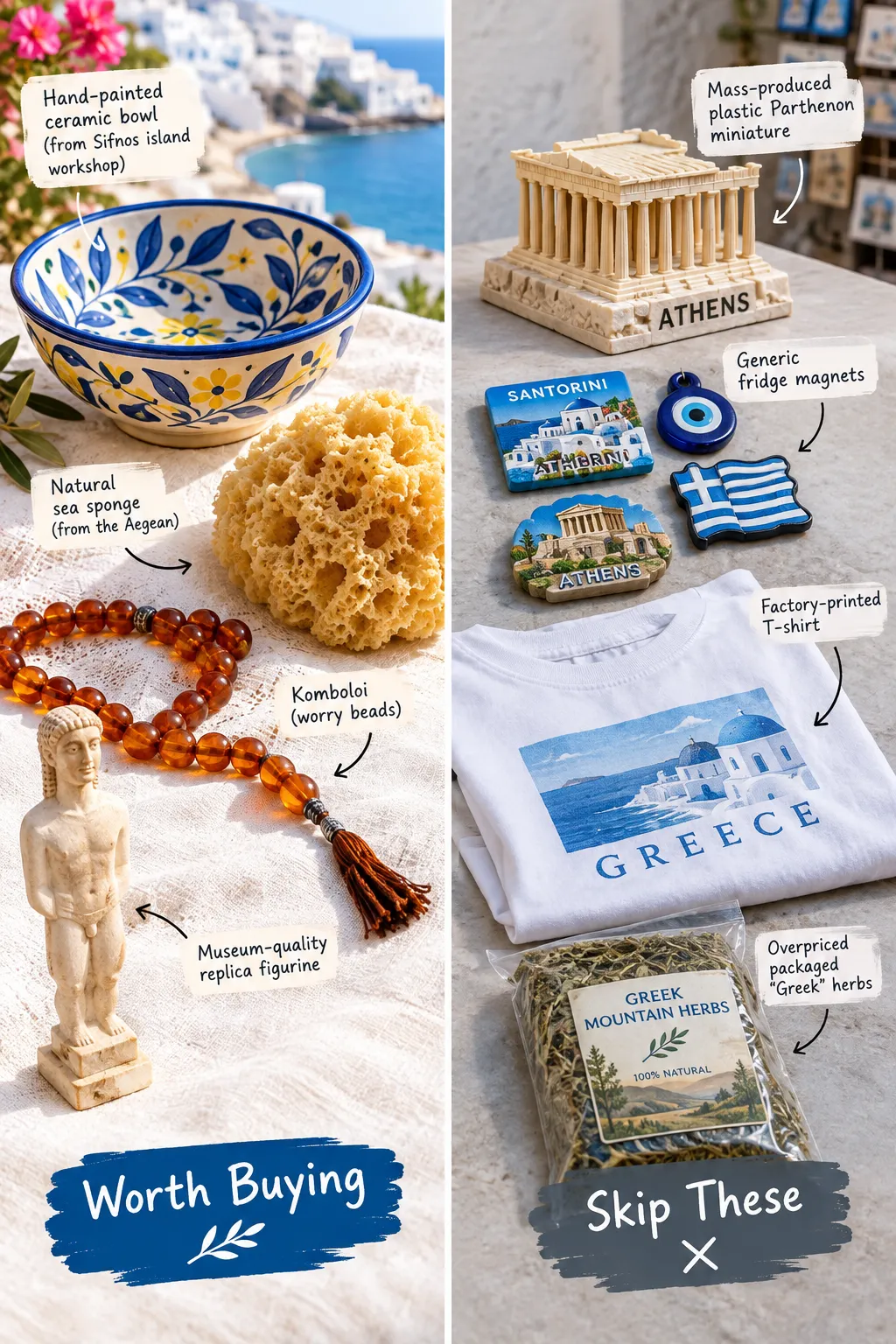
Not everything sold in Greek tourist areas is worth your money or luggage space.
Skip these:
- Mass-produced plastic statues and Parthenon replicas from tourist stalls
- Generic “I love Greece” t-shirts
- Packaged “Greek” herbs from airport gift shops (overpriced, low quality)
- Cheap evil-eye keychains from souvenir mega-stores (often made in China)
- Anything sold within 50 meters of a major cruise ship dock at tourist-inflated prices
The overpriced tourist trap pattern: If a shop has 200 identical items displayed in bins near a major landmark, the quality is almost always lower and the price higher than what you’d find two streets away.
The fix is simple – walk a few blocks away from the main tourist drag and you’ll find the same categories of items at better quality and lower prices.
Greek Olive Oil vs Regular Olive Oil – Which Is Better?
Greek extra virgin olive oil is widely considered among the best in the world, and for most travelers, it outperforms what they buy at home. Greece produces roughly 70-80% of its olive oil as extra virgin grade (estimate based on industry reporting), compared to much lower rates in other producing countries.
The difference comes down to variety, harvest timing, and processing. Greek oils – especially from Crete and the Peloponnese – tend to be high in polyphenols, which means more flavor and better health properties. GreekReporter’s authentic souvenirs guide highlights regional Cretan and Aegean island oils as particularly prized.
What to look for on the label:
- “Extra virgin” (not just “olive oil”)
- PDO or PGI certification
- Harvest date (not just bottling date)
- Single-origin region named
How Much Does Greek Honey Cost Compared to Other Countries?
Greek thyme honey costs roughly 8-20 EUR for a 250-450g jar in Greece, depending on the producer and region. That’s comparable to or slightly higher than generic supermarket honey at home, but significantly cheaper than buying the same product imported.
Premium Hymettus honey (from the Athens region) and Cretan thyme honey can run higher – up to 30 EUR for specialty jars – but the quality difference is noticeable.
The real value isn’t just the price – it’s that genuine Greek thyme honey from the Aegean islands is nearly impossible to find at the same quality outside Greece. It’s one of those purchases where buying locally makes a real difference.
Can You Bring Greek Food Back Through Airport Security?
Yes, most Greek food souvenirs can travel home with you – but the rules depend on your destination country and how you pack.
General rules:
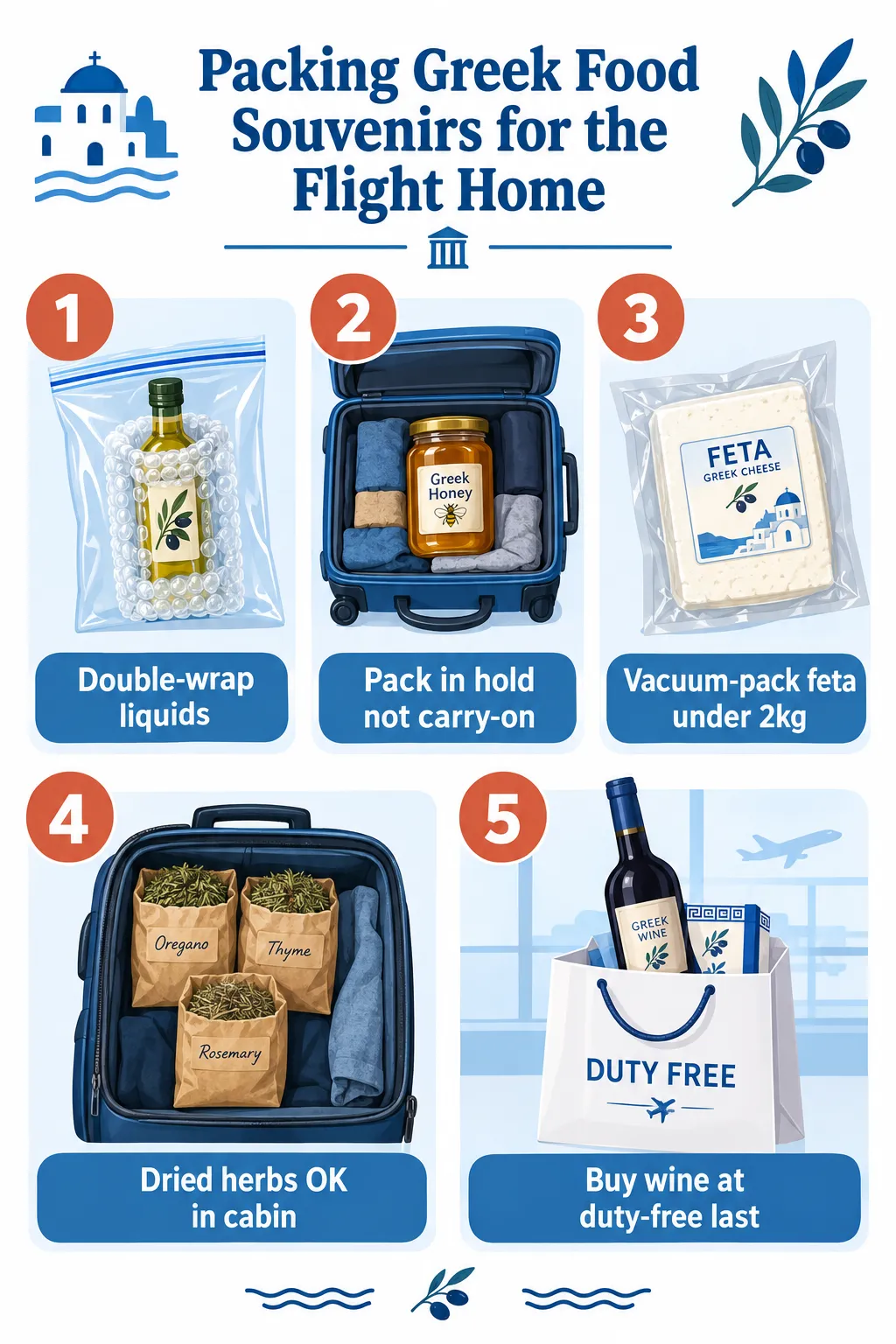
- Dried herbs, spices, and teas: Fine in both carry-on and checked luggage for most destinations
- Honey and olive oil: Must go in checked luggage (over 100ml liquid rule applies to carry-on)
- Greek wine and spirits: Checked luggage only, or buy at duty-free after security
- Feta cheese: See below
Greek feta cheese – how to transport home without it spoiling:
Vacuum-packed feta is the easiest option. Buy a vacuum-sealed block (available at supermarkets and delis), keep it in your checked luggage, and it will stay fresh for the flight. Most countries allow sealed dairy products under 2kg for personal use, but check your destination country’s customs rules before you buy.
If you’re traveling to the US, EU, Canada, or Australia, regulations differ – Australia has strict biosecurity rules around dairy, so check the Australian Border Force website before packing feta.
Practical tip: Pack olive oil and honey bottles in zip-lock bags inside your checked luggage. Double-wrapping prevents a messy disaster if a bottle cracks.
Cultural and Symbolic Items Worth Buying in Greece
Mati charms and komboloi worry beads are two of the most culturally meaningful things to buy in Greece – and both are genuinely affordable.
Mati (evil eye) amulets are a deep part of Greek folk belief. A small blue glass evil-eye charm costs 1-5 EUR from a good shop. Buy from small independent stores in Plaka, Monastiraki, or Psyrri rather than large tourist shops – the quality and variety are much better.
Komboloi are Greek worry beads – not prayer beads, but a tactile stress-relief tool that Greeks use daily. They come in amber, glass, wood, and semi-precious stones. A basic set starts around 5-10 EUR; artisan versions in amber or coral can run 50-200 EUR.
Both items carry real cultural weight and make excellent gifts for people who appreciate meaning behind an object.
If you’re planning a group trip to Greece, this Greece group trip guide with 9 genius stops has great advice on coordinating shopping and sightseeing together.
FAQ
What is the most popular souvenir from Greece?
Extra virgin olive oil is consistently ranked the most popular and most recommended Greek souvenir in 2026. It’s practical, genuinely better than most imported versions, and strongly associated with Greek culture.
What should I buy in Greece for gifts?
Thyme honey, loukoumia (Greek sweets), olive-oil soap, small Mati charms, and packets of dried oregano are all affordable, lightweight, and well-received as gifts. Aegina pistachios are another crowd-pleaser.
Is it cheaper to buy olive oil in Greece than at home?
Yes, generally. Quality extra virgin olive oil in Greece costs 8-15 EUR for 500ml at a local shop – often half the price of equivalent imported Greek oil at home.
Where is the best place to shop in Athens?
Monastiraki and Plaka for ceramics, leather goods, and cultural items. The Athens Central Market for food products. Psyrri for independent artisan shops. Museum shops for high-quality replica artifacts.
Can I bring ouzo on a plane?
Ouzo must go in checked luggage (it’s over 100ml). Alternatively, buy it at the airport duty-free shop after passing security – it then counts as a duty-free purchase and can go in your carry-on in a sealed bag.
What Greek products are overpriced for tourists?
Packaged herbs near major landmarks, mass-produced ceramic plates, and cheap evil-eye keychains from large souvenir stores are typically overpriced and lower quality. Walk two or three streets away from tourist hotspots for better value.
Is Greek wine worth bringing home?
Yes. Varieties like Assyrtiko and Xinomavro are genuinely distinctive and hard to find at home. A good bottle costs 8-20 EUR in a wine shop. Buy at duty-free if you want to avoid packing issues.
What is mastiha and is it worth buying?
Mastiha is a resin from mastic trees grown only on the Greek island of Chios. It’s used in liqueurs, sweets, and cosmetics. Because it’s geographically unique to Chios, it’s one of the most place-specific souvenirs you can buy. The liqueur makes an excellent gift.
Are natural sea sponges from Greece good quality?
Yes. Greek sea sponges – harvested from the Dodecanese islands – are softer and more durable than synthetic alternatives. They’re lightweight, easy to pack, and often sold alongside olive-oil soaps in the same shops.
What are komboloi and should I buy them?
Komboloi are Greek worry beads used for stress relief and idle fidgeting – not religious objects. They’re a genuine part of daily Greek life. A basic set costs 5-10 EUR; quality amber sets run higher. They make thoughtful, culturally meaningful gifts.
What food souvenirs travel best from Greece?
Dried herbs, honey (in checked luggage), vacuum-packed olive oil, loukoumia, and Aegina pistachios all travel well. Avoid anything that needs refrigeration unless you can vacuum-seal it.
Is Santorini a good place to shop in Greece?
Santorini is great for wine (Assyrtiko in particular) and ceramics, but prices are higher than Athens due to the tourist premium. For the best value on most Greek souvenirs, Athens markets are hard to beat.
Conclusion
The best things to buy in Greece share one quality – they keep giving you something after you’re home. A bottle of Cretan olive oil on your kitchen counter. A jar of thyme honey in your tea. A pair of leather sandals you reach for every summer.
Actionable next steps:
- Prioritize food first – olive oil, honey, and herbs are the highest-satisfaction purchases and the easiest to pack (in checked luggage for liquids)
- Shop off the tourist trail – Monastiraki, Psyrri, and local markets beat the souvenir shops near major landmarks every time
- Check customs rules before you buy – especially for dairy (feta) if you’re traveling to Australia or the US
- Leave room in your luggage – seriously, you will buy more than you plan to
- Visit museum shops – they’re underrated for quality gifts and replica artifacts
If you’re still planning your trip, our guide to what to see in Athens Greece beyond the Acropolis will help you find the neighborhoods where the best shopping actually happens. And if you’re comparing European shopping destinations, the 21 best things to buy in Portugal is a great companion read.
Greece rewards travelers who slow down and shop like a local. The things you’ll be most glad you bought are almost never the ones you find in the first shop you walk into.