Last updated: September 28, 2026
Philadelphia packs over 300 years of American history into roughly two square miles of walkable downtown streets. That’s exactly why 2 days in Philadelphia can feel like more than enough time, or barely a scratch on the surface, depending entirely on how you plan it.
Quick Answer: 2 days in Philadelphia is enough time to see Independence Hall, the Liberty Bell, Reading Terminal Market, the Philadelphia Museum of Art, and one South Philly neighborhood like Passyunk Avenue. Spend day one in Old City and Center City for history and food, then use day two for art, museums, and local culture south of downtown. Most travelers spend $250 to $450 per person over two days, depending on hotel choice and how many paid attractions they add.
Key Takeaways
- Independence Hall and the Liberty Bell together take about 2 to 3 hours, including timed-entry tickets.
- Old City and Center City are walkable, so you rarely need a car for a 48-hour Philadelphia trip.
- SEPTA transit and Uber both work well; walking covers most of day one on foot.
- Reading Terminal Market is the single best lunch stop for first-timers.
- South Philly (Passyunk Avenue, the Italian Market, Bok Bar) is the smart focus for day two.
- Summer 2026 brings extra crowds from events like the Chinese Lantern Festival and the US Amateur Championship at Merion, so book hotels early.
- Families should swap one adult-focused museum for the Franklin Institute or Please Touch Museum.
- A guided walking tour of Old City is worth the money once; DIY works fine for art museums.
What Are the Must-See Attractions in Philadelphia for First-Timers?
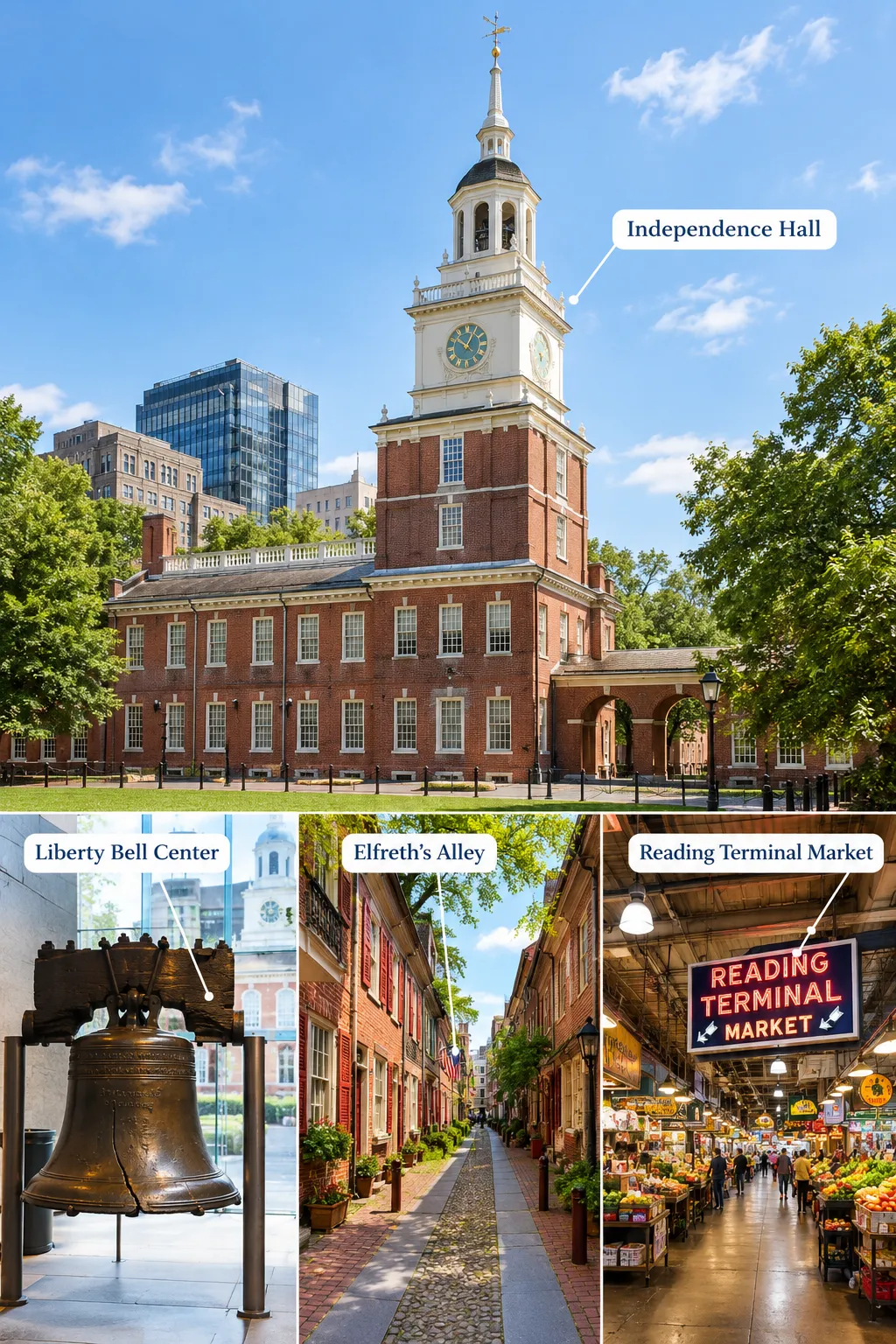
For first-time visitors, the must-see list is short and specific: Independence Hall, the Liberty Bell Center, the Philadelphia Museum of Art, Reading Terminal Market, and Elfreth’s Alley. These five stops cover history, art, food, and photo-worthy streets, all within a compact, walkable area of Old City and Center City.
Here’s what each one delivers:
- Independence Hall: Where the Declaration of Independence and Constitution were debated and signed.
- Liberty Bell Center: Free entry, no ticket required, quick but iconic stop.
- Philadelphia Museum of Art: The “Rocky steps” museum, home to major American and European collections.
- Reading Terminal Market: One of the oldest and largest indoor markets in the US, with over 80 food stalls at 1136 Arch Street.
- Elfreth’s Alley: The oldest continuously inhabited residential street in the country.
A popular day-one starting point recommended in several recent guides is breakfast at Sabrina’s Cafe near Drexel, followed by a walk over the Spring Garden Bridge into Museum Mile, a route that eases you into the city’s rhythm before the crowds build, as outlined in The Triangle’s 48-hour Philly guide.
Mistake to avoid: Trying to squeeze in the Barnes Foundation, the art museum, and the Constitution Center all on day one. Pick two, not three, or you’ll spend more time walking between them than actually looking at anything.
Independence Hall and the Liberty Bell: How Long Do You Need?
Plan for 2 to 3 hours total: roughly 30 to 45 minutes at the Liberty Bell Center, plus a 35 to 45 minute ranger-led tour inside Independence Hall, and walking time between the two sites inside Independence National Historical Park.
A few planning notes:
- Independence Hall requires a free timed ticket, especially in peak season.
- Liberty Bell viewing has no ticket requirement and moves quickly.
- Pair both with the National Constitution Center for a fuller half-day if you want more depth.
Decision rule: Choose the ranger-led Independence Hall tour if you have kids over age 8 or love storytelling. Choose a quick self-guided pass through the Liberty Bell alone if you’re short on time and just want the photo.
Is 2 Days in Philadelphia Enough to See It All?
No city this old gets fully “done” in 48 hours, but 2 days in Philadelphia is enough to comfortably hit the top historic sites, one great museum, and one full neighborhood meal crawl. If you only have one day, plan to cut either the art museum wing or the South Philly neighborhood visit to keep the pace relaxed.
Two days is enough time to fall in love with Philly, not enough time to see all of it. That’s actually the fun part.
If you’re weighing Philadelphia against other short-stay East Coast cities, it helps to see how similar 48-hour formats work elsewhere, like how to spend 2 days in New York or a long weekend in Nantucket. Philadelphia moves at a slightly slower, more walkable pace than Manhattan, which is part of why 48 hours here feels less rushed.
Edge case: If your trip lands during a major event week, like the 126th US Amateur Championship at Merion Golf Club (August 10-16, 2026), hotel availability tightens and crowds shift, according to Visit Philadelphia’s 2026 events calendar. Book lodging weeks ahead if your dates overlap.
The Perfect 2-Day Philadelphia Itinerary, Hour by Hour
The best structure splits history and art on day one, and local neighborhood culture on day two. This keeps walking distances short and avoids doubling back across the city.
Day 1: History and Center City
- Breakfast at Sabrina’s Cafe or a Reading Terminal Market stall.
- Walk to Independence Hall and the Liberty Bell (book the timed tour first).
- Explore Old City streets, including Elfreth’s Alley.
- Lunch at Reading Terminal Market.
- Afternoon at the Philadelphia Museum of Art or a walk up Museum Mile, a route highlighted in the Philadelphia Weekender 48-hour guide.
- Dinner in Center City.
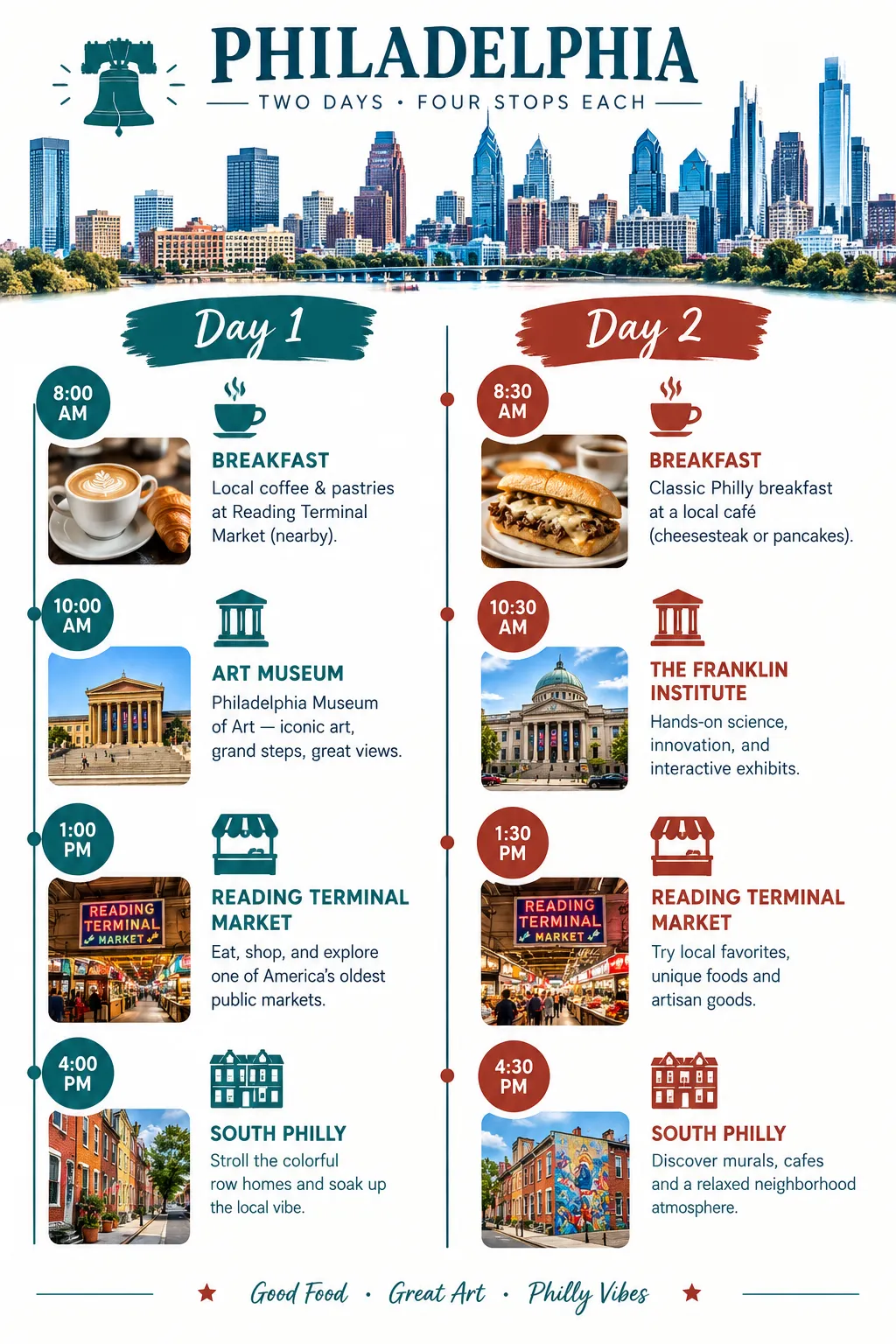
Day 2: South Philly and local culture
- Late breakfast, then head to the Bok Building at 1901 S. 9th St.
- Walk Passyunk Avenue for lunch and browsing.
- Visit the Italian Market for produce, cheese, and people-watching.
- Grab water ice at Rita’s, a South Philly staple worth the short line.
- Evening drinks or dinner on Passyunk Avenue’s restaurant strip.
Best 2-Day Philadelphia Itinerary for Families with Kids
Families should swap one adult-heavy museum stop for something interactive. The Franklin Institute (hands-on science) or the Please Touch Museum (younger kids) fit naturally into the day-one museum block without adding extra travel time.
- Keep the Independence Hall tour, kids generally enjoy the storytelling.
- Skip the Barnes Foundation with young kids; it’s better for older teens or adults.
- Build in a mid-afternoon park break, Franklin Square works well and often has seasonal programming.
- End day two early; South Philly’s food scene is better suited to adult evenings.
Where Should You Stay, Get Around, and What Does This Trip Cost?
Where to Stay for a Weekend Trip
Stay in Center City or Old City if this is your first trip, since both put you within walking distance of nearly every stop on this itinerary. Rittenhouse Square is a strong second choice for a slightly quieter, more residential feel with easy access to restaurants.
- Old City: Closest to Independence Hall and historic sites, great for history-first travelers.
- Center City: Central to everything, best overall base for a 48-hour trip.
- Rittenhouse Square: Quieter, upscale, still walkable to major sights.
Mistake to avoid: Booking a hotel near the airport or in a suburb to save money. The extra Uber or transit time each day eats into your already limited 48 hours.
How Do You Get Around: Public Transit, Uber, or Walking?
Walking covers most of a 2-day Philadelphia itinerary, since Old City, Center City, and the museum area sit close together. Use SEPTA’s subway or bus for longer hops, and Uber for late-night South Philly returns.
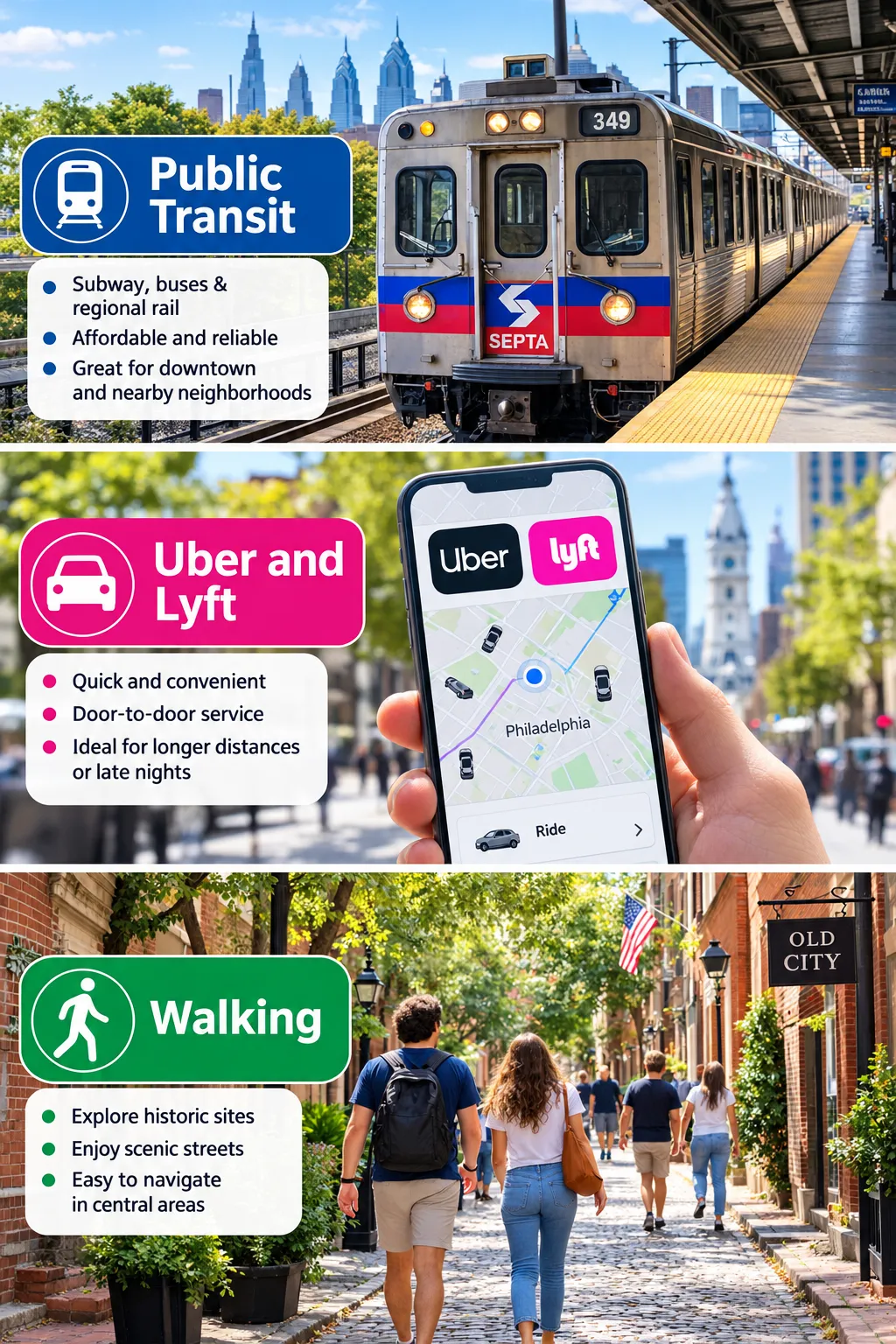
| Option | Best For | Notes |
|---|---|---|
| Walking | Old City to Center City | Flat, compact, very doable on foot |
| SEPTA Transit | Museum Mile, South Philly | Cheap, frequent, avoids traffic |
| Uber or Lyft | Late nights, luggage days | Faster, pricier during event weekends |
How Much Does It Cost to Visit Philadelphia for 2 Days?
Budget roughly $250 to $450 per person for two days, covering a mid-range hotel, meals, and one or two paid attractions like the art museum or Barnes Foundation. The cheapest way to see Philadelphia is to prioritize the free sites first: Liberty Bell, Elfreth’s Alley, and most of Independence National Historical Park cost nothing.
- Free: Liberty Bell, Independence Hall (free timed ticket), Elfreth’s Alley, Rittenhouse Square, Franklin Square (some events ticketed).
- Paid: Philadelphia Museum of Art, Barnes Foundation, Franklin Institute, Please Touch Museum.
- Food: Reading Terminal Market and Italian Market let you eat well without a sit-down restaurant bill.
Best Restaurants in Philadelphia: What Should You Eat?
Eat a Philly cheesesteak at least once, then round out your meals with Reading Terminal Market stalls, Italian Market produce and cheese, and a Passyunk Avenue dinner. This mix covers the city’s classic street food and its more polished, chef-driven side.
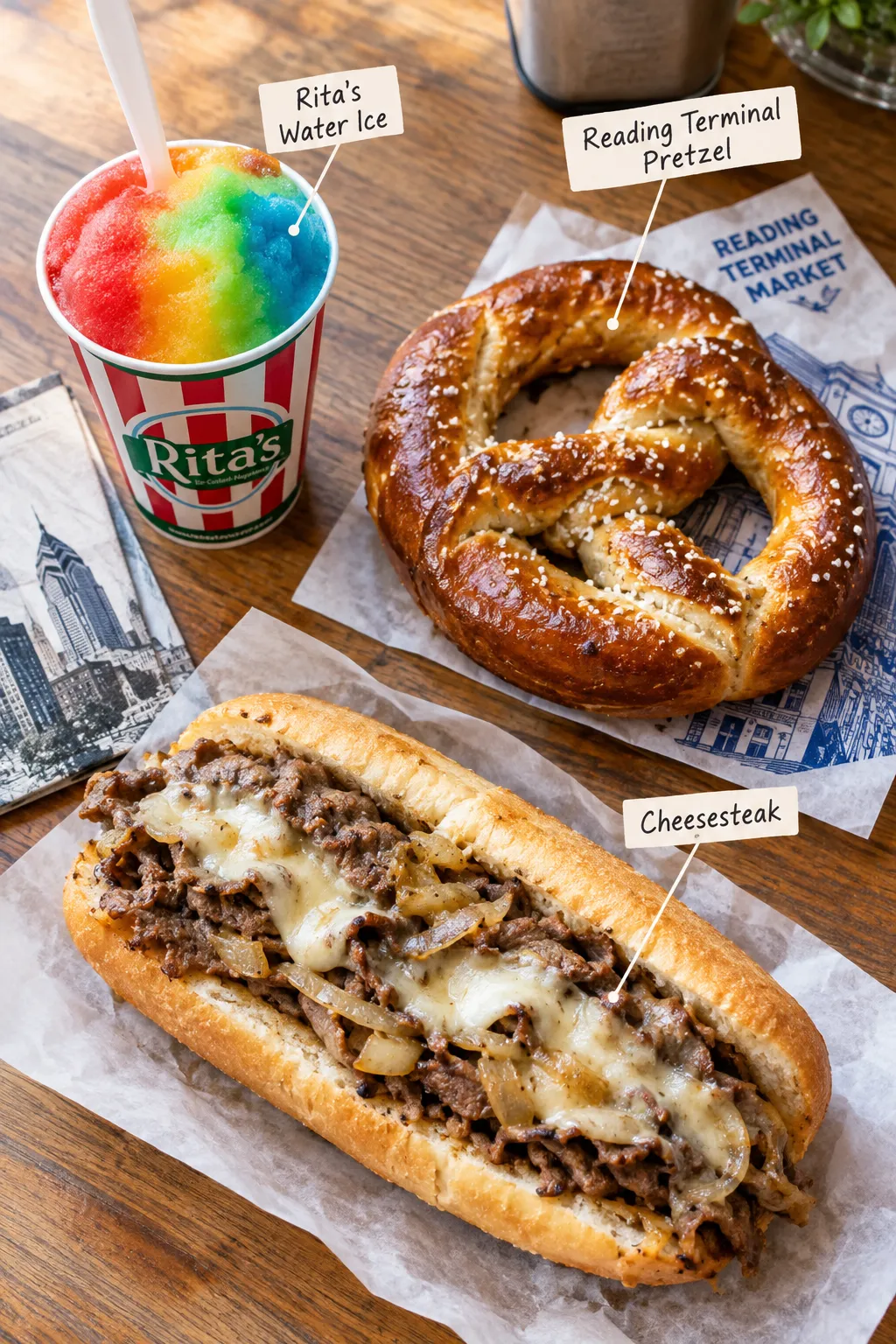
- Cheesesteak: Any respected South Philly shop; skip the tourist-trap lines if the wait exceeds 20 minutes.
- Reading Terminal Market: Try a Pennsylvania Dutch stall, a pretzel, and a sandwich spot in one visit.
- Italian Market: Best for cured meats, fresh mozzarella, and casual lunch counters.
- Rita’s Water Ice: A South Philly tradition, especially refreshing on a summer visit.
- Passyunk Avenue: Strong dinner and cocktail bar scene, good for a relaxed second-night meal, a strip also highlighted in VICE’s Philadelphia weekend travel guide.
Quick example: A realistic day-two food plan looks like: pretzel snack at 10am, cheesesteak lunch at noon, water ice at 3pm, full dinner on Passyunk at 7pm. No reservations required for any of it.
Philadelphia’s Museum and Art Scene: What Shouldn’t You Miss?
The Philadelphia Museum of Art and the Barnes Foundation are the two collections worth prioritizing in a 48-hour trip, since together they represent the city’s deepest art holdings without requiring a full extra day. If you only have time for one, choose the Barnes for a more intimate, curated experience.
- Philadelphia Museum of Art: Broad collection, iconic building, the “Rocky steps” moment.
- Barnes Foundation: Dense, room-by-room installations of Impressionist and Post-Impressionist works.
- Rodin Museum: Small, quick stop, walkable between the two above.
Choose the Barnes if you have 90 minutes and want quality over quantity. Choose the Philadelphia Museum of Art if you want a broader survey and the classic photo stop outside.
Philadelphia in Summer vs Winter: Which Season Is Better?
Summer offers longer days, outdoor festivals, and warmer weather, while winter brings lower hotel rates and fewer crowds at major sites. Neither season is objectively “better,” it depends on whether you prioritize events or savings.
Summer 2026 specifically brings the Philadelphia Chinese Lantern Festival at Franklin Square, running through August 30, 2026, with large handcrafted lanterns and a dedicated food and beer garden, according to Visit Philadelphia’s last-chance summer guide. Late August also sees the return of the Philadelphia Cycling Classic, with street closures for races on August 30, per WHYY’s late-August events coverage.
Big-ticket events also affect logistics. The city’s 2026 resource hub flags high-impact dates like a Phillies postgame concert and Le Dîner en Blanc, both of which can tighten hotel availability and street access. Philadelphia’s new cruise terminal, opened in partnership with Norwegian Cruise Line in August 2026, is also adding short pre- and post-cruise stopover visitors to the city’s weekend mix, according to PAX News’s coverage of the terminal opening.
Choose summer if you want festivals and long daylight for walking. Choose winter if you want cheaper hotels and shorter lines at the art museum and Independence Hall.
Walking Tour vs Guided Tour: Which Is Better for 2 Days in Philadelphia?
A guided walking tour is worth booking for Old City’s historic district, since a good guide adds context you’d otherwise miss walking solo. For museums and neighborhood food stops, a self-guided approach works just as well and saves money.
- Guided tour pros: Historical context, efficient routing, good for first-timers.
- Guided tour cons: Fixed pace, costs more, less flexibility.
- Self-guided pros: Free, flexible timing, easy to adjust on the fly.
- Self-guided cons: Requires more pre-trip research to avoid missing key details.
Decision rule: Book a guided tour for day one’s history stops. Go self-guided for day two’s neighborhood exploring.
If Philadelphia is part of a bigger East Coast swing, it’s worth comparing pacing against nearby short-stay guides like Washington DC in the fall or a cozy NYC weekend trip, both of which follow a similar dense, walkable itinerary logic.
Frequently Asked Questions
Is 2 days enough for Philadelphia?
Yes, 2 days is enough to cover Independence Hall, the Liberty Bell, one major museum, and one South Philly neighborhood without feeling rushed.
What is the cheapest way to see Philadelphia’s top sights?
Prioritize free sites first: the Liberty Bell, Independence Hall’s free timed ticket, and Elfreth’s Alley cost nothing to visit.
Do I need a car in Philadelphia for a weekend trip?
No, most of Center City, Old City, and the museum district are walkable, and SEPTA or Uber cover the rest.
What should first-time visitors eat in Philadelphia?
Try a cheesesteak, a Reading Terminal Market lunch, and Rita’s water ice; these three cover the city’s most iconic food experiences.
Is summer or winter better for a Philadelphia weekend?
Summer offers festivals and longer days, while winter offers lower hotel prices and shorter lines; choose based on your priority.
How long does Independence Hall take to visit?
Plan for about 35 to 45 minutes for the ranger-led tour, plus travel time to and from the Liberty Bell Center nearby.
Is a guided tour worth it in Philadelphia?
Yes, for Old City’s historic district specifically, since a guide adds context that’s easy to miss walking solo.
Where should families with kids stay in Philadelphia?
Center City is the best base for families, keeping the Franklin Institute, Please Touch Museum, and historic sites all within walking distance.
Conclusion: Your Next Steps for 2 Days in Philadelphia
Two days in Philadelphia works best when you split history and art on day one, then local neighborhood culture on day two. Stick to Center City or Old City for your hotel, walk when you can, and lean on SEPTA or Uber for the longer South Philly hops.
Start by booking your Independence Hall timed ticket, since that’s the one thing that requires advance planning. Then pick one museum, one South Philly meal crawl, and let the rest of your 48 hours fill in naturally.
If you’re stitching this into a longer East Coast trip, check out our guides on spending 2 days in New York or a 3-day fall trip to Washington DC to build out a longer itinerary around your Philadelphia stop.