

Last updated: May 31, 2026
Quick Answer: The Royal Mile Edinburgh is a historic street running approximately 1.8 kilometers (just over one mile) through the heart of Edinburgh’s Old Town, connecting Edinburgh Castle to the Palace of Holyroodhouse. It is Scotland’s most visited street, lined with medieval closes, world-class museums, Gothic cathedrals, and centuries of living history. Most visitors can walk its full length in under an hour, though a thorough exploration takes a full day.
Key Takeaways
- The Royal Mile Edinburgh runs roughly 1.8 km and is made up of five named streets: Castlehill, Lawnmarket, High Street, Canongate, and Abbey Strand
- Top landmarks include Edinburgh Castle, St Giles’ Cathedral, the Scottish Parliament Building, and the Palace of Holyroodhouse
- Walking the full length takes 20 to 30 minutes at a casual pace; a full day is needed to explore attractions properly
- Entry to many sites is free, including St Giles’ Cathedral, Parliament Square, and the closes (alleyways)
- August is the busiest month due to the Edinburgh Fringe Festival; spring and autumn offer better crowds and mild weather
- Guided walking tours start from around £10 to £15 per person; many free self-guided options exist
- The street sits on a glacial ridge formed behind the volcanic plug of Castle Rock, giving it a natural downhill slope from castle to palace
- Edinburgh City Council approved a £1.5 million project in February 2026 to replace temporary security barriers with retractable bollards
- Families with children will find the street highly accessible, with interactive museums and open plazas
- Accessibility for mobility-impaired visitors is limited in some areas due to steep closes and cobblestones, but the main street is manageable
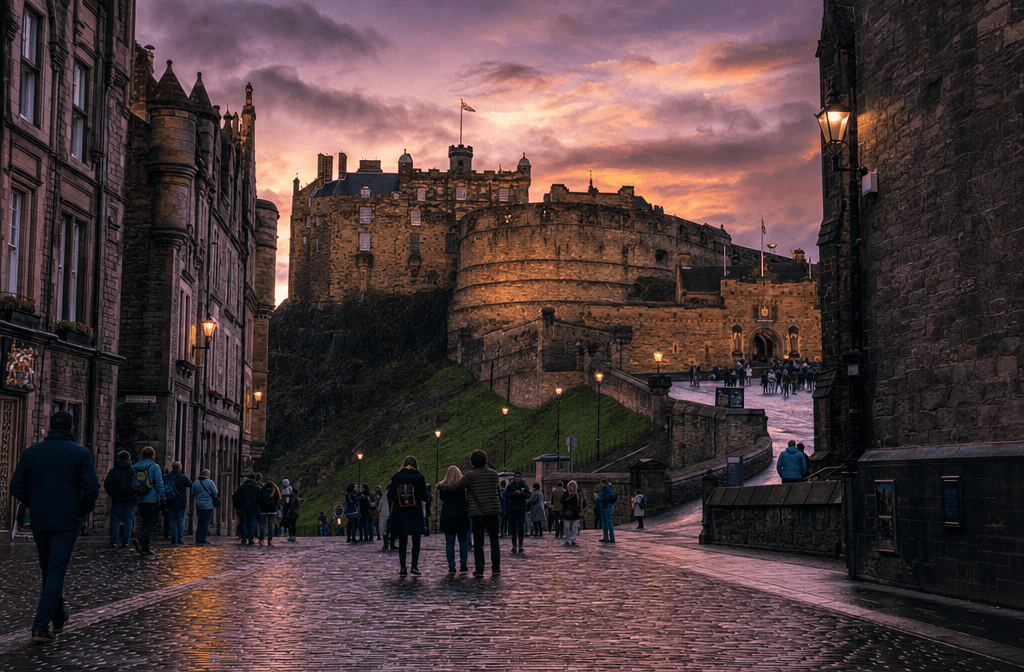
What Exactly Is the Royal Mile in Edinburgh?
The Royal Mile Edinburgh is the historic spine of Edinburgh’s Old Town, a single continuous route connecting the city’s two most iconic royal landmarks. It is not one street but five streets joined end to end: Castlehill, Lawnmarket, High Street, Canongate, and Abbey Strand, each with its own character and history [5].
The street sits on a natural ridge formed by glacial debris deposited behind the volcanic plug of Castle Rock during the last Ice Age. This geological formation, known as a crag and tail, gives the Royal Mile its distinctive downhill slope from west to east, dropping from the castle esplanade toward Holyrood Park [6].
Historically, this was the beating heart of medieval Edinburgh. By the 17th and 18th centuries, the street was one of the most densely populated urban areas in Europe, with tall tenement buildings housing thousands of residents in cramped conditions. Waste was routinely thrown from upper windows onto the street below, a practice that gave rise to the phrase “gardyloo” (a corruption of the French “garde à l’eau,” meaning “watch out for the water”) [5].
Today, the Royal Mile is Edinburgh’s busiest tourist corridor, home to shops, restaurants, museums, pubs, and visitor sites that draw millions of travelers each year [6].
How Long Does It Take to Walk the Entire Royal Mile?
Walking the full length of the Royal Mile Edinburgh from Edinburgh Castle to the Palace of Holyroodhouse takes approximately 20 to 30 minutes at a relaxed pace without stopping. However, if you plan to enter attractions, explore the narrow closes (alleyways), or stop for food, budget a full day.
Here is a practical time breakdown:
| Activity | Estimated Time |
|---|---|
| Walking end to end without stops | 20 to 30 minutes |
| Casual stroll with photo stops | 1 to 2 hours |
| Visiting 2 to 3 major attractions | Half day (4 to 5 hours) |
| Full exploration including castle and palace | Full day (7 to 8 hours) |
The street runs slightly downhill from west to east, so starting at Edinburgh Castle and walking toward Holyroodhouse is the easier direction. If you are planning a broader Edinburgh trip, see our 4-day Edinburgh itinerary for a well-paced schedule that includes the Royal Mile alongside the city’s other highlights.
What Is the Historical Significance of the Royal Mile?
The Royal Mile Edinburgh has been central to Scottish political, religious, and cultural life for over a thousand years. It is where royal processions marched, public executions were carried out, and the Scottish Reformation took hold in the 16th century [5].
Key historical moments tied to the street include:
- The Scottish Reformation (1560): John Knox, whose house still stands on the High Street, led the Protestant Reformation from this very street. St Giles’ Cathedral became the mother church of Presbyterianism.
- Royal processions: Scottish monarchs, from Mary Queen of Scots to Charles II, processed along the mile for coronations and state occasions.
- Public executions: The Mercat Cross on High Street was a focal point for public announcements and, historically, executions.
- Parliament Square: Located along the Royal Mile, Parliament Square houses both the High Court of Justiciary and the Court of Session, making it the legal heart of Scotland [6].
- The Act of Union (1707): The Scottish Parliament met in buildings along the Royal Mile before the union with England dissolved it. The new Scottish Parliament, reopened in 1999, sits at the foot of the mile.
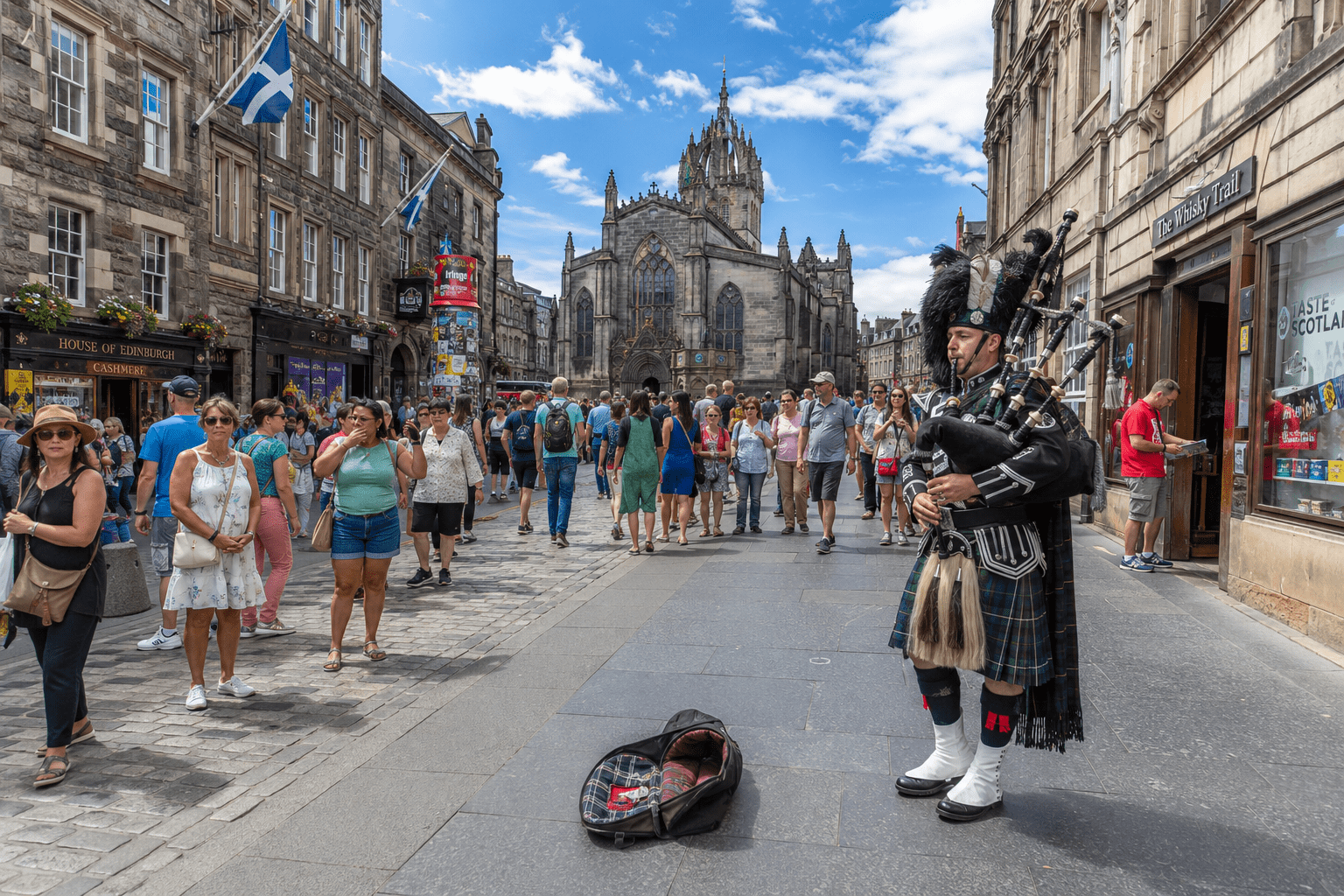
The street has also served as a stage for popular culture. Every August, it transforms into the world’s largest outdoor performance venue during the Edinburgh Fringe Festival, with street performers, musicians, and comedians taking over every available space [6].
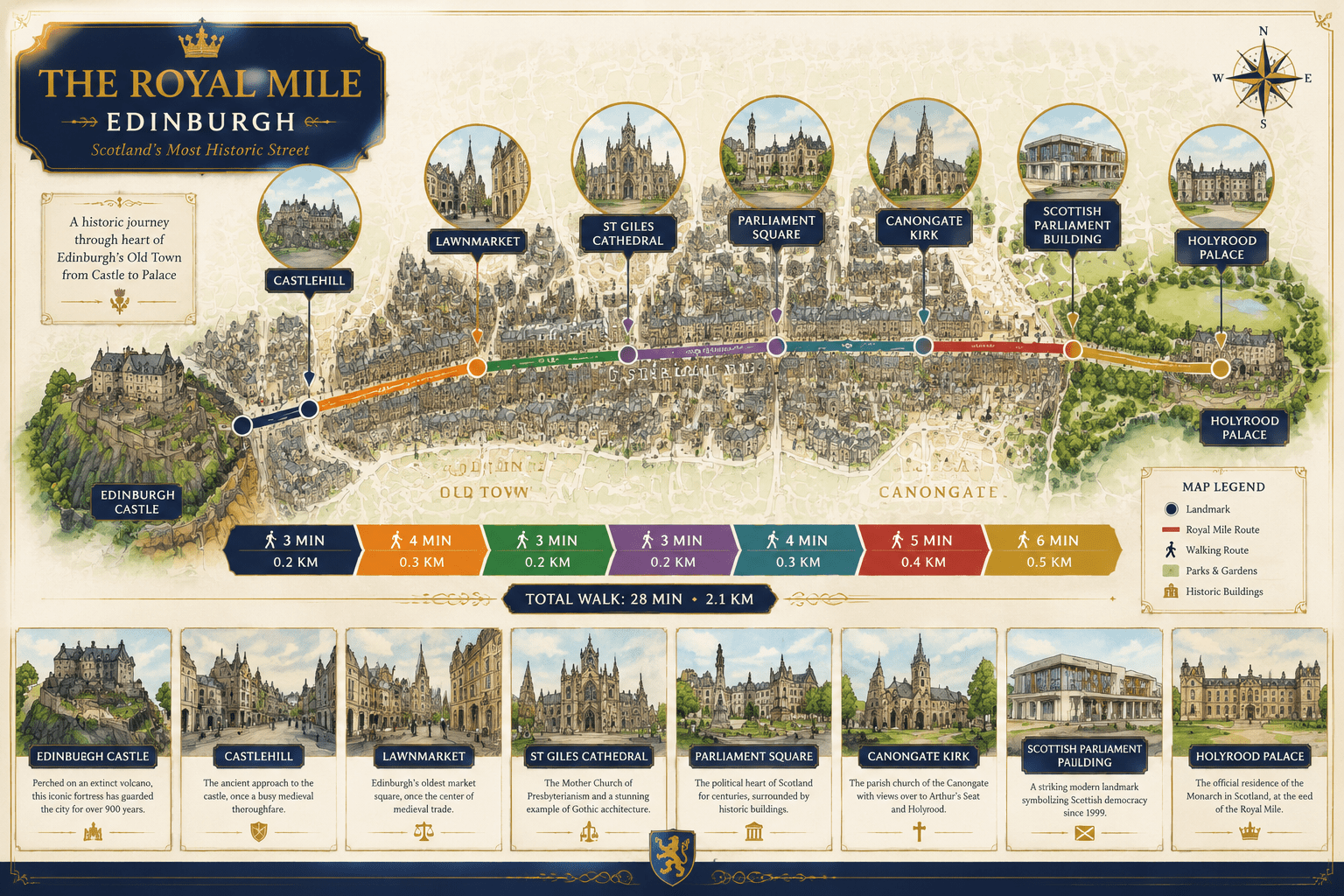
Top Attractions Along the Royal Mile Edinburgh
The Royal Mile Edinburgh packs more historic and cultural landmarks into 1.8 kilometers than almost any comparable street in Europe. Below are the must-see stops, organized from west to east.
Edinburgh Castle (Castlehill)
Perched on the volcanic Castle Rock, Edinburgh Castle is Scotland’s most visited paid attraction. Inside, you’ll find the Scottish Crown Jewels, the Stone of Destiny, and the National War Museum. Entry fees apply; book tickets in advance to avoid queues.
Camera Obscura (Castlehill)
A Victorian optical device offering a live, moving image of the city projected onto a viewing table. The building also houses five floors of optical illusions, making it a strong choice for families.
The Scotch Whisky Experience (Castlehill)
An interactive tour through Scotland’s whisky-making heritage, with tastings included. Good for adults who want a sensory introduction to Scotch.
Gladstone’s Land (Lawnmarket)
A preserved 17th-century merchant’s tenement managed by the National Trust for Scotland. It gives an honest picture of how Edinburgh’s middle class actually lived.
St Giles’ Cathedral (High Street)
The cathedral’s Gothic crown spire is one of Edinburgh’s most recognizable silhouettes. Entry is free, though donations are encouraged. The Thistle Chapel inside is one of the finest examples of Gothic craftsmanship in Scotland.
Parliament Square (High Street)
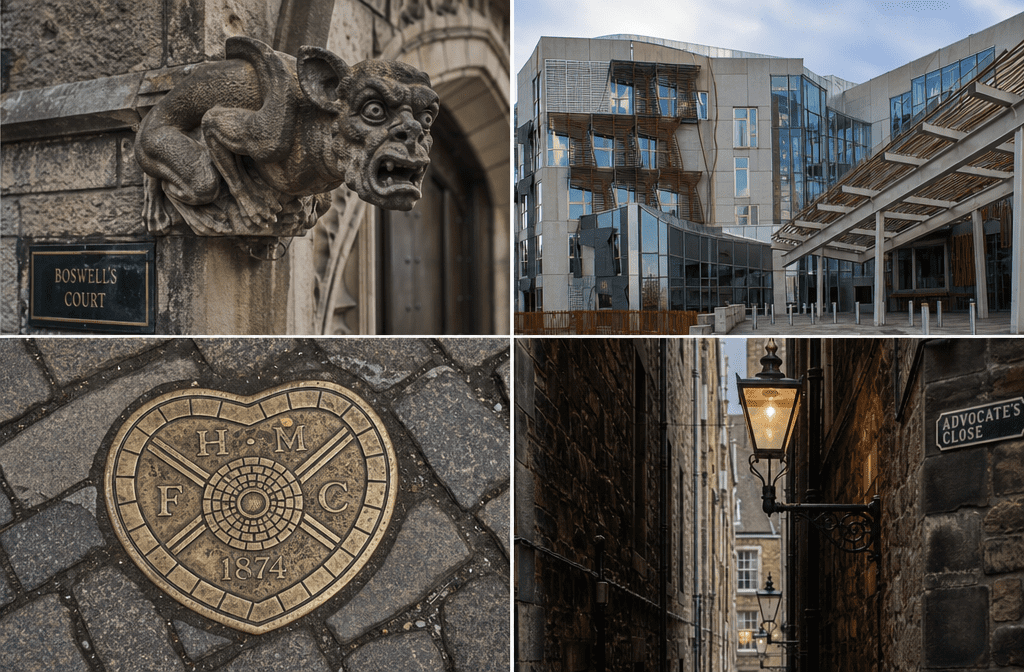
Look for the Heart of Midlothian, a brass mosaic set into the cobblestones outside St Giles’. Locals traditionally spit on it for luck. The square also houses the Supreme Courts of Scotland [6].
John Knox House (High Street)
One of the oldest surviving houses in Edinburgh, dating to the 15th century, and now a museum dedicated to the reformer’s life.
The People’s Story Museum (Canongate)
A free museum housed in the Canongate Tolbooth, focusing on the everyday lives of Edinburgh’s working people from the 18th century to the present.
Museum of Edinburgh (Canongate)
Another free museum covering the city’s history, including the original National Covenant document signed in 1638.
Canongate Kirk (Canongate)
The parish church of the Palace of Holyroodhouse, where several Scottish monarchs are buried. Free to enter.
Scottish Parliament Building (foot of the mile)
Opened in 2004 and designed by Enric Miralles, the building is a striking piece of contemporary architecture. Free public tours are available when Parliament is not in session.
Palace of Holyroodhouse (Abbey Strand)
The official Scottish residence of the British monarch. Mary Queen of Scots lived here, and the palace’s State Apartments are open to visitors. Entry fees apply.
Hidden Gems and Free Things to Do on the Royal Mile
Several of the Royal Mile’s best experiences cost nothing. Free highlights include:
- The closes and wynds: Narrow alleyways branching off the main street, including Advocates Close, Riddle’s Court, and White Horse Close. Each has its own story. Victoria Street, just off the Lawnmarket, is one of the most photographed streets in Scotland.
- The Heart of Midlothian mosaic: Free to see, and part of a centuries-old local tradition.
- People’s Story Museum and Museum of Edinburgh: Both free, both excellent.
- St Giles’ Cathedral: Free entry, with one of the finest medieval interiors in Scotland.
- Scottish Parliament: Free public tours when Parliament is in recess.
- Greyfriars Kirkyard: A short walk from the Royal Mile, this historic cemetery is free and home to the grave of Greyfriars Bobby, the famous loyal Skye Terrier.
In June 2025, the City of Edinburgh Council secured a 25-year lease for a new visitor information centre at 249 High Street. Operated by the Cobbs group, it features stalls promoting local attractions, a café with traditional Scottish baking, and a ‘Made in Scotland’ retail showcase, making it a useful free stop for orientation [1].
What Architectural Styles and Periods Are Represented on the Royal Mile?
The Royal Mile Edinburgh is an open-air survey of Scottish architecture spanning more than six centuries. No single style dominates; instead, the street layers periods on top of each other in a way that rewards close attention.
- Medieval (pre-1600): John Knox House and Gladstone’s Land show the timber-fronted, multi-story tenement style common before the Great Fire of Edinburgh in 1700.
- 17th-century Scottish Baronial: Turrets, crow-stepped gables, and rough-hewn stonework appear throughout the Lawnmarket and Canongate sections.
- Georgian (18th century): Less visible on the mile itself, but the influence of the New Town’s clean lines appears in some later facades.
- Victorian Gothic: St Giles’ Cathedral received significant Victorian restoration, and the Tolbooth buildings reflect the era’s love of Gothic detailing.
- 20th and 21st century contemporary: The Scottish Parliament Building at the foot of the mile is the most dramatic example. Designed by Enric Miralles and completed in 2004, it uses exposed oak, granite, and steel in a design inspired by the Scottish landscape. It sits in deliberate contrast to the medieval stone around it.
Edinburgh City Council’s decision to reject a proposal for a raised outdoor dining deck at an Indian restaurant on the mile in 2026 illustrates how seriously the city guards the Old Town’s historic character [3]. Every addition to this street is weighed against its visual impact on a streetscape that has been a UNESCO World Heritage Site since 1995.
Best Time of Year to Visit the Royal Mile
Late spring (May to June) and early autumn (September to October) are the best times to visit the Royal Mile Edinburgh. The weather is mild, crowds are manageable, and most attractions are fully open.
Month-by-month guide:
| Season | Crowd Level | Weather | Notes |
|---|---|---|---|
| January to February | Low | Cold, wet | Quiet, some reduced hours |
| March to April | Low to moderate | Mild, unpredictable | Good for budget travelers |
| May to June | Moderate | Pleasant | Best overall balance |
| July to August | Very high | Warm | Fringe Festival in August; book everything in advance |
| September to October | Moderate | Crisp | Excellent light for photography |
| November to December | Low | Cold | Christmas markets add charm |
August warning: The Edinburgh Fringe Festival turns the Royal Mile into a performance space. It’s an extraordinary experience, but hotel prices triple, restaurants fill up weeks in advance, and the street is genuinely packed. If you want to see the Fringe, embrace the chaos. If you want a quieter visit, avoid August entirely.
How Much Does a Royal Mile Walking Tour Cost?
Guided walking tours of the Royal Mile Edinburgh typically cost between £10 and £20 per person for a standard 90-minute to 2-hour group tour. Specialist tours (ghost tours, history-focused tours, private guides) range from £15 to £50 or more per person.
Tour options at a glance:
- Free walking tours: Several companies offer tip-based free tours departing from the castle esplanade or the Mercat Cross. Quality varies; tip generously if the guide is good.
- Standard group tours: Around £10 to £15 per person. Cover the main landmarks with historical commentary.
- Ghost and underground tours: £15 to £25 per person. Popular in the evening; explore the vaults beneath the South Bridge.
- Private guided tours: £80 to £150 for a group, depending on duration and guide expertise.
- Self-guided audio tours: Several apps offer Royal Mile audio guides for £3 to £8.
If you are visiting Scotland more broadly, our guide to what to see in Scotland covers the wider country’s highlights, including day trips that pair well with a Royal Mile visit.
Is the Royal Mile Good for Families with Kids?
Yes, the Royal Mile Edinburgh is well suited to families with children. The street itself is wide and easy to navigate, and several attractions are specifically designed to engage younger visitors.
Best family-friendly stops:
- Camera Obscura: Five floors of hands-on optical illusions; children love it.
- Edinburgh Castle: The Crown Jewels and the firing of the One O’Clock Gun are reliable crowd-pleasers.
- The Real Mary King’s Close: An underground tour of a 17th-century street buried beneath the Royal Mile. Atmospheric and educational; some younger children may find it too dark.
- People’s Story Museum: Free, interactive, and accessible.
- Dynamic Earth: Just off the foot of the mile, this science center covers the story of the planet with hands-on exhibits.
Practical tips for families:
- Bring a stroller? The main street is manageable, but the closes (side alleys) are often stepped and narrow.
- Plan for the Camera Obscura early in the day before queues build.
- The castle has a dedicated children’s activity program during school holidays.
For families traveling on a budget, our list of budget-friendly vacations with kids has practical ideas that complement an Edinburgh visit.
Common Tourist Mistakes on the Royal Mile
The biggest mistake is trying to see everything in a single morning. The Royal Mile looks short on a map, but the density of worthwhile stops means rushing through it leaves you with surface impressions and no real sense of the place.
Other frequent mistakes:
- Skipping the closes: The narrow alleyways branching off the main street contain some of the most atmospheric and historically interesting spots. Most tourists walk straight past them.
- Not booking Edinburgh Castle tickets in advance: Queues at the gate can run 45 to 60 minutes in summer. Book online and save the time.
- Eating only on the Royal Mile itself: Restaurants directly on the main street tend to be overpriced and average in quality. Walk one block in either direction and quality improves significantly.
- Visiting in August without a plan: The Fringe is wonderful but chaotic. Without advance bookings for accommodation and restaurants, you will overpay and struggle to find a table.
- Ignoring the lower end of the mile: Many visitors turn back after St Giles’ Cathedral and miss the Scottish Parliament, Canongate Kirk, and the Palace of Holyroodhouse entirely.
- Underestimating the weather: Edinburgh is famously unpredictable. Pack a waterproof layer regardless of the forecast.
Where to Eat on the Royal Mile Without Spending Too Much
Eating well on the Royal Mile Edinburgh without overpaying requires stepping slightly off the main drag. The street itself is lined with tourist-facing cafés and pubs that charge a premium for average food.
Budget-friendly strategies:
- Victoria Street and Grassmarket: A five-minute walk from the Lawnmarket, these areas have a much better range of independent cafés and restaurants at lower prices.
- Greyfriars Bobby’s Bar: A reliable pub near the Grassmarket with honest Scottish pub food at reasonable prices.
- Bakeries and delis: Several independent bakeries along and just off the mile sell fresh sandwiches, pies, and pastries for under £5.
- The visitor information centre café at 249 High Street: Offers traditional Scottish baking in a relaxed setting [1].
- Chayan tea café at 91 South Bridge: Opened in February 2026, this Asian tea café near the Royal Mile offers matcha and bubble tea drinks at accessible price points, making it a good stop for a non-alcoholic break [4].
Avoid: Any restaurant with a menu board in six languages and a staff member standing outside trying to wave you in. These are almost always tourist traps.
Accessibility Options for Elderly or Mobility-Impaired Visitors
The main street of the Royal Mile Edinburgh is paved with cobblestones, which can be uneven and challenging for wheelchair users, those with mobility aids, or visitors with limited balance. However, accessibility has improved significantly in recent years.
What works well:
- The main street is relatively flat along its length (the gradient is gentle).
- Edinburgh Castle has accessible routes to most areas, though some sections involve steep paths.
- The Scottish Parliament Building is fully accessible, with ramps, lifts, and accessible restrooms.
- The Palace of Holyroodhouse has accessible entrances and routes through the State Apartments.
- Most museums along the mile have lift access and accessible facilities.
What is challenging:
- The closes (alleyways) are almost universally stepped and narrow, inaccessible to wheelchairs.
- Cobblestones can be slippery when wet and uneven underfoot.
- Some older tenement buildings have no lift access.
In February 2026, Edinburgh City Council announced a £1.5 million project to replace temporary security bollards installed in 2017 with retractable bollards, which will also improve pedestrian flow and reduce obstacles on the street [2].
Practical tip: Wear sturdy, flat-soled shoes regardless of your mobility level. Cobblestones in wet weather are a genuine hazard.
Photography Tips for Capturing the Royal Mile
The Royal Mile Edinburgh offers extraordinary photographic opportunities, but the most memorable shots require timing and positioning rather than just pointing a camera at the obvious landmarks.
Best times to shoot:
- Golden hour (just after sunrise): The mile is almost empty, and the low-angle light catches the texture of the sandstone beautifully. This is the single best time to photograph the street.
- Blue hour (just after sunset): The castle is lit up, the street lamps glow, and the cobblestones reflect the light. Bring a tripod.
- Overcast days: Scotland’s frequent cloud cover acts as a giant diffuser, eliminating harsh shadows and producing even, flattering light for architectural photography.
Best vantage points:
- Advocates Close: A narrow close that frames a direct view of the Scott Monument and the New Town below. One of the most dramatic urban compositions in Scotland.
- Victoria Street: The curved, two-level street is visually striking and less photographed than the main mile.
- Calton Hill: For a wide aerial view of the full length of the Royal Mile with the castle in the background, walk up to Calton Hill, a 10-minute walk from the foot of the mile.
- The castle esplanade: Looking down the mile from the castle gate gives a strong sense of the street’s length and the layered rooflines of the Old Town.
Technical tips:
- A wide-angle lens (24mm to 35mm equivalent) works best for the narrow closes.
- Use a small aperture (f/8 to f/11) for sharp architectural shots with depth.
- Include people in your shots to give scale to the tall tenement buildings.
If you are planning a broader European trip and want to capture other iconic cities, our spring packing list for Europe includes gear recommendations that work well for street and architectural photography.
How Does the Royal Mile Compare to Other Edinburgh Historic Areas?
The Royal Mile Edinburgh is the Old Town’s main artery, but it sits within a broader historic district that includes the New Town, Grassmarket, and Leith. Understanding the differences helps you plan a more balanced visit.
| Area | Character | Best For |
|---|---|---|
| Royal Mile (Old Town) | Medieval, dense, tourist-facing | History, landmarks, culture |
| New Town | Georgian, elegant, residential | Architecture, shopping, cafés |
| Grassmarket | Bohemian, independent | Pubs, markets, local atmosphere |
| Leith | Maritime, creative, up-and-coming | Seafood, galleries, the Royal Yacht Britannia |
| Canongate (lower mile) | Quieter, less touristy | Parliament, Holyrood, local life |
The Royal Mile is the obvious starting point for any Edinburgh visit, but the city rewards those who venture beyond it. The Grassmarket, just below the castle, has a more local character and better value for food and drink. Leith, a 20-minute walk or short tram ride away, is where Edinburgh’s creative and culinary scene is currently most active.
For travelers also considering Glasgow, our guide to what to see in Glasgow covers Scotland’s other great city, which makes an easy day trip from Edinburgh.
Frequently Asked Questions
What is the Royal Mile in Edinburgh?
The Royal Mile Edinburgh is a historic street in Edinburgh’s Old Town connecting Edinburgh Castle to the Palace of Holyroodhouse. It comprises five named streets: Castlehill, Lawnmarket, High Street, Canongate, and Abbey Strand, and spans approximately 1.8 kilometers.
Is the Royal Mile free to visit?
Walking the Royal Mile itself is completely free. Many attractions along it, including St Giles’ Cathedral, the People’s Story Museum, the Museum of Edinburgh, and the Scottish Parliament, are free to enter. Edinburgh Castle and the Palace of Holyroodhouse charge admission.
How long should I spend on the Royal Mile?
Allow at least half a day for a meaningful visit. A full day is better if you plan to enter Edinburgh Castle and the Palace of Holyroodhouse, both of which require 1.5 to 2 hours each.
Is the Royal Mile safe for tourists?
Yes, the Royal Mile is very safe for tourists. Like any busy urban street, normal precautions apply: watch your belongings in crowds, especially during the August Fringe Festival when the street is extremely busy.
Can I walk the Royal Mile with a stroller or wheelchair?
The main street is manageable, though cobblestones can be challenging. The side closes are generally inaccessible to wheelchairs and strollers. Most major attractions have accessible entrances.
What is the best way to start a Royal Mile visit?
Start at Edinburgh Castle at the top of the mile and walk downhill toward Holyroodhouse. This is the natural direction of travel and puts the most demanding uphill section behind you immediately.
When is the Royal Mile busiest?
August, during the Edinburgh Fringe Festival, is by far the busiest month. Weekends in July and September are also busy. Weekday mornings in spring and autumn are the quietest times.
Are there good restaurants on the Royal Mile?
There are restaurants on the mile, but the best value and quality is found on nearby streets such as Victoria Street, Grassmarket, and the Canongate’s side streets. Eating directly on the main tourist drag tends to cost more for less.
What is the Heart of Midlothian on the Royal Mile?
The Heart of Midlothian is a brass mosaic set into the cobblestones outside St Giles’ Cathedral. It marks the site of the old Tolbooth prison. Local tradition holds that spitting on it brings good luck.
Is the Royal Mile worth visiting in winter?
Yes. Winter crowds are thin, prices are lower, and the Christmas markets near the castle add genuine atmosphere. Some attractions have reduced hours, so check before you go.
How do I get to the Royal Mile?
From Edinburgh Waverley train station, the Royal Mile is a 10-minute walk uphill through the Old Town. Several bus routes stop nearby. Taxis and rideshares drop off at the foot of the mile near Holyrood.
What is the Edinburgh Fringe Festival’s impact on the Royal Mile?
Every August, the Royal Mile becomes an outdoor performance stage during the world’s largest arts festival. Street performers, comedians, and musicians occupy every available space. It is extraordinary to witness but makes the street almost impassable at peak times.
Conclusion
The Royal Mile Edinburgh is not just a street. It is a compressed version of Scottish history, architecture, and culture that rewards visitors who slow down and look closely. The obvious landmarks, Edinburgh Castle, St Giles’ Cathedral, and the Palace of Holyroodhouse, are worth every minute. But the closes, the free museums, the quiet morning light on the cobblestones, and the conversations in a pub off the Grassmarket are what make the experience genuinely memorable.
Actionable next steps for your visit:
- Book Edinburgh Castle tickets online at least two weeks in advance, especially if visiting between June and September.
- Plan your visit for a weekday morning in May, June, September, or October for the best balance of weather and crowd levels.
- Download a self-guided audio tour app before you arrive so you can explore the closes at your own pace.
- Build in at least one full day for the mile, and use a second day for the New Town, Grassmarket, and Leith.
- If you are planning a broader Scotland trip, our Isle of Skye travel guide is an excellent companion for extending your journey beyond Edinburgh.
The Royal Mile has been at the center of Scottish life for a thousand years. Spend a day walking it properly, and you will understand why.
References
[1] Council Secures New Tourism Office For Edinburgh’s Royal Mile – https://www.edinburgh.gov.uk/news/article/14241/council-secures-new-tourism-office-for-edinburgh-s-royal-mile
[2] Works On Royal Mile To Replace Unsightly Security Barriers – https://www.deadlinenews.co.uk/2026/02/25/works-on-royal-mile-to-replace-unsightly-security-barriers/
[3] Edinburgh Royal Mile Restaurant Bid For More Outside Seating Thrown Out – https://www.inkl.com/news/edinburgh-royal-mile-restaurant-bid-for-more-outside-seating-thrown-out
[4] Popular Matcha And Bubble Tea Cafe Opens New Edinburgh Branch – https://www.deadlinenews.co.uk/2026/02/09/popular-matcha-and-bubble-tea-cafe-opens-new-edinburgh-branch/
[5] The Royal Mile Edinburgh – https://edinburgh.guide/the-royal-mile-edinburgh/
[6] Royal Mile – https://en.wikipedia.org/wiki/Royal_Mile
[7] The Royal Mile – https://edinburgh.org/neighbourhoods/the-royal-mile/