Last updated: August 19, 2026
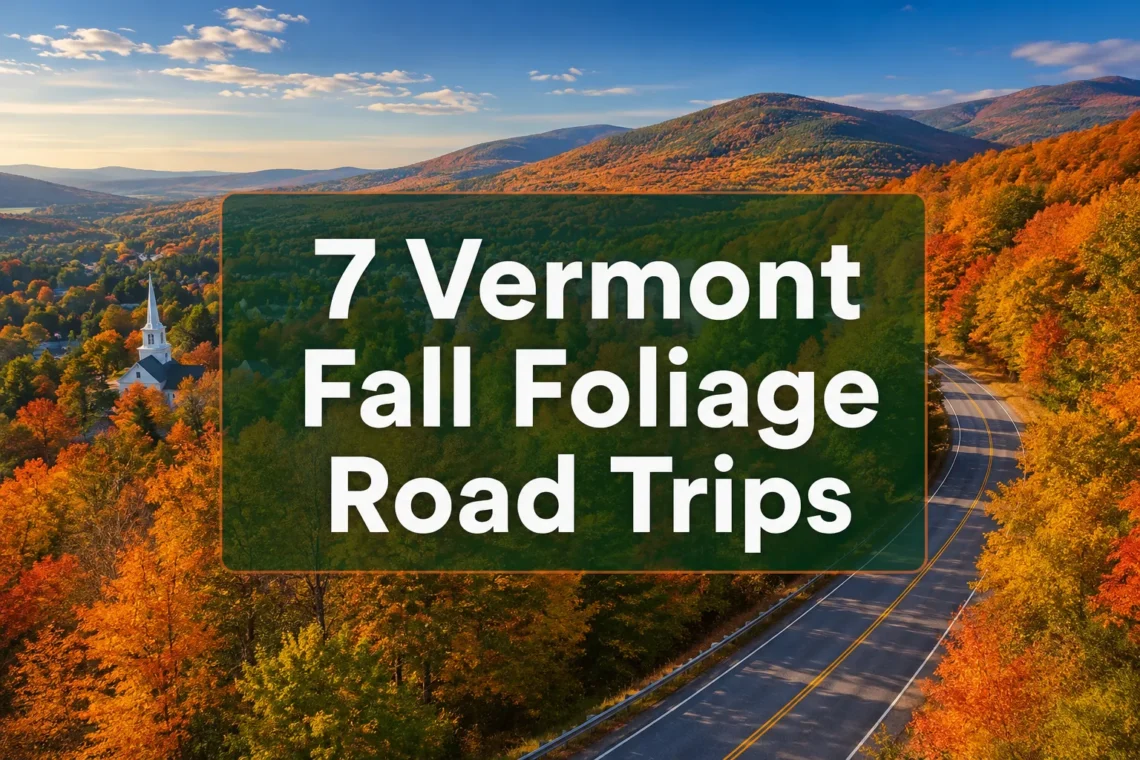
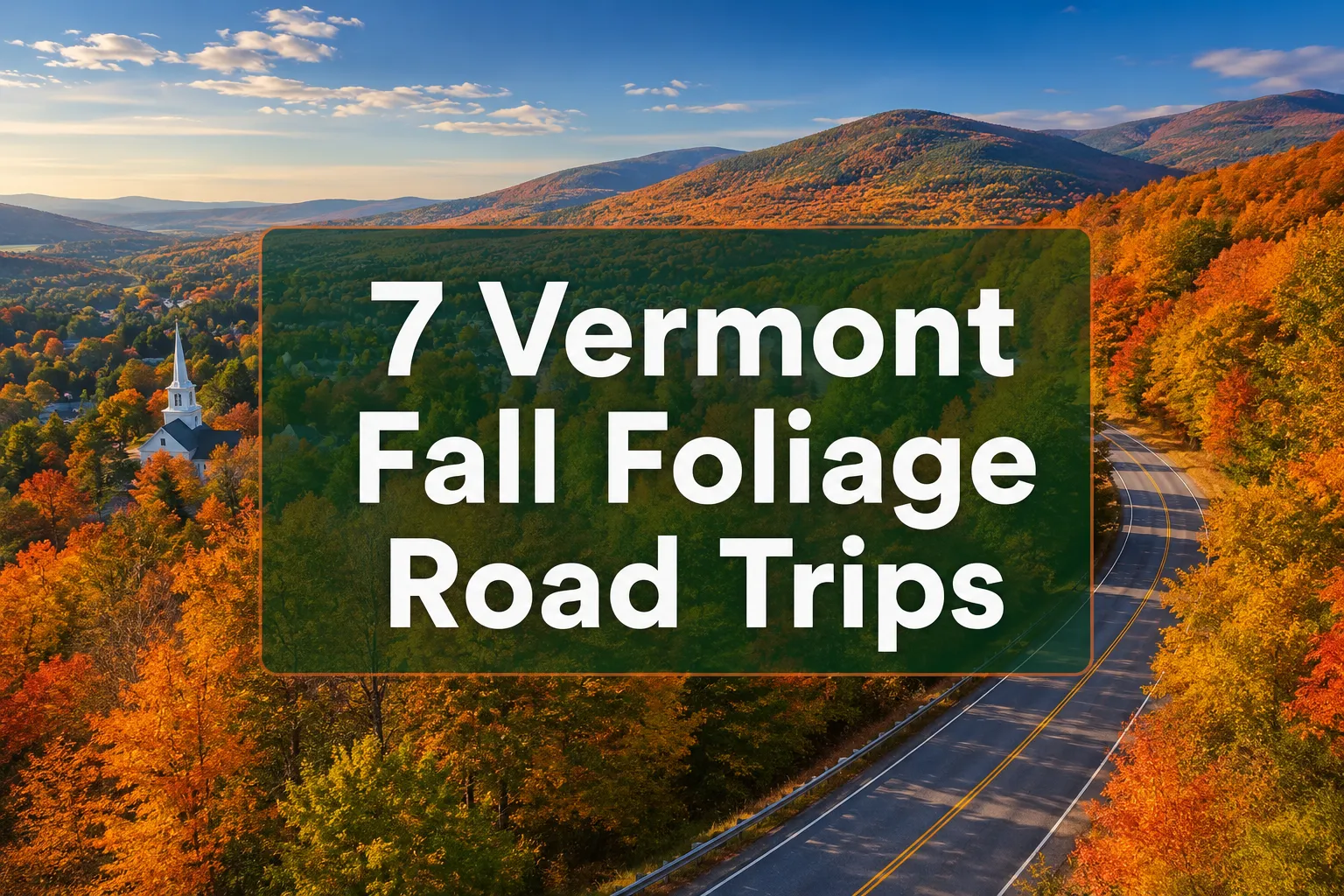
Quick Answer: The best Vermont fall foliage road trips run from late September through mid-October, following a north-to-south progression across the state. Route 100 is the single most popular drive, but routes like the Northeast Kingdom loop and Smugglers’ Notch offer wilder scenery with fewer crowds. Plan for at least 3-4 days to do the experience justice, and book lodging well in advance – peak weekend inns fill up months ahead.
Key Takeaways
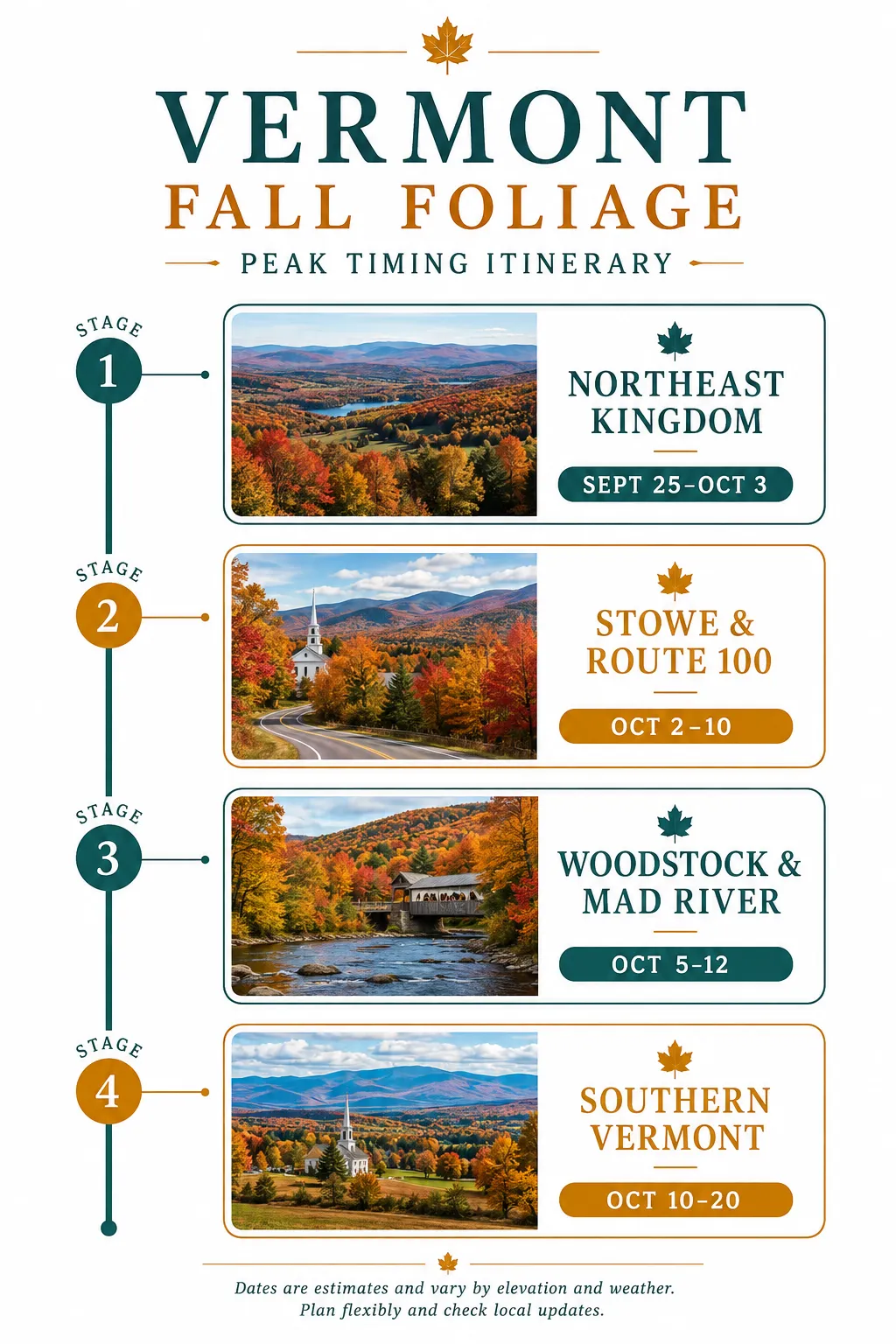
- 🍁 Vermont’s foliage peaks in a north-to-south wave: Northeast Kingdom (Sept 25-Oct 3), central Vermont including Stowe and Route 100 (Oct 2-10), Woodstock and Mad River Valley (Oct 5-12), and southern Vermont (Oct 10-20) in 2026.
- 🚗 Route 100 runs roughly 140 miles through the Green Mountains and is considered Vermont’s best single foliage drive.
- 📅 The second week of October (around Oct 8-14) is the sweet spot for a first-time Vermont fall foliage road trip.
- 🏨 Historic inns along Route 100 regularly hang “No Vacancy” signs at peak season – book 6-8 weeks out minimum.
- 🌧️ Peak color typically holds for 1-2 weeks per region; heavy rain or warm spells can shorten the window.
- 🧒 Vermont fall road trips work well for families – apple orchards, corn mazes, and covered bridges keep kids engaged.
- 🏔️ Smugglers’ Notch (Route 108) peaks earlier due to high elevation – great for late September travelers.
- 💰 Shoulder dates (early weekdays in late September) offer lower lodging rates and emptier roads.
- 📱 Check the Vermont fall foliage tracker before you leave to fine-tune your route.
- 🌿 Vermont consistently outranks New Hampshire for village charm and variety of scenic byways.
What Is the Best Time to Visit Vermont for Fall Foliage?
The best overall week for a first-time Vermont fall foliage road trip in 2026 is October 8-14, when central and southern Vermont hit peak color simultaneously. That said, the ideal timing depends on which part of the state you’re visiting, since color moves north to south across several weeks.
Here’s the 2026 regional breakdown based on current foliage forecasts:
| Region | Peak Window 2026 |
|---|---|
| Northeast Kingdom | Sept 25 – Oct 3 |
| Stowe / Route 100 / Smugglers’ Notch | Oct 2 – Oct 10 |
| Mad River Valley / Woodstock | Oct 5 – Oct 12 |
| Southern Vermont (Wilmington, Manchester) | Oct 10 – Oct 20 |
Cool nights in the 40s°F combined with daytime highs in the 50s-60s produce the most vivid, long-lasting color. Heat waves in September can push peak dates later, so always pair your planning with a live foliage map.
How Long Does Fall Foliage Season Last in Vermont?
Vermont’s fall foliage season runs roughly 6-7 weeks statewide, from mid-September through late October. Within any single region, peak color typically holds for about 1-2 weeks before leaves begin to drop.
Color change usually begins at higher elevations and northern counties around mid-September, then moves down into lower valleys and southern towns through the first three weeks of October. According to Vermont’s official foliage guide, this north-to-south progression means you can actually chase peak color across multiple regions on one extended trip.
What shortens the season:
- Heavy rain or strong winds during peak week
- Unusually warm September temperatures
- Early frost events
What extends vivid color:
- Dry, sunny days with cool nights
- Gradual temperature drops rather than sudden cold snaps
If you only have a weekend, target one region and time it precisely. If you have 4-5 days, you can follow the color south.
Vermont Fall Foliage Road Trip: How Many Days Do You Need?
Three to four days is the sweet spot for a Vermont fall foliage road trip that covers the highlights without feeling rushed. A single day is possible for a focused drive, but you’ll miss a lot.
Here’s a quick guide by trip length:
1 day: Stick to one corridor – Route 100 between Stowe and Waterbury, or the Woodstock-Quechee stretch of Route 4. You’ll get great color but limited flexibility.
2-3 days: Add Smugglers’ Notch, the Mad River Valley, and a southern Vermont detour. This is the most popular format for weekend trips from Boston or New York.
4-5 days: Do the full loop – Burlington to Stowe, down Route 100 through the Mad River Valley, across to Woodstock, then south to Manchester and the Molly Stark Byway. This is the format recommended by most Vermont fall foliage road trip guides.
6+ days: Add the Northeast Kingdom loop for early color, plus Lake Champlain for water-and-mountain views.
“A 3-day fall road trip itinerary typically starts in Burlington, follows I-89 and Route 100 through the Green Mountain Byway to Stowe, then drops down to Woodstock and Manchester.”
For a broader New England adventure, check out this guide to New England road trip mistakes first-time travelers make – many of the same planning pitfalls apply.
The 7 Best Vermont Fall Foliage Road Trips
These are the seven drives worth building your trip around. Each one has a distinct character, a different peak window, and a different crowd level.
1. Route 100 – The Spine of Vermont
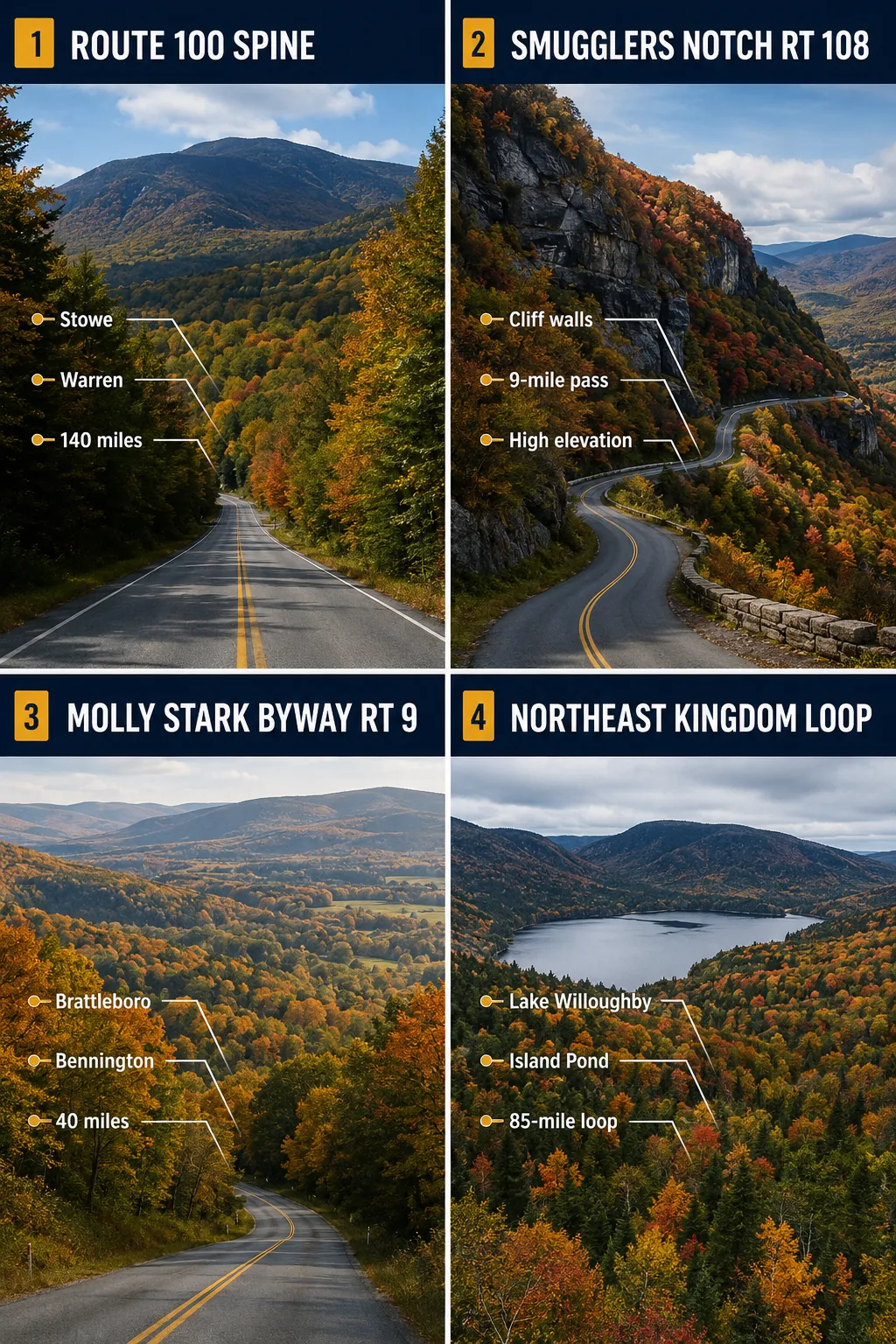
Route 100 is Vermont’s most iconic fall drive. It runs roughly 140 miles from Readsboro in the south through the Green Mountains to Newport near the Canadian border, passing farms, ski resorts, and classic villages like Stowe and Warren.
The Mad River Valley segment – about 45 miles around Waitsfield and Warren – is a standout stretch that typically peaks in early October. Multiple Vermont travel writers rank this as the single best leaf-peeping drive in the state because it overlaps the Green Mountain and Mad River byways.
Best for: First-timers, anyone wanting the full Vermont experience.
Peak 2026: Oct 2-10 for the northern half; Oct 10-20 for the southern half.
2. Smugglers’ Notch and Route 108
Route 108 through Smugglers’ Notch is a 9-mile cliff-lined mountain pass between Stowe and Jeffersonville. The walls of rock rise dramatically on both sides, and the foliage at this elevation hits peak color earlier than the valleys below.
This is one of the most dramatic short drives in New England. Note: the road through the Notch is closed to RVs and large trailers due to tight curves.
Best for: Dramatic scenery, photographers, travelers who can visit late September.
Peak 2026: Late September, due to high elevation.
3. Northeast Kingdom Loop (Routes 5, 105, 114)
The Northeast Kingdom loop covers about 85 miles through towns like Lyndonville, Island Pond, and Norton. This region – including Lake Willoughby, East Burke, and Jay Peak – delivers some of the earliest high-impact color in all of New England.
It’s also the least crowded of the major Vermont foliage drives. If you can travel before Columbus Day weekend, this is your best bet for peak color without the traffic.
Best for: Early-season travelers, those who prefer wild over polished.
Peak 2026: Sept 25 – Oct 3.
4. Woodstock Corridor and Route 4
The 25-mile Route 4 corridor around Woodstock and Quechee is Vermont’s most refined foliage drive. It mixes covered bridges, historic inns, and the stunning Quechee Gorge – Vermont’s “Little Grand Canyon.”
Woodstock itself is frequently called the prettiest small town in America, and the surrounding hills in peak color back that claim up convincingly. Central Vermont, including Woodstock and Killington, typically peaks around October 5-12 in 2026.
Best for: Couples, history lovers, anyone who wants village charm alongside leaf color.
Peak 2026: Oct 5-12.
5. Molly Stark Byway (Route 9)
The 40-mile Molly Stark Trail runs between Brattleboro and Bennington through the southern Green Mountains. It’s one of the best southern Vermont foliage roads, with typical peak color from about October 12-20.
Pair it with Route 7A (the Shires of Vermont Byway) and Route 30 through the West River Valley for a full southern Vermont loop. These routes offer quieter back roads and historic town centers that feel far less crowded than Route 100.
Best for: Late-season travelers, those coming from Connecticut or Massachusetts.
Peak 2026: Oct 12-20.
6. Green Mountain Byway (Stowe to Waterbury)
The Green Mountain Byway connects Stowe and Waterbury with sweeping mountain views and easy access to Ben & Jerry’s factory, Cabot Creamery, and Cold Hollow Cider Mill. It’s a natural add-on to any Route 100 trip.
This corridor typically peaks in early to mid-October, and the combination of mountain scenery, farm stands, and classic New England towns makes it one of the most satisfying short drives in the state.
Best for: Foodies, families, travelers combining scenery with stops.
Peak 2026: Oct 5-12.
7. Lake Champlain and Champlain Valley Loop
The Lake Champlain loop connects Burlington, Middlebury, and the Champlain Islands, framing brilliant orange and red maples against views of the Adirondacks across the water. It’s a different visual experience from the mountain drives – wider, more open, and equally stunning.
According to Vermont’s official foliage itineraries, the Champlain Valley peaks from late September into the first week of October, making it a great early-season option.
Best for: Travelers who want water views alongside fall color, Burlington-based trips.
Peak 2026: Late Sept – early Oct.
Where to Stay on a Vermont Fall Foliage Road Trip
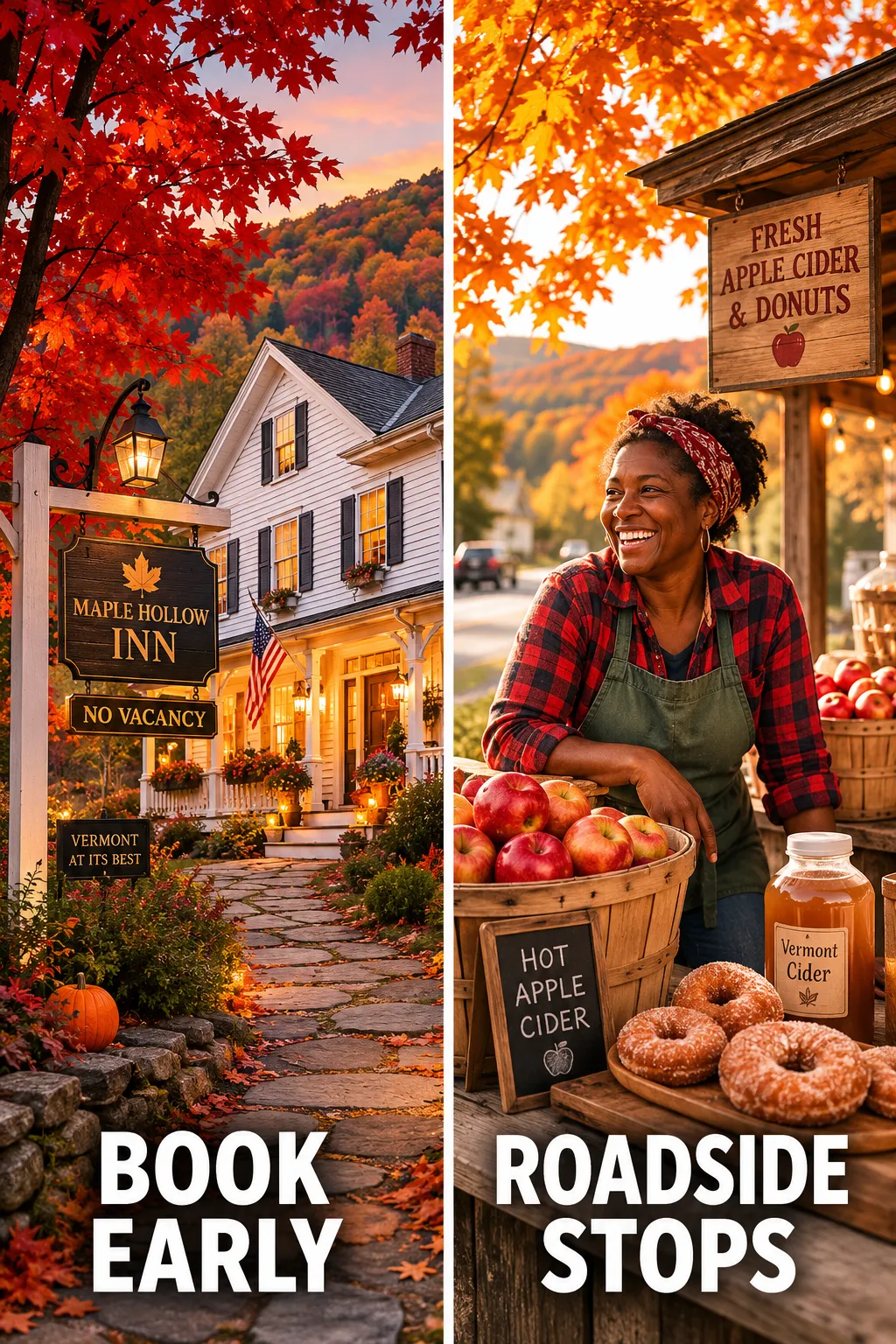
Book lodging at least 6-8 weeks before your trip – ideally earlier if you’re targeting Columbus Day weekend. Historic inns along Route 100 commonly hang “No Vacancy” signs during peak season, and the most popular properties fill up months in advance.
Best base towns by region:
- Stowe – Best base for Route 100 north, Smugglers’ Notch, and Green Mountain Byway. Widest range of inns and hotels.
- Woodstock – Perfect for the Route 4 corridor. Charming, walkable, and central.
- Burlington – Best for the Lake Champlain loop and as a starting point for multi-day trips.
- Manchester – Ideal base for southern Vermont drives including Route 7A and Route 9.
- Lyndonville or St. Johnsbury – Best for the Northeast Kingdom loop.
Accommodation types:
- Historic country inns (book earliest – these sell out first)
- Vacation rentals (more availability, better for families)
- Chain hotels in Burlington or Brattleboro (more last-minute flexibility)
If you’re also considering a coastal New England extension, this guide to where to stay in Maine in the fall covers the best inns and hidden gems across the border.
Cheapest Time to Visit Vermont in Fall
Early weekdays in late September offer the best combination of value and color, especially in northern Vermont. Rates drop significantly compared to Columbus Day weekend, and the Northeast Kingdom and Smugglers’ Notch are already at or near peak.
Money-saving tips:
- Travel Tuesday-Thursday instead of Friday-Sunday
- Target late September for northern Vermont instead of early October
- Stay in smaller towns like Waitsfield or Johnson instead of Stowe
- Book vacation rentals for groups of 4 or more
- Skip the most famous inns and look for B&Bs on side roads
The most expensive dates in Vermont fall are Columbus Day weekend (Oct 11-13, 2026) and the surrounding weekends. If your schedule allows, arriving just before or just after that window saves money without sacrificing much color.
Vermont Foliage Report: How to Know When to Go
Vermont’s foliage trackers update weekly (sometimes daily) starting in early September. The Vermont foliage tracker is the most reliable free tool, with region-by-region color reports updated throughout the season.
How to use foliage reports effectively:
- Check the tracker starting September 1 to establish a baseline.
- Look for reports of “50% color change” in your target region – that’s typically 5-7 days before peak.
- Cross-reference with a long-range weather forecast. Cool nights accelerate color; warm nights slow it.
- If reports show “past peak” in the north, shift your focus south – color is likely just arriving there.
Vermont Public’s interactive fall foliage drives map is another excellent tool, showing drive routes alongside regional color status.
2026 forecast note: Analysts describe 2026 as a “late but great” season. The Northeast Kingdom is expected to peak around September 25-October 3, with central Vermont following October 2-10 and southern Vermont October 10-20.
Can You Do a Vermont Fall Road Trip in One Day?
Yes, a one-day Vermont fall road trip is possible and can be genuinely rewarding if you pick the right corridor. The key is choosing a focused route rather than trying to cover the whole state.
Best one-day options:
- Stowe to Waterbury on Route 100 – About 30 miles, easy to extend with a stop at Cold Hollow Cider Mill or Ben & Jerry’s.
- Woodstock to Quechee on Route 4 – 25 miles, includes Quechee Gorge and one of Vermont’s most beautiful village centers.
- Molly Stark Byway (Route 9) – 40 miles from Brattleboro to Bennington, great for travelers coming from southern New England.
If you’re driving up from Boston or New York for a day trip, build in extra time for traffic on Route 89 near Burlington and Route 4 near Woodstock – both get congested on peak weekends.
Vermont Fall Foliage vs. New Hampshire: Which Is Better?
Vermont wins for village charm, variety of scenic byways, and overall road trip experience. New Hampshire wins for the White Mountains’ dramatic peaks and the famous Kancamagus Highway.
Choose Vermont if:
- You want covered bridges, historic inns, and classic New England towns alongside the color
- You prefer a multi-day road trip with lots of stops
- You’re traveling with kids who’ll enjoy farm stands, orchards, and cider mills
Choose New Hampshire if:
- You want dramatic mountain scenery and higher elevation drives
- You’re focused on a single iconic highway (the Kancamagus)
- You prefer hiking over driving
Many travelers do both on a longer New England trip. For a full overview of how to plan that kind of multi-state adventure, see this New England road trip guide covering the most common mistakes and best stops.
You might also enjoy pairing a Vermont fall trip with a visit to Portland, Maine for a coastal contrast after the mountains.
Vermont Fall Foliage Road Trip with Kids
Vermont fall road trips are excellent for families. The state has a high density of kid-friendly stops that break up long drives naturally.
Top family-friendly stops along foliage routes:
- Cold Hollow Cider Mill (Waterbury) – Free samples, fresh cider donuts, and a working cider press kids can watch
- Billings Farm & Museum (Woodstock) – Working farm with animals, harvest activities, and hands-on exhibits
- ECHO Science Center (Burlington) – Great rainy-day backup on Lake Champlain
- Corn mazes – Several farms along Route 100 and Route 7A run mazes through October
- Quechee Gorge – Short trail to a dramatic overlook that kids love
Tips for road tripping with kids in Vermont:
- Break drives into 45-60 minute segments with a stop at each
- Pack snacks and layers – Vermont weather changes fast in October
- Download the foliage tracker app so kids can track color changes like a game
- Book a cabin or vacation rental with a yard so kids have space to run
For more family travel tips, this list of genius beach hacks for kids has a lot of transferable packing and logistics advice for any family road trip.
Why Are Vermont Leaves Not Changing This Year?
If Vermont leaves seem late or dull, the most common causes are warm September temperatures, drought stress, or an unusually wet summer. Foliage color depends on a specific combination of conditions: warm days, cool nights (below 50°F), and adequate soil moisture.
Common reasons for delayed or muted color:
- Warm nights in September – The single biggest factor. Leaves need cool nights to trigger color change.
- Drought – Stressed trees often drop leaves early without vivid color.
- Overcast skies – Don’t affect color directly, but make existing color look less vivid in photos.
- You’re in the wrong region – If you’re in southern Vermont in late September, the leaves may simply not have started yet.
If color seems late in 2026, check the Vermont foliage tracker for updated regional reports. Forecasters note that a late season often produces excellent color once it arrives – the delay doesn’t mean the season will be poor.
Vermont Fall Foliage Crowded: Which Routes to Avoid
Route 100 between Stowe and Waterbury is the most congested foliage corridor in Vermont, especially on Columbus Day weekend. Route 4 near Woodstock also sees heavy traffic on peak Saturdays and Sundays.
Lower-crowd alternatives:
- Northeast Kingdom loop (Routes 5, 105, 114) – Dramatically fewer cars than Route 100, comparable or better color in late September
- Route 30 West River Valley – Quieter than Route 100 with beautiful river views
- Champlain Islands – Rarely crowded even at peak, with stunning water-and-mountain views
- Peacham-Groton loop – A local favorite highlighted on Vermont Public’s foliage drives map
- Pleasant Valley Scenic Drive – Less-traveled alternative to the Stowe main road
Timing tips to avoid crowds:
- Drive on Tuesday, Wednesday, or Thursday
- Start early – roads are noticeably quieter before 9 AM
- Target the week before or after Columbus Day weekend
Best Restaurants and Stops on Vermont Fall Foliage Drives
Vermont’s fall food scene is as good as the scenery. The best stops combine local produce, maple products, and classic New England cooking.
Top stops by route:
Route 100 / Stowe area:
- Cold Hollow Cider Mill (Waterbury) – Fresh cider and donuts
- The Hen of the Wood (Waterbury) – One of Vermont’s best farm-to-table restaurants
- Stowe Farmers Market (Sundays through October)
Woodstock / Route 4:
- The Prince and the Pauper (Woodstock) – Classic Vermont bistro
- Sugarbush Farm (Woodstock) – Maple syrup and aged cheese tasting
- Quechee Gorge Village – Antique shops and a small food hall
Southern Vermont / Route 9:
- Brattleboro Food Co-op – Great for picnic supplies
- Madison Brewing Co. (Bennington) – Local craft beer and pub food
- Grafton Village Cheese (Grafton) – Award-winning Vermont cheddar
Northeast Kingdom:
- The Creamery Restaurant (Danville) – Local institution, classic diner food
- Kingdom Brewing (Newport) – Small craft brewery with lake views
For those combining a Vermont trip with a broader New England itinerary, this guide to fall foliage train rides in the USA covers some great Vermont and New England rail options worth adding to your trip.
What to Pack for a Vermont Fall Foliage Road Trip
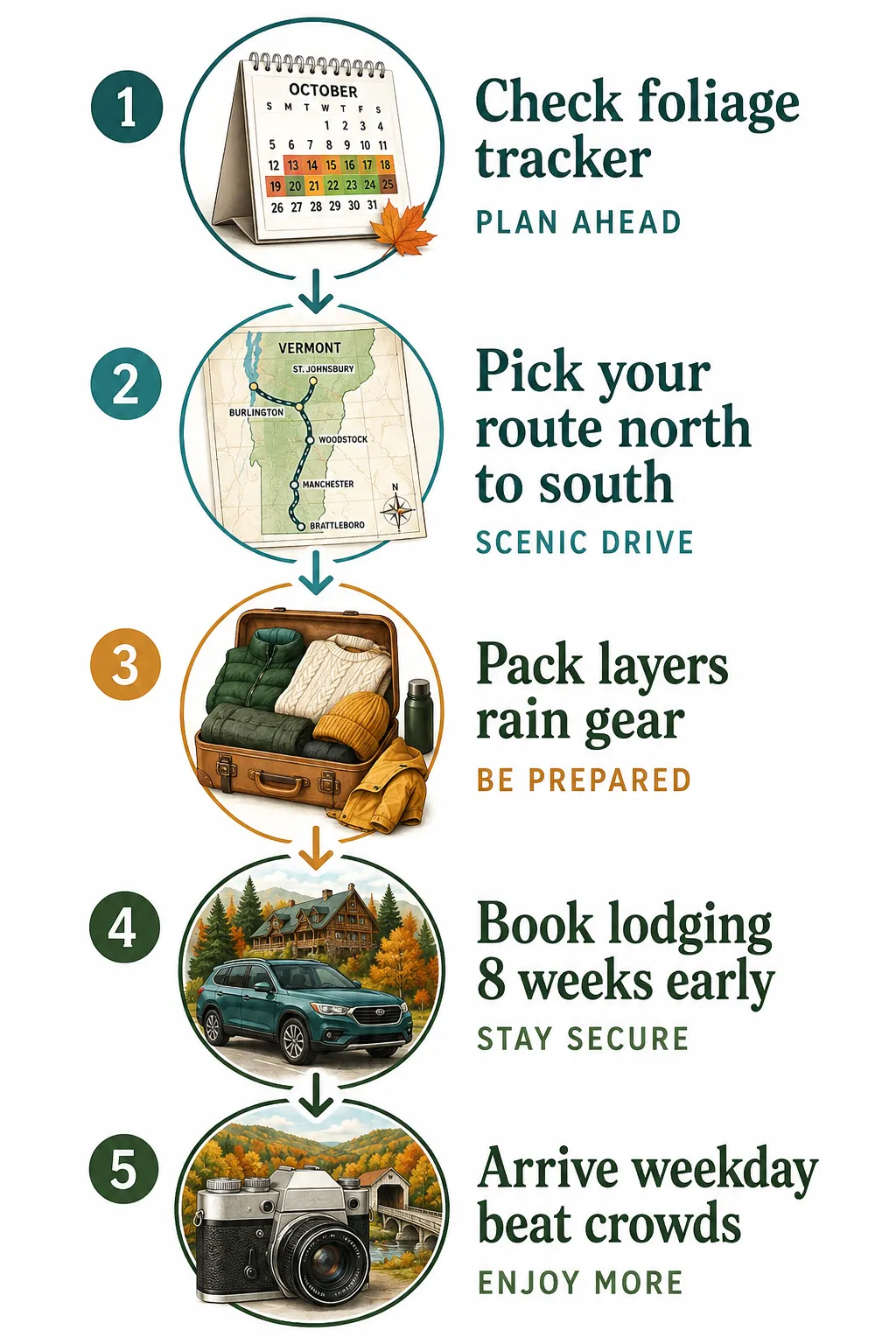
Vermont in October means unpredictable weather – you can have 65°F sunshine and a cold rain within the same day. Pack for both.
Essential packing list:
- Layers – A base layer, mid-layer fleece, and a waterproof outer shell
- Waterproof hiking boots or trail shoes – Wet leaves on trails are slippery
- Rain jacket – Non-negotiable in October Vermont
- Camera or charged phone – The light on peak foliage days is extraordinary
- Reusable water bottle and snacks – Some stretches of Route 100 and the Northeast Kingdom have limited services
- Physical map or downloaded offline maps – Cell service is patchy in the Northeast Kingdom and Smugglers’ Notch
- Cash – Many farm stands and small inns are cash-only or prefer it
- Sunscreen – Bright October days at elevation can burn
Optional but useful:
- Binoculars for spotting color on distant hillsides
- A small cooler for farm stand purchases (apple cider, cheese, maple syrup)
- A compact umbrella
Conclusion
Vermont fall foliage road trips are worth every bit of the planning they require. The state delivers a combination of dramatic mountain scenery, charming villages, and a north-to-south color progression that lets you follow the peak across multiple weeks.
Your action plan:
- Pick your dates using the 2026 regional peak windows above. Target Oct 8-14 for the best statewide coverage, or late September for the Northeast Kingdom.
- Choose your route based on how many days you have. Route 100 for a classic trip, Northeast Kingdom for early color and fewer crowds, Molly Stark Byway for a southern Vermont focus.
- Book lodging now – don’t wait. Popular inns fill up 6-8 weeks out, sometimes more.
- Check the Vermont foliage tracker starting in early September and fine-tune your exact route based on live reports.
- Drive on weekdays if at all possible to avoid Route 100 and Woodstock traffic.
The leaves won’t wait – and neither should your planning.
Frequently Asked Questions
When is peak foliage in Vermont in 2026?
In 2026, Vermont’s peak foliage follows a north-to-south schedule: Northeast Kingdom peaks September 25-October 3, central Vermont and Stowe peaks October 2-10, Woodstock and Mad River Valley peaks October 5-12, and southern Vermont peaks October 10-20.
What is the best road trip route for Vermont fall foliage?
Route 100 is the most popular and scenic single drive, running about 140 miles through the Green Mountains. For a complete multi-day trip, combine Route 100 with Smugglers’ Notch (Route 108), the Woodstock corridor (Route 4), and the Molly Stark Byway (Route 9) for a full north-to-south loop.
How many days do I need for a Vermont fall foliage road trip?
Three to four days covers the highlights comfortably. Two days works for a focused weekend trip on one or two routes. Five or more days lets you explore the Northeast Kingdom, Lake Champlain, and southern Vermont without rushing.
How far in advance should I book lodging for Vermont fall foliage?
Book at least 6-8 weeks before your trip, and 3-4 months ahead if you’re targeting Columbus Day weekend (October 11-13, 2026). Popular inns along Route 100 sell out months in advance.
Is Vermont or New Hampshire better for fall foliage?
Vermont wins for variety of scenic drives, village charm, and overall road trip experience. New Hampshire’s Kancamagus Highway is more dramatic for a single iconic drive. Most serious foliage travelers prefer Vermont for a multi-day trip.
Can you do a Vermont fall foliage road trip in one day?
Yes. The Stowe-to-Waterbury stretch of Route 100 (about 30 miles), the Woodstock-Quechee Route 4 corridor (25 miles), or the Molly Stark Byway (40 miles) all make excellent one-day drives. Start early to avoid weekend traffic.
What is the cheapest time to visit Vermont in fall?
Early weekdays in late September offer the best rates. Avoid Columbus Day weekend for the lowest prices. Staying in smaller towns like Waitsfield or Johnson instead of Stowe also reduces costs significantly.
Why are Vermont leaves not changing?
Warm September nights are the most common cause of delayed color. Leaves need temperatures below 50°F at night to trigger the color change process. Drought and tree stress can also cause early leaf drop without vivid color. Check the Vermont foliage tracker for live regional updates.
Which Vermont foliage routes are least crowded?
The Northeast Kingdom loop (Routes 5, 105, 114), the Champlain Islands, Route 30 in the West River Valley, and the Peacham-Groton loop are all significantly less crowded than Route 100 and Route 4 near Woodstock.
Is a Vermont fall road trip good for families with kids?
Absolutely. Vermont has a high density of family-friendly stops – cider mills, corn mazes, working farms, and covered bridges – that break up drives naturally. The Billings Farm in Woodstock and Cold Hollow Cider Mill in Waterbury are especially popular with kids.
What should I pack for a Vermont fall road trip?
Pack waterproof layers, a rain jacket, waterproof footwear, a camera, cash for farm stands, and downloaded offline maps. Cell service is unreliable in the Northeast Kingdom and near Smugglers’ Notch.
How long does peak color last in Vermont?
Within any single region, peak color typically holds for 1-2 weeks. Heavy rain, strong winds, or warm spells can shorten that window. Statewide, the full foliage season runs roughly 6-7 weeks from mid-September through late October.