
Last updated: September 10, 2026
Quick Answer: A smart 2 weeks in Australia itinerary focuses on the east coast – Sydney, Canberra, Melbourne, and the Whitsundays – flying between hubs rather than driving long distances. This approach gives you 4 nights in each major city, iconic experiences at every stop, and almost zero wasted transit days. It’s the most efficient first-timer route available.
Key Takeaways
- 🗺️ Stick to the east coast for a 2-week trip – it has the best infrastructure, most flights, and top attractions.
- 🏙️ Three to four cities is the sweet spot. More than that and you spend your holiday in airports.
- ✈️ Fly between cities, not drive. Australia is bigger than the continental US.
- 🌊 Whitsundays is the reef access point that saves the most time compared to flying to Cairns.
- 💰 Budget roughly AUD $250-$350 per day for a comfortable mid-range trip (accommodation, food, activities).
- 📅 September to November is the best overall window for a first-timer covering multiple regions.
- 🐠 You can see Whitehaven Beach and Hardy Reef in 2 weeks – but Uluru and Perth require a dedicated trip.
- ⏱️ 4 nights per hub is the minimum to feel settled and actually enjoy a city.
- 🚫 The biggest regret first-timers report: spending too many nights in one city and rushing the rest.
- 📊 According to Australian Bureau of Statistics data, the median international stay in Australia is 12 days – a 14-day trip already beats the average.
Is 2 Weeks Enough Time to See Australia?
Two weeks is enough to see Australia’s highlights – but only if you’re realistic about what “Australia” means in 14 days. The country is roughly the size of the continental United States. You will not see all of it.
What you can do in 2 weeks is cover the east coast’s greatest hits: Sydney Harbour, Melbourne’s laneways, the Great Ocean Road, and the Whitsundays. That’s a genuinely world-class trip.
Tourism Australia’s 2023-24 Annual Report shows international visitors spent A$47.8 billion in a single year – and the experiences driving that spend are concentrated on the east coast, where infrastructure is mature and tours are optimized for short stays.
Choose this trip if:
- It’s your first time in Australia
- You have 13-15 days on the ground
- You want iconic, not obscure
Wait and plan longer if:
- You want Uluru AND the reef AND Perth
- You want to road trip the whole east coast at a slow pace
What’s the Best Route to See Australia in 2 Weeks
The best 2 weeks in Australia itinerary runs: Sydney → Canberra → Melbourne → Great Ocean Road (day trip) → Whitsundays → Sydney (fly home from Sydney or Hamilton Island).
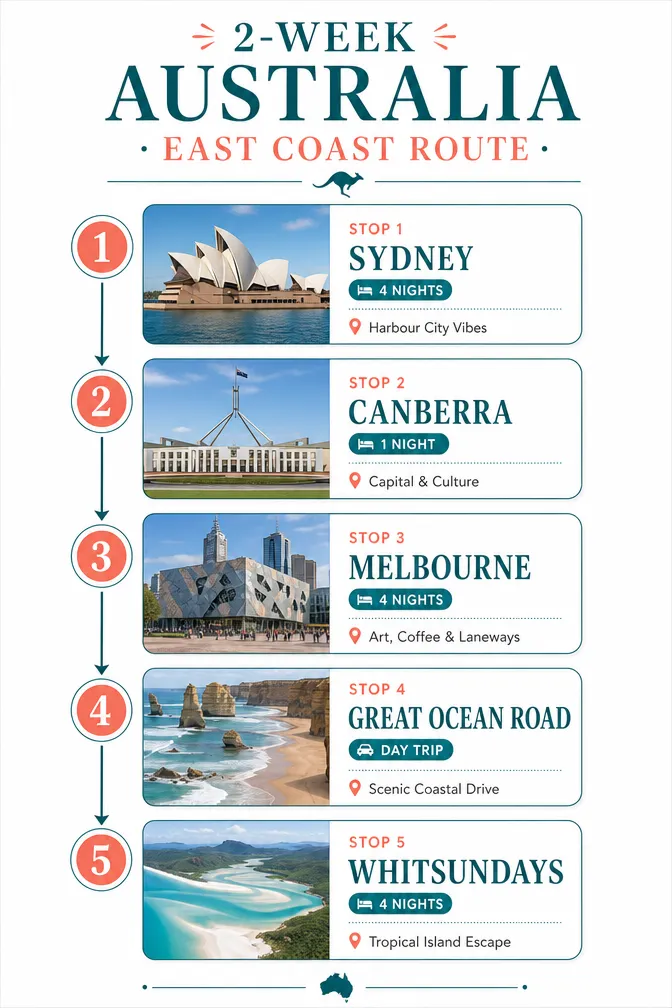
This route clusters nights in three main hubs and avoids backtracking. Here’s how the days break down:
| Destination | Nights | Key Experiences |
|---|---|---|
| Sydney | 4 | Harbour, BridgeClimb, Bondi, Blue Mountains day trip |
| Canberra | 1 | War Memorial, National Gallery (transit stop) |
| Melbourne | 4 | Laneways, food scene, Great Ocean Road day trip |
| Whitsundays | 4 | Whitehaven Beach, Hardy Reef, sailing |
| Travel/buffer | 1 | Flights, arrivals, departures |
The logic is simple: fly Sydney to Canberra (or take the 3-hour coach), then Melbourne, then fly north to the Whitsundays. No zigzagging. No 12-hour drives.
How Many Cities Can You Visit in 2 Weeks in Australia
Realistically, 3 to 4 cities is the right number for a 2-week trip. Any more and you’re spending your holiday in airports and hotel lobbies.
The east coast gives you natural stopping points. Sydney is your likely arrival and departure hub. Melbourne is a 1-hour flight south. The Whitsundays are a 2-hour flight north from Melbourne or Sydney.
Canberra works as a single overnight stop between Sydney and Melbourne – it’s worth a half-day but doesn’t need more.
What to skip on a first trip:
- Perth (separate 5-hour flight from Sydney, needs its own trip)
- Darwin (remote, better for a dedicated Top End adventure)
- Hobart (wonderful, but better as a standalone Tasmania trip)
If you’re planning other first-timer trips around the world, check out what to see in Japan for first-time visitors – the same “hub and spoke” logic applies there too.
Where Should First-Timers Go in Australia
First-timers should go to Sydney, Melbourne, and the Whitsundays. These three destinations cover the iconic city experience, world-class food and culture, and the Great Barrier Reef – all within a logical flight path.
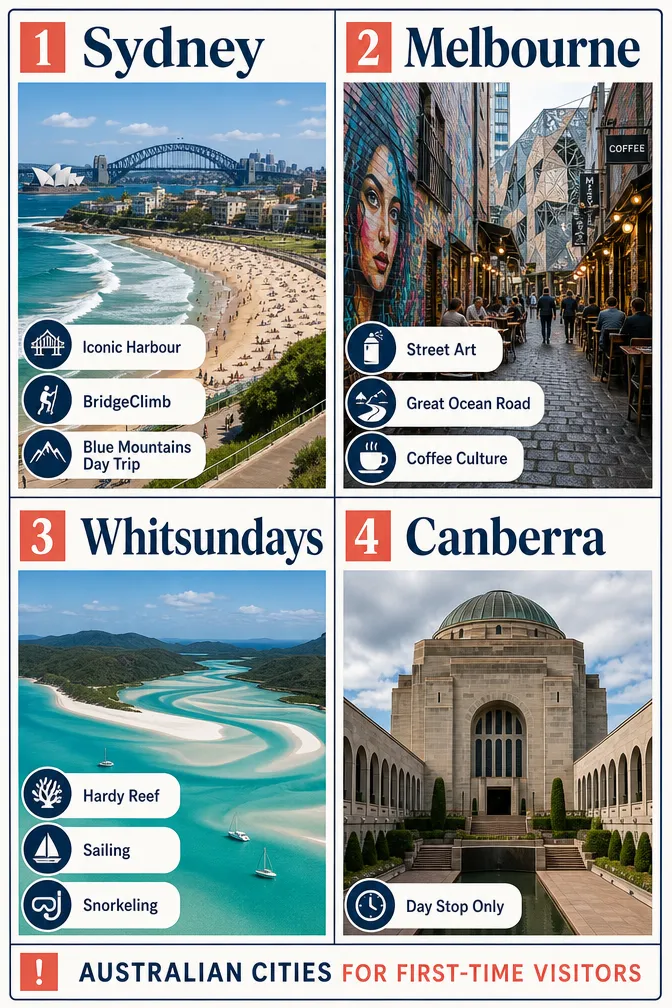
Here’s what each stop delivers:
Sydney (4 nights)
- Sydney Opera House and Harbour Bridge walk
- BridgeClimb (book in advance – it sells out)
- Bondi Beach and the coastal walk to Coogee
- Blue Mountains day trip (about 2 hours from the city)
Melbourne (4 nights)
- Hosier Lane and the street art laneways
- Queen Victoria Market and the coffee culture
- Great Ocean Road day tour (12 Apostles, Loch Ard Gorge)
- Federation Square and the arts precinct
Whitsundays (4 nights)
- Whitehaven Beach – genuinely one of the world’s best beaches
- Hardy Reef snorkeling or diving
- Sailing day trip around the 74 islands
- Base at Airlie Beach or Hamilton Island
According to Tourism Research Australia’s December 2024 international results, the top visitor source markets – the US, UK, China, and India – all favor exactly this east-coast circuit. The infrastructure is built around it.
Should I Fly Between Cities or Drive in Australia
Fly. For a 2-week first-timer itinerary, flying between cities is almost always the right call.
The Sydney to Melbourne drive is about 9 hours. Sydney to the Whitsundays is over 20 hours. Those are days you’d spend behind a wheel instead of at Whitehaven Beach.
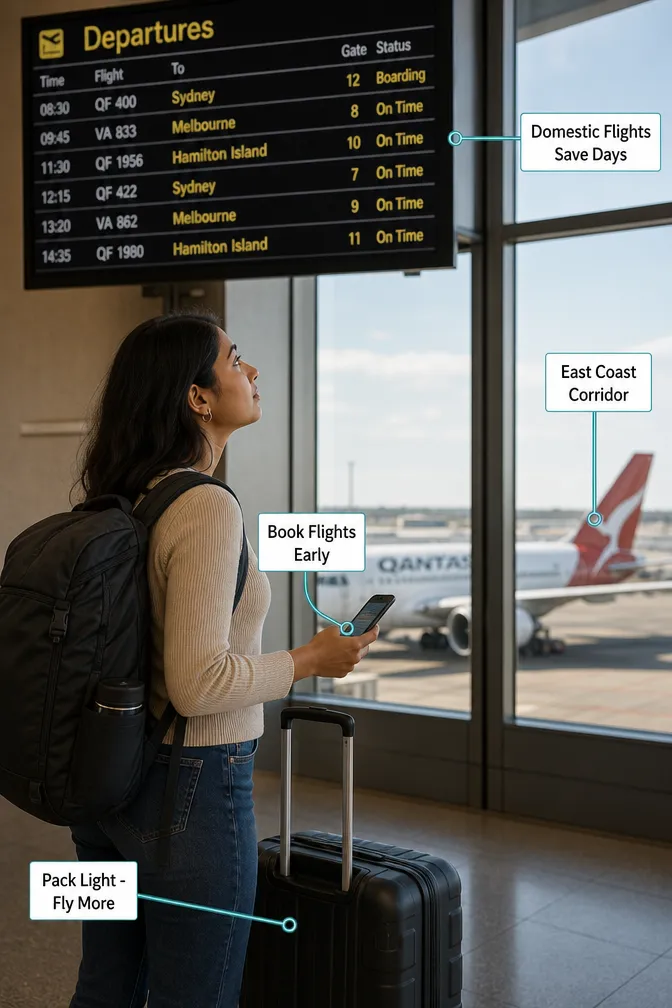
When flying makes sense (most of the time):
- Any city-to-city leg over 3 hours by road
- When you’re flying into one city and out of another
- When you have 2 weeks or less
When driving makes sense:
- The Great Ocean Road – this is a must-drive, not a must-fly
- Blue Mountains from Sydney (2-hour drive, totally manageable)
- If you have 3+ weeks and want a slow coastal road trip
Domestic flights between Sydney, Melbourne, and Hamilton Island (Whitsundays gateway) are frequent and often cheap when booked 6-8 weeks ahead. Qantas, Jetstar, and Virgin Australia all operate these routes daily.
What’s the Cheapest Way to Travel Around Australia for 2 Weeks
The cheapest way to travel Australia in 2 weeks is to fly budget carriers between cities, stay in mid-range hotels or Airbnbs, and book tours locally rather than through international package operators.
Here’s a rough daily budget breakdown:
- Budget traveler: AUD $100-$150/day (hostels, self-catering, free attractions)
- Mid-range: AUD $200-$300/day (3-star hotels, mix of eating out and cooking, paid tours)
- Comfortable: AUD $350-$500+/day (4-star hotels, most meals out, guided experiences)
Money-saving tips:
- Book domestic flights 6-8 weeks out for the best fares
- The Blue Mountains day trip from Sydney can be done independently by train for about AUD $8 return
- Eat at food markets and local cafes rather than tourist restaurants
- The Great Ocean Road tour from Melbourne is cheaper booked locally than through hotel concierges
For packing advice that keeps luggage fees low, the ultimate 2 weeks in Europe spring packing guide has transferable tips for carry-on-only travel.
What’s the Best Time of Year to Visit Australia for 2 Weeks
September to November is the best overall window for a first-timer covering Sydney, Melbourne, and the Whitsundays. Spring weather is mild across the south and the Whitsundays are just entering their dry season.
Here’s a quick seasonal breakdown:
| Season | Months | Best For | Watch Out For |
|---|---|---|---|
| Spring | Sep-Nov | All regions, mild temps | School holiday crowds in Oct |
| Summer | Dec-Feb | Sydney beaches, Melbourne | Extreme heat inland, cyclone risk in Whitsundays |
| Autumn | Mar-May | Melbourne, Sydney | Whitsundays can still be humid |
| Winter | Jun-Aug | Whitsundays (dry season) | Cool in Melbourne and Sydney |
If your priority is the Whitsundays and reef, June to August is actually ideal – dry, clear water, and no cyclone risk. Just pack a layer for Melbourne evenings.
Avoid January in the Whitsundays if you can. It’s cyclone season and visibility for snorkeling drops.
Can You See Uluru and the Great Barrier Reef in 2 Weeks
You can see the Great Barrier Reef (via the Whitsundays) in 2 weeks. Adding Uluru to the same trip is very difficult and not recommended for a first-timer on a 14-day schedule.
Uluru is in the Northern Territory – a 3-hour flight from Sydney or Melbourne. Adding it means burning 2 full days in transit and cutting time from your main hubs.
The honest trade-off:
- Whitsundays + Uluru in 2 weeks = rushed everywhere, no city depth
- Whitsundays without Uluru = relaxed, memorable, genuinely satisfying
Save Uluru for a second trip, ideally paired with a Katherine Gorge or Alice Springs extension. It deserves more than a rushed overnight.
Is It Better to Do the East Coast or the Full Country in 2 Weeks
East coast, every time for a 2-week first trip. The full country – east coast plus Perth plus Uluru – is a 3-to-4-week trip minimum.
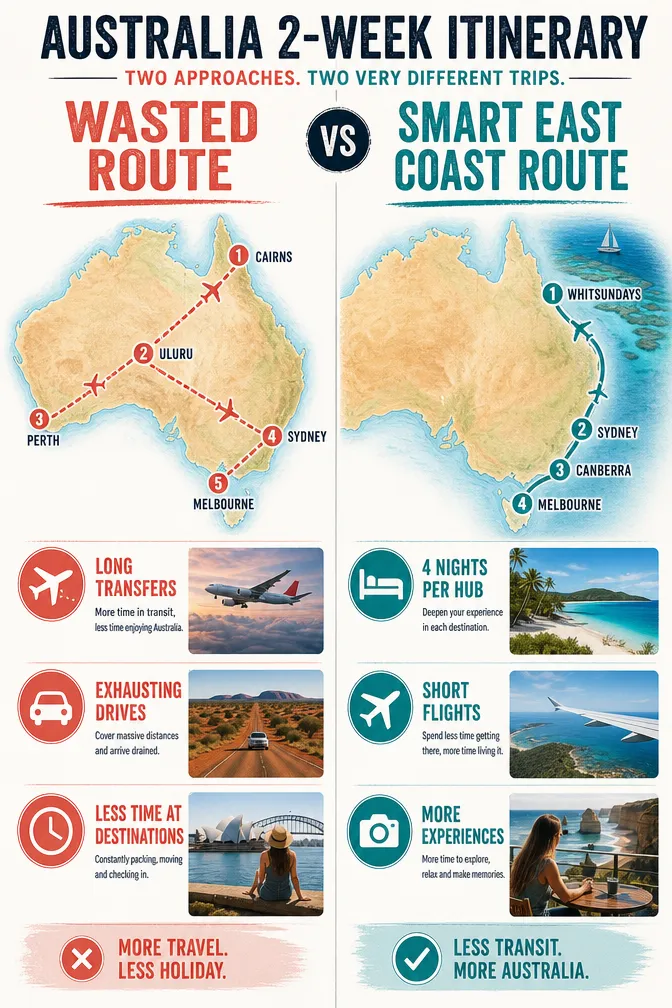
The east coast alone covers:
- Two of the world’s most liveable cities (Sydney and Melbourne)
- One of the world’s best beaches (Whitehaven)
- World Heritage reef access (Hardy Reef, Whitsundays)
- Iconic road trip (Great Ocean Road)
- A national capital with world-class museums (Canberra)
That’s a complete trip. Trying to add Perth or Darwin dilutes everything.
ABS overseas arrivals data shows 7.8% year-on-year growth in visitor arrivals as of December 2024, with the east coast corridor remaining the dominant visitor route. The flights, tours, and accommodation are all optimized for this path.
How Much Does a 2-Week Australia Trip Cost
A realistic 2-week Australia trip costs between AUD $3,500 and $7,000 per person (excluding international flights), depending on your travel style.
Key cost drivers:
- Accommodation: AUD $80-$200/night depending on city and standard
- Domestic flights: AUD $150-$400 per leg if booked in advance
- Great Barrier Reef day trip: AUD $150-$250 per person
- BridgeClimb Sydney: AUD $174-$403 depending on time of day
- Great Ocean Road tour: AUD $80-$150 per person
- Food: AUD $40-$100/day depending on how much you cook
The Whitsundays is the most expensive leg – accommodation on Hamilton Island and sailing tours add up quickly. Staying in Airlie Beach on the mainland cuts costs significantly while still giving full reef access.
How Much Time Should I Spend in Each Australian City
Four nights per major city is the sweet spot for a first-timer. It gives you two full days of sightseeing, one day trip, and buffer for arrival/departure logistics.
Here’s the minimum time that makes each stop worthwhile:
- Sydney: 3 nights minimum, 4-5 ideal
- Melbourne: 3 nights minimum, 4 ideal
- Whitsundays: 3 nights minimum, 4 ideal for reef + beach
- Canberra: 1 night is enough (it’s a transit stop, not a destination)
Don’t try to do Sydney in 2 nights. You’ll spend half a day recovering from jet lag and the other half rushing. Four nights lets you actually exhale.
What Do People Regret Not Doing on Their Australia Trip
The most common regrets from first-time visitors to Australia fall into a few clear patterns.
Top regrets:
- Not booking the BridgeClimb in advance (it sells out, especially on weekends)
- Skipping Coogee to Bondi coastal walk – it’s free and stunning
- Not spending a night on Hamilton Island (the sunsets are worth it)
- Rushing Melbourne to fit in too many cities
- Missing a sunrise at Whitehaven Beach (most day tours arrive mid-morning)
- Not trying a reef snorkel because they assumed they needed to dive
One thing almost everyone wishes they’d done more of: sitting in Melbourne’s laneways with a flat white and doing nothing. Australia rewards slowing down.
If you enjoy first-timer guides that help you skip the obvious mistakes, the Morocco travel guide for first-timers and first time in San Francisco mistakes to avoid follow the same honest format.
How Do You Avoid Wasting Time Traveling in Australia
The single biggest time-waster in Australia is overland travel between cities. The second biggest is booking too many single-night stops.
Rules that eliminate wasted days:
- Never book fewer than 3 nights anywhere (1-night stops mean you spend a day arriving and a day leaving)
- Fly city-to-city for any leg over 3 hours by road
- Do day trips from a base city rather than moving your luggage
- Book the Great Ocean Road and Blue Mountains as day tours from Melbourne and Sydney respectively
- Fly into Sydney, out of Hamilton Island (or vice versa) to avoid backtracking
Tourism Australia’s insights data confirms that east-coast hubs are where visitor-serving transport is most frequent and reliable – which directly reduces the transit friction that eats into shorter trips.
Also: build in one completely free afternoon in both Sydney and Melbourne. Wandering without a plan is often where the best memories happen.
FAQ
Can I do a 2-week Australia trip without a visa?
Most nationalities need an Electronic Travel Authority (ETA) or eVisitor visa for Australia. Both are applied for online and typically approved within minutes. Check the Australian Department of Home Affairs website for your specific passport.
Is Australia safe for solo travelers?
Yes. Australia consistently ranks among the safest countries for solo travel, including solo female travel. Standard city precautions apply, but violent crime against tourists is rare.
Do I need a car for a 2-week east coast itinerary?
No. You can do the entire Sydney-Canberra-Melbourne-Whitsundays route using domestic flights, trains, and organized day tours. A car is only useful if you’re road-tripping the Great Ocean Road independently.
What’s the time difference between Sydney and Melbourne?
They’re in the same time zone (AEST), so no adjustment needed when moving between them. The Whitsundays (Queensland) don’t observe daylight saving, so there can be a 1-hour difference in summer.
Should I tip in Australia?
Tipping is not expected or required in Australia. It’s appreciated in restaurants for excellent service, but there’s no social pressure. Prices include service.
How far in advance should I book for a 2-week Australia trip?
Book international flights 3-6 months out for the best prices. Domestic flights and popular tours (BridgeClimb, reef trips) should be booked 4-8 weeks ahead, especially for peak season travel.
Is the Great Barrier Reef accessible from the Whitsundays?
Yes. Hardy Reef and Heart Reef are accessed via day tours from Airlie Beach and Hamilton Island. You don’t need to fly to Cairns to see the reef on a 2-week trip.
What’s the best way to get from Sydney to Melbourne?
Fly. The flight is about 1 hour 20 minutes and tickets can be as cheap as AUD $60-$100 booked in advance on Jetstar or Virgin Australia. The train takes 11 hours.
Conclusion
A well-planned 2 weeks in Australia itinerary doesn’t try to do everything. It picks the east coast, commits to 4 nights per hub, flies between cities, and fills the days with signature experiences rather than transit.
Your action steps:
- Book your international flights into Sydney and out of Hamilton Island (or reverse) to avoid backtracking
- Lock in 4 nights each in Sydney, Melbourne, and the Whitsundays, plus 1 night in Canberra
- Pre-book the BridgeClimb, Great Ocean Road tour, and a Hardy Reef snorkel trip – these sell out
- Leave at least one free afternoon in both Sydney and Melbourne
- Pack light enough for carry-on only to speed up domestic airport transitions
Australia rewards the traveler who slows down in a few great places rather than sprinting through many. Fourteen days is genuinely enough to fall in love with this country – if you use them wisely.
For more inspiration on planning first-timer trips to iconic destinations, check out the 2 weeks in Bali itinerary with hidden gems or the California 10-day road trip itinerary for a similar hub-based approach.