


Last updated: September 12, 2026
Quick Answer: Most visitors to Athens spend their entire trip within 500 meters of the Acropolis and never realize what they’re missing. A well-planned Athens Greece walking tour can take you through Cycladic-style alleyways, ancient hilltop viewpoints, and a dawn market that locals have used for centuries – all within easy walking distance of the main sights. The historic center covers roughly 6 km and can be explored in 2-3 hours at a brisk pace, or 5-7 hours if you stop and actually look around.
Key Takeaways
- 🗺️ The historic center is about 6 km – walkable in one day with the right route
- 🕗 Start between 8:00-9:00 AM for cooler temperatures and quieter streets
- 💶 Most hidden stops are free – the main paid entry is the Acropolis combo ticket (around €20-30)
- 🏘️ Anafiotika is the single most overlooked neighborhood in central Athens
- 🌿 Philopappos Hill and the National Garden are crowd-free alternatives to the Acropolis
- 🧭 Self-guided and guided options both work – guided tours run around $70 for 3 hours
- 👟 Wear flat, rubber-soled shoes – marble and cobblestone streets get slippery
- 🌅 Central Market at dawn is one of the most authentic Athens experiences you can have
- 📱 Apps like Google Maps offline + izi.TRAVEL work well for self-guided exploration
- 🏛️ Pnyx Hill – birthplace of democracy – is 10 minutes from the Acropolis and almost always empty
What Are the Best Hidden Gems in Athens Greece?
The best hidden gems in Athens are the spots that sit just off the main tourist corridors – close enough to walk to, but overlooked because most visitors follow the same well-worn path between the Acropolis, Plaka, and Monastiraki Square.
According to Athens Tourism’s off-the-beaten-path guide, there are over 30 verified hidden stops in the historic center alone. The ones that consistently surprise visitors include:
- Anafiotika – a Cycladic-style village built into the north slope of the Acropolis rock
- Pnyx Hill – where Athenian democracy was literally invented, and almost no one visits
- Kerameikos Cemetery – one of the oldest cemeteries in the world, serene and rarely crowded
- The Tower of the Winds (inside the Roman Agora) – often walked past without a second glance
- Philopappos Hill – pine-shaded trails with some of the best Acropolis views in the city
- The National Garden’s inner paths – locals use these daily; tourists rarely venture past the entrance
- Socrates’ Prison – a carved rock site on the Philopappos slope, easy to miss without a map
- Athens Central Market at dawn – raw, loud, and completely real
- The unmarked “balcony” on Lycabettus Hill – a viewpoint locals know but guidebooks skip
- Gazi neighborhood courtyards – post-industrial streets turned into a living local neighborhood
- The Panathenaic Stadium’s outer walls – free to photograph from the street, stunning at golden hour
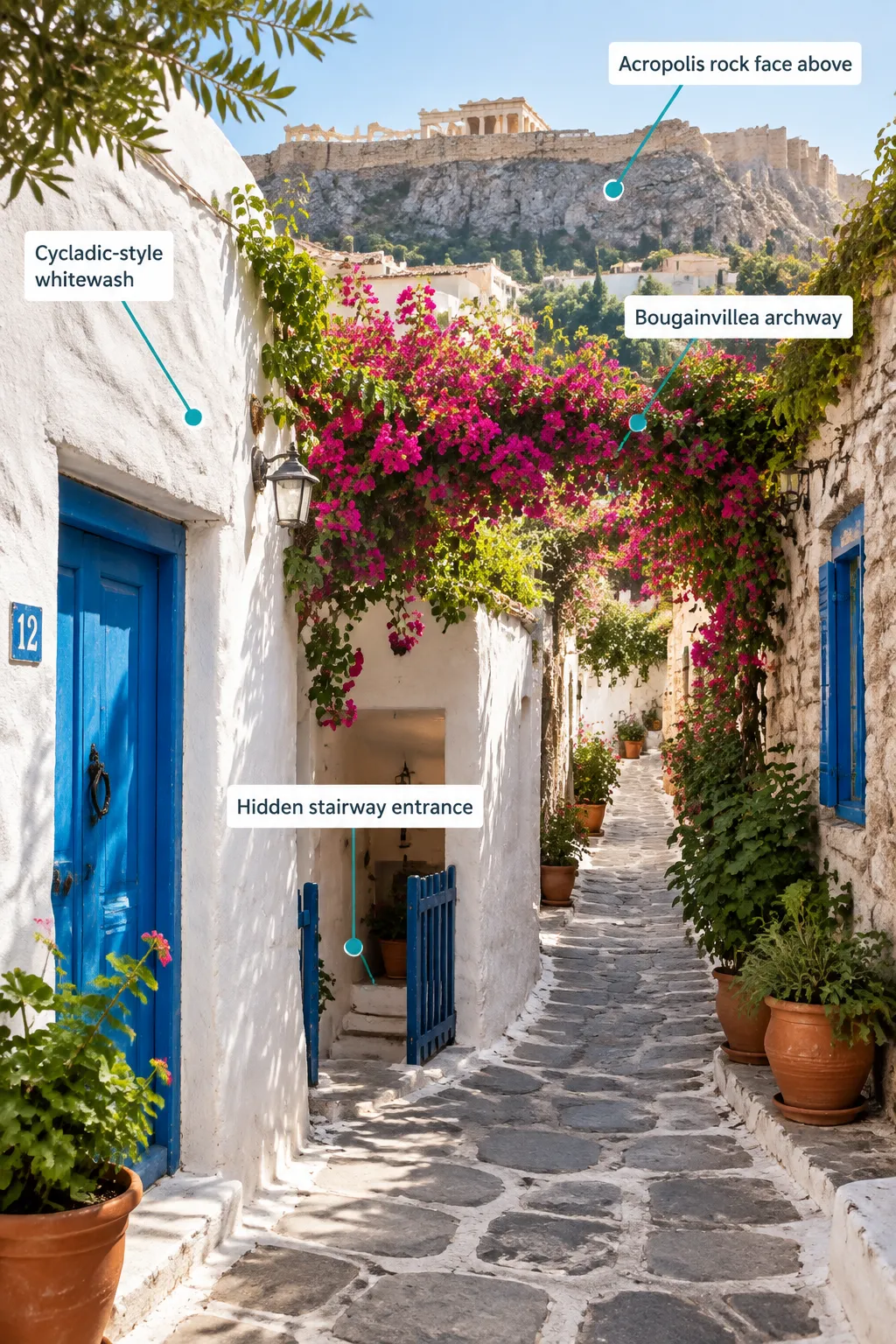
These stops appear repeatedly in off-the-beaten-path Athens guides as the places that give visitors a genuine sense of the city beyond its monuments.
Athens Walking Tour Routes That Avoid Crowds
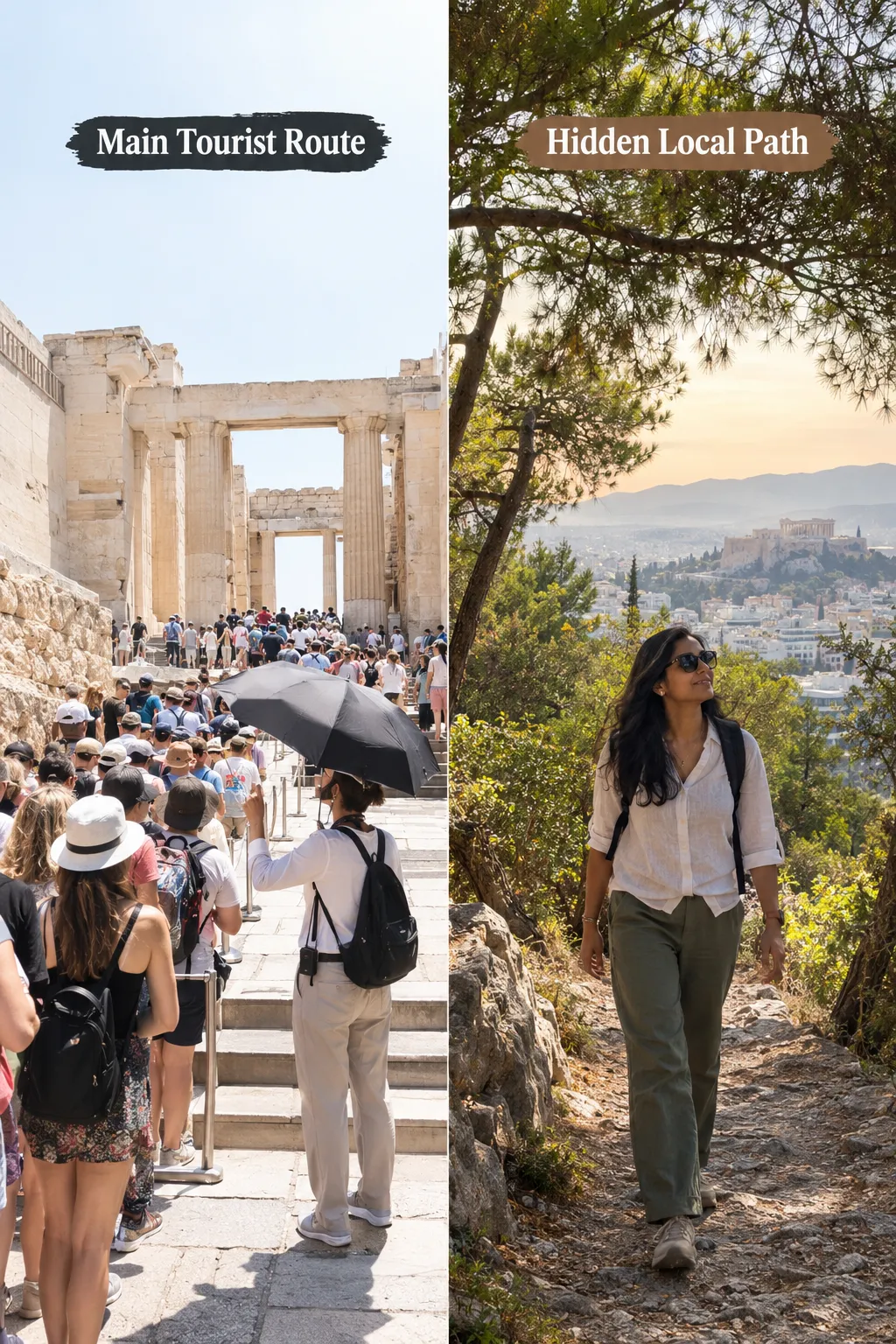
The best crowd-free Athens walking tour routes run through Anafiotika, up Philopappos Hill, and along the back streets of Psyrri and Gazi – neighborhoods that sit just outside the main archaeological zone.
The standard tourist flow goes: Syntagma Square → Plaka → Monastiraki → Acropolis. If you reverse or offset this route, you immediately lose 80% of the foot traffic.
Three low-crowd route options:
- The Hill Loop – Start at Thissio metro, walk up Philopappos Hill, cross to Pnyx, then descend into Anafiotika before finishing at Monastiraki. Mostly shaded, almost no crowds before 10 AM.
- The Market Morning Route – Begin at Athens Central Market at 7 AM, walk through Psyrri’s side streets, then into the Roman Agora before the tour groups arrive.
- The Neighborhood Drift – Gazi to Kerameikos to Thisseio, following the ancient city walls. This route has almost no tourist infrastructure, which is exactly the point.
A self-guided hidden gems walking route covering about 7.5 hours combines major landmarks with these lesser-known corners and consistently ranks among the most booked independent walking experiences in the city.
For more inspiration on exploring Greece beyond the obvious, check out our guide on what to see in Athens Greece beyond the Acropolis.
How Long Does a Typical Athens Walking Tour Take?
A typical Athens walking tour takes 2-3 hours at a steady pace for the core historic loop, or 5-7 hours if you add hidden stops, sit-down breaks, and market visits.
The historic center is a roughly 6 km loop connecting Syntagma Square, the Acropolis, Plaka, Monastiraki, the Ancient Agora, and Areopagus Hill. That’s about 3.7 miles – manageable in a morning.
Time estimates by tour type:
| Tour Type | Duration | Best For |
|---|---|---|
| Core highlights only | 2-3 hours | First-time visitors, short layovers |
| Hidden gems add-ons | 5-7 hours | Curious travelers, repeat visitors |
| Full city deep dive | Full day (8+ hrs) | History enthusiasts, slow travelers |
| Guided small-group tour | 2-3 hours | Those who want context and stories |
Guided options like the Athens Hidden Gems Walking Experience run about 2 hours and start at Syntagma Square, threading through the National Garden, Panathenaic Stadium, and quieter Plaka back streets.
Best Time of Day to Walk Around Athens
The best time to walk Athens is between 7:00 AM and 10:00 AM. Streets are cooler, light is golden, and the main tourist sites haven’t filled up yet.
In summer (June-September), temperatures regularly exceed 35°C by midday. Walking after 11 AM without shade becomes genuinely uncomfortable. Early morning also means the Central Market is in full swing and Anafiotika’s alleys are empty.
Quick timing guide:
- 7:00-9:00 AM – Best for markets, quiet neighborhoods, photography
- 9:00-11:00 AM – Still manageable, most sites just opening
- 11:00 AM-3:00 PM – Avoid outdoor walking in summer; use this for museums
- 4:00-7:00 PM – Crowds thin out, light improves, cafes come alive
- After 8:00 PM – Pleasant for Plaka and Monastiraki, but hidden stops are closed
Most Athens self-guided walking guides recommend starting between 8:00-9:00 AM specifically to reach the quieter “secret” spots before tour groups arrive.
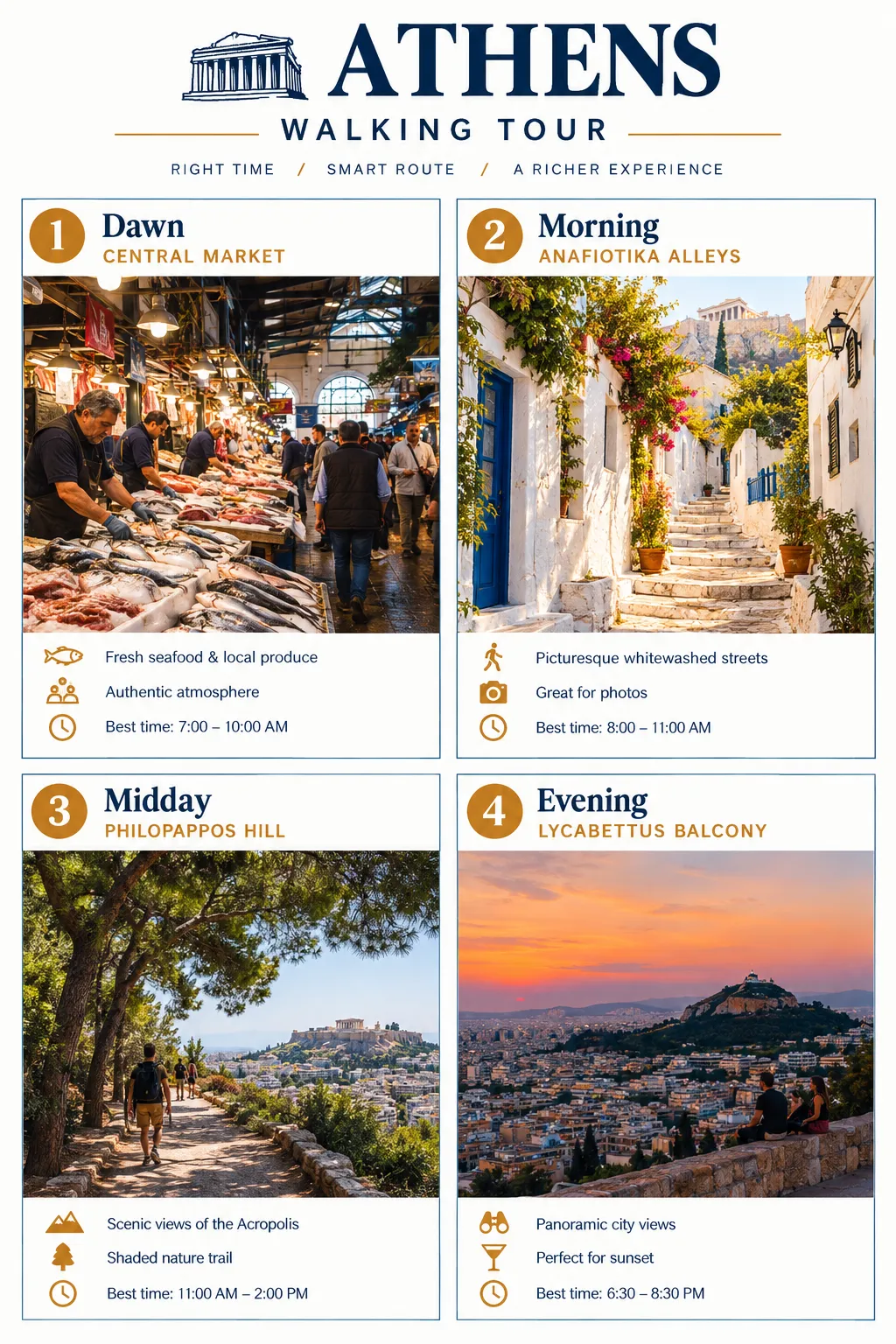
Athens Walking Tour Prices and Guided vs. Self-Guided Options
Guided Athens walking tours typically cost between $25 and $90 per person depending on group size and duration. Self-guided tours are essentially free, aside from any paid entry fees.
Self-guided: The only major paid stop is the Acropolis combo ticket at around €20-30, which covers several archaeological sites. Everything else – Philopappos Hill, Pnyx, Kerameikos exterior, Anafiotika, the National Garden – is free to walk through.
Guided options:
- A 2-hour small-group hidden gems tour starts at Syntagma and covers quieter paths through the National Garden, Roman Agora, and an ancient cemetery
- A 3-hour “Must-do attractions and local hidden gems” tour runs around $70 and meets near Thissio station
- The Walk Athens Beyond Acropolis tour focuses on Pnyx Hill, Socrates’ Prison, and the Tower of the Winds
Choose guided if: You want historical context, stories, and someone to point out what you’d otherwise walk past.
Choose self-guided if: You prefer your own pace, travel with a small group, or want to linger somewhere without a schedule.
Can You Do an Athens Walking Tour in One Day?
Yes, you can cover the core Athens walking tour in one day – including several hidden stops – if you start early and plan your route in advance.
A realistic one-day plan:
- 7:00 AM – Athens Central Market (Varvakios Agora)
- 8:30 AM – Walk through Psyrri to Monastiraki
- 9:00 AM – Ancient Agora and Kerameikos Cemetery
- 10:30 AM – Anafiotika alleyways
- 11:30 AM – Acropolis (buy combo ticket here)
- 1:30 PM – Lunch break in Plaka
- 3:00 PM – Philopappos Hill and Pnyx
- 5:00 PM – National Garden paths
- 6:30 PM – Lycabettus Hill viewpoint (funicular or walk)
That’s a full day, but it’s paced well. If you’re also planning a broader Greece trip, our Greece group trip guide with 9 genius stops is worth reading before you go.
What to Wear for Walking in Athens
Wear flat, rubber-soled shoes with grip. This is the single most important gear decision you’ll make for an Athens walking tour.
The streets in Plaka, Anafiotika, and around the Acropolis are made of marble, limestone, and uneven cobblestone. They look beautiful and become dangerously slippery when wet or worn smooth. Sandals with thin soles are fine for flat streets but risky on hill paths.
Packing checklist:
- ✅ Flat rubber-soled shoes or trail sneakers
- ✅ Lightweight, breathable clothing (linen works well in summer)
- ✅ Sun hat and sunscreen – shade is rare on the main routes
- ✅ Refillable water bottle – Athens has public water fountains throughout the center
- ✅ Small daypack for layers and snacks
- ❌ Heels or smooth-soled dress shoes
- ❌ Heavy backpack – you’ll regret it on the hills
For more general packing tips for European city trips, our packing for France in winter guide has useful principles that transfer well to Athens in shoulder seasons.
Athens Walking Tour for Elderly Visitors or Those With Mobility Issues
Athens can be challenging for visitors with mobility issues, but several hidden stops are accessible with planning. The main difficulty is the hills and uneven stone surfaces.
Accessible stops:
- National Garden – flat, paved paths, benches throughout
- Syntagma Square to Plaka lower streets – mostly flat
- Panathenaic Stadium exterior – flat approach, great views from street level
- Monastiraki Square and flea market – flat, wide streets
Challenging stops:
- Anafiotika (steep stairs, uneven stone)
- Philopappos Hill (unpaved trails)
- Lycabettus Hill (steep – use the funicular instead of walking)
- Pnyx Hill (rocky paths)
The Athens Hidden Gems guided walking tour covers several accessible stops and provides a map for independent exploration of flatter areas afterward.
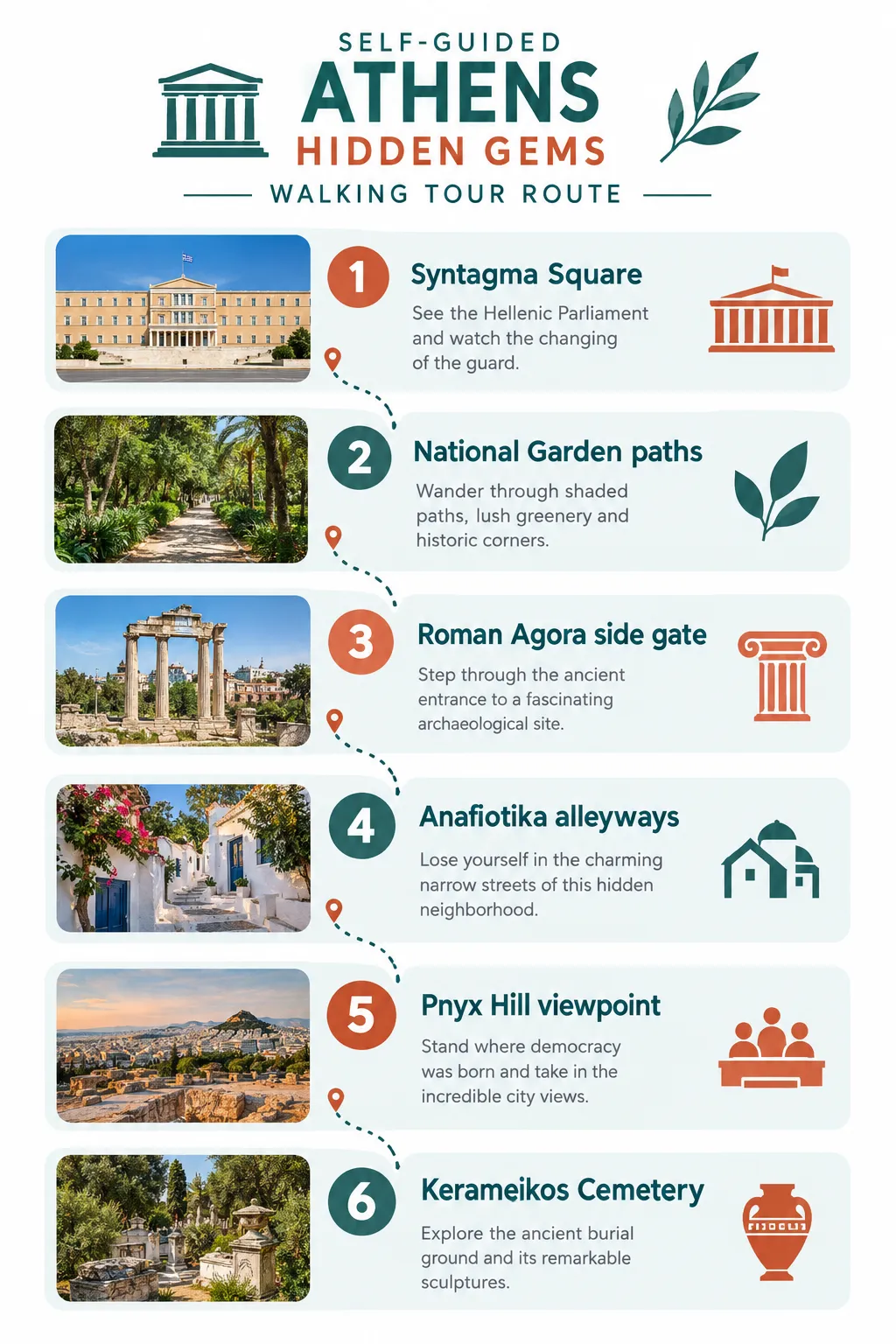
What’s the Difference Between an Acropolis Tour and a City Walking Tour?
An Acropolis tour focuses entirely on the hill, its monuments, and the Acropolis Museum. A city walking tour covers the broader urban fabric – neighborhoods, markets, hills, and lesser-known archaeological sites.
The Acropolis tour is vertical and concentrated. You spend 2-3 hours on one site. The city walking tour is horizontal and wide-ranging – you might cover 6 km and visit 8-10 different locations.
Many visitors do both, but the city walking tour reveals a completely different Athens. The Walk Athens Beyond Acropolis experience was specifically designed to show visitors what lies just outside the Acropolis perimeter – including Pnyx Hill, the Tower of the Winds, and Socrates’ Prison.
Hidden Neighborhoods in Athens Worth Exploring
The most rewarding hidden neighborhoods for walking are Anafiotika, Psyrri, Gazi, and Koukaki – each with a distinct character that most tourists never see.
- Anafiotika – Built by craftsmen from Anafi island in the 1800s, this tiny neighborhood clings to the Acropolis rock. Whitewashed walls, cats on windowsills, and almost no tourists before 10 AM.
- Psyrri – Once a working-class district, now a mix of street art, small restaurants, and local bars. Feels like the real Athens, not the postcard version.
- Gazi – Built around a former gasworks (now the Technopolis arts center). Walking tours here explore courtyard houses and everyday life before modern apartment blocks changed the city.
- Koukaki – Directly south of the Acropolis, this residential neighborhood has excellent coffee shops, local bakeries, and almost zero tourist infrastructure.
If you enjoy exploring hidden neighborhoods in European cities, our guides on hidden gems in Florence Italy and hidden gems in Amsterdam follow a similar approach.
Common Mistakes Tourists Make on Athens Walking Tours
The biggest mistake is trying to see everything in one go without accounting for heat, hills, and midday crowds. The second biggest is staying only within Plaka and Monastiraki.
Other common mistakes:
- Starting too late – Arriving at the Acropolis after 10 AM in summer means long queues and brutal sun
- Skipping the market – Athens Central Market (Varvakios Agora) is one of the most authentic experiences in the city, and most visitors walk right past it
- Ignoring the hills – Philopappos, Pnyx, and Lycabettus all offer better views than the Acropolis itself, for free
- Wearing the wrong shoes – Marble streets are beautiful and unforgiving
- Not buying the combo ticket – The Acropolis combo ticket covers the Ancient Agora, Kerameikos, and several other sites. Buying individual tickets costs significantly more
- Rushing Anafiotika – This neighborhood deserves at least 45 minutes of slow wandering, not a 5-minute photo stop
Is It Safe to Walk Around Athens at Night?
Athens is generally safe to walk at night, especially in the main tourist areas of Plaka, Monastiraki, Psyrri, and Kolonaki. Like any major city, some areas require more awareness after dark.
The neighborhoods around Omonia Square can feel unsettled late at night and are best avoided after midnight. Exarchia, while interesting by day, has a more unpredictable atmosphere at night.
For evening walks, Plaka and the area around the Acropolis are well-lit, lively, and safe. The rooftop bars and restaurants in Monastiraki stay busy until late, which keeps streets active and well-populated.
Best Apps and Maps for a Self-Guided Athens Walking Tour
The most useful apps for a self-guided Athens walking tour are Google Maps (downloaded offline), izi.TRAVEL, and the Athens City Voice app.
App breakdown:
- Google Maps offline – Download the Athens map before you go. Works without data and is accurate for walking routes
- izi.TRAVEL – Free audio guides for self-guided walking tours, including several Athens routes focused on hidden stops
- Athens City Voice app – Local recommendations, neighborhood guides, and event listings
- Komoot – Better for hill routes like Philopappos and Lycabettus, with trail detail Google Maps misses
A printed map is still worth having for Anafiotika and Psyrri, where small alleys don’t always register correctly on GPS.
FAQ
How much does an Athens walking tour cost?
Self-guided tours are free except for the Acropolis combo ticket (around €20-30). Guided small-group tours run between $25 and $90 per person depending on duration and operator.
Can I walk from the Acropolis to Anafiotika?
Yes, Anafiotika is literally built into the north slope of the Acropolis rock. It’s a 5-minute walk from the main Acropolis entrance down a set of stone stairs.
Is Philopappos Hill worth visiting?
Yes. Philopappos Hill offers some of the best views of the Acropolis in the city, has shaded pine trails, and is almost always less crowded than the Acropolis itself. Entry is free.
What is Pnyx Hill?
Pnyx Hill is the site where ancient Athenian citizens gathered to vote and debate – the birthplace of democracy. It’s a 10-minute walk from the Acropolis and almost always quiet.
How do I get to Kerameikos Cemetery?
Take the metro to Thissio station (Line 1) and walk about 10 minutes north. The cemetery is open daily and has a small on-site museum.
Is the Athens Central Market open every day?
The market (Varvakios Agora) is open Monday through Saturday, with the busiest and most atmospheric time being between 6:00 AM and 10:00 AM.
Can I walk the entire Athens historic center without a guide?
Yes. The historic center is compact and well-signposted. A downloaded offline map and a basic route plan are enough for most travelers.
What is the Tower of the Winds?
The Tower of the Winds (Aerides) is an ancient marble clocktower inside the Roman Agora, built around 50 BC. It’s one of the best-preserved ancient structures in Athens and is often walked past without notice.
How steep are the Athens walking routes?
Plaka and Monastiraki are relatively flat. Anafiotika, Philopappos Hill, Pnyx, and Lycabettus all involve significant climbing. Wear shoes with grip and take your time.
Is Athens good for solo travelers on foot?
Athens is excellent for solo walkers. The city is compact, public transport fills gaps, and the walking culture means you’ll rarely feel out of place exploring on foot.
Conclusion
An Athens Greece walking tour done right is one of the best travel experiences in Europe. The city rewards slow walkers who leave the main path – whether that means ducking into Anafiotika’s whitewashed alleys, climbing Philopappos Hill before the crowds arrive, or standing in the exact spot where democracy was born on Pnyx Hill.
Your next steps:
- Download Google Maps offline for Athens before you fly
- Book your Acropolis combo ticket in advance to skip the queue
- Plan your start time for 8:00 AM – this single change makes the whole day better
- Add at least 3 stops from this list that aren’t on your current itinerary
- Wear the right shoes – seriously
If you’re building a broader Greece itinerary, check out our guide on what to see in Crete Greece and what to do in Mykonos Greece for the next stops after Athens.
Athens has been hiding in plain sight for centuries. The tourists who walk right past these 11 stops are missing the best parts of the city.