Last updated: October 5, 2026
Quick Answer: A Europe train itinerary that avoids the tourist trail connects cities like Ghent, Ljubljana, Olomouc, and Plovdiv using a mix of night trains and regional rail. In 2026, a wave of new sleeper routes makes this easier than ever – and often cheaper than flying into the obvious hubs. You don’t need a rigid plan, just a loose corridor and a few advance bookings for overnight trains.
Key Takeaways
- 🚂 Cities like Ghent, Ljubljana, Olomouc, Plovdiv, and Novi Sad are easy by train and far less crowded than Paris or Rome.
- 🌙 New night train routes in 2026 – including Paris-Brussels-Berlin and Brussels-Milan – open up multi-country itineraries without wasted daytime hours.
- 🎫 Eurail passes save money for trips covering 5+ countries; point-to-point tickets are better for 2-3 country trips with fixed dates.
- ⏱️ A solid Europe train trip needs at least 10-14 days to feel worthwhile; 3 weeks is the sweet spot.
- 📅 Book sleeper trains 60-90 days ahead; regional trains can often be bought the same week.
- 🗺️ Not every European country connects seamlessly – gaps exist in the Balkans and parts of Eastern Europe.
- ❌ The biggest mistakes are over-scheduling, skipping seat reservations, and ignoring regional trains.
- 💡 High-speed trains are fast but miss small towns; regional trains are slower but far more scenic and interesting.
What Are the Best Hidden Gem Cities to Visit by Train in Europe?
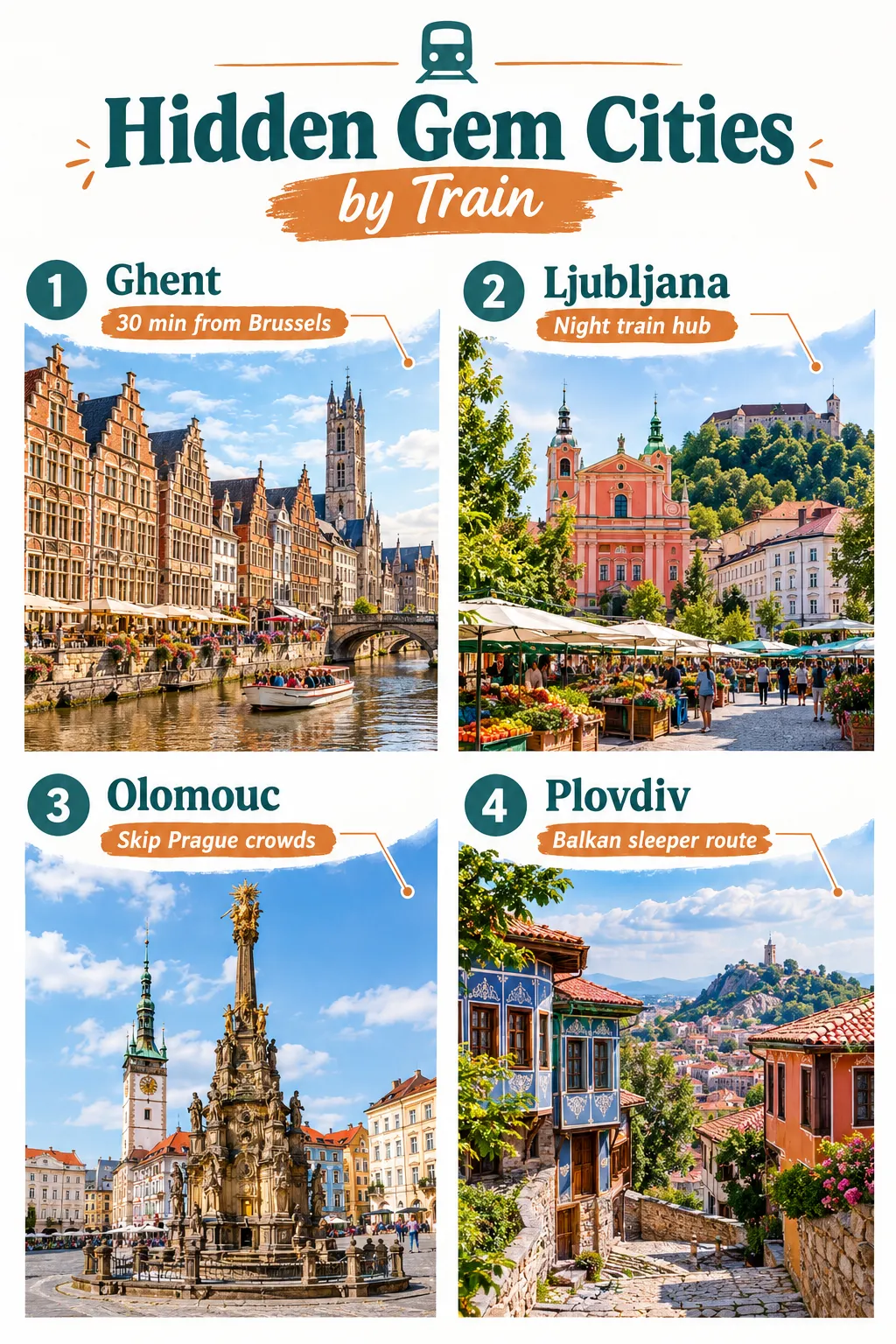
The best off-the-beaten-path cities for a Europe train itinerary are Ghent (Belgium), Ljubljana (Slovenia), Olomouc (Czech Republic), Plovdiv (Bulgaria), and Novi Sad (Serbia). Each sits on or near a major rail corridor, so getting there doesn’t require complicated logistics.
Here’s a quick breakdown:
| City | Country | Why It Works | Nearest Rail Hub |
|---|---|---|---|
| Ghent | Belgium | Medieval canals, zero crowds vs. Bruges | Brussels (30 min) |
| Ljubljana | Slovenia | Compact, walkable, night train access | Vienna or Zagreb |
| Olomouc | Czech Republic | Baroque fountains, university town | Prague (1.5 hrs) |
| Plovdiv | Bulgaria | Oldest city in Europe, colorful old town | Sofia (2 hrs) |
| Novi Sad | Serbia | Danube views, Exit Festival city | Belgrade (1.5 hrs) |
If you’re drawn to the Italian side of things, Piedmont feels like a quieter Tuscany and connects well from Milan or Turin by regional train.
Common mistake: Travelers skip these cities because they don’t appear in standard “2 weeks in Europe” guides. That’s exactly why they’re worth visiting.
How Long Does It Take to Plan a European Train Itinerary?
Planning a basic Europe train itinerary takes about 3-5 hours if you have a route in mind. A more complex multi-country trip with night trains takes 1-2 focused planning sessions spread over a week.
Here’s a realistic planning timeline:
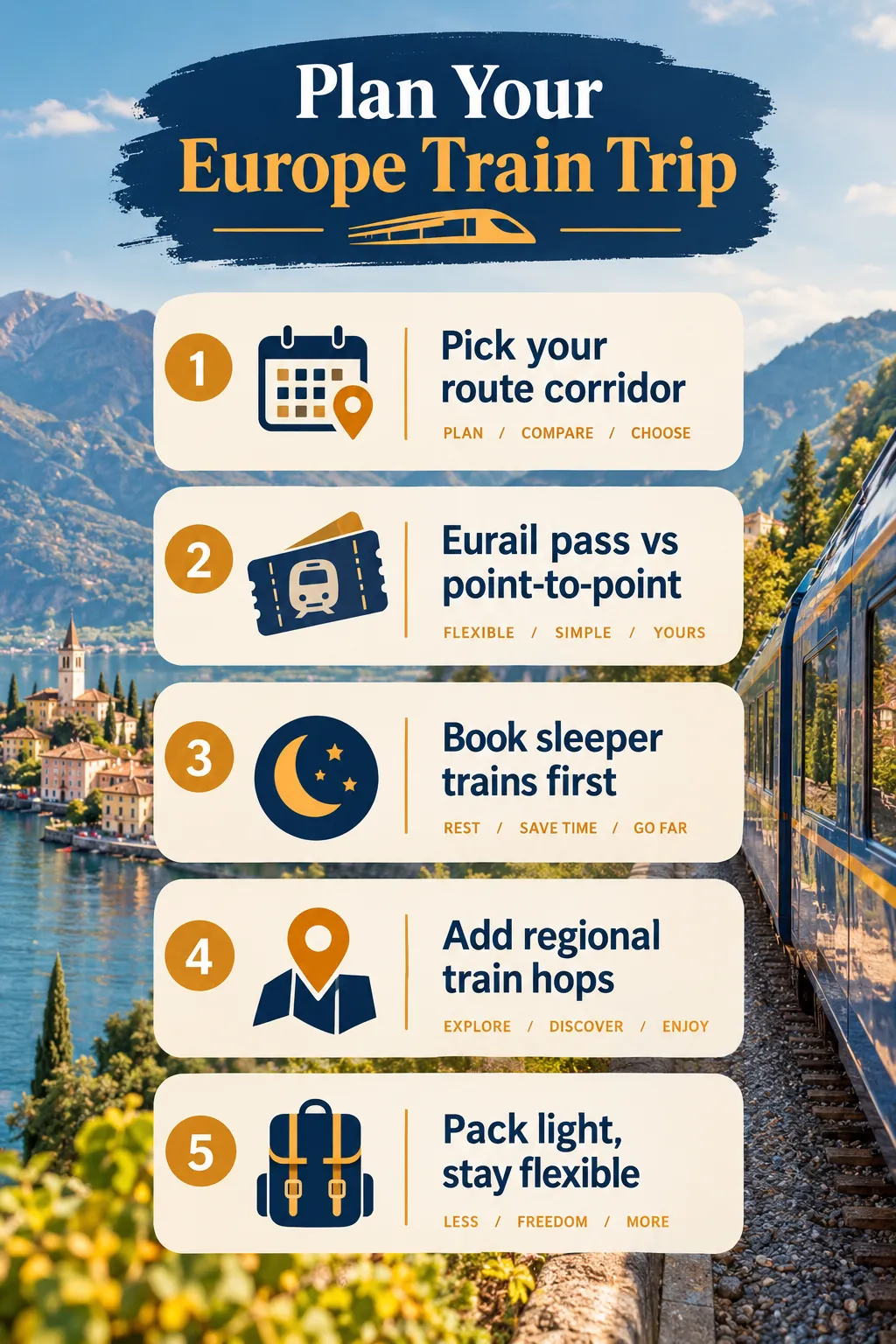
- Week 1 – Pick your entry and exit cities, sketch a rough corridor (e.g., Brussels to Plovdiv via Berlin and Vienna).
- Week 2 – Check night train availability on the Interrail timetable update for 2026 and book sleepers first.
- Week 3 – Fill in daytime regional hops, check reservation requirements, and sort accommodation.
For a 2-week trip, you can realistically plan everything in under 5 hours total. The key is booking night trains early – everything else is flexible.
Eurail Pass vs. Point-to-Point Tickets – Which Is Cheaper?
For trips covering 5 or more countries over 2+ weeks, a Eurail Global Pass is usually cheaper. For shorter trips with 2-3 fixed destinations, point-to-point tickets booked in advance almost always win on price.
A few rules to help you decide:
- Choose Eurail if you’re traveling for 3+ weeks, want flexibility, or plan to use many regional trains.
- Choose point-to-point if your dates are fixed, you’re visiting 2-3 countries, and you can book 60+ days ahead.
- Watch out: Even with a Eurail pass, most night trains and high-speed trains require a reservation fee (typically €3-€40 extra per leg, depending on the route and operator).
The Interrail 2026 timetable update lists current reservation requirements by route – worth checking before you buy a pass.
What Train Routes in Europe Avoid Tourist Crowds?
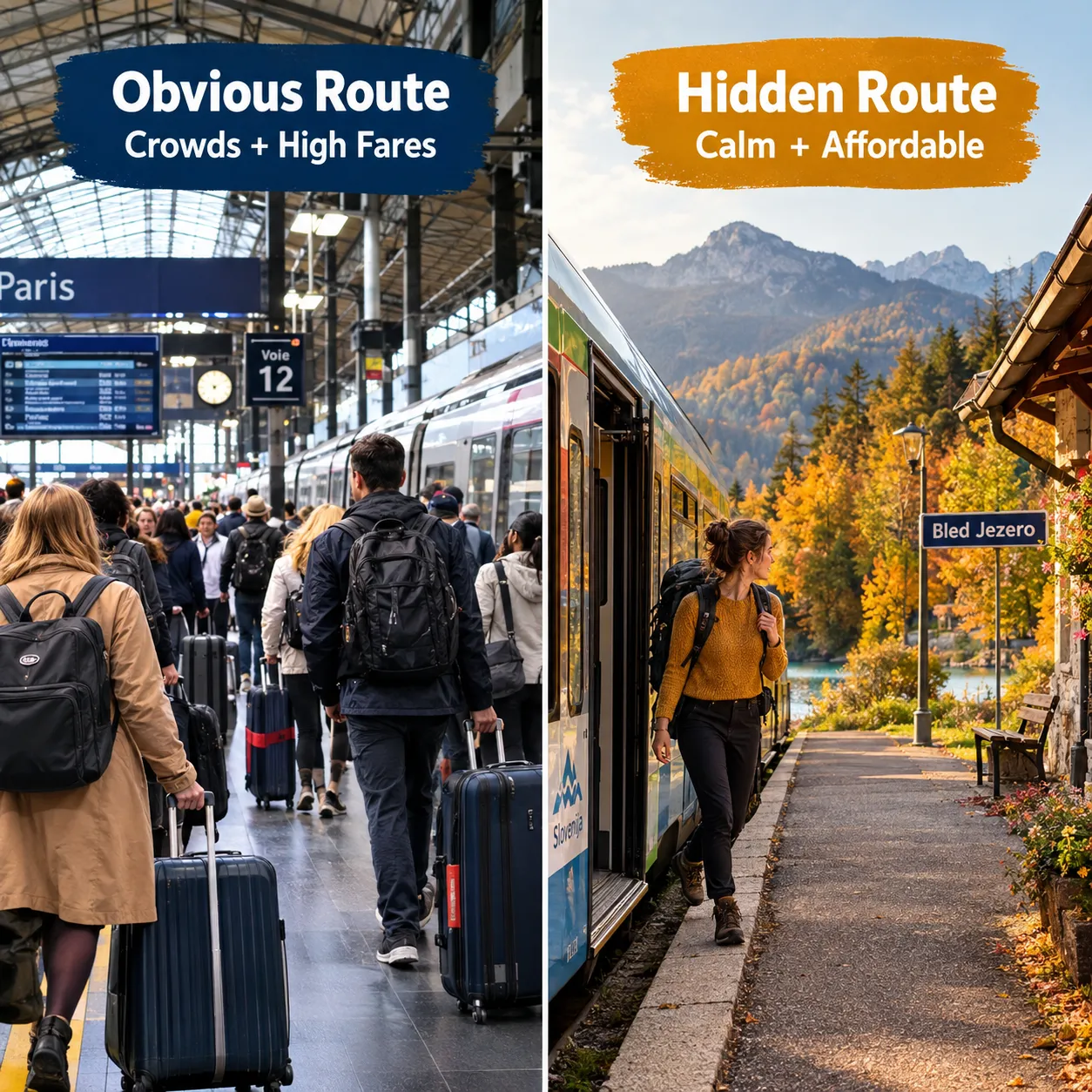
The quietest, most adventurous rail routes in Europe run through Central and Eastern Europe, the Balkans, and the Alpine edges. These corridors carry far fewer tourists than the Paris-Amsterdam or Rome-Florence lines.
Top low-crowd routes for a Europe train itinerary:
- Berlin to Krakow via Wroclaw – passes through lesser-known Polish cities with stunning architecture.
- Vienna to Ljubljana to Zagreb – a gorgeous Alpine and river corridor with almost no tourist rush.
- Budapest to Plovdiv via Belgrade and Sofia – the Balkan corridor, slow but deeply rewarding.
- Munich to Przemysl via Prague and Budapest – the new EuroNight route that stitches hidden Eastern Europe into one overnight journey.
For a broader Central European loop, this 1-month Central Europe itinerary with 9 stops is a great reference point.
Best Time to Book European Train Tickets for the Cheapest Fares
Book European train tickets 60-90 days in advance for the best fares on high-speed and night trains. Regional trains in Central and Eastern Europe are less price-sensitive and can often be booked 1-2 weeks out without a big cost difference.
Booking tips:
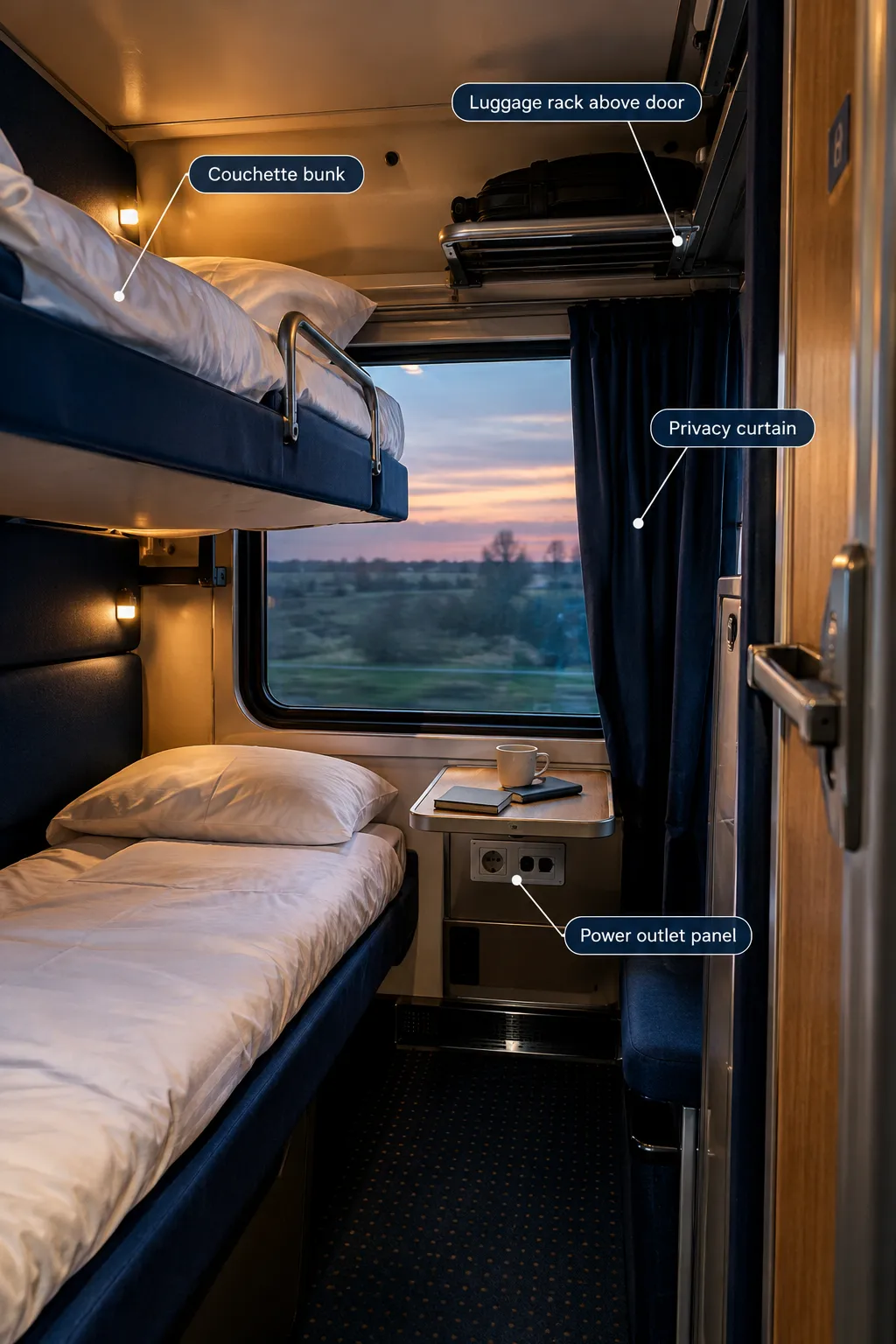
- Night trains (Nightjet, European Sleeper): Book as early as possible – couchette berths sell out fast, especially on the revived Paris-Brussels-Berlin night train that launched in March 2026.
- High-speed trains (Thalys, Eurostar, TGV): Prices rise sharply inside 30 days.
- Regional trains: Buy at the station or app within a week – prices are usually flat.
- Avoid school holidays in France, Germany, and the UK – fares spike and trains fill up.
Can You Take Trains Between All European Countries, or Are There Gaps?
You can connect most Western and Central European countries by train with no major gaps. However, the Balkans, parts of Eastern Europe, and some island or coastal regions have limited or slow rail connections that may require buses or ferries to fill in.
Known gaps to plan around:
- Albania has almost no usable passenger rail.
- North Macedonia and Kosovo have very limited cross-border train options.
- Greece to Bulgaria has a slow, infrequent connection via Thessaloniki and Sofia.
- Portugal to Spain has improved but still has fewer fast cross-border trains than you’d expect.
For the Balkans, budget overnight buses fill the gaps reasonably well. For Western Europe, the Back on Track EU network actively advocates for better cross-border rail – and new routes are being added regularly.
How Do I Get Between Small Towns by Train in Europe?
Regional trains are the backbone of small-town travel in Europe. Most small towns within 100 km of a major city are reachable by regional rail, often with trains every 1-2 hours. The key is using local rail apps (like DB Navigator in Germany, SNCF in France, or CD.cz in the Czech Republic) rather than just Eurail’s planner.
Practical tips:
- Use Rome2Rio or Trainline to find connections that booking sites miss.
- In Italy, Trenitalia Regionale covers hundreds of small towns not on the high-speed network – check out hidden gems in Italy that are reachable this way.
- In Austria and Switzerland, regional trains connect to buses and cable cars in a single timetable – it’s genuinely seamless.
- In the Balkans, expect slower trains and longer gaps between services. Build in buffer time.
What’s the Difference Between High-Speed and Regional Trains in Europe?
High-speed trains (like TGV, ICE, Eurostar, and Frecciarossa) cover long distances fast – typically 250-320 km/h – and stop only at major cities. Regional trains run slower, stop more often, and pass through countryside and small towns that high-speed lines bypass entirely.
For an adventure-focused Europe train itinerary, you’ll want both:
- High-speed trains to cover big distances quickly (e.g., Paris to Brussels, Milan to Rome).
- Regional trains for the actual exploration – the scenic valleys, small market towns, and quiet stations.
The Brussels-Milan night train launched in September 2026 is a good example of a service that bridges both worlds – it covers four countries overnight, including a stretch past Lake Maggiore, without requiring you to spend a full day on a fast train.
Is It Better to Plan a Strict Itinerary or Go Spontaneous With Trains?
A loose framework beats both extremes. Book your night trains and the first night of accommodation in each city in advance, then leave daytime regional hops open. This gives you flexibility without the stress of scrambling for a sleeper berth at the last minute.
Strict planning works for:
- Night trains (they sell out weeks ahead)
- Travel during summer peak season (June-August)
- Trips under 10 days where every day counts
Spontaneity works for:
- Regional train hops under 3 hours
- Travel in shoulder season (April-May, September-October)
- Countries like Austria, Switzerland, and Germany where trains run every 30-60 minutes
What Mistakes Do People Make When Doing Train Travel Across Europe?
The most common mistakes on a Europe train itinerary are over-scheduling, skipping reservations on trains that require them, and packing too much to move comfortably between stations.
Top mistakes to avoid:
- Booking too many cities – 3-4 nights per stop is the minimum to feel like you’ve actually been somewhere.
- Ignoring reservation requirements – A Eurail pass doesn’t always include a seat. Many trains need a separate reservation, especially night trains and high-speed services.
- Bringing oversized luggage – Regional trains and old station lifts are not suitcase-friendly. A 40L backpack is the sweet spot.
- Not checking strike schedules – France and Italy have periodic rail strikes. Check local news before departure.
- Assuming all connections are fast – A “2-hour journey” on paper can involve a 45-minute wait at a junction station.
If you’re new to train travel in general, these Amtrak train travel tips for first-time riders cover transferable principles that apply to European rail too.
How Many Days Do You Need for a Good European Train Trip?
A minimum of 10 days gives you enough time to cover 3-4 cities meaningfully. Two weeks (14 days) is the sweet spot for a proper Europe train adventure covering 5-6 stops. Three weeks lets you go deep into one region or wide across two or three.
A sample 14-day hidden-gem Europe train itinerary:
- Days 1-3: Ghent, Belgium (arrive via Brussels)
- Days 4-5: Cologne, Germany (scenic Rhine Valley train)
- Days 6-7: Prague, Czech Republic (overnight train from Cologne)
- Days 8-9: Olomouc, Czech Republic (regional train, 1.5 hrs)
- Days 10-11: Vienna, Austria (regional train from Olomouc)
- Days 12-14: Ljubljana, Slovenia (regional train via Graz)
This route avoids Paris, Amsterdam, and Rome entirely – and every leg is under 6 hours.
What If I Get Sick or Need to Cancel My Train Tickets in Europe?
Cancellation and refund policies vary significantly by ticket type and operator. Flexible tickets (usually more expensive) allow full refunds up to a few hours before departure. Non-flexible advance tickets are often non-refundable or carry a penalty fee.
Key things to know:
- Eurail passes are partially refundable if unused, but used travel days are non-refundable.
- European Sleeper and Nightjet tickets: refund policies differ by booking platform – always check at time of purchase.
- Travel insurance is strongly recommended for multi-week trips. Look for a policy that covers trip interruption and missed connections specifically.
- If you get sick mid-trip, regional train tickets in Germany, Austria, and Switzerland are often date-flexible or easy to exchange at the station.
Which European Countries Have the Best Train Systems for Travelers?
Switzerland, Austria, Germany, and the Netherlands consistently rank as the best countries for train travel in Europe, based on punctuality, frequency, and network coverage. France is excellent for high-speed travel but has gaps in regional coverage.
For adventurous travelers specifically:
- Austria – Nightjet network is expanding fast, and regional trains are punctual and scenic.
- Czech Republic – Affordable, well-connected, and underrated for rail travel.
- Slovenia – Small but beautiful rail network; Ljubljana is a great hub.
- Sweden – The Berlin-Stockholm EuroNight continues under RDC from September 2026, keeping the Nordic connection alive.
Do I Need to Book Sleeper Trains in Advance or Can I Buy Last Minute?
Book sleeper trains at least 60-90 days in advance, especially for popular routes. Last-minute sleeper berths do occasionally appear (cancellations, released inventory), but relying on that is a gamble – especially in summer.
The 2026 night train landscape has expanded significantly. According to Euronews’s 2026 night train map, there are now more sleeper routes running across Europe than at any point in recent years – but that also means more demand.
New routes worth booking early:
- Paris-Brussels-Berlin (European Sleeper, from March 2026)
- Brussels-Milan (launched September 9, 2026, crossing Lake Maggiore)
- Munich-Prague-Budapest-Przemysl EuroNight (eastern Poland corridor)
- Brussels/Amsterdam-Copenhagen-Malmö (planned for 2028 per Railway Gazette)
FAQ
Q: Do I need a visa to travel by train across multiple European countries?
A: If you’re traveling within the Schengen Area, one visa covers most of Western and Central Europe. Serbia, North Macedonia, and some Balkan countries are outside Schengen – check requirements for your nationality before booking.
Q: Can I bring a bicycle on European trains?
A: Many regional trains allow bikes with a bike reservation (usually €5-€15 extra). High-speed trains often don’t allow bikes, or only allow folded bikes in a bag. Check per route.
Q: What’s the best app for planning European train routes?
A: Trainline covers most of Europe in one app. For Germany specifically, DB Navigator is more accurate. For Austria and Switzerland, use the ÖBB or SBB apps.
Q: Is it safe to travel alone by train in Eastern Europe?
A: Yes, for the vast majority of travelers. Train stations in major Eastern European cities are well-lit and busy. Night trains have lockable compartments. Standard travel precautions apply.
Q: How early should I arrive at the station for a European train?
A: For regional trains, 10-15 minutes is fine. For international high-speed trains or night trains, aim for 20-30 minutes. Eurostar (London-Paris/Brussels) requires 30-45 minutes for passport control.
Q: Are there luggage restrictions on European trains?
A: Most trains don’t have formal luggage limits, but overhead racks are small. A 40L backpack or a carry-on-sized bag is the practical maximum for comfortable travel on regional trains.
Q: Can I eat on European trains?
A: Most long-distance and high-speed trains have a dining car or trolley service. Regional trains usually don’t. Bring snacks for journeys over 2 hours.
Q: What’s the cheapest country to start a Europe train trip from?
A: Prague, Budapest, and Warsaw are significantly cheaper as starting points than Paris or Amsterdam, both for accommodation and onward train tickets.
Conclusion
A Europe train itinerary built around hidden cities is more achievable in 2026 than it’s ever been. New night trains are connecting places that used to require a flight or a long bus ride. Cities like Ghent, Olomouc, Ljubljana, and Plovdiv are genuinely rewarding – and far less exhausting than fighting crowds in the obvious spots.
Your next steps:
- Pick a rough corridor (e.g., Brussels to Vienna, or Berlin to Plovdiv).
- Check the Interrail 2026 timetable for night train options on your route.
- Book sleeper trains first – everything else can wait.
- Keep at least 3 nights per city so you actually feel it, not just see it.
- Pack light. Seriously.
For more inspiration on building a longer European adventure, the 1-month Central Europe itinerary with 9 stops is worth bookmarking. And if you’re planning a winter trip, the Europe Christmas market itinerary pairs beautifully with a train-first approach.
The trains are running. The berths are booking up. Go find the Europe that most people miss.