Last updated: September 6, 2026
Quick Answer: One day in Zermatt is absolutely possible and genuinely rewarding – if you plan it right. The best single-day formula is simple: take the early Gornergrat Railway for sunrise Matterhorn views, head up to Matterhorn Glacier Paradise by midday, and spend late afternoon wandering Zermatt town. That sequence covers the three highlights most travelers come for, without wasting a minute.
Key Takeaways
- 🏔️ Arrive early – the first Gornergrat train leaves around 7:00 AM and morning light on the Matterhorn is unbeatable
- 🚡 Prioritize two mountain areas – Gornergrat and Matterhorn Glacier Paradise are the top picks for one day
- 🎿 Non-skiers are very welcome – cable cars, viewpoints, and village walks make a full day without skis
- 💰 Budget CHF 150-250+ per person for a realistic full day including transport and a major mountain excursion
- 🚆 Zermatt is car-free – you arrive by train and get around on foot, e-taxis, or the mountain railways
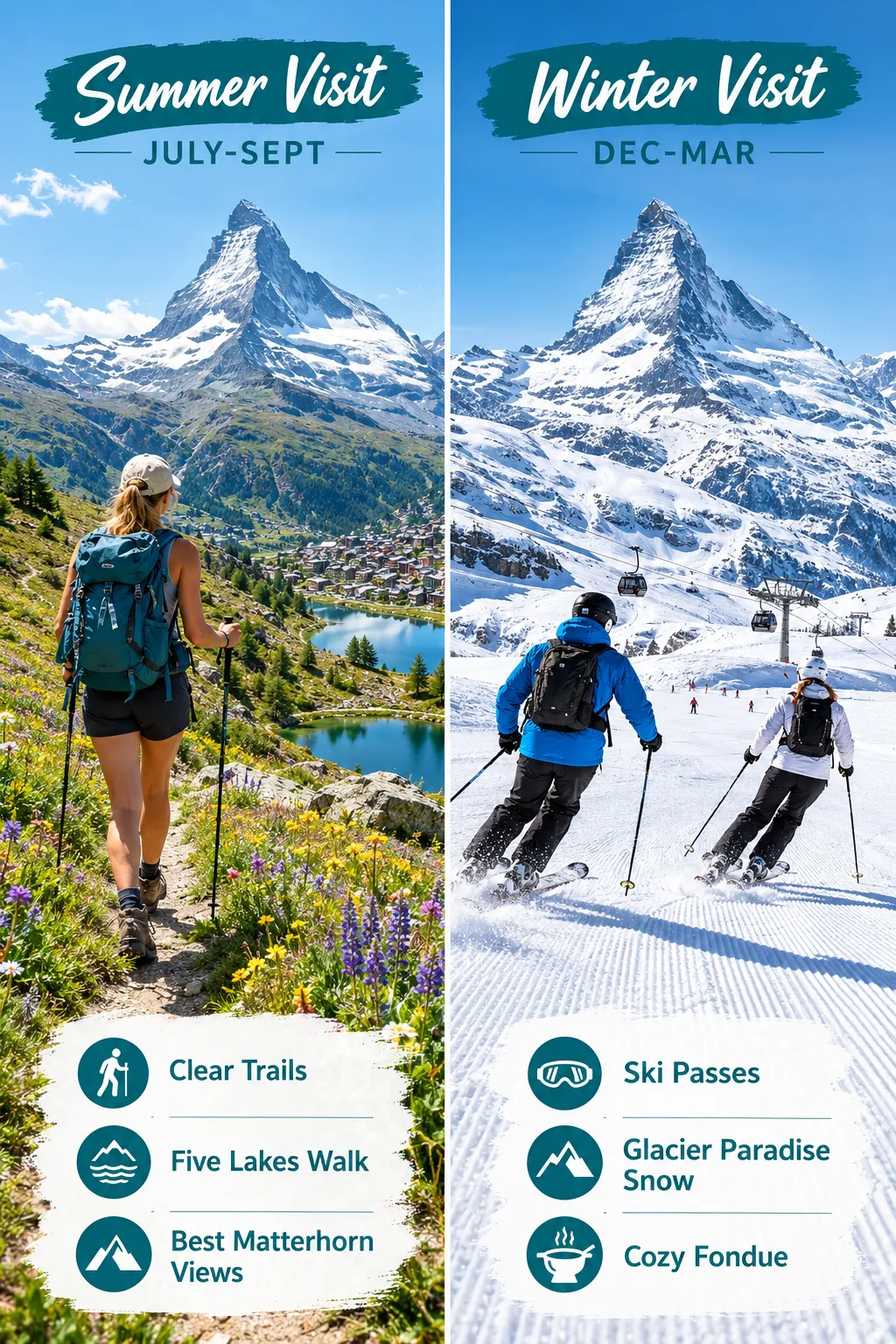
- 📅 July to September is the best time for clear Matterhorn views and open hiking trails
- 🗺️ One day is the minimum – two to three days lets you see both Gornergrat and Glacier Paradise without rushing
- 🏘️ Save 1-2 hours for Zermatt town – Hinterdorf’s wooden chalets and the Matterhorn Museum are worth it
What Can You Do in Zermatt in One Day?
One day in Zermatt is enough to hit the three pillars every visitor talks about: the Gornergrat summit, the Matterhorn Glacier Paradise, and the charming car-free town itself. The key is stacking them in the right order so you spend maximum time at altitude when the light and weather are at their best.
Here’s a realistic breakdown of what fits in a single day:
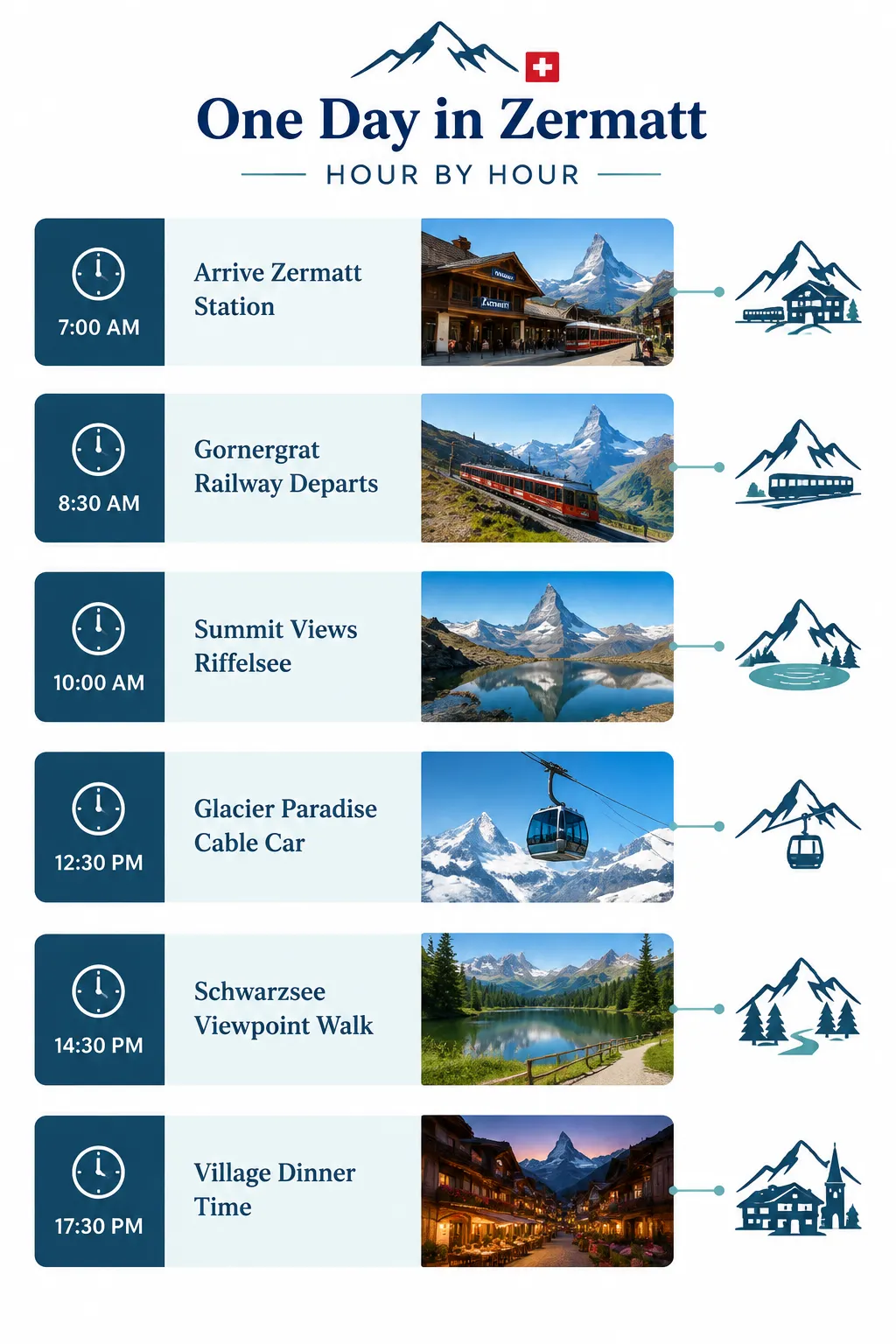
- Morning (7:00-12:00): Gornergrat Railway ride, summit views, Riffelsee lake reflection, optional Rotenboden trail
- Midday (12:00-14:00): Cable car up to Matterhorn Glacier Paradise, quick lunch at altitude
- Afternoon (14:00-17:30): Schwarzsee viewpoint, Zermatt Sign photo stop, village walk
- Evening (17:30-19:30): Dinner at a traditional Swiss restaurant in Zermatt town
This itinerary is confirmed by multiple 2026 planning guides as the most satisfying use of 24 hours in the area.
Getting to Zermatt: Train Times and Logistics
Zermatt sits at the end of a valley in the Swiss Alps and is completely car-free, so every visitor arrives by train. The journey takes roughly 3.5 hours from Zurich and about 3 hours from Geneva, both via Visp, where you change to the Matterhorn Gotthard Bahn for the final leg.
Key arrival tips:
- From Zurich: take an early SBB train to Visp, then connect to Zermatt – aim to arrive in Zermatt by 8:00-8:30 AM
- From Geneva: similar connection via Visp or Lausanne – Lausanne is a common transfer point
- From Interlaken or Grindelwald: plan for roughly 2.5-3 hours with connections
- Day trips from Zurich or Geneva are possible but leave only 4-5 effective hours in Zermatt, making an overnight stay the smarter choice
Rick Steves and most seasoned Switzerland travel writers agree: if you’re doing a day trip to Zermatt from a city, you’re racing the clock. Staying overnight – even just one night – transforms the experience.
Pro tip: Book your train tickets in advance on the SBB website or through the Swiss Travel Pass if you’re covering Europe by rail. Seats fill up fast in summer.
The Suggested One Day in Zermatt Itinerary
The best one day in Zermatt itinerary follows a top-to-bottom logic: start high, work your way down, and finish at village level. Here’s the hour-by-hour plan that experienced Zermatt travelers consistently recommend.
Start Your Day: Gornergrat Railway (7:00-11:30 AM)
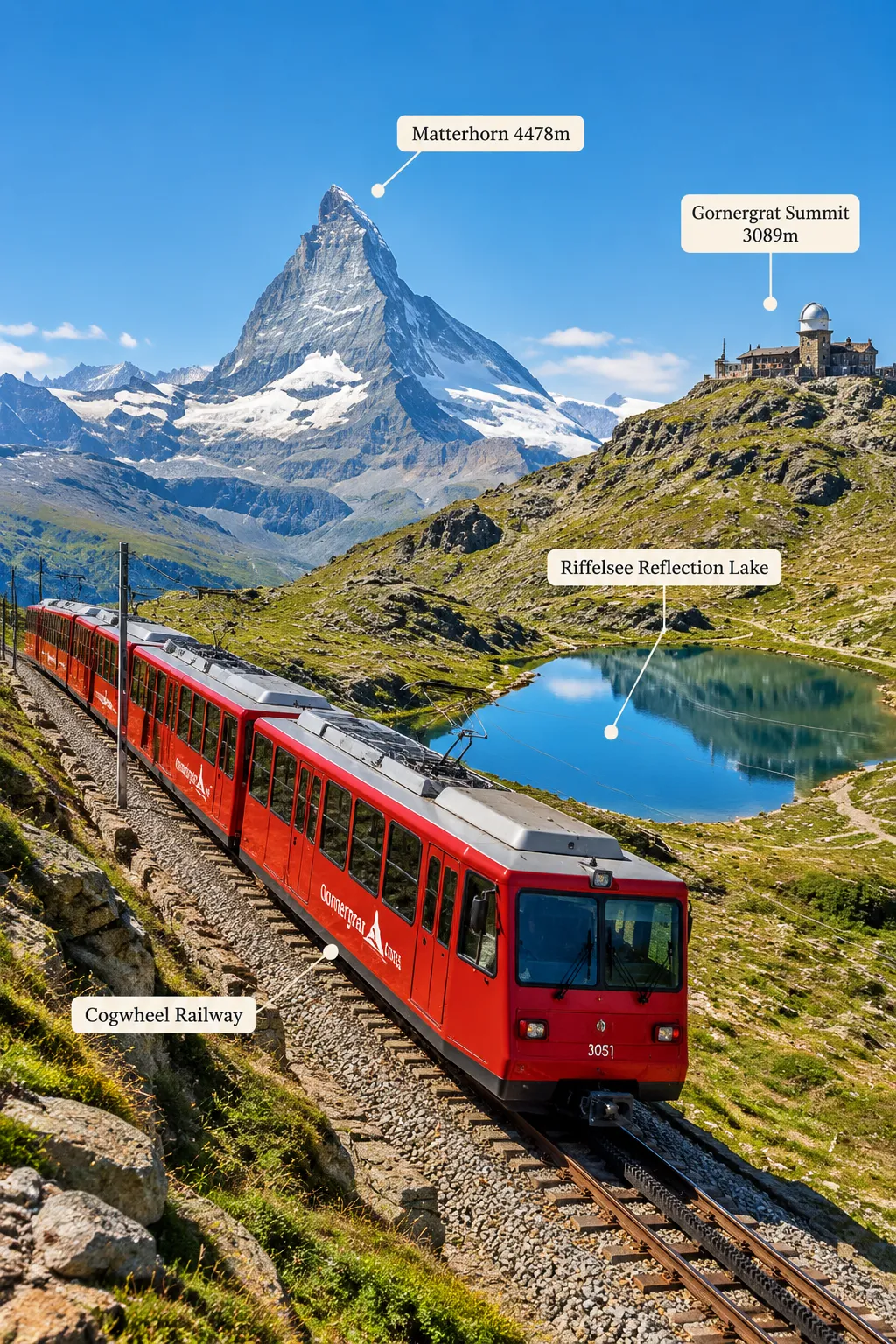
Start your day at the Gornergrat Railway station, just a short walk from Zermatt’s main train station. The cogwheel train runs from Zermatt at 1,604 m up to Gornergrat at 3,089 m – a ride of about 33 minutes each way.
Why go early:
- Morning light hits the Matterhorn from the east, creating the most dramatic photography conditions
- Fewer crowds at the summit before 10:00 AM
- Weather in the Alps is typically clearest before noon
At the top, you get a jaw-dropping 360-degree panorama. The Matterhorn stands at 4,478 m and looks close enough to touch. On a clear day you can also see the Monte Rosa massif and the vast Gorner glacier below.
Don’t miss the Riffelsee – a small alpine lake about 20 minutes downhill from Gornergrat summit (near Rotenboden station). On calm mornings, it reflects the Matterhorn perfectly. This is one of the most photographed spots in all of Switzerland. The Gornergrat Scenic Trail to Rotenboden takes about 30-45 minutes and is easy walking on a well-marked path.
Make Your Way to Matterhorn Glacier Paradise (11:30 AM-2:00 PM)
Matterhorn Glacier Paradise sits at 3,883 m – the highest cable car station in the Alps – and it takes roughly 40 minutes each way from Zermatt via a series of cable cars. This is the place to see the glacier up close, walk through the ice palace carved inside the glacier itself, and get a view that genuinely stops people in their tracks.
The route goes: Zermatt – Furi – Trockener Steg – Klein Matterhorn (Matterhorn Glacier Paradise). Each segment is a separate cable car, and the full journey takes about 40 minutes from the valley station.
At Matterhorn Glacier Paradise:
- Walk through the Glacier Palace – an ice cave with sculptures carved inside the glacier
- Step onto the viewing platform for a panorama stretching into Italy and France
- Grab a quick lunch at the summit restaurant – the views from the terrace are worth the Swiss prices
Trockenersteg is the mid-station worth a brief stop on the way back down. It sits at 2,939 m and offers a different angle on the Matterhorn and the surrounding glacier terrain.
Schwarzsee and the ZERMATT Sign (2:00-4:00 PM)
On the way back down from Glacier Paradise, stop at Schwarzsee (2,583 m). This small alpine lake has a tiny chapel beside it and sits directly below the Matterhorn’s north face – the view here is arguably more dramatic than from the summit stations because you’re looking straight up at the peak.
The famous ZERMATT sign – large wooden letters spelling out the town’s name – is located near the village and is a classic photo stop. It’s the kind of thing that feels touristy but you’ll be glad you did it.
Zermatt Town: What to See in the Village
Zermatt town itself deserves at least 1.5-2 hours, and it’s best explored in the late afternoon when the mountain light turns golden. The town is compact, car-free, and genuinely beautiful – not just a ski resort but a real Swiss mountain village with centuries of history.
Top spots in Zermatt town:
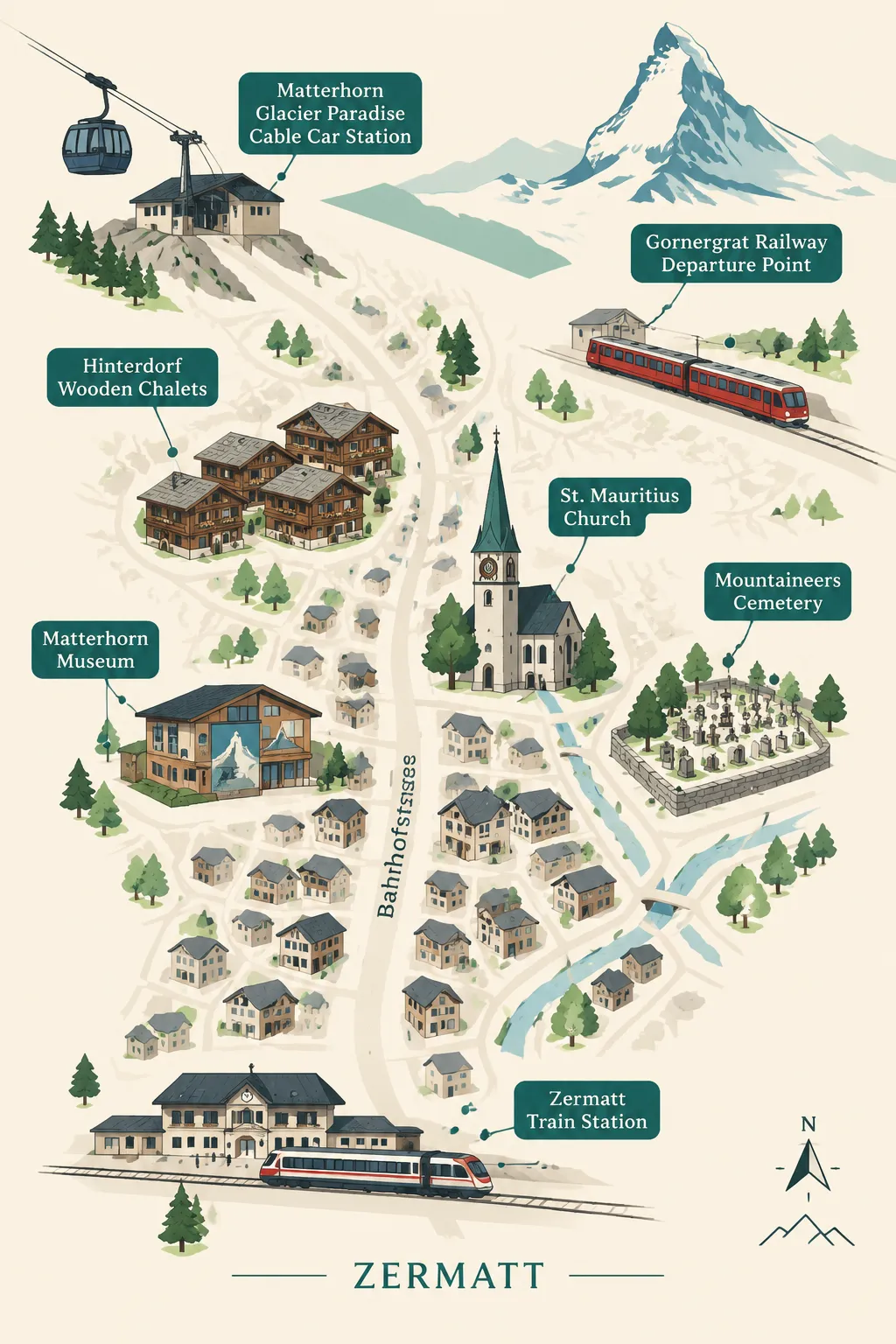
- Hinterdorf – the oldest part of Zermatt, with traditional wooden chalets called Mazots (raised on stone mushrooms to keep out rodents). This is the most photogenic street in town.
- St. Mauritius Church – the main village church, dating back centuries, with a peaceful churchyard
- Mountaineers’ Cemetery – a sobering and moving memorial to climbers who died on the Matterhorn and surrounding peaks, including the famous 1865 first ascent tragedy
- Matterhorn Museum (Zermatlantis) – an underground museum telling the story of Zermatt’s mountaineering history. Budget about 45-60 minutes here.
- Bahnhofstrasse – the main shopping street, lined with Swiss watch shops, outdoor gear stores, and bakeries
The Matterhorn Museum is particularly recommended for anyone interested in the history of alpinism in Europe. It’s well-designed and genuinely engaging even for non-climbers.
Best Hikes in Zermatt for One Day
If you’d rather hike than take cable cars all day, Zermatt has trails for every fitness level. The most popular single-day hike is the Five Lakes Walk (Fünf-Seenweg), a 9.5 km loop that passes five alpine lakes, each reflecting the Matterhorn from a different angle.
Top hike options for one day:
| Hike | Distance | Difficulty | Best For |
|---|---|---|---|
| Five Lakes Walk | 9.5 km | Moderate | Photographers, summer visitors |
| Gornergrat to Riffelberg | 5 km | Easy-Moderate | First-timers, families |
| Schwarzsee to Zermatt | 8 km | Moderate | Non-skiers, wildflower season |
| Sunnegga to Findeln | 4 km | Easy | Leisurely walkers |
The Gornergrat to Riffelberg trail is especially recommended for first-time visitors because it combines the railway experience with a downhill walk that passes Riffelsee and ends at Riffelberg station, from where you can take the train back down.
Summer hiking note: July to September is peak season for open trails. Snow can linger on higher paths well into June, so check conditions before setting out.
Is One Day Enough for Zermatt? Honest Answer
One full day is the minimum to get a real taste of Zermatt, but it’s genuinely enough to see the highlights if you plan well. The honest answer is: one day in Zermatt is satisfying but you will leave wanting more.
Here’s the reality check:
- One day = Gornergrat OR Glacier Paradise (not comfortably both) + village walk
- Two days = Gornergrat AND Glacier Paradise + hiking + village properly
- Three days = All of the above + day trips, Five Lakes Walk, and a relaxed pace
Several 2026 travel experts note that trying to squeeze both Gornergrat and Glacier Paradise into a single day is possible but leaves you feeling rushed. If you only have one day, pick the one that excites you most and do it properly.
Choose Gornergrat if: You want the classic Matterhorn panorama, prefer a train ride, and want to hike down via Riffelsee.
Choose Glacier Paradise if: You want to see an actual glacier up close, stand at 3,883 m, and walk through an ice palace.
For a related adventure in the Swiss Alps region, check out our 3-day Glacier National Park itinerary for tips on making the most of alpine landscapes in a short time.
Zermatt Day Trip from Geneva or Zurich: Is It Worth It?
A day trip to Zermatt from Geneva or Zurich is possible but comes with real trade-offs. From Zurich, the train journey is about 3.5 hours each way, leaving roughly 4-5 hours in Zermatt. From Geneva, it’s about 3 hours each way via Visp.
The math on a day trip:
- Depart Zurich at 6:30 AM – arrive Zermatt around 10:00 AM
- Leave Zermatt by 15:00-16:00 to catch the last comfortable connection
- That gives you 5 hours maximum in Zermatt
Five hours is enough for Gornergrat (with the train ride and 1 hour at the summit) and a quick village walk. It is NOT enough for both Gornergrat and Glacier Paradise.
Day trip from Interlaken or Grindelwald is slightly shorter in travel time but still involves 2.5+ hours each way. Visiting Zermatt as a day trip from Grindelwald is a popular move for travelers doing a Switzerland loop – both towns sit in the same mountain region but have very different characters.
The official Zermatt tourism maps portal – which launched new features in July 2026 – now offers real-time route planning and trail conditions, making it much easier to optimize a short visit with up-to-date information.
Zermatt One Day Budget: How Much Does It Cost?
A realistic one-day budget in Zermatt runs CHF 150-250+ per person, depending on which mountain excursion you choose and where you eat. Switzerland is not cheap, and Zermatt is one of Switzerland’s pricier destinations.
Key costs to plan for:
- Gornergrat Railway return ticket: approximately CHF 80-90 per adult
- Matterhorn Glacier Paradise return cable car: approximately CHF 90-100 per adult
- Lunch at altitude: CHF 20-35 for a basic meal
- Dinner in Zermatt town: CHF 30-60 per person at a mid-range restaurant
- Matterhorn Museum entry: approximately CHF 10-12 per adult
If you’re doing a day trip from Zurich or Geneva, add CHF 60-120 for the return train fare (Swiss Travel Pass holders ride free on most routes).
Budget tip: The Zermatt area offers combination tickets that bundle multiple cable car segments at a discount. Check the Zermatt Bergbahnen website before you visit to see current multi-day or multi-route passes.
Zermatt Weather and What to Pack for One Day
Mountain weather in Zermatt can change fast, even in summer. The Matterhorn creates its own micro-weather patterns and clouds can roll in by early afternoon on many days. Packing smart is essential for a one-day visit.
What to pack for one day in Zermatt:
- 🧥 Warm layer – even in July, temperatures at 3,883 m can drop below freezing
- 🌧️ Waterproof jacket – afternoon showers are common in summer
- 🥾 Sturdy walking shoes – trail runners or light hiking boots for the Riffelsee path
- 🕶️ Sunglasses and sunscreen – UV exposure at altitude is intense
- 💧 Water bottle – stays hydrated at altitude
- 📱 Offline maps – signal can be patchy on the mountain trails
Seasonal guide:
- July-September: Best overall. Clear skies most mornings, trails fully open, Riffelsee accessible
- December-March: Ideal for skiing. Glacier Paradise is stunning in snow. Dress very warmly.
- April-June: Shoulder season. Some trails still snowy. Fewer crowds, lower prices.
- October-November: Quieter but unpredictable weather. Some cable cars close for maintenance.
For a complete packing checklist for European mountain travel, our travel essential list covers everything you need.
Where to Eat and Stay in Zermatt
Zermatt has excellent dining options ranging from casual mountain huts to fine dining with Matterhorn views. For a one-day visit, the best strategy is a quick lunch at altitude and a proper dinner in town.
Top dining picks:
- Whymper-Stube: Classic Swiss fondue and raclette in a cozy setting named after Edward Whymper, who made the first Matterhorn ascent
- Brown Cow Pub: Casual, good value, popular with skiers and hikers
- Restaurant Findlerhof: Perched above the village with panoramic Matterhorn views – book ahead
- Brasserie Lusi: Mid-range Swiss and international menu, reliable quality
Where to stay for one night:
- Budget: Zermatt Youth Hostel (book well ahead in summer)
- Mid-range: Hotel Simi, Hotel Rhodania
- Splurge: Mont Cervin Palace, The Omnia
Staying overnight in Zermatt – even just one night – makes the whole trip feel less rushed and lets you catch the Matterhorn at golden hour, which is worth the extra cost.
Zermatt Day Trips and Tours Worth Knowing About
Beyond the self-guided approach, Zermatt offers several organized tours that work well for a one-day visit. These are especially useful if you’re visiting Zermatt for the first time and want a guide to handle the logistics.
Popular tour options:
- Guided Gornergrat + Riffelsee walk: A half-day guided hike from the summit down to Rotenboden and Riffelberg, with a naturalist guide explaining the glacier and alpine ecosystem
- Photography tours: Early morning guided tours focused on capturing the Matterhorn at sunrise from Riffelsee and other key viewpoints
- E-bike tours of Zermatt valley: Good for covering more ground in the valley without the altitude
- Matterhorn Museum guided visit: Available in English, German, and French
For those visiting Zermatt as part of a broader Switzerland trip, Switzerland’s official tour portal has up-to-date listings of licensed guides and organized excursions.
If you enjoy mountain scenery and are planning a broader European trip, our guide to things to do in Positano, Italy covers another stunning European destination worth adding to your itinerary.
FAQ: People Also Ask About One Day in Zermatt
Is it worth going to Zermatt for a day?
Yes, one day in Zermatt is absolutely worth it. Even a single day gives you access to world-class mountain views, the iconic Matterhorn, and a genuinely charming car-free Swiss village. The key is arriving early and prioritizing one major mountain excursion – either Gornergrat or Matterhorn Glacier Paradise – rather than trying to rush both into the same day.
What movie was filmed in Zermatt?
Several films and TV productions have used Zermatt and the Matterhorn as a backdrop. Most notably, scenes from the James Bond film “On Her Majesty’s Secret Service” (1969) were filmed in the Zermatt area, using the surrounding Swiss Alps for dramatic alpine sequences. The region’s iconic Matterhorn pyramid and glacier scenery make it a natural choice for filmmakers seeking dramatic mountain settings.
How many hours do you need in Zermatt?
You need a minimum of 6-8 hours to see Zermatt’s highlights properly. That allows time for one major mountain excursion (Gornergrat or Matterhorn Glacier Paradise), the Riffelsee lake viewpoint, and a walk through Zermatt town including the Hinterdorf chalets and Matterhorn Museum. Two full days is the recommended minimum to see both mountain areas without feeling rushed.
Which is more beautiful, Grindelwald or Zermatt?
Both are stunning, but they offer different experiences. Zermatt has the Matterhorn – one of the world’s most recognizable mountain shapes – and the highest cable car in the Alps at Glacier Paradise. Grindelwald sits below the Eiger’s north face and has the Jungfraujoch “Top of Europe” railway. Most travelers say Zermatt edges ahead for sheer iconic impact, but Grindelwald is arguably more accessible and less expensive for a day trip.
Conclusion: Make the Most of Your One Day in Zermatt
One day in Zermatt is a tight but very doable adventure – and with the right plan, it’s one of the best single days you can spend anywhere in Europe. The formula is simple: start early at Gornergrat, catch the Matterhorn reflection in Riffelsee, head up to Glacier Paradise for the glacier experience, and wind down with a slow walk through Zermatt town before dinner.
Your action steps before you go:
- Book trains in advance – SBB tickets sell out, especially in July and August
- Check the weather forecast – clear mornings are not guaranteed; have a backup plan
- Buy cable car tickets online – skip the queues at Zermatt Bergbahnen’s website
- Pack warm layers – even on a warm summer day, Glacier Paradise is cold
- Arrive the night before if at all possible – it turns a rushed day trip into a genuinely great trip
Zermatt is one of those places that earns every superlative thrown at it. The Matterhorn really is that dramatic. The glacier really is that impressive. And the town really is that charming. One day gives you a taste – but we’d bet you’ll be planning your return before you even get back on the train.
For more European travel inspiration, check out our guides to best things to do in Paris and things to do in Fira, Santorini for more iconic destinations worth your travel days.