
Last updated: September 26, 2026
Quick Answer: A well-stocked emergency bag for travel should include personal prescription medications, basic first-aid supplies, symptom-relief medicines, hygiene essentials, and key documents. Pack it before every trip – not after something goes wrong. Most travelers can fit everything into a compact pouch that slides inside a carry-on.
Key Takeaways
- Your emergency bag for travel is not the same as a basic first aid kit – it includes medications, documents, and hygiene items too.
- Always carry enough prescription medication for your full trip, plus a few extra days for delays.
- Core supplies include bandages, antiseptic wipes, a thermometer, tweezers, and gauze pads.
- Insect repellent with DEET (30-50%) and broad-spectrum sunscreen (SPF 30+) belong in every travel kit.
- A compact pouch under 1 liter fits most essentials and passes TSA screening without issues.
- Keep copies of prescriptions, your medical summary, and insurance info inside the bag.
- Replace expired items every 6-12 months, or after each trip where you used supplies.
- Traveling with kids requires child-specific dosing and a few extra items.
What Should I Actually Put in an Emergency Travel Bag?
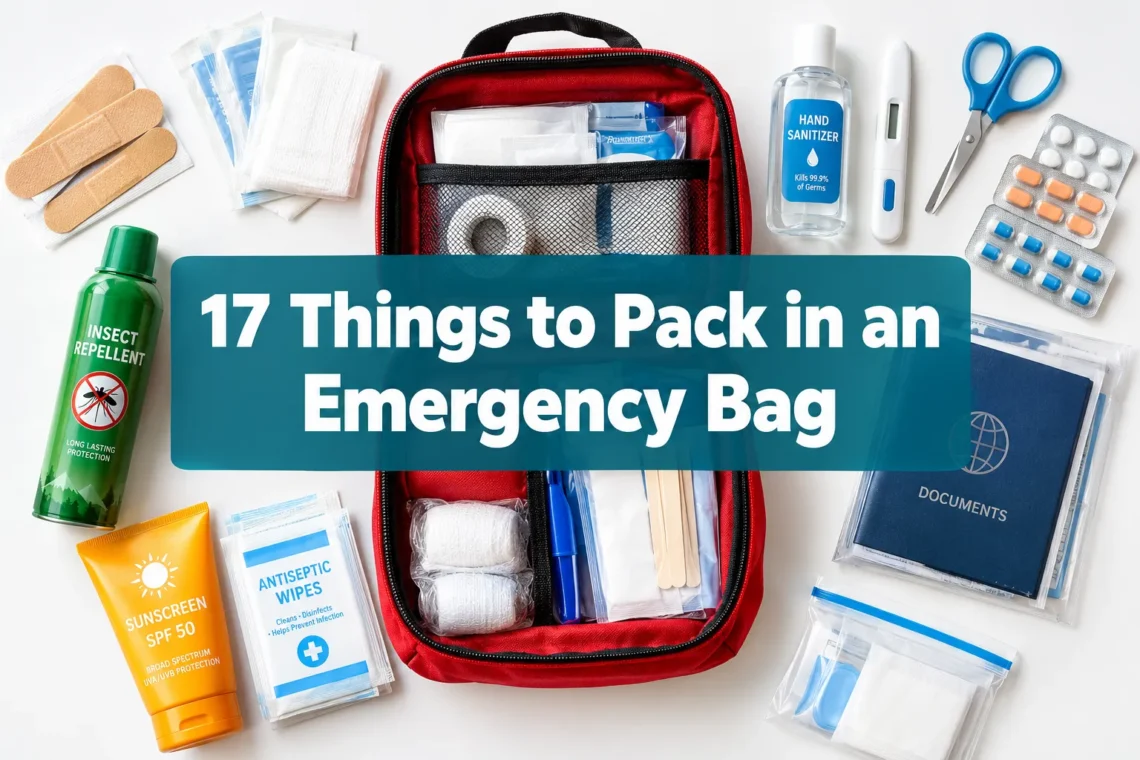
The 17 essentials that belong in every emergency bag for travel cover four categories: medications, wound care, tools, and documents. Here’s the full list, grouped so you can pack it in under 10 minutes.
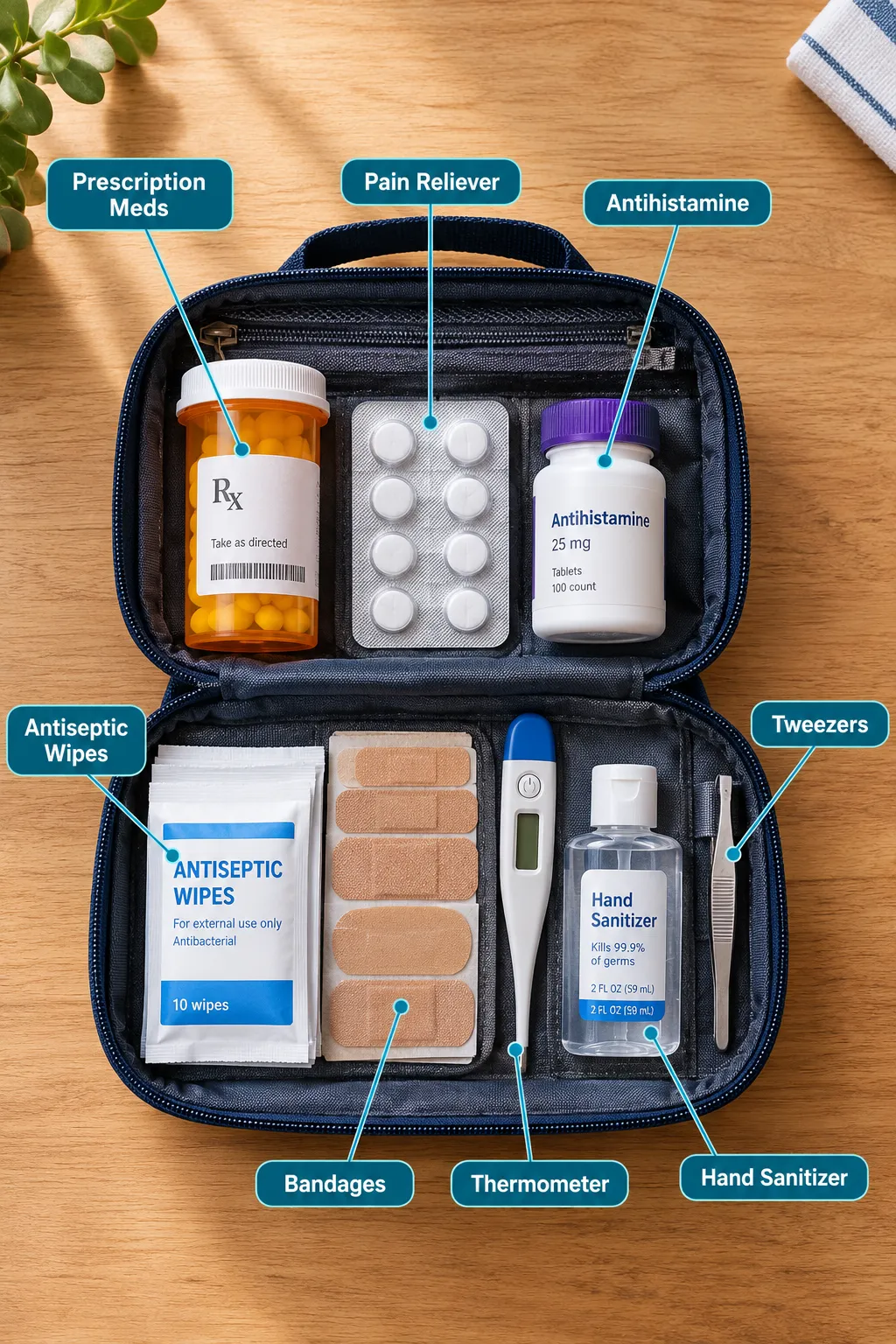
Medications (Items 1-5)
1. Personal prescription medications
This is non-negotiable. Pack enough for the entire trip plus 2-3 extra days in case of delays. Keep them in original labeled containers. According to CDC travel health guidance, travelers should also carry a written medical summary with diagnoses, medication names (including generic names), dosages, and known allergies.
2. Pain reliever
Acetaminophen or ibuprofen covers headaches, fever, and muscle pain. Pick one you’ve used before – don’t experiment abroad.
3. Antihistamine
Useful for allergic reactions, bug bites, and even mild hay fever. A non-drowsy formula works well during the day.
4. GI medications
Pack an antacid, an anti-diarrheal (like loperamide), and an anti-nausea medicine. These three cover the most common travel stomach complaints. Hopkins Medicine’s traveler first aid guidance lists all three as standard kit items.
5. Motion sickness medicine
Even if you’ve never had motion sickness, a winding mountain road or rough ferry crossing can surprise you.
Wound Care (Items 6-10)
6. Assorted adhesive bandages
Pack a range of sizes. Small ones for blisters, larger ones for cuts.
7. Sterile gauze pads
For covering larger wounds or applying pressure. The Red Cross travel first aid checklist includes these as a core item.
8. Medical tape
Holds gauze in place and can secure a makeshift splint in a pinch.
9. Antiseptic wipes or solution
Clean a wound before bandaging it. This single step prevents most minor infections from becoming serious.
10. Elastic (compression) bandage
Useful for sprains, especially on hiking or active trips.
Tools (Items 11-14)
11. Fine-tipped tweezers
For splinters, thorns, and tick removal. The Cleveland Clinic’s travel first aid kit list specifically recommends fine-tipped tweezers as a must-have tool.
12. Small scissors
Cut tape, gauze, or clothing in an emergency.
13. Thermometer
A digital one takes up almost no space and tells you quickly whether a fever needs medical attention.
14. Disposable nitrile gloves
Protect yourself and others when treating wounds. Latex-free is safer for everyone.
Hygiene and Protection (Items 15-17)
15. Hand sanitizer and antibacterial wipes
Use alcohol-based sanitizer with at least 60% alcohol. Travel health guidance updated in 2026 now treats hand hygiene products as a core kit item, not an optional extra.
16. Insect repellent
Choose a formula with 30-50% DEET or up to 15% picaridin. Essential for tropical destinations, camping, and anywhere mosquitoes are active.
17. Sunscreen
Broad-spectrum SPF 30 or higher with UVA/UVB protection. A small 3 oz (88 ml) tube fits in your carry-on liquids bag.
Emergency Bag for Travel vs. Regular First Aid Kit – What’s the Difference?
A regular first aid kit covers wound care only – bandages, gauze, tape. An emergency bag for travel goes further: it includes personal medications, symptom-relief drugs, hygiene supplies, and critical documents.
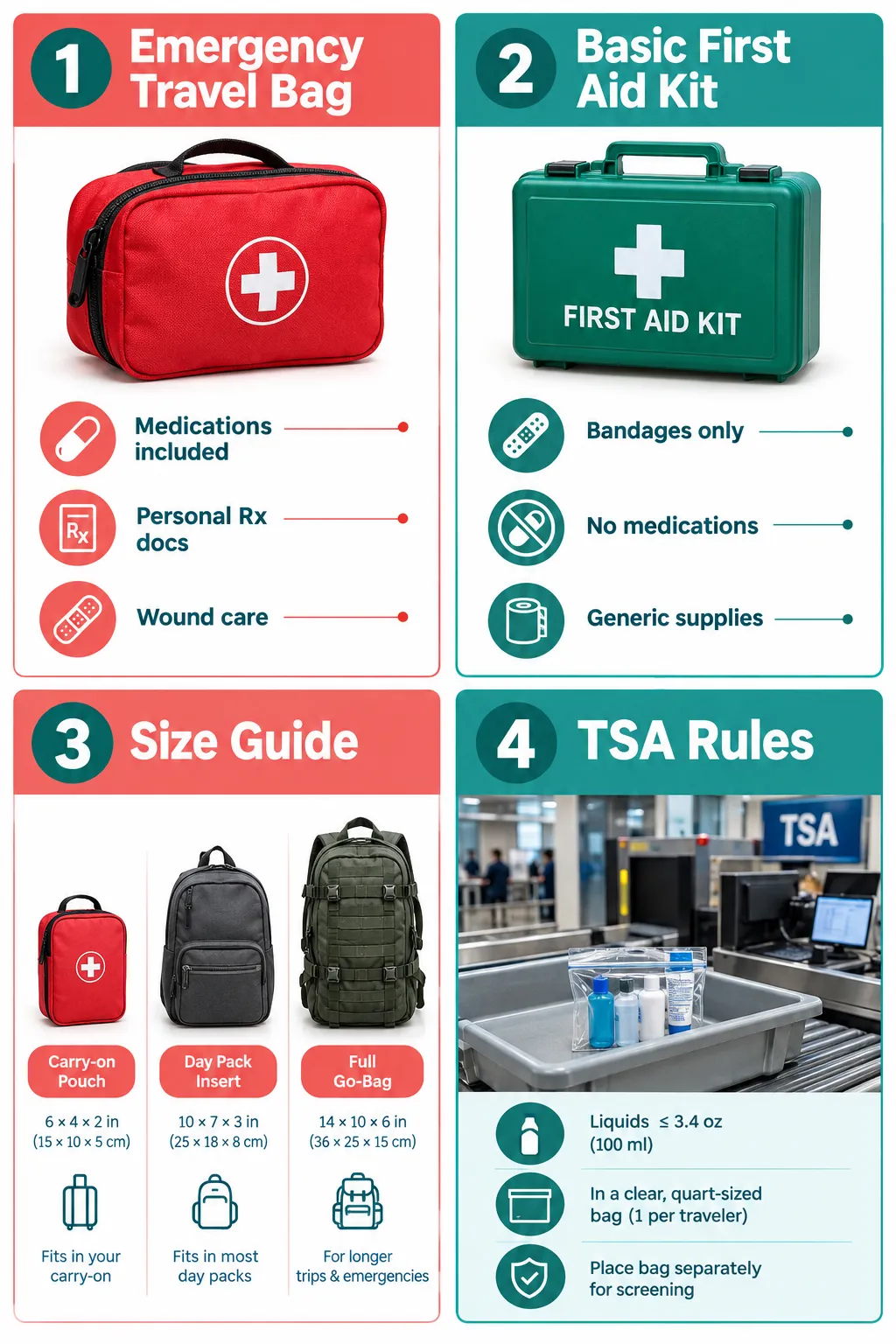
Think of it this way: a basic first aid kit handles a cut finger. A travel emergency bag handles a cut finger, a stomach bug, an allergic reaction, a fever, a lost prescription, and a delayed flight – all in the same trip.
The American College of Emergency Physicians frames the travel kit as a personalized health resource, not just a box of bandages.
How Big Should an Emergency Travel Bag Be?
Most travelers can fit everything they need into a 0.5-1 liter clear or zippered pouch. That’s roughly the size of a large pencil case.
A few sizing rules that work well:
- Carry-on only trips: A small clear toiletry pouch (about 20 x 15 cm) fits all 17 items if you use travel-size products.
- Week-long trips: A dedicated 1-liter first aid pouch with internal pockets keeps things organized.
- Extended travel or family trips: A 2-liter soft-sided bag gives room for extra supplies without adding much weight.
Don’t overpack. A bag you can’t find things in quickly is a problem during a real emergency.
For tips on fitting everything into your luggage efficiently, see how to pack a suitcase efficiently.
Can You Bring an Emergency Bag Through Airport Security?
Yes, with a few standard rules. Liquids (sanitizer, antiseptic solution, sunscreen) must follow the TSA 3-1-1 rule: containers of 3.4 oz (100 ml) or less, all in one clear quart-sized bag.
Prescription medications are exempt from the 3-1-1 liquid rule but should be in original labeled containers. Declare them separately at the security bin if needed.
Scissors with blades under 4 inches are allowed in carry-on bags. Tweezers are always fine. Thermometers (digital) are fine too.
Common mistake: Packing a full-size bottle of antiseptic or hand sanitizer. Decant into a travel-size bottle before you leave home.
Emergency Bag Essentials for International Travel
International travel adds a few items to the standard list. The CDC Yellow Book on travel health kits recommends that international travelers also carry:
- A written medical summary (diagnoses, medications, allergies) in English and ideally the local language
- Copies of all prescriptions with generic drug names
- Proof of travel health insurance and emergency contact numbers
- Consular contact information for your home country
- Water purification tablets or a portable filter for destinations with unreliable water
For destinations with high mosquito activity – like parts of Southeast Asia, Central America, or sub-Saharan Africa – add an N95 mask for air quality issues and oral rehydration salts for dehydration from heat or illness.
Planning a trip to a specific destination? Check out our Morocco travel guide for first timers or the Vietnam travel guide for hidden gems for destination-specific health considerations.
Do I Need an Emergency Bag If I Have Travel Insurance?
Yes. Travel insurance covers costs – it doesn’t hand you a thermometer at 2am in a rural village.
Insurance reimburses you after the fact. Your emergency bag handles the situation in real time. They solve different problems.
That said, your bag should include your insurance policy number, the 24-hour emergency assistance number, and your next-of-kin contact details. If you’re incapacitated, medical providers need that information fast.
How to Pack an Emergency Travel Bag So It Doesn’t Take Up Luggage Space
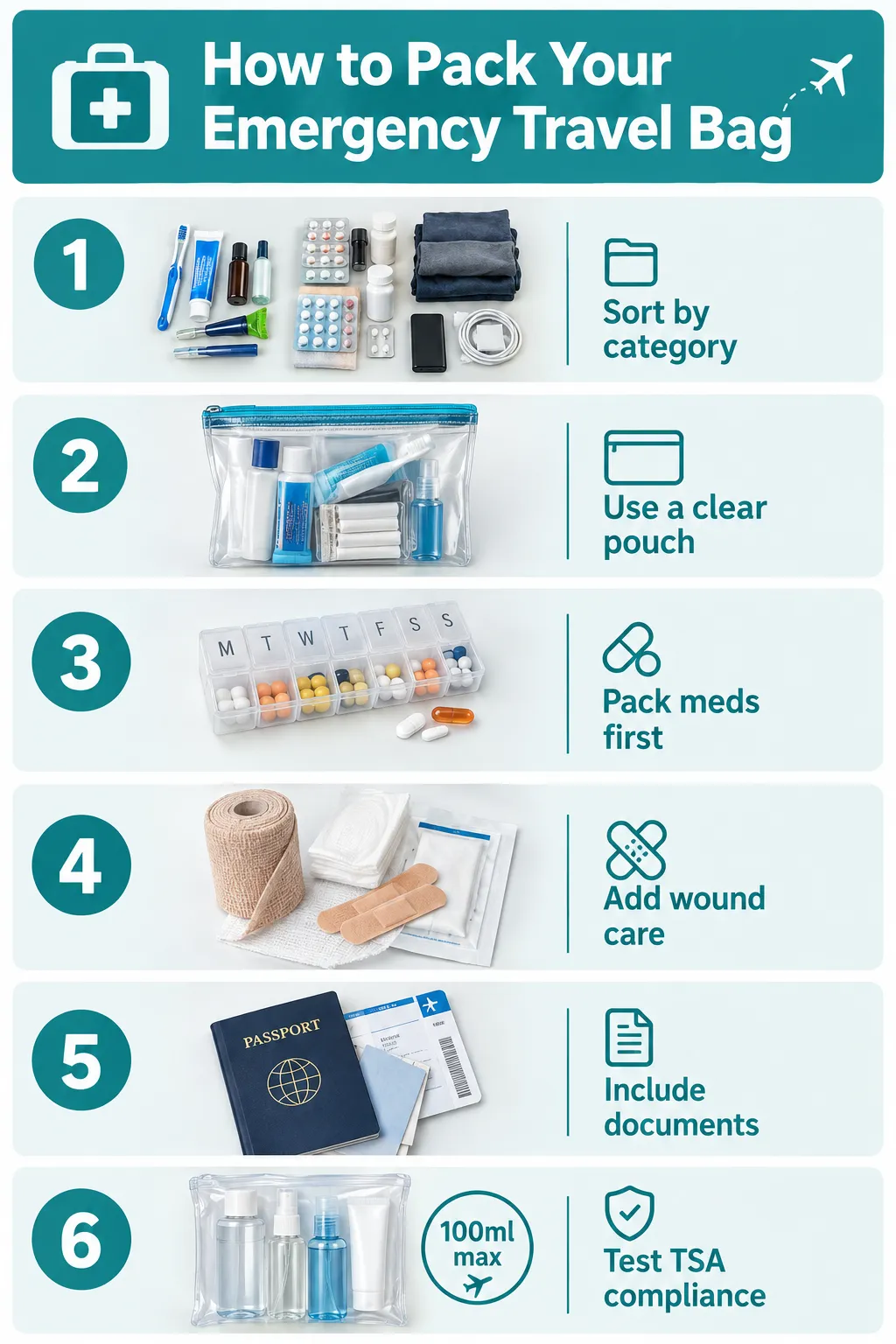
Pack smart and you’ll barely notice it’s there. Here’s a system that works:
- Use a clear pouch – You can see everything without digging.
- Buy travel-size versions – Most pharmacies sell 30-50 ml versions of antiseptic, sanitizer, and sunscreen.
- Use a pill organizer – Consolidate loose medications instead of carrying full boxes.
- Fold documents flat – A folded A5 card with your medical summary takes zero space.
- Pack it last, access it first – Store it in the top pocket of your carry-on or day bag.
Also check the only travel essential list you’ll ever need for a broader packing framework that fits your emergency bag into the bigger picture.
What Medications Should Be in a Travel Emergency Bag?
According to Atlantic Health’s first aid kit guidance and DAN’s travel medical kit resource, the core medication list for travelers includes:
| Category | What to Pack |
|---|---|
| Pain and fever | Acetaminophen or ibuprofen |
| Allergy | Antihistamine (e.g., cetirizine, loratadine) |
| Stomach | Antacid, loperamide, anti-nausea tablet |
| Motion sickness | Dimenhydrinate or meclizine |
| Prescription | All regular medications + extras |
| Topical | Antiseptic cream or spray |
Always check whether any of your medications require a doctor’s letter for international travel. Some countries restrict certain drugs that are common elsewhere.
Emergency Bag for Travel With Kids – What to Include
A family emergency bag for travel needs a few key additions beyond the adult list.
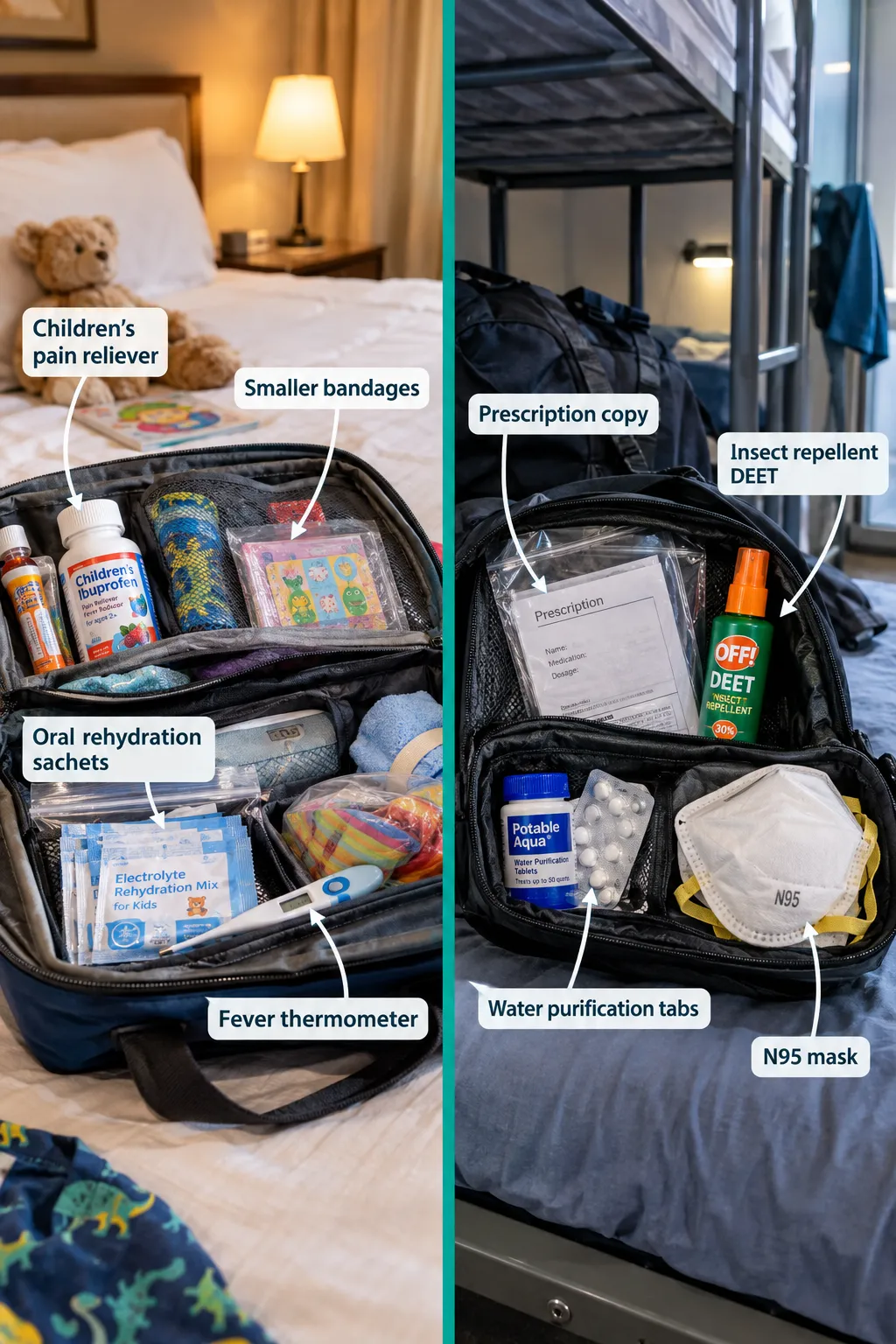
Add these for traveling with children:
- Children’s pain reliever and fever reducer – Acetaminophen or ibuprofen in the correct pediatric dose for your child’s weight
- Oral rehydration sachets – Kids dehydrate faster than adults from diarrhea or vomiting
- Smaller bandage sizes – Standard adult bandages don’t work well on small fingers
- Children’s antihistamine – In liquid or chewable form if your child can’t swallow tablets
- Digital ear thermometer – Faster and easier with young children
Keep medications clearly labeled with your child’s name and dosage. If you’re traveling to a theme park destination like Disney, our Disney World travel tips guide has useful notes on managing kids’ health on busy days.
Emergency Bag for Road Trips vs. Flying – Key Differences
For road trips, you have more space and fewer restrictions. You can carry full-size bottles, a larger first aid kit, and extras like a flashlight, spare batteries, a whistle, and a basic tool (wrench or pliers) – all recommended by Ready.gov’s emergency kit guidance.
For flying, you’re working within carry-on limits and TSA rules. Focus on the compact 17-item list and use travel-size products.
Road trip additions worth considering:
- Flashlight and spare batteries
- Whistle (for signaling in remote areas)
- Water purification tablets
- Emergency blanket
- Basic multi-tool
If you’re planning a long road trip, our Amtrak train travel tips also covers useful ground for longer overland journeys.
How Often Should I Replace Items in My Travel Emergency Bag?
Check your bag every 6-12 months and after every trip where you used something. Key things to watch:
- Medications: Check expiry dates before every trip. Expired drugs lose potency.
- Bandages and gauze: Replace if packaging is torn or they’ve been exposed to moisture.
- Antiseptic wipes: These dry out over time even in sealed packets.
- Sunscreen: Most sunscreens are effective for 2-3 years from manufacture date.
- Hand sanitizer: Alcohol evaporates over time – replace if the bottle has been open for more than a year.
A quick 5-minute check before each trip takes care of this completely.
Where to Buy Pre-Made Emergency Travel Bags
Pre-made travel first aid kits are widely available and a good starting point. Look for them at:
- Pharmacies (CVS, Walgreens, Boots) – basic kits from around $10-20
- Outdoor retailers (REI, Decathlon) – more comprehensive kits designed for travel
- Amazon – search “travel first aid kit” for a range of options
- Travel health clinics – some sell personalized kits when you visit for vaccines
The limitation with pre-made kits: they don’t include your personal medications or documents. Use a pre-made kit as your wound-care and tools base, then add your personal medications and paperwork on top.
FAQ
What’s the most important item in a travel emergency bag?
Your personal prescription medications. Running out of a daily medication abroad is harder to fix than any other emergency kit gap.
Can I carry a travel emergency bag in my carry-on?
Yes. Keep liquids under 3.4 oz (100 ml) and in a clear quart bag. Medications in original containers are allowed beyond the liquid limit.
Do I need a doctor’s note for my travel emergency bag?
Not usually for domestic travel. For international trips, carry a signed letter from your doctor listing all prescription medications, especially for controlled substances or injectable drugs.
What’s the best bag to use for a travel emergency kit?
A clear, zippered pouch with internal pockets. Transparent material means you can find things fast. A bright color (red, orange) helps you spot it quickly in your luggage.
Should I pack a first aid manual?
A small laminated quick-reference card is more practical than a full manual. Many first aid apps also work offline.
Is insect repellent really necessary for all destinations?
No – skip it for urban trips in low-risk climates. But for tropical, rural, or outdoor-heavy destinations, it’s one of the most important items in the bag.
What’s the minimum I need for a weekend city trip?
Pain reliever, antihistamine, a few bandages, antiseptic wipes, hand sanitizer, your prescription medications, and a copy of your insurance details. That covers 90% of weekend emergencies.
How do I handle medications that need refrigeration while traveling?
Use an insulated travel medication case with a small ice pack. Check with your airline about carrying gel packs – most allow them.
Can I buy a travel emergency bag pre-assembled?
Yes. Pre-made kits are a good base, but always add your personal medications, documents, and any destination-specific items like insect repellent or altitude sickness tablets.
What documents should I keep in my emergency travel bag?
A written medical summary, copies of all prescriptions, travel insurance policy number and emergency contact, next-of-kin details, and your accommodation address.
Conclusion
A solid emergency bag for travel doesn’t need to be heavy, expensive, or complicated. The 17 items in this list fit into a pouch the size of a pencil case and cover the vast majority of health situations travelers actually face.
Your next steps:
- Download or print this list and check what you already have at home.
- Buy any gaps – most items cost under $5 each.
- Pack your medications first, then wound care, then tools.
- Add your medical summary and insurance details on a folded card.
- Check expiry dates before every trip.
The best time to build your emergency travel kit is right now – not at the airport, not in a foreign pharmacy at midnight. Pack it once, refresh it regularly, and travel with real confidence.
For a broader look at what to bring on your next trip, see the only travel essential list you’ll ever need.