
Last updated: August 25, 2026
Quick Answer: A 3-day Redwood National Park itinerary covers the best of all four parks – Redwood National Park plus Del Norte Coast, Jedediah Smith, and Prairie Creek Redwoods State Parks. Start in the north near Crescent City, work south to Orick, and mix short hikes with scenic drives. Entry is free, but a few key spots require advance permits.
Key Takeaways
- 🌲 Three days is the sweet spot for seeing the major highlights without rushing
- 🗺️ The park system spans roughly 60 miles of Northern California coastline
- 💰 Entry to all four parks is free in 2026 – but budget for gas, food, and lodging
- 🚗 You’ll need a car; public transit doesn’t reach most trailheads
- 📅 September and October offer the best balance of good weather and fewer crowds
- 🥾 Most iconic stops involve short, easy walks – great for families and beginners
- 🌫️ Summer mornings are foggy and cool; bring layers even in July
- 🏕️ Book campsites or lodging in Crescent City or Arcata at least 2-3 months ahead for summer
- 🎟️ Tall Trees Grove requires a free permit – get it at the Thomas H. Kuchel Visitor Center
- 📵 Cell service is patchy throughout the park – download offline maps before you go
Your Day-by-Day Redwood National Park Itinerary
A solid Redwood National Park itinerary divides the route geographically from north to south across three days. This structure keeps driving time manageable and lets you experience the range of ecosystems – from old-growth groves to dramatic coastal bluffs.
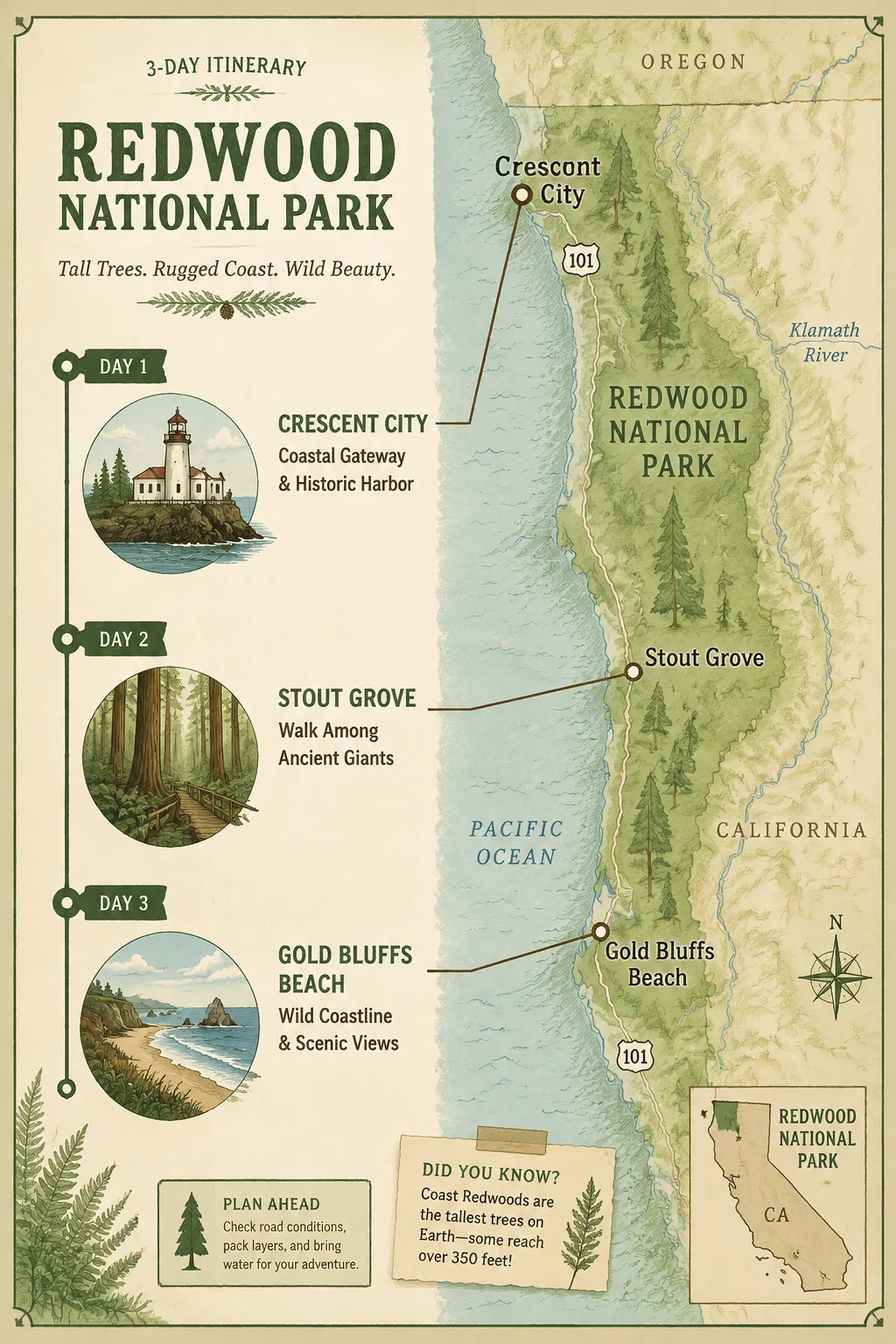
Day 1 – Crescent City and the Northern Groves
Start at: Jedediah Smith Redwoods State Park
Stop 1: Stout Memorial Grove
This is one of the most awe-inspiring old-growth groves in the entire park system. The trees here are massive – some over 300 feet tall. The walk from the parking area is flat and short (about 0.5 miles), making it accessible for almost everyone. According to experienced Redwood visitors and travel planners, Stout Grove is consistently ranked as a must-see first stop.
Stop 2: Howland Hill Road
This unpaved, 10-mile scenic drive winds through old-growth forest so dense it feels like a tunnel. It’s narrow – not suitable for RVs or large trailers – but standard cars handle it fine. Allow 45-60 minutes to drive slowly and stop for photos.
Stop 3: Battery Point Lighthouse (Crescent City)
End the afternoon in Crescent City. The Battery Point Lighthouse sits on a small island you can walk to at low tide. It’s a great way to stretch your legs and catch a coastal sunset. Check tide tables before you go – access is only possible during low tide.
Day 2 – Prairie Creek and the Coastal Trail
Stop 4: Fern Canyon
Fern Canyon is worth every bit of hype. Five-to-seven-story walls draped in five-spot fern create a scene that feels prehistoric. The loop is about 1 mile. Travel guides consistently highlight Fern Canyon as one of the top experiences in the entire park system. Wear waterproof shoes – you’ll cross a shallow creek multiple times.
Stop 5: Gold Bluffs Beach
Right next to Fern Canyon, this wild stretch of beach sits below golden bluffs with elk often grazing nearby. It’s free to access and rarely crowded. Spend 30-45 minutes here before heading south.
Stop 6: Prairie Creek Redwoods – Newton B. Drury Scenic Parkway
This 10-mile paved drive through Prairie Creek Redwoods State Park is one of the best scenic drives in California. You’ll pass through dense old-growth forest with pullouts for short walks. Itinerary planners consistently include this drive as a Day 2 anchor because it’s both easy and spectacular.
Stop 7: Elk Prairie
Roosevelt elk are frequently spotted in the meadow at Elk Prairie, especially in early morning and late afternoon. Keep a respectful distance – these animals are large and wild. The visitor center here is small but helpful.
Day 3 – Southern Redwood National Park Itinerary Highlights
Stop 8: Thomas H. Kuchel Visitor Center
Start Day 3 here to pick up your free permit for Tall Trees Grove. The staff can also give you current trail and road conditions. This stop takes about 20 minutes and is genuinely useful.
Stop 9: Tall Trees Grove
This grove contains some of the tallest trees ever measured on Earth. Access requires a free permit and a 4-mile round-trip hike. It’s worth every step. Detailed Redwood itineraries consistently flag this as the most rewarding hike in the park for those willing to put in the effort.
Stop 10: Lady Bird Johnson Grove
A 1.4-mile loop through a stunning old-growth grove, dedicated in 1969. It’s paved, well-maintained, and one of the most accessible old-growth experiences in the park. Great for families or anyone with limited mobility.
Stop 11: Redwood Creek Overlook
End your trip with a sweeping view of the Redwood Creek watershed. The short walk to the overlook takes about 10 minutes from the parking area. It’s a quiet, reflective way to close out three days in the forest.
What’s the Best Time of Year to Visit Redwood National Park?
September and October are the best months for most visitors. Crowds thin out after Labor Day, temperatures are mild (55-70°F), and the fog that blankets the coast in summer starts to lift. Seasonal planning guides for the Redwoods confirm fall as the sweet spot for weather and accessibility.
Summer (June-August) is peak season. Expect foggy, cool mornings and busy parking lots, especially at Fern Canyon and Lady Bird Johnson Grove.
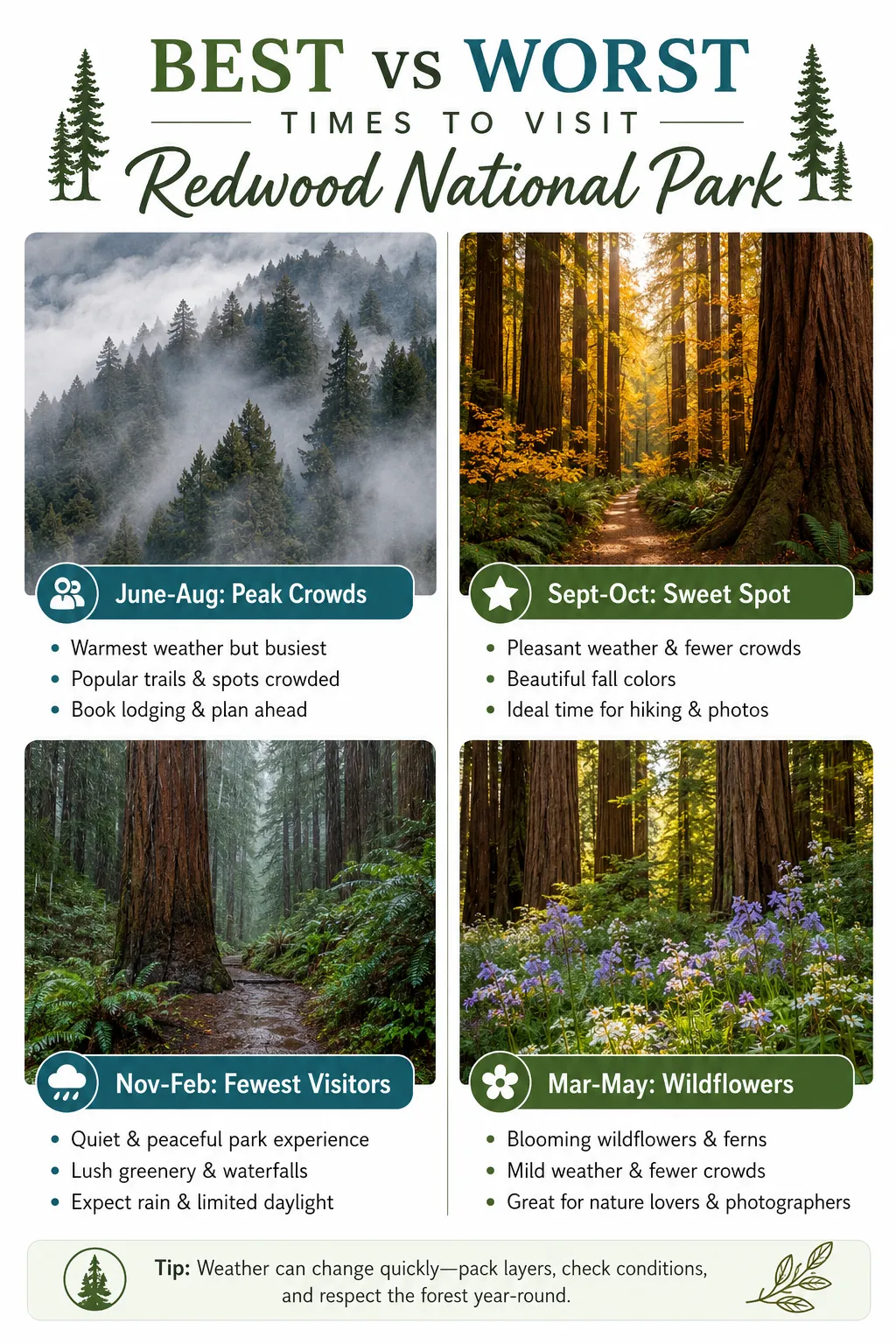
Winter brings heavy rain and occasional road closures, but also the fewest crowds. Spring (March-May) offers wildflowers and green ferns at their most vibrant.
How Long Does It Take to Drive Through Redwood National Park?
The park spans roughly 60 miles from north to south along Highway 101. A straight drive without stops takes about 1.5 hours. But stopping at the main sites adds significant time – realistically, you need 3 full days to cover the highlights without rushing.
If you’re short on time, the Newton B. Drury Scenic Parkway and Fern Canyon can be done in a single long day from Eureka or Crescent City.
Can You Do Redwood National Park in 2 Days Instead of 3?
Yes, two days is doable if you’re strategic. Drop Tall Trees Grove (which requires a permit and a longer hike) and focus on Fern Canyon, Stout Grove, Newton B. Drury Scenic Parkway, and Lady Bird Johnson Grove. Two-day Redwood itineraries typically prioritize these four stops as the non-negotiable core.
Three days is still the recommended minimum if this is your first visit. The extra day lets you slow down and actually absorb the scale of the trees.
Is Redwood National Park Worth Visiting Compared to Other California Parks?
Redwood National Park offers something no other California park does – ancient coastal redwoods, the tallest trees on Earth. It’s less crowded than Yosemite and more accessible than many Sierra Nevada parks. If you’ve already done a Yosemite National Park 1-day itinerary, Redwood feels completely different – quieter, greener, and more primal.
The combination of old-growth forest, wild coastline, and Roosevelt elk makes it genuinely unique. It’s worth the detour even if you’re on a broader California 10-day road trip.
How Much Does It Cost to Visit Redwood National Park?
Entry to all four parks in the Redwood National and State Parks complex is free in 2026. No entrance fee, no day-use fee for most areas.
Costs to budget for:
- Camping: $35-$55/night at developed campgrounds (reserve through ReserveCalifornia)
- Lodging in Crescent City or Arcata: $100-$200/night depending on season
- Gas: the route covers roughly 100-150 miles of driving over 3 days
- Food: limited options inside the park – stock up in Crescent City or Arcata
- Tall Trees Grove permit: free, but requires a trip to the visitor center
The park is genuinely one of the most affordable major national park experiences in the U.S.
What’s the Difference Between Redwood National Park and the State Parks?
Redwood National Park is managed by the National Park Service. The three state parks – Del Norte Coast, Jedediah Smith, and Prairie Creek Redwoods – are managed by California State Parks. All four are jointly managed and often referred to together as Redwood National and State Parks (RNSP).
In practice, the distinction matters mainly for camping reservations (state parks use ReserveCalifornia; national park areas use Recreation.gov). Planning resources for the full RNSP system explain the joint management structure clearly.
Best Hiking Trails in Redwood National Park for Beginners
These trails are short, well-marked, and don’t require technical gear.
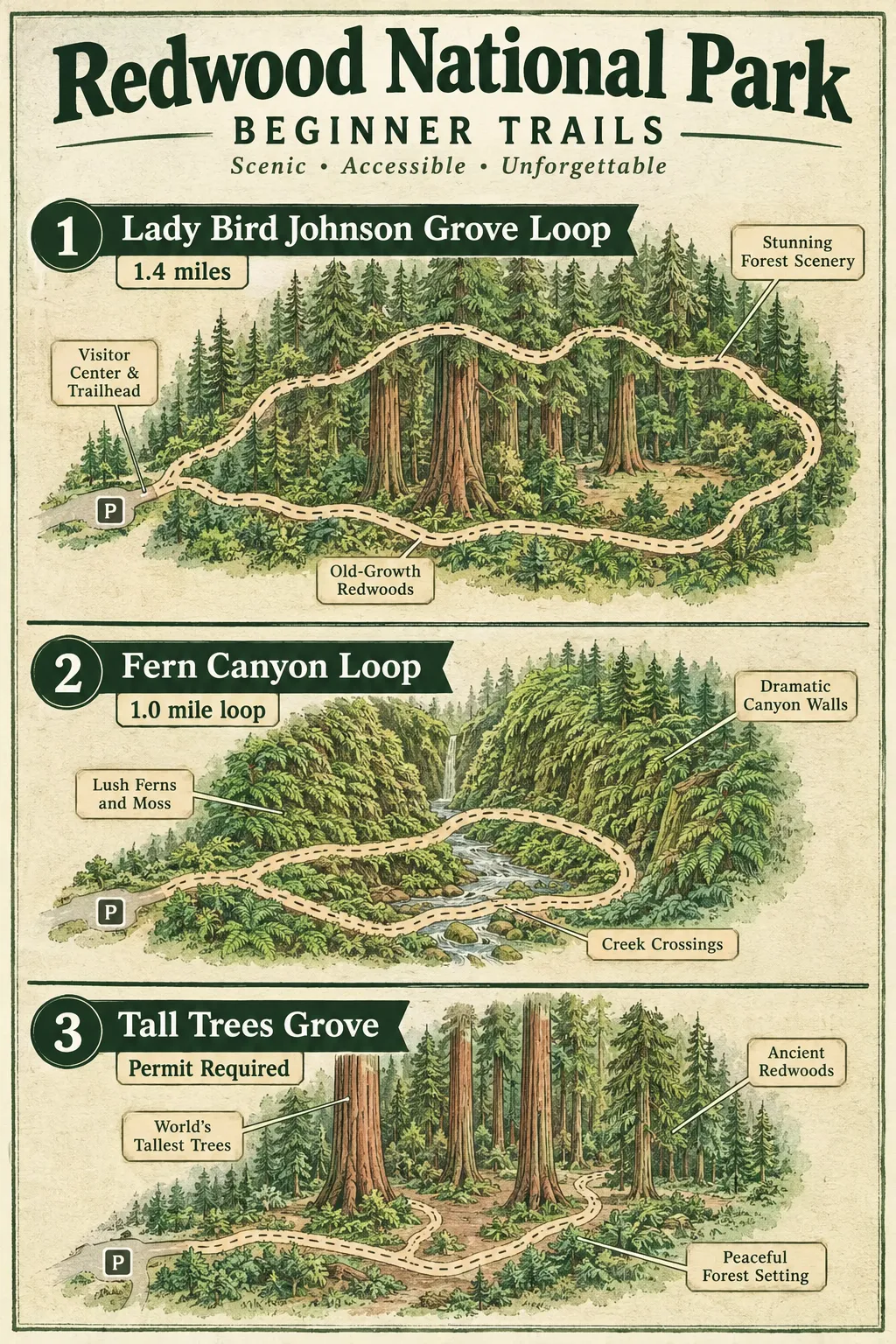
| Trail | Distance | Difficulty | Highlight |
|---|---|---|---|
| Lady Bird Johnson Grove Loop | 1.4 miles | Easy | Old-growth grove, paved path |
| Fern Canyon Loop | 1.0 mile | Easy-Moderate | Fern-covered canyon walls |
| Stout Memorial Grove | 0.5 miles | Easy | Massive old-growth trees |
| Boy Scout Tree Trail | 5.6 miles | Moderate | Secluded, rarely crowded |
| Tall Trees Grove | 4.0 miles RT | Moderate | Tallest trees, permit required |
Most of these trails are suitable for kids and older adults. Fern Canyon involves creek crossings – wear waterproof shoes.
What Should I Pack for Redwood National Park?
Pack for cool, damp conditions even in summer. The coast stays in the 50s-60s°F most mornings.
Packing essentials:
- Waterproof hiking shoes or boots
- Rain jacket or windbreaker (even in July)
- Layers – temperatures shift quickly between forest and coast
- Water bottle – fill up at visitor centers
- Snacks and a packed lunch (food options inside the park are very limited)
- Offline maps downloaded to your phone (Google Maps or AllTrails work)
- Insect repellent for creek areas
- Sunscreen for coastal sections
Is Redwood National Park Good for Families with Kids?
Yes – Redwood is one of the best national parks for families. Most of the iconic stops involve short, flat walks that kids handle easily. The Roosevelt elk at Elk Prairie are a genuine highlight for children. Fern Canyon feels like a movie set (it was used in Jurassic Park 2), which kids love.
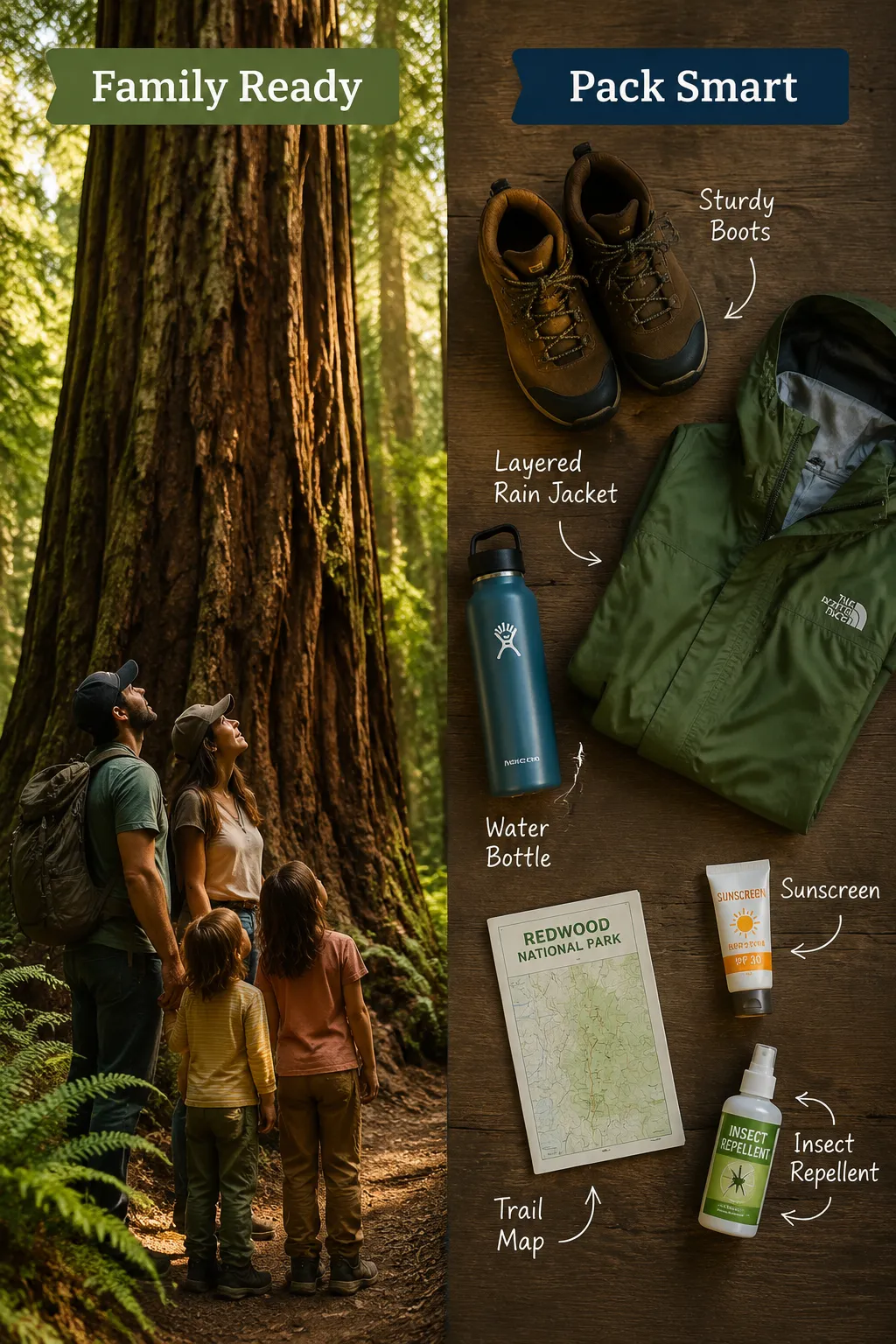
For a family-friendly Redwood National Park itinerary, prioritize Lady Bird Johnson Grove, Fern Canyon, Gold Bluffs Beach, and Elk Prairie. Skip Tall Trees Grove with young kids – the 4-mile hike is long for little legs.
If you enjoy planning national park trips with family, check out our 3-day Glacier National Park itinerary for another great option.
What Roads Are Closed and How Crowded Is It in Summer?
Road conditions change seasonally. Howland Hill Road (unpaved) and some coastal access roads close after heavy rain or storm damage. Always check the official NPS Redwood conditions page before your trip.
Summer is the busiest season. Fern Canyon parking fills by 9am on weekends in July and August. Arrive early (before 8am) or visit on a weekday. The Newton B. Drury Scenic Parkway and Lady Bird Johnson Grove are less congested but still busy midday.
Can You See Old-Growth Redwoods Without Hiking?
Yes. Several spots let you experience old-growth trees from your car or with minimal walking.
- Howland Hill Road – a slow scenic drive through dense old-growth
- Newton B. Drury Scenic Parkway – paved, 10 miles, multiple pullouts
- Stout Memorial Grove – 0.5-mile flat walk from parking
- Big Tree Wayside – a single massive tree just steps from the parking area on Newton B. Drury Scenic Parkway
These options are ideal for visitors with mobility limitations or very young children.
What’s the Closest Town for Food and Gas?
Crescent City is the main service hub for the northern section of the park. It has grocery stores, gas stations, restaurants, and motels. It’s about 9 miles from Jedediah Smith Redwoods State Park.
Orick is a small town near the southern end of the park with very limited services – one or two small markets and a gas station.
Arcata and Eureka (about 45 miles south of Orick) are the best options for a wider range of restaurants, grocery stores, and lodging if you’re based in the south.
Stock up before entering the park. Don’t count on finding food or fuel inside park boundaries.
FAQ
Do I need a reservation to visit Redwood National Park?
No reservation is needed for day use. Camping requires advance booking through ReserveCalifornia (state parks) or Recreation.gov (national park campgrounds). Book 2-3 months ahead for summer.
Is there cell service in Redwood National Park?
Cell service is limited and unreliable throughout most of the park. Download offline maps and trail guides before you arrive.
Can I bring my dog to Redwood National Park?
Dogs are allowed in parking areas, campgrounds, and on paved roads, but not on most trails. They must be on a leash at all times.
What is the closest airport to Redwood National Park?
Arcata-Eureka Airport (ACV) is the closest regional airport, about 45 miles south of Orick. San Francisco (SFO) is roughly 6 hours south by car.
Are there bears in Redwood National Park?
Yes, black bears live in the park. Use bear canisters or bear boxes for food storage at campsites. Don’t leave food in your car overnight.
How do I get the Tall Trees Grove permit?
Pick up a free permit in person at the Thomas H. Kuchel Visitor Center near Orick. Permits are limited and issued on a first-come, first-served basis each day.
Is the park accessible for wheelchair users?
Several areas are accessible, including Lady Bird Johnson Grove (paved path), Big Tree Wayside, and most visitor centers. Fern Canyon and Tall Trees Grove are not wheelchair accessible.
Can I see the ocean from Redwood National Park?
Yes. Gold Bluffs Beach, Crescent Beach, and the Coastal Trail all offer direct ocean access and views.
Conclusion
Three days in Redwood National Park gives you enough time to experience the full range of what makes this place extraordinary – ancient groves, wild coastline, elk in open meadows, and fern-draped canyons.
Actionable next steps:
- Book your campsite or lodging now – summer fills up fast
- Download offline maps and the AllTrails app before you leave home
- Check road conditions at the NPS Redwood website 48 hours before arrival
- Pick up your Tall Trees Grove permit first thing on Day 3
- Pack layers and waterproof shoes regardless of the forecast
If you love road trip planning, our 3-day Glacier National Park itinerary and one-day Yellowstone guide are worth bookmarking for your next adventure. And if you’re building a longer California trip, the California 10-day road trip itinerary pairs naturally with a Redwood visit.
The trees have been here for over 2,000 years. They’ll put everything else in perspective.