
Last updated: August 25, 2026
Quick Answer: The best Mount Rainier National Park itinerary for first-timers focuses on the Longmire-Paradise corridor, covering Narada Falls, Christine Falls, Myrtle Falls, the Henry M. Jackson Visitor Center, Skyline Trail, Reflection Lakes, and the Longmire Historic District. Plan for 2-3 days. As of August 2026, the Sunrise and White River areas are closed due to the Grand Park 2 Fire, so all itineraries should route through the Nisqually and Stevens Canyon entrances instead.
Key Takeaways
- 🏔️ 2-3 days is the sweet spot for a first visit, with Day 1 focused on Paradise
- 🚫 Sunrise area is fully closed as of August 2026 due to the Grand Park 2 Fire – check NPS alerts before you go
- 🌸 Late July through mid-September is peak wildflower and best-weather season
- 💵 Entry fee is $35 per vehicle (7-day pass); America the Beautiful Pass covers it
- 🥾 No permit needed for day hikes on most popular trails, including Skyline Trail
- 🚗 You cannot drive to the summit – the road ends at Paradise (5,400 ft elevation)
- 📍 The 9 stops below are all accessible from the Longmire-Paradise-Stevens Canyon route
- 🌡️ August highs average around 74°F at lower elevations; bring layers for Paradise
- 🌲 Grove of the Patriarchs remains closed due to flood damage – no reopening date yet
- 📷 Best photography windows are early morning (7-9 AM) at Reflection Lakes and Myrtle Falls
What Is the Best Time of Year to Visit Mount Rainier?
Late July through mid-September is the best window for a first visit. The wildflowers are at peak bloom, Paradise Road is fully open, and you get the longest daylight hours for hiking. Snow can linger at Paradise well into July, so arriving before mid-July risks closed trails.
- July 15 – September 15: Peak season, all major trails open, wildflowers blooming
- June: Some trails still snow-covered above 5,000 ft; call ahead
- October: Crowds thin but early snow is possible; some facilities close
- Winter (Nov-April): Roads close above Longmire; snowshoe access only
August 2026 weather shows typical highs in the mid-60s to mid-80s°F at lower elevations, with lows in the low-40s°F. Freezing levels sit around 12,500-14,500 ft. Expect occasional afternoon showers even in summer – this is the Pacific Northwest.
Pro tip: Start hikes before 9 AM. Afternoon clouds and smoke (during fire season) can obscure the summit by midday.
How Many Days Do I Need at Mount Rainier National Park?
Two to three days is ideal for a first-time visitor. One day is doable but rushed. Three days lets you explore Paradise thoroughly, spend time at Longmire, and add a second hike without feeling like you’re sprinting between stops.
According to multiple expert trip-planning guides for Mount Rainier, a 2-day structure works like this:
- Day 1: Longmire historic district, Christine Falls, Narada Falls, Paradise (Jackson Visitor Center, Myrtle Falls, Skyline Trail)
- Day 2: Reflection Lakes, Stevens Canyon Road viewpoints, Mowich Lake or Carbon River area (currently accessible)
If you only have one day, prioritize the Paradise corridor without question.
Mount Rainier National Park Entrance Fees and Passes
The standard entrance fee is $35 per vehicle for a 7-day pass (as of 2026, per NPS). Motorcycles pay $30. Individuals entering on foot or bike pay $20.
The America the Beautiful Annual Pass ($80) covers entry to all federal recreation sites and pays for itself in 3 visits. If you’re also planning a 3-day Glacier National Park itinerary or a one-day Yellowstone adventure on the same trip, the annual pass is a no-brainer.
- Passes are available at all entrance stations and online at recreation.gov
- No timed-entry reservations are currently required for day visitors (verify before your trip)
- Camping reservations are separate and book up fast – reserve 6+ months ahead for summer
The 9-Stop Mount Rainier National Park Itinerary I’d Follow
This route runs from the Nisqually entrance up to Paradise, then loops back via Stevens Canyon. It’s the most efficient path for first-timers and covers the highest concentration of iconic stops in a single day or spread across two.
Stop 1 – Longmire Historic District
Enter through the Nisqually entrance and your first stop is Longmire. It’s a 6-mile drive from the gate and sets the tone for the whole trip.
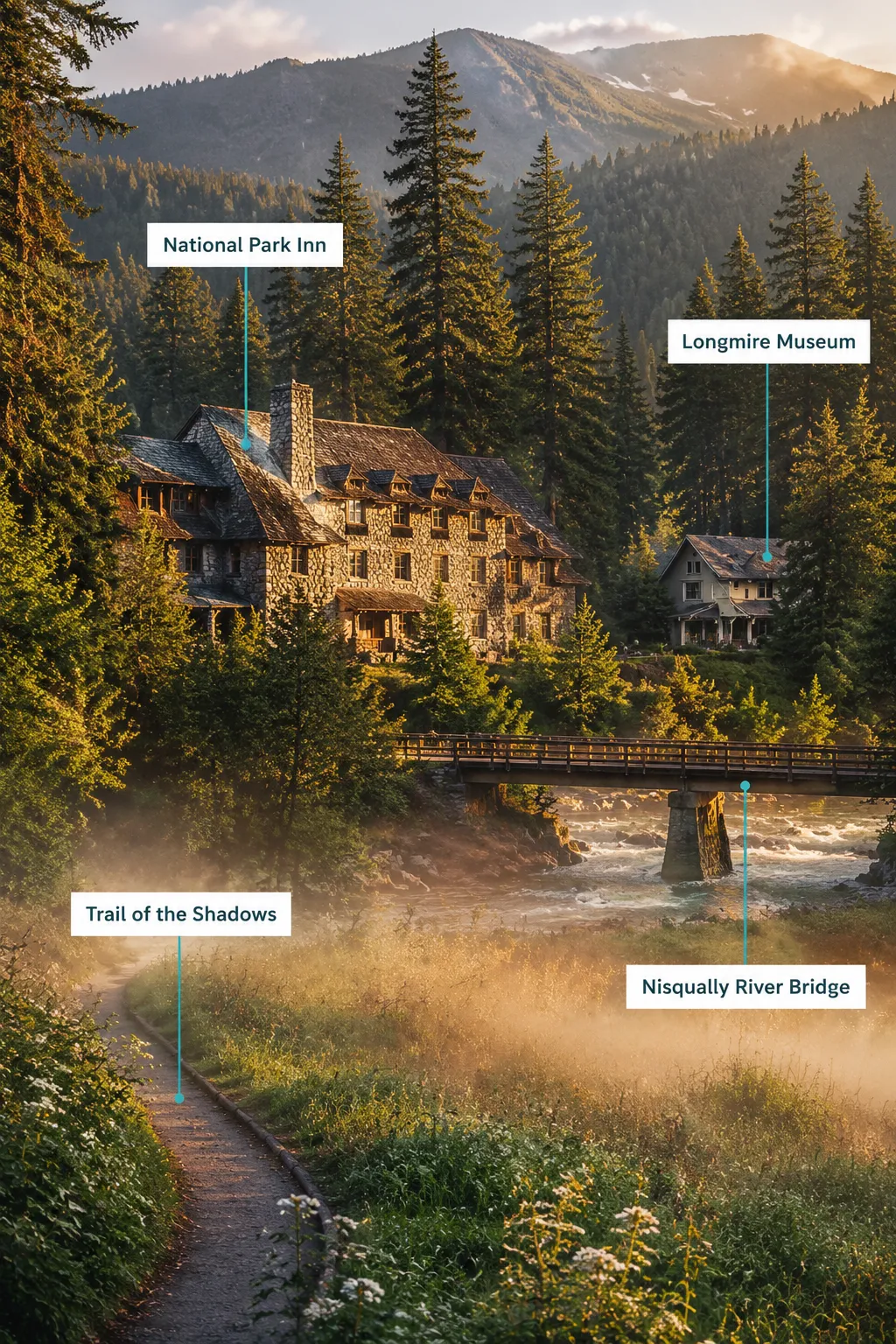
Walk the Trail of the Shadows (0.7-mile loop) around the meadow and mineral springs. It’s flat, easy, and genuinely beautiful. The Longmire area is a recommended gateway stop for context on the park’s history, with the Longmire Museum and the historic National Park Inn right there.
Grab coffee, use the restrooms, and check the ranger board for any same-day trail closures.
Stop 2 – Christine Falls
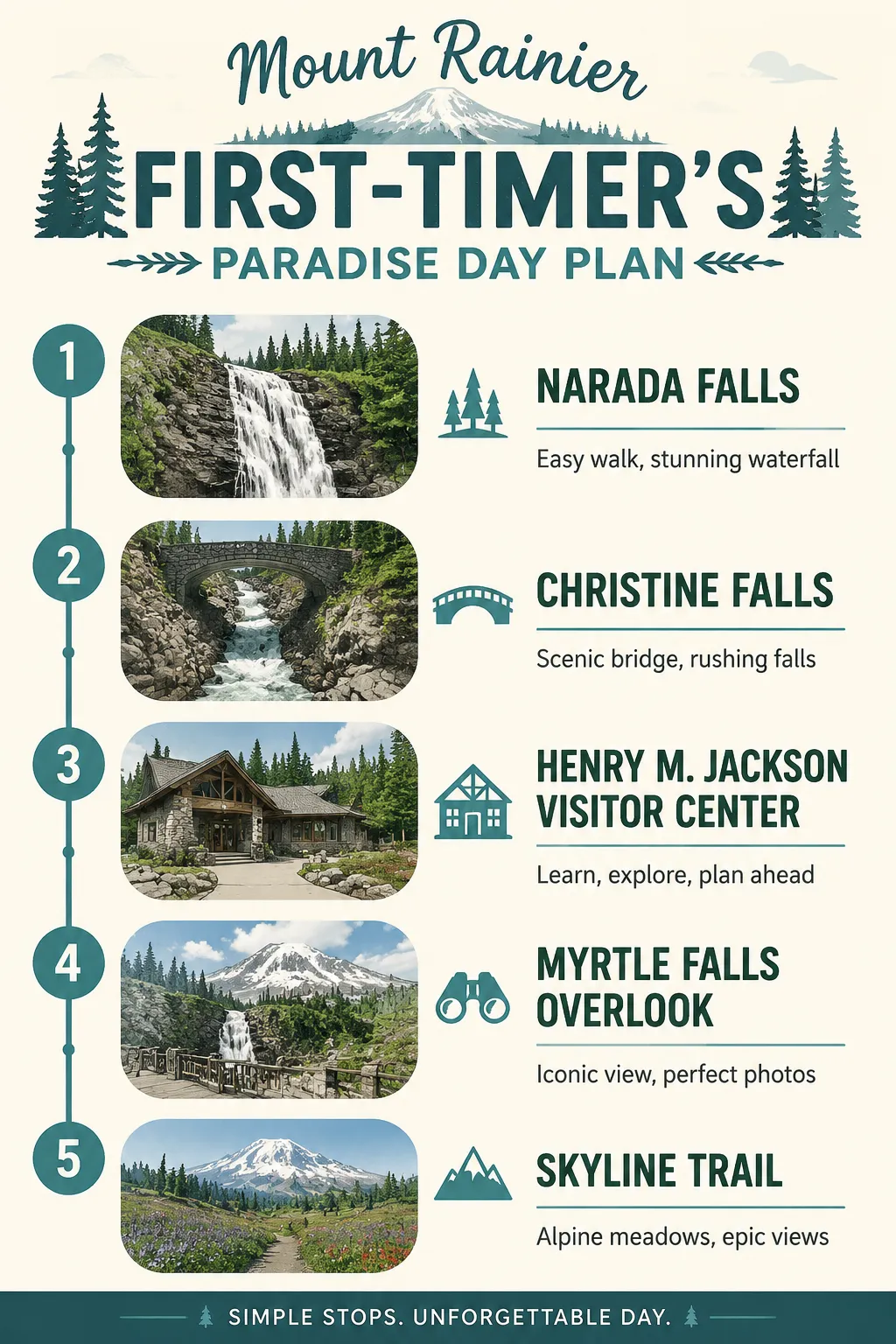
About 9 miles past Longmire on the road to Paradise, Christine Falls sits right next to the road. Pull into the small lot and walk 2 minutes to the stone arch bridge overlook.
It’s one of the most photogenic spots in the park – a two-tiered waterfall framed by a hand-built stone bridge. Takes 10 minutes total. Don’t skip it.
Stop 3 – Narada Falls
Just 1.5 miles further up the road, Narada Falls drops 168 feet into a misty pool. The short trail from the parking lot takes about 5 minutes. Narada Falls consistently ranks as a top highlight for first-time visitors because the scale surprises people – it’s much bigger than it looks from the road.
Early morning light hits this one perfectly.
Stop 4 – Henry M. Jackson Visitor Center (Paradise)
The visitor center at Paradise (elevation 5,400 ft) is the heart of any solid Mount Rainier itinerary. It has exhibits, ranger talks, a cafe, and the best panoramic views of the mountain from the building itself.
Spend 20-30 minutes here before heading out on the trails. Rangers post updated trail conditions daily – ask about snow on Skyline if you’re visiting before August.
Stop 5 – Myrtle Falls
From the visitor center, it’s a 0.4-mile walk to Myrtle Falls – one of the most photographed spots in the entire park. The falls frame perfectly with Mount Rainier in the background on a clear day.
This stop is consistently included in expert first-trip itineraries because it delivers a huge payoff for minimal effort. Go early to avoid crowds at the overlook.
Stop 6 – Skyline Trail to Panorama Point
This is the marquee hike of any first-timer’s Paradise day. The full Skyline Trail loop is 5.5 miles with 1,400 ft of elevation gain – rated moderate. If that’s too much, hike to Panorama Point (4.5 miles round trip) and turn back. The views from Panorama Point are genuinely stunning.
The Skyline Trail is the recommended signature hike for first-time Paradise visitors and is currently open (as of August 2026). Start early – afternoon clouds can roll in fast.
Stop 7 – Reflection Lakes
Drive back down toward Stevens Canyon and stop at Reflection Lakes. On a calm morning, the lake mirrors Mount Rainier almost perfectly. It’s a roadside stop – park and walk to the water’s edge.
Best visited early morning or late afternoon for the reflection and the light. This is one of the top photography spots in the park.
Stop 8 – Box Canyon
Continue along Stevens Canyon Road to Box Canyon, where the Muddy Fork of the Cowlitz River has carved a narrow 100-foot-deep gorge. A short 0.2-mile paved loop takes you over a bridge with a dramatic straight-down view into the canyon.
It’s easy, fast, and completely different from anything else on this list. Great for families.
Stop 9 – Packwood (Gateway Town)
End your day in Packwood, a small town about 12 miles south of the Stevens Canyon entrance. It has good food options, lodging, and a laid-back mountain-town vibe. A recent first-trip Rainier itinerary highlights Packwood as the ideal base camp and evening stop – grab dinner, relax, and prep for Day 2.
Best Hiking Trails for Beginners at Mount Rainier
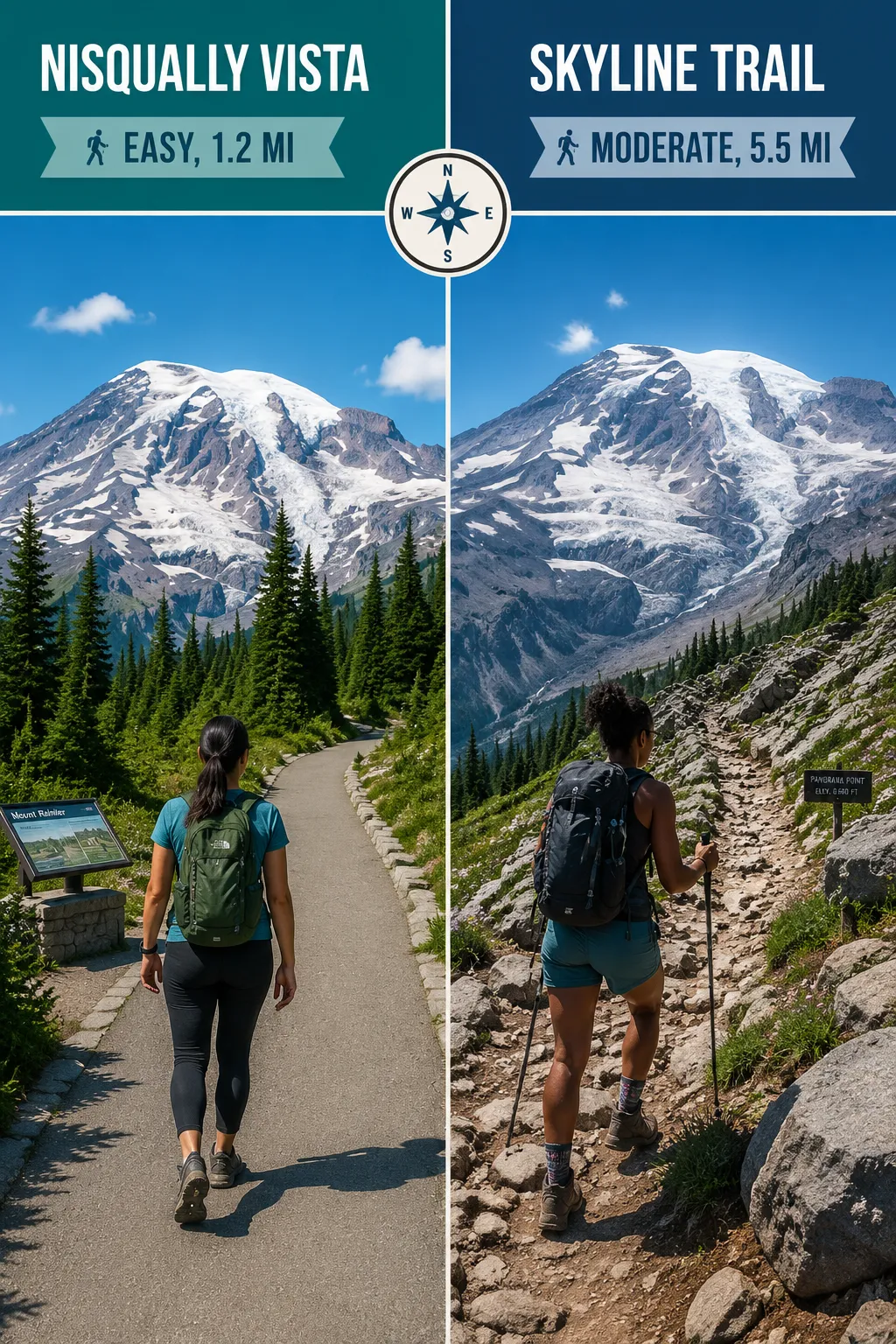
The Nisqually Vista Trail, Myrtle Falls Trail, and Trail of the Shadows are the best options for beginner hikers. All three are under 2 miles, have minimal elevation gain, and deliver excellent views.
| Trail | Distance | Difficulty | Highlight |
|---|---|---|---|
| Trail of the Shadows | 0.7 mi loop | Easy | Historic springs, meadow |
| Myrtle Falls | 0.8 mi RT | Easy | Falls + mountain backdrop |
| Nisqually Vista | 1.2 mi loop | Easy | Glacier views |
| Skyline Trail | 5.5 mi loop | Moderate | Best all-around hike |
| Panorama Point | 4.5 mi RT | Moderate | Sweeping summit views |
Common mistake: Beginners often underestimate elevation. Paradise sits at 5,400 ft. If you’re coming from sea level, even “easy” trails feel harder. Take it slow.
Can You Drive to the Summit of Mount Rainier?
No – you cannot drive to the summit. The highest point accessible by car is the Paradise parking area at approximately 5,400 feet. The summit of Mount Rainier sits at 14,411 feet and requires a multi-day technical mountaineering climb with permits.
The road to Paradise is paved and well-maintained. The former Sunrise Road (which reached about 6,400 ft) is currently closed due to the Grand Park 2 Fire as of August 2026.
Where to Stay Near Mount Rainier National Park
The two best base camp options for first-timers are Packwood (south side) and Ashford (west side, near Nisqually entrance). Both have lodging ranging from budget motels to cozy cabins.
- Ashford: Closest to the Nisqually entrance; good for early starts to Paradise
- Packwood: Slightly further but more dining options; great for Stevens Canyon access
- Inside the park: National Park Inn at Longmire (book 6+ months ahead) and Paradise Inn (currently check availability – some facilities have 2026 construction closures)
If you’re building a bigger Pacific Northwest trip, check out this California 10-day road trip itinerary for ideas on extending your adventure south.
What Should I Pack for Mount Rainier in Summer?
Pack layers, rain gear, and sun protection regardless of the forecast. Weather at Paradise changes fast – it can be 75°F and sunny at Longmire while it’s raining and 50°F at Paradise.
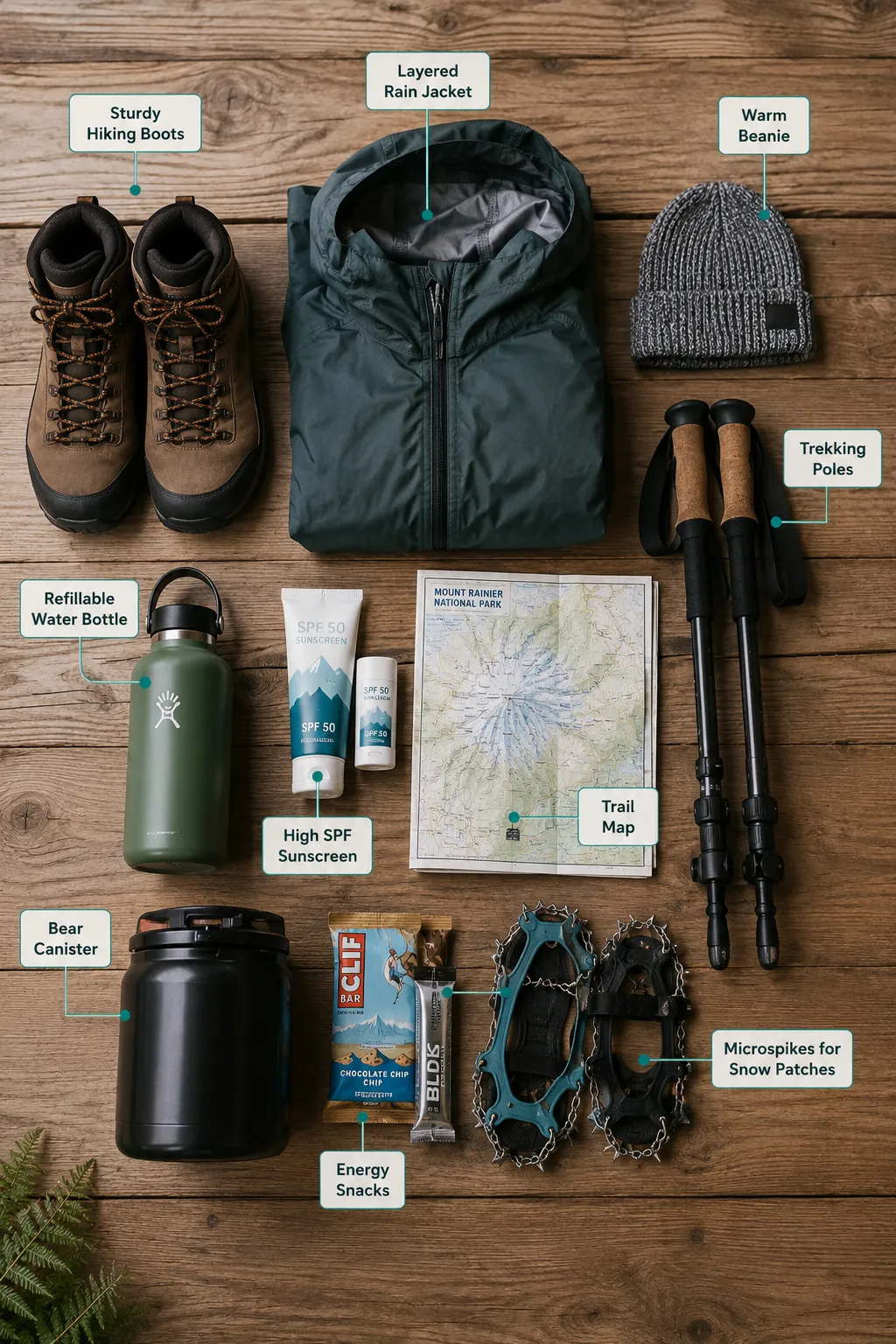
Essential packing list for a summer day hike:
- Waterproof rain jacket (non-negotiable)
- Wool or synthetic mid-layer fleece
- Moisture-wicking base layer
- Sturdy hiking boots with ankle support
- Trekking poles (helpful on Skyline Trail)
- 2+ liters of water per person
- High-SPF sunscreen (UV is intense at altitude)
- Snacks and a packed lunch (Paradise cafe has limited options and long lines)
- Wool or fleece hat and gloves (for Panorama Point)
- Microspikes if visiting before mid-August
For a full gear checklist, see the only travel essentials list you’ll need.
Is Mount Rainier Safe to Visit Right Now?
The park is safe to visit in August 2026, but with important caveats. The Grand Park 2 Fire has forced complete closure of the Sunrise and White River areas, including Sunrise Road and all trails from that corridor. The Plummer Peak Fire has also closed Pinnacle Peak Trail.
- ✅ Open: Nisqually entrance, Paradise, Longmire, Stevens Canyon Road, Box Canyon
- 🚫 Closed: Sunrise Visitor Center, White River Campground, Fremont Lookout, Emmons Vista, Sourdough Ridge, Pinnacle Peak Trail, Grove of the Patriarchs (flood damage, no reopening date)
- 🌫️ Air quality: Expected good to moderate with occasional smoke impacts – check AQI before heading out
Always verify current conditions at the NPS Mount Rainier alerts page before your trip.
Do I Need a Permit for Mount Rainier Trails?
No permit is required for day hiking on popular trails like Skyline, Nisqually Vista, or Myrtle Falls. You only need a permit for overnight backcountry camping, which requires a Wilderness Permit (free, available at visitor centers or online through recreation.gov).
Summit climbers need a separate Climbing Cost Recovery Fee. Day hikers just need the park entrance pass.
Mount Rainier vs. Other Washington National Parks
Mount Rainier is the best choice for first-time visitors who want alpine scenery, wildflowers, and accessible hiking in a single location. North Cascades National Park offers more remote wilderness but fewer paved roads and visitor services. Olympic National Park covers more terrain types (rainforest, coast, mountains) but requires more driving between zones.
- Choose Rainier if: You want iconic views, easy-to-moderate hikes, and a manageable 2-3 day trip
- Choose Olympic if: You want diversity – rainforest, coastline, and mountains in one park
- Choose North Cascades if: You’re comfortable with remote hiking and minimal facilities
For comparison, a Glacier National Park 3-day itinerary offers a similar alpine experience in Montana if you’re planning a broader national parks road trip.
Best Photography Spots at Mount Rainier National Park
The top photography spots are Reflection Lakes (early morning mirror shots), Myrtle Falls (mountain framing), and Panorama Point (360-degree alpine views). Golden hour at Reflection Lakes is worth setting an alarm for.
- Reflection Lakes: Arrive by 7 AM for calm water and mountain reflection
- Myrtle Falls overlook: Best in morning light, facing northeast
- Panorama Point: Clear days only; afternoon clouds often obscure the summit
- Christine Falls bridge: Overcast days work well here – softer light on the water
- Narada Falls: Morning light hits the mist beautifully
Mount Rainier Weather and Road Conditions
Summer weather at Mount Rainier is mild but unpredictable. August 2026 averages show highs around 74°F at lower elevations and lows around 46°F. Paradise is consistently 10-15°F cooler than Longmire.
Road conditions change fast in shoulder seasons. Paradise Road typically opens fully by early July and closes to standard vehicles by late October or first heavy snowfall. Always check NPS road conditions the day before your visit.
FAQ
Q: How long does it take to hike Skyline Trail at Mount Rainier?
A: The full 5.5-mile Skyline Trail loop takes 3-4 hours for most hikers at a moderate pace, including stops for photos and views. Allow extra time if you’re not used to altitude.
Q: What is the closest airport to Mount Rainier?
A: Seattle-Tacoma International Airport (SEA) is the main gateway, about 2 hours from the Nisqually entrance. Tacoma is roughly 1.5 hours away.
Q: Is the Sunrise area open in 2026?
A: No. As of August 2026, Sunrise and White River areas are fully closed due to the Grand Park 2 Fire. Check NPS alerts for updates before your trip.
Q: Can I see Mount Rainier’s summit on a clear day from Paradise?
A: Yes – on clear days the summit is clearly visible from Paradise, Panorama Point, and Reflection Lakes. Clouds often move in by early afternoon, so morning visits give the best summit views.
Q: Is Mount Rainier good for kids?
A: Yes. Trail of the Shadows, Myrtle Falls, and Box Canyon are all easy, short, and stroller-friendly. The Jackson Visitor Center also has kid-friendly exhibits.
Q: Do I need a reservation to visit Mount Rainier?
A: As of 2026, no timed-entry reservations are required for day visitors. Campground reservations are a different matter – book those well in advance.
Q: What is the elevation of Paradise at Mount Rainier?
A: Paradise sits at approximately 5,400 feet (1,646 meters) above sea level. Visitors coming from low elevations may feel mild altitude effects.
Q: Is there cell service at Mount Rainier?
A: Cell service is limited and unreliable throughout most of the park. Download offline maps (Google Maps or Gaia GPS) before you arrive.
Q: Can I see wildlife at Mount Rainier?
A: Yes – black bears, marmots, deer, and mountain goats are all present. Keep food stored properly and maintain distance from all wildlife.
Q: What is the best entrance to use for a first-time visitor?
A: The Nisqually entrance (Highway 706 from Ashford) is the most popular and leads directly to Longmire and Paradise – the best route for a first trip.
Conclusion
A well-planned Mount Rainier National Park itinerary doesn’t need to be complicated. Focus on the Longmire-Paradise corridor, hit the 9 stops above, and you’ll leave with memories that outlast any checklist.
Your next steps:
- Check NPS alerts at nps.gov/mora before finalizing your route – closures change fast in 2026
- Book lodging in Ashford or Packwood at least 2-3 months ahead for summer visits
- Download offline maps and a weather app before leaving cell range
- Start your Paradise hikes by 8 AM to beat clouds and crowds
- Get the America the Beautiful Pass if you’re visiting other national parks this year
If you’re building a bigger Pacific Northwest or national parks road trip, our Glacier National Park in September guide and one-day Yellowstone itinerary are solid next reads.
Mount Rainier rewards the people who show up prepared and stay flexible. The mountain will do the rest.