


Last updated: September 3, 2026
Quick Answer: A well-planned Andalusia Spain itinerary goes far beyond Seville, Granada, and Córdoba. The region draws around 36 million visitors per year, yet most stick to the same three cities. The 10 stops below mix iconic landmarks with genuinely overlooked towns, gorges, and Roman ruins that reward travelers who venture a little further.
Key Takeaways
- Andalusia is Spain’s most visited region, but inland tourism is growing fast – meaning the crowds haven’t caught up with the best hidden spots yet.
- 10 days is the sweet spot for a complete Andalusia Spain itinerary that includes both major cities and smaller gems.
- Spring (March to May) and autumn (September to October) are the best seasons to visit.
- You can travel most of the region by train and bus – a car is optional but helpful for white villages.
- Solo travelers, families, and couples all find Andalusia very accessible and safe.
- Budget travelers can eat and sleep well for under €80 per day; luxury options exist in every major city.
- The 10 stops most travelers miss include Setenil de las Bodegas, Alhama de Granada, Carmona, Baelo Claudia, and more.
- Booking the Alhambra and Mezquita tickets in advance is non-negotiable.
What Is Andalusia Spain Known For?
Andalusia is Spain’s southernmost region and its cultural heartland. It’s the birthplace of flamenco, bullfighting, and tapas culture, and it holds some of Europe’s most impressive Islamic, Roman, and Christian heritage.
The big draws are obvious: the Alhambra palace in Granada, the Mezquita in Córdoba, and Seville’s cathedral. But the region also has dramatic gorges, whitewashed hilltop villages, Roman ruins, and one of Europe’s most underrated coastlines – the Costa de la Luz.
Roughly 35% of all visitors come primarily for historical heritage and cultural events, which tells you how deep the well goes beyond the postcard shots.
Best Time to Visit Andalusia Spain
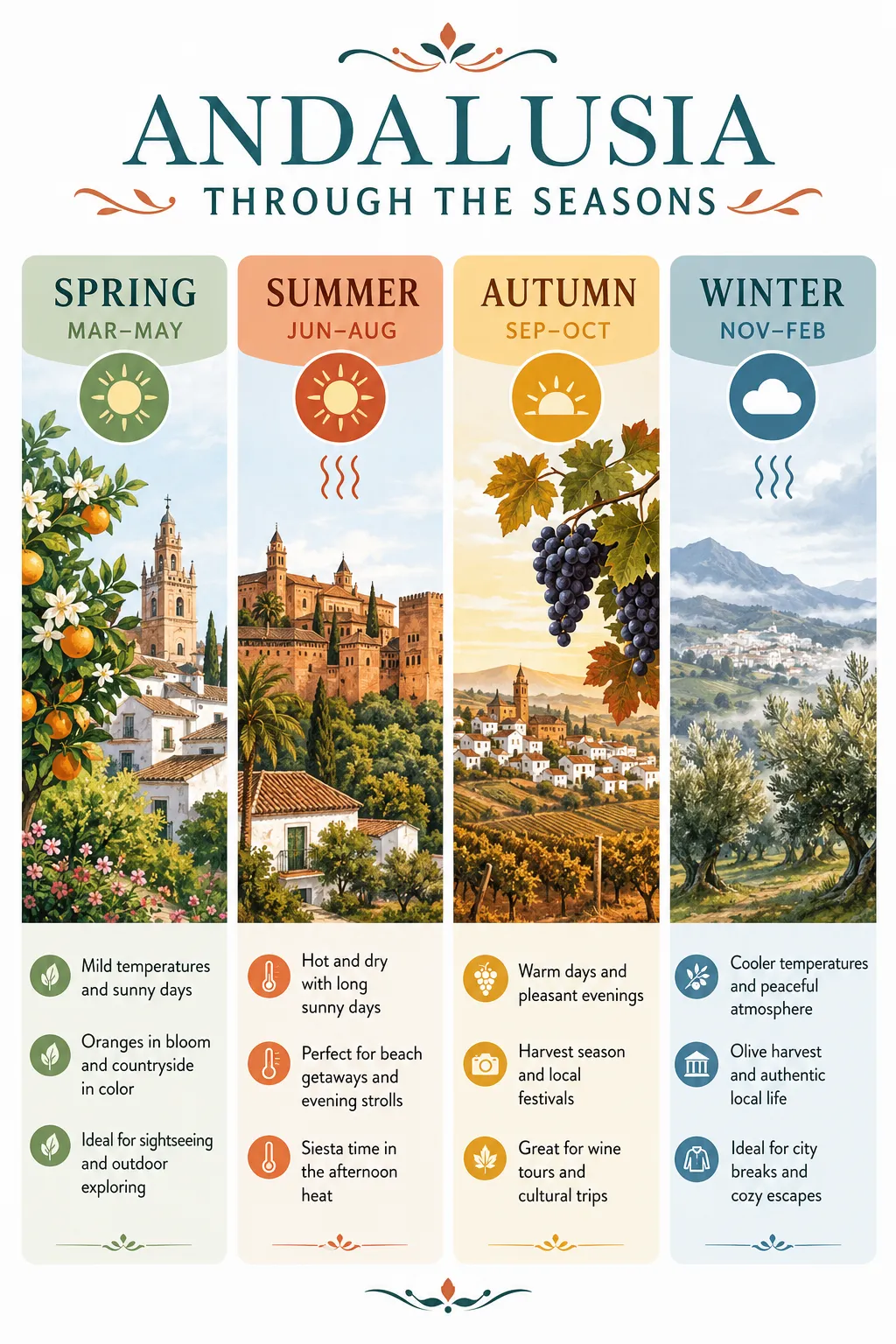
Spring (March to May) and early autumn (September to October) are the best times to visit. Temperatures are comfortable (18-26°C), crowds are manageable, and prices are lower than peak summer.
Summer (June to August) brings intense heat – Seville regularly hits 40°C – and large tourist crowds. It’s doable but exhausting, especially for families or anyone planning to walk a lot.
Winter (November to February) is mild by northern European standards and nearly crowd-free. Some smaller towns feel quiet, but cities like Seville and Málaga are pleasant year-round.
| Season | Temp Range | Crowds | Best For |
|---|---|---|---|
| Spring (Mar-May) | 18-26°C | Moderate | First-timers, hikers |
| Summer (Jun-Aug) | 30-40°C | Very high | Beach lovers |
| Autumn (Sep-Oct) | 20-28°C | Low-moderate | Culture, food |
| Winter (Nov-Feb) | 10-18°C | Low | Budget travelers |
How Many Days Do I Need in Andalusia?
Seven days covers the core cities; 10 days lets you add the stops most travelers miss. Fourteen days gives you a relaxed pace with day trips and coastal time.
Here’s a rough breakdown:
- 7 days: Seville (3 nights) + Córdoba (1 night) + Granada (2 nights) + Málaga (1 night)
- 10 days: Add Ronda, Cádiz or Jerez, and at least one white village
- 14 days: Add Jaén, Alhama de Granada, Costa de la Luz, and Carmona
Don’t try to rush all 10 stops in 7 days. You’ll spend more time on buses than actually experiencing places.
Andalusia Spain Itinerary: 7 Days vs 10 Days
A 7-day Andalusia Spain itinerary works well if you’re focused on the three main cities. The standard expert route runs Seville – Córdoba – Granada – Málaga, which you can do entirely by train.
A 10-day Andalusia Spain itinerary is where things get interesting. You can extend the core loop with:
- Ronda – dramatic gorge city, 2 hours from Málaga
- Cádiz – Europe’s oldest city, stunning Atlantic coast
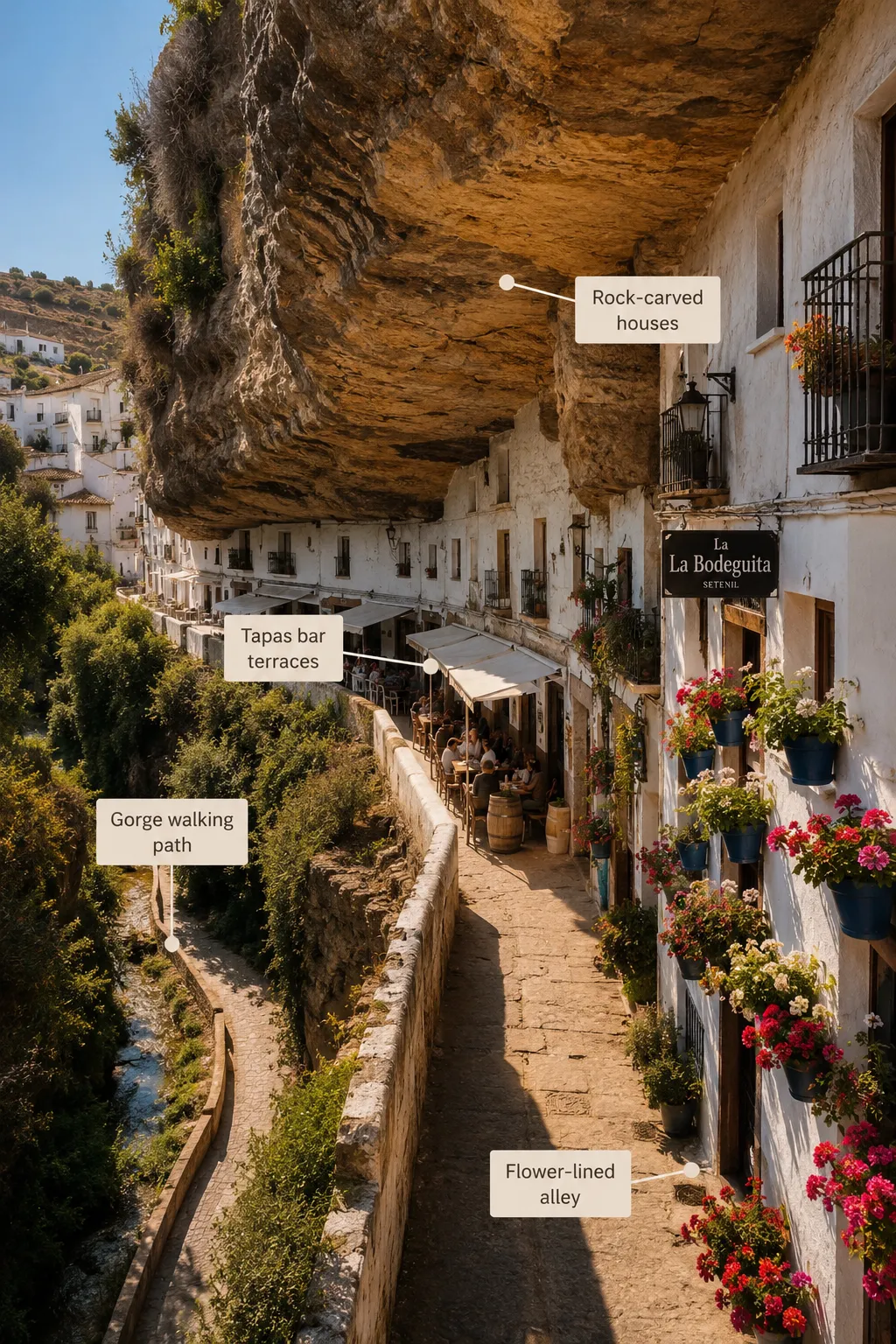
- Setenil de las Bodegas – white village built into rock overhangs
- Carmona – Roman walls and hilltop views, 35 minutes from Seville
- Alhama de Granada – thermal baths and a jaw-dropping gorge
The 10-day version is the sweet spot. You see the icons AND you come home with stories nobody else has.
For more inspiration on multi-stop European routes, check out this 1-month Central Europe itinerary to see how to pace longer trips effectively.
Hidden Gems in Andalusia That Tourists Miss
Most tourists skip inland Andalusia entirely. That’s changing – inland tourism grew 5.6% in 2024, surpassing 6.8 million visitors – but these places are still far less crowded than the main cities.
Here are the 10 dreamy stops most travelers miss on their Andalusia Spain itinerary:
- Setenil de las Bodegas – Houses literally built under rock overhangs. Surreal and completely free to wander.
- Carmona – A Roman hilltop town 35 km east of Seville with almost no tourist crowds.
- Alhama de Granada – A thermal spa town perched above a dramatic gorge. Locals have been coming here for centuries.
- Acinipo – Roman ruins near Ronda with a hilltop theatre and panoramic views. Almost always empty.
- Baelo Claudia – A remarkably preserved Roman city right on the beach near Tarifa.
- Jaén – Andalusia’s most overlooked provincial capital, with a stunning Renaissance cathedral and an ocean of olive groves.
- Frigiliana – One of Spain’s most beautiful white villages, just above Nerja on the Costa del Sol. See the full Frigiliana Spain travel guide for what to do there.
- El Torcal de Antequera – Alien-looking limestone rock formations. An easy day trip from Málaga.
- Zahara de la Sierra – A white village perched above a turquoise reservoir in the Sierra de Grazalema.
- Costa de la Luz – The Atlantic coast between Cádiz and Tarifa. Wilder and less crowded than the Costa del Sol.
“The best memories from my Andalusia trip weren’t at the Alhambra – they were at a tiny bar in Setenil where the owner brought out unlisted tapas just because we asked what he recommended.”
What’s the Difference Between Seville and Granada in Andalusia?
Seville is Andalusia’s buzzing capital – flamenco, nightlife, grand boulevards. Granada is more intimate, more Moorish, and feels like a different world. Both are essential but they serve different travel moods.
Seville is best for:
- Tapas bar-hopping and nightlife
- The Cathedral and Giralda tower
- Flamenco shows
- Day trips to Carmona and Cádiz
Granada is best for:
- The Alhambra (book 2-3 months ahead)
- The Albaicín neighborhood at sunset
- Free tapas culture (yes, tapas come free with drinks here)
- Day trips to Alhama de Granada and the Sierra Nevada
Spend at least 2 nights in each. If you only have one, choose based on your priorities – culture and history point to Granada; food, nightlife, and energy point to Seville.
For a deeper dive, check out top things to do in Seville Spain and the best things to do in Malaga Spain for the coastal angle.
How to Get Around Andalusia Without a Car
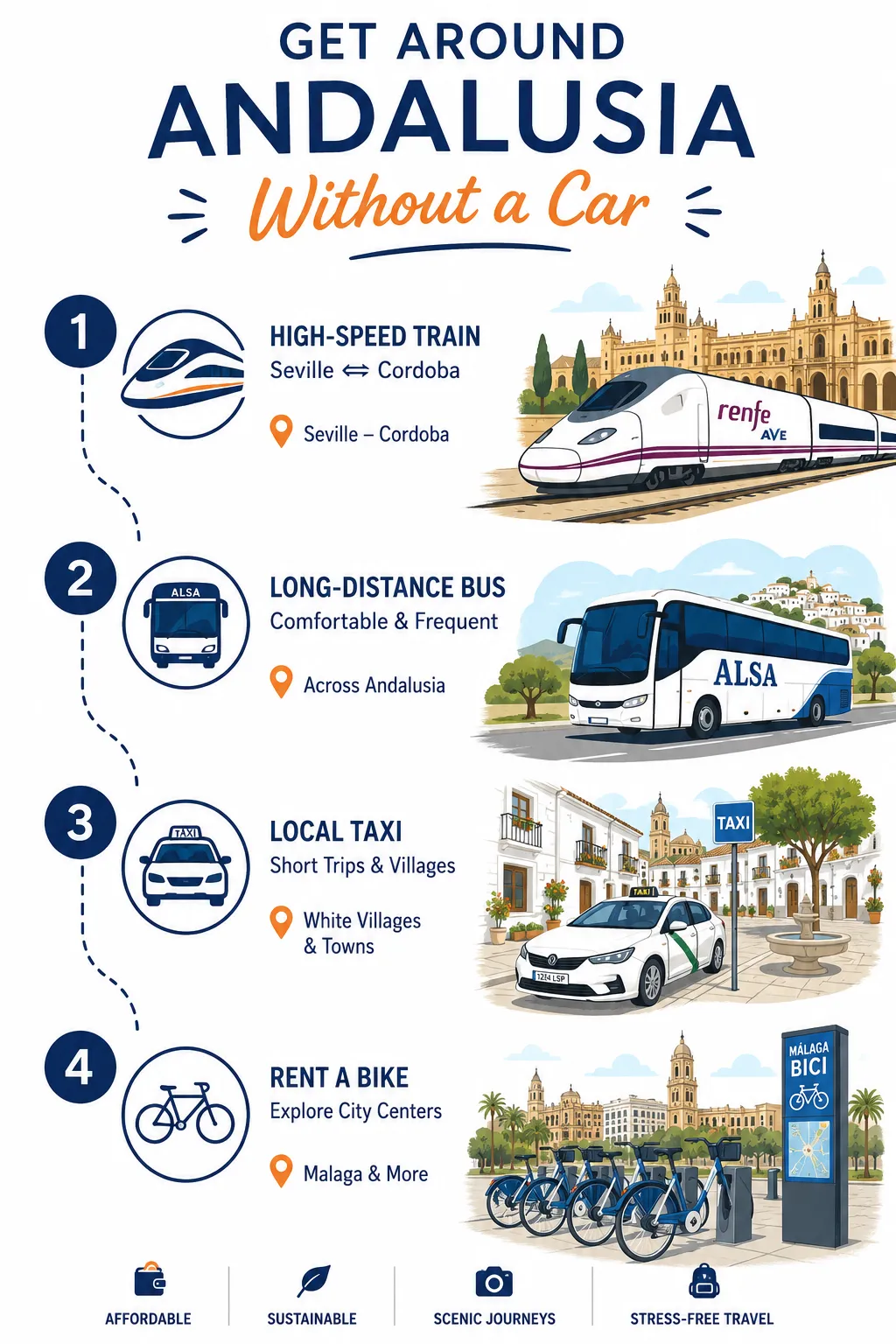
You don’t need a car for the major cities – Renfe’s AVE high-speed trains connect Seville, Córdoba, Granada, and Málaga efficiently. For white villages and rural spots, a rental car or organized day trip is the practical choice.
Key transport options:
- AVE high-speed train: Seville to Córdoba takes about 45 minutes. Seville to Málaga takes around 2 hours.
- ALSA buses: Cover smaller towns and white villages that trains don’t reach. Affordable and reliable.
- Day tours: From Ronda, Seville, or Málaga, you can join organized day trips to Setenil, El Torcal, and the white villages without renting a car.
- Taxis and rideshares: Useful within cities and for short hops between nearby towns.
Common mistake: Assuming buses are slow and uncomfortable. Modern ALSA coaches are air-conditioned and often faster than driving through mountain roads.

Andalusia Spain Budget vs Luxury Travel Costs
Andalusia works for almost any budget. Tourists rate the region 9.0-9.2 out of 10 and average daily spend sits around €82, but you can go much lower or much higher depending on your choices.
Budget traveler (under €70/day):
- Stay in well-reviewed hostels or guesthouses (€20-35/night)
- Eat the menú del día (3-course lunch for €10-14)
- Use trains and buses exclusively
- Visit free tapas cities like Granada
Mid-range traveler (€100-180/day):
- Boutique hotels in historic city centers (€70-120/night)
- Mix of sit-down restaurants and tapas bars
- Occasional day tour or flamenco show
Luxury traveler (€250+/day):
- Paradores (state-run historic hotels in castles and convents)
- Private Alhambra tours and rooftop dining
- Private driver for white village routes
The best value move? Base yourself in Granada for the free tapas culture, then splurge one night at a Parador.
Is Andalusia Safe for Solo Travelers?
Andalusia is very safe for solo travelers, including solo women. It’s one of Spain’s most visited regions, cities are walkable and well-lit, and locals are generally warm and helpful.
Petty theft (bag snatching, pickpocketing) is the main risk in busy tourist areas like Seville’s Santa Cruz neighborhood and Málaga’s port. Standard precautions apply – use a crossbody bag, don’t leave valuables visible.
Solo female travelers specifically report feeling comfortable here. For detailed tips, the Spain solo female travel guide covers everything from neighborhoods to avoid to the best solo-friendly accommodation types.
For broader solo travel planning, the solo travel in Spain guide is a solid starting point.
Andalusia Spain Itinerary With Kids
Andalusia works well with children, especially for families who mix history with outdoor activities. The key is keeping walking distances short and building in downtime.
Kid-friendly highlights:
- El Torcal de Antequera – kids love the weird rock formations
- Caminito del Rey – a dramatic gorge walkway (minimum age 6, under 12 needs adult)
- Seville’s Alcázar gardens – beautiful and easy to explore
- Nerja’s Balcón de Europa – beach access and gelato in one spot
- Zahara de la Sierra – swimming in the reservoir in summer
Avoid scheduling the Alhambra as a full-day event with young children. Do the Nasrid Palaces in the morning and keep the afternoon free.
Best Small Towns in Andalusia Off the Beaten Path
The white villages (pueblos blancos) of Andalusia are the region’s best-kept secret. Most tourists drive past them on the way to Ronda without stopping.
Top picks for your Andalusia Spain itinerary:
- Zahara de la Sierra: Hilltop village above a turquoise lake. One of the most photogenic spots in Spain.
- Grazalema: Base for hiking in the Sierra de Grazalema Natural Park.
- Olvera: A dramatic white village with a Moorish castle visible for miles.
- Arcos de la Frontera: Built on a sheer cliff above the Guadalete River.
- Setenil de las Bodegas: The rock-ceiling village that stops everyone mid-scroll.
Choose Zahara if you want scenery and swimming. Choose Setenil if you want the most unique architecture. Choose Arcos if you want dramatic views without a long drive.
Common Mistakes People Make Visiting Andalusia
The biggest mistake is trying to see too much in too little time. Andalusia is large – about the size of Portugal – and distances between stops add up fast.
Other common mistakes:
- Not booking the Alhambra in advance. Tickets sell out weeks or months ahead. Book the moment your dates are confirmed.
- Visiting Seville in August. The heat is brutal and the city empties out as locals leave.
- Skipping Córdoba. Many travelers see it as a one-hour stop. It deserves a full day or overnight.
- Ignoring the Costa de la Luz. The Atlantic coast near Tarifa and Cádiz is wilder and less commercialized than the Costa del Sol.
- Eating dinner before 9pm. Restaurants outside tourist zones don’t fill up until 9:30-10pm. Eating at 7pm marks you as a tourist and sometimes gets you worse service.
For packing advice before you go, the travel essential list covers everything you’ll actually need for a southern Spain trip.
What to Pack for an Andalusia Spain Trip
Pack light, breathable layers and good walking shoes. Cobblestone streets are everywhere and distances add up quickly.
Essential items:
- Lightweight linen or cotton clothing (even in spring, it gets warm)
- Comfortable walking shoes with ankle support
- A compact day bag with anti-theft features
- Sunscreen SPF 50+ (the Andalusian sun is intense from April onward)
- A light jacket or layer for evenings and air-conditioned trains
- Portable water bottle – hydration matters in summer heat
- Offline maps downloaded (Google Maps or Maps.me)
- Printed or downloaded Alhambra tickets
Skip: Heavy jeans, formal shoes, and more than one “just in case” outfit. Laundry is easy and cheap across Andalusia.
FAQ
Can you visit all of Andalusia in one trip?
You can cover the highlights in 10-14 days, but “all of Andalusia” would take a month. Pick a focus – cities, white villages, coast, or nature – and build your itinerary around that.
Do I need to speak Spanish in Andalusia?
Not for the main tourist cities. In smaller villages, basic Spanish phrases go a long way and locals genuinely appreciate the effort.
Is the Alhambra worth the hype?
Yes. It’s one of the most extraordinary buildings in Europe. Book the Nasrid Palaces slot specifically – that’s the most impressive section.
How far is Seville from Granada?
About 3 hours by bus or 2.5 hours by car. There’s no direct train, so most travelers take the bus or drive.
Is Ronda worth a stop on an Andalusia itinerary?
Absolutely. The Puente Nuevo bridge over the El Tajo gorge is genuinely dramatic. One night is enough; two nights lets you explore the surrounding white villages.
What’s the cheapest city in Andalusia?
Jaén and Almería are consistently cheaper than Seville, Granada, and Málaga – for accommodation, food, and activities.
Can I do Andalusia without a rental car?
Yes, for the main cities. For white villages and rural spots, a car makes life much easier. Day tours from major cities are a good middle ground.
What’s the best base city for an Andalusia road trip?
Seville or Málaga. Both have major airports, good transport links, and are well-positioned to reach most of the region within 2-3 hours.
Is Cádiz worth visiting on an Andalusia itinerary?
Yes – it’s one of Europe’s oldest cities and has a completely different feel from inland Andalusia. The 1 day in Cádiz guide is a good starting point.
When should I book Alhambra tickets?
As soon as your travel dates are confirmed. Aim for at least 6-8 weeks in advance, especially for spring and autumn visits.
Conclusion
A well-planned Andalusia Spain itinerary rewards travelers who go beyond the obvious. The three big cities – Seville, Córdoba, Granada – are genuinely unmissable. But the region’s real magic is in the places between them: rock-carved villages, empty Roman ruins, Atlantic coastline, and hilltop towns that feel frozen in time.
Your next steps:
- Choose your trip length – 7 days for cities only, 10 days to add the hidden gems.
- Book Alhambra tickets immediately after confirming your dates.
- Pick 2-3 white villages to visit based on the guide above.
- Download offline maps and the Renfe app before you leave.
- Read the 15 must-see places in Spain for first-time visitors to see how Andalusia fits into a broader Spain trip.
Andalusia doesn’t ask much of you. Show up curious, eat late, and be willing to take one unexpected turn off the main road. That’s usually where the best part of the trip begins.